Showing posts with label The Society of Jesus. Show all posts

Wednesday, September 30, 2020

Saint Francis Borgia, SJ

Phyllis McGinley wrote a book titled Saint-Watching in 1969; one of my History professors gave me a copy after I'd taken a class on Eighteenth Century English History--an independent study class--and I remember her comments about how unlikely "we" think a Borgia saint would be. The Borgias, so notorious for intrigue, poisoning, nepotism, a bad pope (Alexander VI), Cesare and Lucretia--and yet Francis Borgia, the former 4th Duke of Gandia, Superior General of the Society of Jesus, was canonized a saint in 1620.

He lived two vocations in one lifetime: first as a husband and father of eight and then, after the death of his wife Eleanor, as a Jesuit priest and the third Superior General of the Society of Jesus as this Loyola Press Ignatian Spirituality post explains (quoting Bert Ghezzi's Voices of the Saints):

St. Francis Borgia, a relative of Pope Alexander VI, King Ferdinand of Aragon, and Emperor Charles V, joined Spain’s imperial court at age eighteen. The next year he married Eleanor de Castro, who bore him eight children. In 1539, shortly after experiencing a religious conversion, Francis left the court but continued in public life as viceroy of Catalonia. At this time under the influence of Peter of Alcántara and Peter Favre, he progressed in prayer and the spiritual life.

In 1543, Francis succeeded his father as duke of Gandia, but when his wife died three years later he decided to become a Jesuit. He provided for his children and joined the society in 1550. While he preferred a quiet life of solitude, the Jesuits felt differently and promoted him so that he could use his great administrative talents for the church. In 1554, St. Ignatius appointed Francis commissary for Spain, where he founded twelve colleges and a novitiate. The Jesuits chose Francis as their general in 1565. His consolidation of the society and expansion of its ministry has caused him to be recognized as the second founder of the order. He established disciplined novitiates in every Jesuit province, writing regulations and books of spiritual instruction for them.

So he was Superior General during the reign of Queen Elizabeth I, before the great Jesuit missions were founded for England. In reading his entry in the Catholic Encyclopedia, England is never even mentioned. Saint Francis Borgia was focused on Missions to the East and West Indies and establishing colleges and foundations in Europe. As the Jesuit historian Thomas McCoog explains, that situation had an impact in England:

Even within Jesuit Britain, Borgia is overlooked. With the exception of the Jesuit residential district in East Anglia, named in honour of Blessed Francis Borgia in 1625 after his beatification in 1624 – a name abandoned when the residence was re-branded as the College of the Holy Apostles after William, Lord Petre’s endowment in 1632 – the English and later British Province has dedicated nothing to him.

There is one intriguing comment in the Catholic Encyclopedia article, however, and that was Borgia's interest in liturgical music while serving Charles V, the Holy Roman Emperor:

The newly-created Marquess of Lombay enjoyed a privileged station. Whenever the emperor was travelling or conducting a campaign, he confided to the young equerry the care of the empress, and on his return to Spain treated him as a confidant and friend. In 1535, Charles V led the expedition against Tunis unaccompanied by Borgia, but in the following year the favourite followed his sovereign on the unfortunate campaign in Provence. Besides the virtues which made him the model of the court and the personal attractions which made him its ornament, the Marquess of Lombay possessed a cultivated musical taste. He delighted above all in ecclesiastical compositions, and these display a remarkable contrapuntal style and bear witness to the skill of the composer, justifying indeed the assertion that, in the sixteenth century and prior to Palestrina, Borgia was one of the chief restorers of sacred music.

Also, as the University of Dayton website notes, Borgia, like Pope Francis today, was most devoted to the image of the Mother of God as the Salus Populi Romani. And this website, from Macau, highlights Saint Francis Borgia's influence on the diffusion of the image throughout the world:

It was only in the middle of the 16th century when Francis Borgia proposed the image to be installed permanently at the Pauline Chapel [of the Basilica of Saint Mary Major in Rome] in 1569. Until this time, copies of this image were never made. In this regard, [St.] Francis Borgia (1510-1572), then the third Superior General of the Society of Jesus, was the central figure. Likewise, the founder St Ignatius of Loyola as well as St Stanislaus Kostka were devoted to this image.

In June 1569, Pius V (1504-1572) granted the permission to reproduce the image. The order’s particular devotion to this image played a significant role in obtaining a mobility to elsewhere in the world. It was a revolutionary event, breaking with custom. The significance of this event is evidenced by the 17th century engraving of St Francis Borgia with the Salus Populi Romani Madonna in his hand, at the Archivum Romanum Societatis Iesu.

Saint Francis Borgia died on September 30, 1572. His feast was celebrated on the the Roman Calendar on October 10 until the revision in 1970. The Society of Jesus celebrate his feast on October 3.

Saint Francis Borgia, pray for us!

Monday, September 26, 2016

Handing Down Family Relics: Thomas More's Descendants


In her National Catholic Register article about the exhibition on St. Thomas More at the Saint John Paul II National Shrine in Washington, DC, Charlotte Hays notes the source of several of the relics on display:

Several objects in the exhibit were given to the Jesuit college in the 18th century by Jesuit Father Thomas More, the last male descendant of St. Thomas More (More had four children, three daughters and a son). These include an enameled gold crucifix that has three pearls hanging from it and likely contained a relic, now lost, of an earlier saint. Because of the size of the crucifix, it likely sat on More’s desk rather than worn around the neck and likely was on his desk in the Tower of London. A homey gift from Father More was the saint’s reversible nightcap, made with golden thread and gilded spangles. Family history attributed the cap to More’s beloved daughter Meg.

The Center for Thomas More Studies has this resource for the family tree (though not in the form of a family tree) for the More family, based upon a book from Gracewing. According to this site:

Fr Thomas More—the last descendant in the direct male line of St.Thomas More, Lord Chancellor of England—died on 20 May 1795 in Bath. He had been the Jesuit provincial superior at the time of the suppression of the Society in 1773.

Thomas More was the eldest of the five children of Thomas and Catherine (née Giffard) of Barnborough or Bamburg Hall in the West Riding of Yorkshire. Born on 19 September 1722, he was followed by Christopher, Bridget, Catherine and Mary. Both sons became Jesuits. Bridget married twice—Peter Metcalfe and Robert Dalton and had descendants; she died in 1797. Catherine died unmarried in 1786. Mary became Sister Mary Augustine of the Austin Canonesses at Bruges and died in 1807. Their home, Barnborough Hall, had been in the family since John, the only son of St. Thomas, had acquired it by his marriage to Anne Cresacre and it remained so until the nineteenth century.

In one of  the appendices to a book written after More's beatification by Father Thomas Edward Bridgett, you may read about all the relics of St. Thomas More that Father Thomas More, SJ gave to Stonyhurst College, including their family history and provenance.

I really think I may have to plan a visit to Washington, DC to see this exhibit, visit the National Shrine, etc. 

Thursday, March 31, 2016

Reading Half of a Book: "Conversions"

I admit immediately that I read half of this book (Conversions: Two Family Stories from the Reformation and Modern America); the half I was interested in. I had purchased this book a few years ago and was always more interested in the Reformation era conversion story than I was the modern era conversion story. So I when I picked up the book again a couple of weeks ago, I barely skimmed the modern era conversion story chapters and concentrated on the Reformation era conversion story.

Mea culpa, mea culpa, mea maxima culpa.

As the publisher, Yale University Press, describes the book:

This powerful and innovative work by a gifted cultural historian explores the effects of religious conversion on family relationships, showing how the challenges of the Reformation can offer insight to families facing similarly divisive situations today. Craig Harline begins with the story of young Jacob Rolandus, the son of a Dutch Reformed preacher, who converted to Catholicism in 1654 and ran away from home, causing his family to disown him. In the companion story, Michael Sunbloom, a young American, leaves his family’s religion in 1973 to convert to Mormonism, similarly upsetting his distraught parents. The modern twist to Michael’s story is his realization that he is gay, causing him to leave his new church, and upsetting his parents again—what will they do now?

Recounting these stories in short, alternating chapters, Harline underscores the parallel aspects of the two far-flung families. Despite different outcomes and forms, their situations involve nearly identical dynamics and heart-wrenching choices. Through the author’s deeply informed imagination, the experiences of a seventeenth-century European family are transformed into immediately recognizable terms.

Jacob Rolandus was in a situation comparable to that of English converts, and so I was most interested in his story. Harline describes not only the family conflict Jacob's conversion caused, but the careful response of Catholic in Calvinist Holland. Although Catholics weren't in as much danger there as they were in England, there were still restrictions on their freedom. It could be dangerous to take in a convert--he could be an agent of the government trying to find out about the Catholic underground. Rolandus had to prove not only to his parents that his mind could not be changed, but prove to the Catholics, including the Jesuits or others from whom he was seeking help and protection from his parents, that he could be trusted. 

Harline explores the moral conflict of Jacob's disobedience to his parents when he becomes a Catholic. His father wants him to come home but Jacob, who is 21, wants to make a new life for himself in the Catholic world. He is finally accepted by the Society of Jesus and studies for the priesthood, eventually becoming a missionary to Brazil.  Jacob and his sister Maria exchange letters in which he tries to convince her to become a Catholic and she tries to convince him to come back home and be reunited with the family in their Reformed faith. Harline has provided a complete translated transcript of these letters on his website.

Harline presents these two conversion stories as parallel, but they really aren't. Jacob Rolandus becomes a Catholic; he is faithful to the Catholic Church; he becomes a Jesuit and a missionary, devoting his life to the spreading of the Gospel. "Michael Sunbloom" becomes a Mormon but then decides he can't remain a Mormon because he has decided he is a homosexual, so he is not faithful to the Mormon Church. Because, as a couple of other reviewers I've read have also noted (like this one), Harline focuses the discussion of conversion, conscience and conflict all on a relational level, he doesn't see the truth claims of religious faith. In fact, he rather dismisses the whole idea of truth in religious affiliation as a case of--particularly when describing the correspondence between Jacob and Marie--something habitual and social. Then why did Jacob leave his home, hurt his parents, sacrifice his life, and become not just a Catholic, but a Jesuit and a missionary? Do we really make such great changes in our lives out of habit and social convention? Because Jacob had some Catholic friends, he became a Catholic and endured all that meant in his time? That's why I skipped so much of the "Michael Sunbloom" narrative and don't accept Harline's conclusions. But I enjoyed the story of Jacob Rolandus, SJ. He was a brave and resolute man.

Wednesday, March 30, 2016

English Jesuits in the Crimean War

From the Jesuits in Britain website:

This year, the 30th of March marks the 160th anniversary of the Treaty of Paris: the Treaty which put an end to over two years of fighting between Russia and an alliance of France, the United Kingdom, the Ottoman Empire, and Sardinia in the Crimean War. It was to be a war of several firsts: it was one of the first conflicts to use modern technologies such as explosive naval shells, railways, and telegraphs, one of the first to be documented extensively in written reports and photographs, and it was the first occasion on which the British Government appointed permanent Catholic chaplains to the army.

Among those chaplains were two Jesuits of the English Province (as it was then): Fr Joseph Woollett SJ (1818-1898) and Fr Gerrard Strickland SJ (1822-1856). You may have deduced from the dates of the latter that Fr Strickland was sadly not to return from the Crimea. In an account of Woollett and Strickland prepared for the
Letterae Annuae in the Archives (reference UI/10/2) we are told that:

Since the fall of Sebastopol, the English army had enjoyed the best of health, and the hospital work became light. The Frs felt free to offer their services to the chaplain in the French camp and they proposed that they... should visit the French hospitals which were full with cases of fever, scurvy and frost bite...The Frs saw the danger they incurred and could not expect to escape any more than the French clergy – but charity called them and they were happy to answer the call.

Fr Woollett caught the fever in March 1856 but after a severe illness recovered. Fr Strickland was taken ill two days after Woollett embarked for England but was not so fortunate; he died on the 26th of April. He was buried at Cathcart’s Hill and the funeral was attended by the whole of his Regiment, and by men from every other Regiment in the Division.

Father Woollett had met Florence Nightingale on his way to the Crimea; he also met with Frances Taylor, who would become a Catholic and a religious sister, founding the Poor Servants of the Mother of God. In 2014, she was declared Venerable.

The Jesuits were there to provide religious services for the Irish serving in the British army. As this website notes, many Irish rode in the famous "Charge of Light Brigade":

There were in fact 673 men in the Light Brigade, of whom 114, or nearly 20%, were Irish. During the charge 118 (including 21 Irish) were killed, 127 (including 16 Irish) were wounded and 45 (including 7 Irish) were taken prisoner by the Russians. Some 360 horses were also killed. Of the Light Brigade’s five regiments, the Royal Irish Hussars had the most Irishmen; after returning from the Crimea in 1856 they were based in Dundalk.

Additional detail about Irish involvement in the Crimean war from the same site:

Irish involvement in the Crimea was not, of course, confined to the Light Brigade’s charge, which had no effect on the War. In his excellent work, Ireland and the Crimean War, the historian David Murphy reckons that of 111,000 men who fought in Britain’s Crimean army, over 37,000, or one-third, were Irish, of whom some 7,000 were killed. About 4,000 more Irishmen served there in the British navy. The newly introduced Victoria Cross was awarded to 28 Irishmen in the Crimea, Sgt(later General Sir) Luke O’Connor from Elphin, Co Roscommon, winning the first ever VC in 1857.

Over 100 Irishmen served as British army surgeons; and some 33 Irish Sisters of Mercy and Sisters of Charity went as nurses. Florence Nightingale visited the Mercy Sisters in Dublin in 1852, when she considered becoming a Catholic and joining their order. Eight Irish priests went as chaplains to the Crimea, where three of them died.

Irishmen also served in other armies in the Crimea, most of them with the French. The best known were General (later Marshal) MacMahon, who became President of France; Wexford-born General Sutton, Count of Clonard; and General O’Malley. Among those in the Turkish army were General Coleman, who left Ireland after the 1848 rising; Major John Bernard from Co Offaly; and Major Richard Guyon, a Clareman.

Nearly 650,000 men died in the War: 21,000 British and Irish, 95,000 French and 530,000 Russians, 76% from diseases.

Tuesday, March 29, 2016

Tobias Matthew, RIP (And His Son)

Tobias Matthew was born in 1546, son of Sir John Mathew of Ross and died on March 29, 1628. In between those dates, he attended University College and Christ Church at the University of Oxford, taking his B.A. in 1564 and his M.A. in 1566. Attracting the kind attention of Queen Elizabeth I, he continued to rise along a university and clerical career: Public Orator in 1569, President of St. John's College in 1572; Dean of Christ Church in 1576 and then Vice Chancellor of the University in 1579. He then became Dean of Durham in 1579; Bishop of Durham in 1595 and finally Archbishop of York during the reign of James I in 1606.

In 1581, he was one of the debate opponents of St. Edmund Campion at Westminster and he published his argument in Piissimi et eminentissimi viri Tobiae Matthew, archiepiscopi olim Eboracencis concio apologetica adversus Campianam. Although he may have wanted to celebrate his efforts, but it was clear that Campion had bested the Anglican divines: that's why only the first debate was held in public (the rest were in private apartments in the Tower). As Archbishop of York he worked hard to convert recusants, to persuade them to conform to the established Church of England. Nevertheless, he fell out of James I's favor.

Ironically, then, his son Tobie Matthew born in October of 1577, became a Roman Catholic! Like his father he attended Christ Church, receiving his M.A. in 1597; then he studied at Gray's Inn and became a friend of Francis Bacon and a Member of Parliament. Active at both the Courts of Elizabeth and James, he traveled to Italy in 1604--there he met several Catholics and became a Catholic. He had promised his parents that he would not travel in Italy; evidently they were concerned about some attractions he would encounter there. Obviously, the conversion of the Archbishop of York's son was a serious matter. When he returned to England he was imprisoned and held in the Fleet Prison for six months as officials attempted to re-convert him. Eventually he was released and returned to the Continent where he studied for the priesthood in Rome, ordained by Cardinal Robert Bellarmine on May 20, 1614.

James I allowed him to return to England and he translated Bacon's Essays into Italian in 1617--then he was exiled again from 1619 to 1622, recalled thereafter to assist in the negotiations for the marriage of Charles to Maria Anna, the Infanta of Spain. James I sent him to Madrid, Spain and knighted him. Even though that marriage plan fell through, Charles I would marry Henrietta Maria after his accession, and Father Tobie Matthew was very much in that Catholic Queens' circle at Court.

When the Civil War started in 1640 he fled to Ghent and lived with the Jesuits there, dying in October of 1655. He completed other translations and wrote A Relation of the death of Troilo Severe, Baron of Rome (1620), A Missive of Consolation sent from Flanders to the Catholics of England (1647), and A True Historical Relation of the Conversion of Sir Tobie Matthew to the Holie Catholic Faith. There is some debate about whether or not he became a Jesuit.

Saturday, January 30, 2016

Venerable Mary Ward: Ahead of Her Time

Mary Ward, English nun and recusant, died on January 30, 1645. She was declared Venerable by Pope Benedict XVI in 2009, according to this news release from the Sisters of Loretto:

On 19th December 2009 His Holiness Benedict XVI formally promulgated the Decree recognising the ‘heroic virtue’ demonstrated by Mary Ward and thereby conferring on her the title ‘Venerable’. Her cause will now go forward to the next stage in the process towards beatification and eventual canonization.

Mary Ward (1585-1645) was an Englishwoman from Yorkshire who felt called by God to found a congregation of apostolic, non-enclosed religious women along the model of the Society of Jesus. She spent many years in Rome petitioning the Pope to recognise her new congregation, but in 1631 her order was suppressed and Mary Ward herself accused of heresy. No charges were ever brought but she remained under the shadow of the Inquisition in Rome and her congregation was disbanded. Mary Ward’s ideal of an active congregation of religious women serving the needs of the Church was too advanced for her time. She suffered at the hands of authorities who in different circumstances might have recognised the need for such a congregation. Only in 1877 was her congregation recognised by the Church and only in 1909 was Mary Ward allowed to be named as foundress.

The cause for Mary Ward’s canonization was opened in 1929. The historical research was begun by Fr Grisar SJ and completed by Sr Immolata Wetter CJ accompanied by the Postulator Fr Paul Molinari SJ and the Relator Fr Peter Gumpel SJ. This was accepted by the Congregation for the Causes of Saints in 1995. The theologians completed their investigation in May 2009 and recommended unanimously that Mary Ward demonstrated ‘heroic virtue’ and that her cause should go forward. This was confirmed by the commission of Cardinals and Bishops in November 2009 and subsequently by the Pope.

This essay, by Laurence Lux-Sterritt, published in the Revue de L'Histoire des Religions (vol. 225) in 2008 (see full citation below) explains why Mary Ward's vocation to found an order for women modeled on St. Ignatius of Loyola's Society of Jesus was so fraught with difficulty. It wasn't just that she wanted to form an active, not cloistered, order for women, but that she was using the Jesuits as a model. The entire essay is fascinating in its exploration of the propaganda for and against the Jesuits inside and outside of the Church. The author summarizes the issues thus:

Mary Ward’s institute would fall victim to the complexity of the religious context in which it was born. In the post-Tridentine Church, in which historian Elizabeth Rapley observes “a growing male-female dichotomy, an aggressive antifeminism, an irresistible trend towards patriarchy,”[48] Elizabeth Rapley, The Dévotes: Women and Church in...[48] the Institute of English Ladies was condemned as a new female order that was thought both unacceptable and absurd. But this simple opposition, which was encountered by a number of new feminine movements in the seventeenth century, was exacerbated by the predicament of a more political nature. Specifically, for the Church—torn by the strife that set the secular clergy against the Jesuits—Mary Ward was living proof of the ascendancy that the Society of Jesus enjoyed among devoted Catholics of the period. Besides its contempt for the monastic tradition, the mission of the institute gave the Jesuits no small advantage by entrusting them with the guidance of newly converted families. In the context of the 1620s, such a congregation was bound to incur the disapproval of the enemies of the Society of Jesus.

That was why, in September 1630, the Church ordered the nuncio Pierluigi Carafa to interrogate seven members of the institute at their community in Liege.[49] Wetter, Mary Ward, 38–59.[49] The transcript of the hearing was sent to Rome and studied by Francesco Ingoli, secretary of Propaganda Fide, who was overtly hostile to the Jesuits. He condemned the institute in his report and called for punitive measures. After the deliberations in the congregation, November 21, 1630, Urban VIII remitted the affair to the Inquisition, which decided, in February 1631, to imprison Mary Ward in Munich. The axe fell a little later, when Urban VIII declared the suppression of the so-called “Jesuitesses” in the bull Pastoralis Romani Pontificis. Mary Ward was declared a heretic, and her institute was reduced to the status of a sect in violation of female decency and the prerogatives of the clergy. The supreme pontiff hoped to eradicate “these plants hurtful to the Church.” He ordered they should be “pulled up by the roots, andextirpated”[50] National Library of France, Z Thoisy, 312, items related...[50] since, according to him, the English Ladies threatened the established order far more than they preserved it. 

After her release, Mary Ward retired to England where she continued to serve the recusant community with some of her sisters in a private capacity; she died in Yorkshire in 1645. The institute, however, survived thanks to the elector of Bavaria, Maximilian I (1573–1651), who permitted the English Ladies stationed in Munich to continue to teach, on the strict condition that they no longer claim to be a religious order.[51] See Peters, Mary Ward, 594–97.[51] It was from Munich that renewed effort to obtain papal approval was made. This new institute focused on the instruction of girls, observed enclosure, and did not claim any missionary vocation; it officially had nothing to do with the institute founded by Mary Ward and suppressed in 1631. In 1749, in the bull Quamvis Justo, Benedict XIV recognized it under the name of the Institute of the Blessed Virgin Mary. Not until June 7, 2003 (nearly four centuries after Mary Ward claimed to have received the divine command “Take the same of the Society”), did the Church permit the vocation of the founder to exist as she would have liked by adapting the rules of Ignatius of Loyola to a congregation of women, who were at last given the right to bear the name Congregation of Jesus.[52] I thank Sophie Houdard (Université de Paris III - Sorbonne...[52]

Laurence Lux-Sterritt, “ Mary Ward et sa Compagnie de Jésus au féminin dans l'Angleterre de la Contre-Réforme ”, Revue de l’histoire des religions 3/2008 (Volume 225) , p. 393-414
URL : www.cairn.info/revue-de-l-histoire-des-religions-2008-3-page-393.htm.

Saturday, January 24, 2015

Speaking of Jesuit Conspiracies

Today is the anniversary of the first executions of Jesuits in England's Popish Plot, a vast Jesuit conspiracy to assassinate Charles II and bring the Catholic Duke of York to the throne--except that there was no vast Jesuit conspiracy and Titus Oates made it all up. You'd think this kind of stuff would be in the ash bins of history by now, but Damian Thompson writes in The Catholic Herald about an organization that still propagates these Jesuit conspiracies, including the sinking of the Titanic:

The building of the Titanic at the Harland and Wolff shipyard in Belfast coincided with a meeting of top bankers at the Jekyll Island Club, Georgia, an exclusive winter retreat for the super-rich. It was here, in November 1910, that representatives of J P Morgan, the Rothschilds and the Rockefellers agreed to set up the US Federal Reserve, America’s central banking system.

This much is a matter of historical record. What isn’t widely known is that these men were acting on behalf of their paymasters, the Jesuits, who “desperately wanted a central bank in America so that they would have a bottomless reservoir from which to draw money for their many wars and other hideous schemes around the world”.


This quotation is taken from a book published by the Pacific Institute of San Diego, California, which bravely exposes Catholic conspiracies, as well as offering “astounding” interpretations of Bible prophecy. (It meets every Saturday morning at the Ramona Community Centre, should you find yourself in the area and want “conclusive proof” of its claims.)

Anyway, the Jesuits knew that the creation of the “Fed” would be opposed by powerful men outside the Rothschild/Morgan/Rockefeller cartel. These opponents “had to be destroyed by a means so preposterous that no one would suspect they were murdered”. So the Society of Jesus, displaying its trademark cunning, ordered the building of an “unsinkable” death ship that would take its plutocrat passengers – who included members of the Guggenheim and Astor families – to a watery grave.


Thompson goes on to discuss how Catholics aren't immune from creating these conspiracy theories and what we ought to do about them. The roots of the these theories about the Jesuits date from the 17th century with the Monita Secreta, a forgery that purported to be instructions for Jesuit control of Europe. Like the Popish Plot, the Monita was the creation of someone kicked out by the Jesuits, taking his revenge.

Read the rest from The Catholic Herald here.

The Popish Plot Begins to Take Its Toll

Blessed William Ireland, SJ (picture) and Blessed John Grove, a Jesuit lay brother, were executed on 24 January 1679, found guilty in Titus Oates' perjured plot: 

William Ireland (1636-1679) worked for 10 years in Flanders, waiting to return to his native England. When he was finally able to do so, he served as procurator (responsible for finances) for only one year before he became the first victim of the infamous Titus Oates plot. Ireland studied at the English College at Saint-Omer, Flanders, and entered the Jesuit novitiate at age 19. After studying theology at Liège, he was ordained in 1667. For the next decade he taught at his alma mater and was confessor to the Poor Clares at Gravelines. Finally, he was able to return to England in June 1677 and settled in London where he used the alias "Ironmonger" while he cared for the financial affairs of the Jesuit mission. 

Titus Oates was a renegade Anglican minister who hated the Society of Jesus. Along with another minister, Israel Tonge, he invented a story that the English Jesuits planned to assassinate King Charles II, overthrow the government and its established religion and reinstate Catholicism. This fabricated tale raised an angry furor and led to a renewed persecution of Catholics. Among the first to suffer was Father Ireland who was arrested along with Father John Fenwick and their lay assistant, Mr. John Grove. They were imprisoned in the Newgate and burdened with heavy chains that rubbed the flesh on their legs raw. After three months, Ireland and his companions came to trial on Dec. 17, 1678; along with them were Fr. Thomas Whitbread and Thomas Pickering, a Benedictine brother. 

At the trial Titus Oates testified that he had been present at a meeting of Jesuits in April that year and listened to plans being made to murder the king. He claimed that Ireland, Fenwick and Grove were present at the meeting, while Whitbread and Pickering had been assigned to carry out the murder. According to Oates, Ireland had been seen loitering about the royal residence during August; an attempt would have already been made but Pickering's pistol failed three times to fire. A second witness agreed with most of the testimony. Ireland had witnesses to prove that he was in the Midlands and North Wales at the time he was alleged to have loitered about the royal palace. To contradict him, Oates bribed a maid to say she had seen him in London at that time. On the basis of the false testimony, Ireland, Grove and Pickering were found guilty of high treason and condemned to be hanged, drawn and quartered. The execution was postponed for a month by royal order because Charles II never believed that the Jesuits were involved in a plot against him. Oates produced more unreliable witnesses and the king allowed the executions to take place out of fear for popular anger. 

Ireland and Grove were taken to Tyburn on Jan. 24, 1679. The people of London pelted them with stones and insults as they were dragged to the gallows. They were hanged until dead, and then cut down so their bodies could be drawn and quartered. 

They were beatified in 1929 by Pope Pius XI.

Sunday, January 4, 2015

At the Name of Jesus


Yesterday in the Ordinary Form and today in the Extraordinary Form, the Church honors the Name of Jesus. It makes such good sense that we honor His Name during the Christmas season. He was given the name Jesus when conceived in the womb of the Blessed Virgin Mary by the Holy Spirit (Luke 1:31); He was given in the name Jesus when He was circumcised (Luke 2:21).

The Introit for Mass yesterday and today is taken from St. Paul's Epistle to the Philippians:" at the name of Jesus every knee should bow, in heaven and on earth and under the earth, and every tongue confess that Jesus Christ is Lord, to the glory of God the Father."

This Feast had been suppressed after the Second Vatican Council but was restored in 2002. It is common in Catholic piety to devote the month of January to the Holy Name. The Fish Eaters website notes that we should be ready to pray in reparation when this Name, the only name by which we may be saved (Acts 4:8-12) is taken in vain, used as swear word, or otherwise disrespected:

the Catholic in the room will (or at least should) make reparation by crossing himself and praying "Sit nomen Dómini benedíctum!" ("Blessed be the Name of the Lord!"), to which another Catholic who might be in the room replies, "Ex hoc nunc, et usque in sæculum!" ("from this time forth for evermore!") or "per ómnia saecula saeculórum" ("unto ages of ages").

St. Bernard of Clairvaux wrote a prayer to the Holy Name commonly used as a hymn for the Feast:

Jesus, the very thought of Thee With sweetness fills the breast! Yet sweeter far Thy face to see And in Thy presence rest.

No voice can sing, no heart can frame, Nor can the memory find, A sweeter sound than Jesus' name, The Savior of mankind.

O hope of every contrite heart! 0 joy of all the meek! To those who fall, how kind Thou art! How good to those who seek!

But what to those who find? Ah! this Nor tongue nor pen can show The love of Jesus, what it is, None but His loved ones know.

Jesus! our only hope be Thou, As Thou our prize shalt be; In Thee be all our glory now, And through eternity. Amen.


In the fifteenth century, St. Bernardine of Siena promoted devotion to the Holy Name, using the initials IHS as an image for veneration. Devotion to the Holy Name of Jesus spread to England in the fifteenth century and was at its height in popular devotion before the English Reformation, with a fraternity and parish guilds, chapels dedicated to the Name, the practice of special votive Masses, specific prayers, and use of the IHS initials. Since it was a devotion based so firmly on the Holy Bible, some aspects of devotion survived the English Reformation, and the feast of the Holy Name was included in The Book of Common Prayer

The imagery of the IHS initials, however, was too Catholic for many in the Church of England and was associated with High Church Anglo-Catholicism as practiced by Bishop Lancelot Andrewes and Archbishop of Canterbury William Laud, so the cult of devotion to the Holy Name was suppressed, according to this article. The IHS symbol became a mark of recusant Catholicism, especially since the Society of Jesus used the initials as an emblem. Since Englishmen who studied for the priesthood on the Continent and returned as Jesuit missionaries to the Catholics of England were singled out from Elizabeth's reign to the Popish Plot as traitorous spies and instigators of rebellion, it could not be an acceptable sign in England.

Monday, April 15, 2013

"The Most Controversial" Robert Persons, SJ

Robert Persons SJ
In 2010, Father Thomas McCoog, SJ, published this article in the online journal of the British Jesuits, Thinking Faith:

On 15 April 2010, the 400th anniversary of the death of Robert Persons, arguably the most controversial Englishman to enter the Society of Jesus, passed without much fanfare. On Thinking Faith, Joe Egerton did indeed pay homage to Persons as he applied principles from the Jesuit’s writings to contemporary political situations, and also drew attention to a persistent preference for Edmund Campion over Persons, his religious superior on the English mission.

For the Elizabethan government, for some Catholic contemporaries and for a few subsequent historians, Persons exemplified the Jesuit of myth and legend. A secular priest, William Watson, himself executed in 1603 for alleged involvement in a plot against King James I, lamented the establishment of an uncommon ecclesiastical structure, the archpresbyterate. The archpriest exercised jurisdiction over the diocesan clergy within England, but according to the regulations, on matters of importance he could not act without prior consultation of the Jesuit superior. Watson complained: ‘For whereas now all Catholikes must depend upon the Archpriest, & the Archpriest upon father Garnet, & Garnet upon Persons, & Persons upon the devel, (the author of all rebellious conspiracies, treasons, murthers, disobedience, heresies, & all such other diabolicall & bloudy designements, as this wicked Iesuit hath hitherto devised) then and in what case this dependency had bin utterly void.’ (A Decacordon of Ten Quodlibeticall Questions concerning Religion and State [N.p. (London), 1602] pp. 150-51).

McCoog describes Persons' mission to England with St. Edmund Campion and points out some interesting contrasts:

Persons was the driving force behind the English mission from its inauguration in 1580 to his death in 1610. For 30 years, he courted earthly powers, wrote masterpieces of controversial literature, adapted Ignatian spirituality for English Catholic (and Protestant) readers, solicited funds for colleges and seminarians, and infiltrated Elizabeth’s court. One may well ask if Campion would have been up to the task if he had survived and Persons been martyred.

Practically from his admission into the Society of Jesus in Rome, Robert Persons retained contact with other Englishmen and campaigned for Jesuit involvement on the English mission. Campion, meanwhile, showed little if any concern for his native land. Indeed, his friend Gregory Martin accused him of forgetting England altogether once he had entered the Society. Collaborating with William, later Cardinal, Allen, Persons finally succeeded in persuading a reluctant Father General Everard Mercurian to seize the opportunity provided by the qualified religious tolerance that would follow the marriage/alliance of Queen Elizabeth and Francis de Valois, Duke of Anjou. Persons volunteered for the mission; Campion was selected. Campion admitted more than once that only obedience motivated him.

And the rest of the article continues to illuminate Father Persons' efforts to support the Jesuit mission to England. Fascinating.

Friday, February 1, 2013

St. Henry Morse, SJ--February 1, 1645

Philip Caraman, SJ wrote a life of today's English Catholic Martyr titled Henry Morse: Priest of the Plague. The Jesuit Curia in Rome provides this biography:

Henry Morse (1595-1645) was five times arrested for being Catholic and four times was released or escaped. His ability to get out of prison meant that he had a much longer ministry career than most Jesuits in England.

He began his studies at Cambridge then took up the study of law at Barnard's Inn, London; at the same time he became increasingly dissatisfied with the established religion and more convinced of the truth of the Catholic faith. He was received into the Catholic church at the English College at Douai, Flanders, and then returned to England to prepare to enter the seminary that autumn. Port authorities in England asked him to take the oath of allegiance acknowledging the king's supremacy in religious matters. The recent convert refused to do so and was arrested the first time. He was imprisoned four years before being set free in 1618 when the king released hundreds of religious dissenters and exiled them to France. Morse first went to Douai but the English College had too many students, so he was sent to Rome, where studied theology and was ordained in 1623.

Before Morse left Rome, he met the Jesuit superior general and asked to be admitted into the Society; the general said Morse would be admitted as soon as he returned to England. He probably entered the Jesuits in 1624, and spent his novitiate period doing pastoral work in the Newcastle area in northern England. After 18 months of traveling from station to station, he was due to make the month-long Spiritual Exercises to complete his novitiate. He was supposed to do so at Watten, Flanders; but the ship he boarded to take him there was halted in the mouth of the Tyne River so soldiers could search for a priest, possibly disguised as a foreign merchant. They discovered Father Morse instead, although he carried only a rosary. He was arrested the second time and sent to Newcastle's prison. Soon another Jesuit was imprisoned, Father John Robinson, a classmate from Rome, who was on his way to take Morse's place. Both ended up at York Castle, where Robinson directed Morse in the retreat which completed his novitiate. Morse spent three years in prison before he was released and banned from the land. The young Jesuit returned to Flanders and served as chaplain to the English soldiers serving in the Spanish army then in Flanders. He had to give up this work when his health broke; then he became assistant to the novice master.

In 1633 he was again assigned to England to work at the parish of St. Giles in a poor district outside London. While he was there, the city was ravaged by a plague. Several isolated cases were discovered in late 1635, but by mid-April both city and suburbs were afflicted by the dread disease. Morse threw himself into caring for the sick, in the classic Jesuit fashion. He found medicine for the sick, took viaticum to the dying and prepared the dead for burial. His reward for this selfless service was to be arrested a third time when a priest-hunter recognized him and incarcerated him in Newgate Prison. On April 22 he came to trial and ably defended himself, but was convicted anyway although sentence was never passed. He was released on June 17 because of the intervention of Queen Henrietta Maria in recognition of his service to plague victims. He briefly returned to pastoral work, but could no longer move about safely so he returned to the continent and again became chaplain to the soldiers.

He was again assigned to England in 1643, but sent to Cumberland where he was less well-known. This strategy worked for 18 months until he accidentally walked into a group of soldiers late one night. They suspected he was a priest because he was travelling alone, so they arrested him and held him overnight in the home of a local official. Fortunately, the official's wife was Catholic and she helped the Jesuit escape. For six weeks he enjoyed freedom, but then had the extreme bad fortune to knock on a door seeking directions when he was lost. The man who opened the door happened to be one of the soldiers who had recently apprehended him and remembered him well.

There would be no fifth escape. He was moved from local jails to London's Newgate Prison in January 1645 and tried in Old Bailey; his very presence in England proved him guilty of violating the law by coming back after he had been banished. He was quickly found guilty of high treason and condemned to death. Early in the morning of his last day, he celebrated Mass and then was dragged to Tyburn to be executed. He stood on a cart under the gallows and was left hanging when the cart moved away. After he was dead, his body was torn open, his heart removed and his entrails burned. His head was exposed on London bridge and the four sections of his quartered body were mounted on the city's four gates.

His life and death--or the life and death of some of the other English Catholic martyrs, like St. Edmund Campion, especially--should be the subject of a great adventure movie. It would be good to balance out the anti-Catholic offenses of the Cate Blanchett Elizabeth movies, with the murderous Jesuit. Depicting early modern Cambridge, Douai, Rome, St. Giles, and London would be a great challenge, of course! But can't you see the scene of Father Morse knocking at the door and the soldier who'd arrested him opening the door? Imagine him standing in the cart at Tyburn, rope around his neck, saying these words:

"I am come hither to die for my religion. . . . I have a secret which highly concerns His Majesty and Parliament to know. The kingdom of England will never be truly blessed until it returns to the Catholic faith and its subjects are all united in one belief under the Bishop of Rome. . . . I pray my death may be some kind of atonement for the sins of this kingdom."

Sunday, October 21, 2012

Book Review: Father John Gerard's Memoir

As this author notes:

It is difficult to over-estimate the importance of the Elizabethan period in English history to the problems of our own times. In the sixteenth century, the English crown was determined to assert the authority of the State over the minds and hearts of all those within its borders. This was the essence of the war on the “old religion”, which insisted on the indissolubility of marriage, on the authority of the Pope in spiritual matters, and on the necessity of the Church for salvation.

This situation closely mirrors our own, as the various Western powers, in the name of a secular relativism controlled by the modern State, gradually restrict the rights of Catholics and other non-compromising Christians to express and live their Faith. With each passing year, there are more statements that Catholics are not allowed to say, more actions they are not allowed to perform, and more immoral policies they are forced to support.

For this reason, it is also difficult to overrate the decision of Ignatius Press to bring out a new edition of The Autobiography of a Hunted Priest, written by John Gerard, SJ to describe the secret work of the Jesuits in England in the 16th and early 17th centuries. A generation ago, this account might have been read mainly out of historical interest; now it reads like a prophecy.

Even the Gunpowder Plot Society calls Father John Gerard, SJ, "one of the most fascinating of the Jesuit priests in England".

Reading his memoir of his time in England as a missionary priest, I can see why--and in this Year of Faith, he provides a magnificent example of absolute trust in the Providence of God. As Father Gerard hides, finds places for other priests to hide, wears disguises, works to convert fallen away Catholics and sympathetic Anglicans, he is always reliant on God's protection and the inspiration of the Holy Spirit. He describes his efforts to convince potential converts as never being his own successes, but inspired by the Holy Spirit. Father Gerard endures torture, experiences danger and discomfort, and enjoys comfort and safety, all with the same spirit of faith in God, love for the Church and the people he converses with, and hope that everything he does in the mission for the good of others will be rewarded with success. Father Gerard is even concerned for the wellbeing of the gaoler when he escapes from the Tower, doing all he can to divert blame from the man and his wife! He writes vividly and directly of his efforts and also of those who suffered martyrdom: St. Anne Line, Blessed Edward Oldcorne, St. Nicholas Owen, and several others. His memoir also highlights the Catholics who suffered fines and imprisonment, arrest and questioning, especially the many women who ran their households as safehouses and often yearned for the religious life (for which they had to go into exile, of course.

This Ignatius Press edition includes some excellent supporting material--an introduction by Father James V. Schall, SJ., footnotes, endnotes with more detail, and several appendices. Please note that I purchased this book; I recommend it highly.

Tuesday, July 31, 2012

St. Ignatius of Loyola and the Jesuits in England

Today is the feast of St. Ignatius of Loyola. His foundation the Society of Jesus would have a great impact on post-Reformation England. Many of the English martyrs mentioned on this blog were Jesuits, including most famously St. Edmund Campion and St. Robert Southworth. Forty years after the order's formation, the Jesuit mission to England began. It might have begun earlier, as the Jesuits wanted to be involved in the restoration and revival of Catholicism in England during the reign of Mary I. Reginald Cardinal Pole, the Archbishop of Canterbury had different plans for that effort, however, as Eamon Duffy described in his study of that reign, Fires of Faith.

As the U.K. site for the Society of Jesus states:

The history of the Elizabethan Jesuits is the stuff of legends and hagiography: clandestine meetings, priest-holes, raids, escapes from the Tower of London, imprisonment, torture, and martyrdom.

There were also conflicts between the Jesuits and the secular priests over the strategy for perpetuating Catholicism in England. Some Catholics, the Appellants, wanted to demonstrate loyalty to the Queen and to England, while Father Robert Parsons, who came to England with Edmund Campion and then returned to the Continent, urged steps like the excommunication of Elizabeth I and the Spanish Armada. Jesuit colleges in France, Spain, and Italy trained young men for the mission in England.

The Jesuits in England were also involved in some manner in the plots to place Mary, Queen of Scots on the throne of England and the Gunpowder Plot; then they were suspected in the so-called Popish Plot and supported the Jacobite rebellions after the Glorious Revolution--and therefore many of them suffered execution and/or martyrdom. On the other hand, Lord Baltimore asked the Jesuits to assist in the founding of Maryland in the New World.

The French Revolution drove the English Jesuits from the Continent to Stonyhurst in England in 1794, even though the Pope had suppressed the order in 1773. In 1801 the Jesuits were restored and in 1803 the English Province was restored. Finally, Catholic Emancipation in 1829 and the Restoration of the Hierarchy in 1850 led to the foundation of many Jesuit colleges--including Campion Hall in Oxford--and parishes throughout England.

Famed English Jesuits of the modern era include: Gerard Manley Hopkins, convert and poet; Frederick Copleston, the historian of philosophy; John Hungerford Pollen and Philip Caraman, historians and biographers who focused on the English recusant era of Jesuit martyrdoms; and Clifford Howell, who wrote on doctrine and worship. A more infamous Jesuit was George Tyrrell, the Modernist theologian.

Wednesday, June 20, 2012

With Ropes Around Their Necks, An Offer of a Pardon

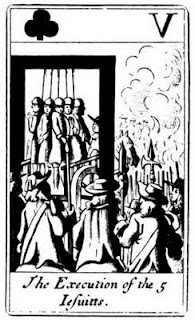
Today is the anniversary of the martyrdoms of five Jesuit Popish Plot Martyrs on June 20, 1679, who died as a result of the false, perjurous claims there was a vast, Jesuit, Catholic-wing conspiracy to assassinate Charles II and bring the Catholic Duke of York, James, his brother to the throne. Oates convinced the Whigs in Parliament that he knew who was in on this plot and he was given the authority to round up the suspects. At the trials for his accused, any witnesses they brought forward would be discounted by the Prosecution and the Judge, because, of course, they were also Catholics and if not in on the plot were probably in favor of the plot! After one of these manifestly unfair trials, five Jesuits were martyred on June 20, 1679 at Tyburn Tree in London:

John Gavan
William Harcourt
Anthony Turner
Thomas Whitbread
John Fenwick

Fathers John Fenwick and William Ireland were arrested in September of 1678 and held in prison. Then Oates captured Fathers Thomas Whitbread and Edward Mico, who were ill with the plague and living in the household of the Spanish ambassador. By December that year Father Whitbread was well enough to join Fathers Fenwick and Ireland in Newgate Prison; Father Mico died in custody. Father William Ireland was executed in January of 1679 with the Jesuit laybrother John Grove, but Fenwick and Whitbread awaited their fate and another trial. They had given evidence that refuted Oates', so Oates needed more time to gather more evidence! Fathers John Gavan, William Harcourt, and Anthony Turner in the meantime had been arrested and they were brought together with Father Fenwick and Whitbread (tried for the second time--no double jeopardy in Charles II's courts for Catholics!)

At the trial, the defense produced plenty of  witnesses from Saint-Omer to testify that Oates hadn't even been in England the day he was supposed to have heard the Jesuits plotting to assassinate King Charles II--he was at the college in St. Omer's that day. But the Court told the jury to trust Oates' evidence over the Catholic witnesses. The jury returned a verdict of guilty, condemning the five Jesuits to die for treason.

The circumstances of their execution were quite dramatic. All five were standing in a cart under the scaffold, with their hands bound and the nooses around their necks. They had each spoken, each prepared themselves for death, when suddenly, a rider galloped up, crying "A Pardon, A Pardon!"

Charles II issued them a conditional pardon to spare their lives--all they had to was admit their guilt and tell him all they knew about the plot. Trouble was that they weren't guilty of any plot and they couldn't tell him what they knew because there wasn't any plot in the first place! They declined the pardon, protesting that they could not lie to save their lives--they could not risk their immortal souls to save their physical bodies.

Therefore, they prepared themselves again for death--the rider returned to Charles II with the news--the cart pulled away and they were hung until dead before their bodies were quartered and their heads cut off. They were buried in the churchyard of St. Giles in the Fields. According to the church's website, there are actually eleven of twelve martyrs originally buried there in the churchyard:

The testimony of Titus Oates, led during 1678-81, to the burial in St Giles Churchyard of twelve Roman Catholic martyrs who were later beatified - Whitebread, Harcourt, Fenwick, Gavan, Turner, Coleman, Langhorne, Mico, Ireland, Grove, Pickering and Oliver Plunket, Archbishop of Armagh. All were priests except Coleman, who was secretary to the Duchess of York, Langhorne, who was a barrister, Grove, and Pickering, who was a laybrother; and all except Mico, who died after his arrest, had been executed at Tyburn (then close to where Marble Arch now stands). The first five are the Jesuit fathers with whom Plunket asked to be buried in the churchyard of St. Giles. The burial place is said to be near the north wall of the church. Though the body of Oliver Plunket, who was canonised in 1975, was later exhumed and taken to Lamspringe in Germany (the head being now at Drogheda and the body at Downside), there is in the St. Giles Burial Register for 1 July, 1681 a most legible entry of the burial.