Showing posts with label Sir Walter Raleigh. Show all posts

Monday, August 10, 2020

This Morning: Saints Polydore Plasden and Edmund Gennings

Just a reminder that I'll be on the Son Rise Morning Show at about 7:50 a.m. Eastern/6:50 a.m. Central to continue our series on the 40 Martyrs of England and Wales. Matt Swaim and I will discuss Saints Polydore Plasden and Edmund Gennings, executed on December 10, 1591 for being priests in England not willing to swear the Oath of Supremacy.

Please listen live here on the Sacred Heart Radio website; the podcast will be archived here. 

Both men had left England to study for the priesthood on the Continent, both studying at the English College in Rheims. Father Plasden was ordained in 1586; Father Gennings in 1590. Father Plasden returned to England in 1588; Father Gennings immediately after his ordination. So Father Plasden served in the mission for about three years; Gennings for one.

Details of St. Edmund Gennings' life include that he was a convert to Catholicism, following the example of his mentor Richard Sherwood, whom he served as a page. When Father Gennings returned to England he sought out his family and found his brother John in London. Their meeting did not go well: John believed Edmund to be a traitor because of his conversion. John knew about his brother's execution on December 10, 1591 and rejoiced that Edmund would not be able to persuade him to convert to Catholicism, which would have been an act of treason for both of them. There must have been something in his brother that made him concerned that Edmund could persuade him!

But thinking about his brother's life in contrast to his own, John began to realize that he had nothing to live for except pleasure while Edmund had had something to live and to die for, and he resolved to learn more about the Catholic faith. As the older Dictionary of National Biography explains, John Gennings' life changed drastically, as he left England, became a Catholic and studied for the priesthood becoming a Franciscan Friar and priest--and a missionary to England like his brother, during the reign of King James I:

He entered the English College at Douay, was ordained priest in 1607, and was sent on the mission in the following year. In 1614 or 1615 he was admitted into the order of St. Francis. In 1616, in his capacity of vicar and custos of England, he assembled at Gravelines about six of his brethren, including novices, and within three years he succeeded in establishing at Douay the monastery of St. Bonaventure, of which he was the first vicar and guardian. In 1621, with the assistance of Father Christopher Davenport he founded the convent of St. Elizabeth at Brussels for English nuns of the third order of St. Francis. On the restoration of the English province of his order he was appointed its first provincial, in a chapter held at Brussels on 1 Dec. 1630. He was re-elected provincial in the second chapter held at Greenwich on 15 Jan. 1633–4, for another triennium, and again in the fourth chapter at London on 19 April 1640. He died at Douay on 2 Nov. (O.S.) 1660.

This just demonstrates again the impact of these English and Welsh martyrs on those who witnessed or heard of their sacrificial love. 

Perhaps those of us who have family members who have left the Catholic Church and her Sacraments should choose Saint Edmund Gennings as an intercessor for their return!

Saint Polydore Plasden, pray for us!
Saint Edmund Gennings, pray for us!

Friday, August 7, 2020

Preview: Two More on Gray's Inn Road

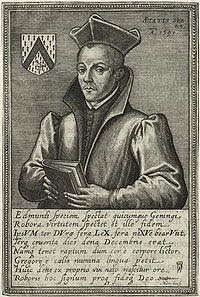
On Monday, August 10, Matt Swaim and I will discuss two more of the 40 Martyrs of England and Wales, Saint Edmund Gennings (portrait on the right) and Polydore Plasden on the Son Rise Morning Show (about 7:50 a.m. Eastern/6:50 a.m. Central) broadcast on Sacred Heart Radio from Cincinnati, Ohio.

The execution of two priests and three laymen at a specially built gallows at Gray's Inn Road on December 10, 1591 drew a crowd and some special spectators: Richard Topcliffe was there, as was Sir Walter Raleigh, one of Elizabeth I's favorite courtiers.

These priests were being execution simply because they were English subjects who had gone to the Continent to study and be ordained and had returned to England. Parliament had passed a new law in 1584, 27 Elizabeth Cap 2 (Act Against Jesuits, Seminary Priests and Other Such Disobedient Subjects). Unless these returning priests were willing to leave England within 40 days of arrival or accept the queen's supremacy over the Church in England, they were considered traitors. Anyone who harbored these recusant priests, the "other such disobedient subjects", were guilty of a felony: thus Saint Swithun Wells, and the Blesseds John Mason and Sidney Hodgson were hanged to death as felons that day.

But the presence of Richard Topcliffe (as demonstrated by his dialogue with Saint Swithun Wells described last week) and Sir Walter Raleigh also made these executions notable. Their presence also made a difference in the way the two priests suffered their executions.

St. Polydore Plasden and Sir Walter Raleigh (portrait on the left), according to the "Relation of Fr. James Young" included in Father Philip Caraman SJ's The Other Face: Catholic Life Under Elizabeth I discussed the priest's prayers for the queen. Raleigh was willing to have Plasden's execution stayed when he swore that he would defend Elizabeth's life against any threat of assassination. But then Topcliffe intervened and asked if Father Plasden would fight to assist Philip II of Spain in reasserting Catholicism in England. He said as a priest he could not, but that he would argue against any attack on the queen in such a cause. But Topcliffe pressed the argument further and Plasden said he would not counsel anyone else not to fight to reestablish the Catholic Church in England (in other words that he would support military action if necessary to replace the Church of England with the Catholic Church)--and Raleigh agreed that he was indeed a traitor to England because of his loyalty to the Catholic Church. Father Plasden said that he could not deny his faith in Christ and His Church. "O Christ" saith he, looking up to heaven and kissing the rope. "I will never deny thee for a thousand lives." And so he was hanged--but Raleigh ordered that he be allowed to hang until dead, so that he didn't suffer the agonies that followed.

He was 28 years old.

Father Gennings was not so fortunate in his conversation with Topcliffe. As the website of the Dominicans in England and Scotland recounts:

“If to return to England a Priest, or to say Mass be a Popish treason, then I confess I am a traitor. But I think not so. And therefore I acknowledge myself guilty of those things, not with repentance, but with an open protestation of inward joy.” Topcliffe, the notorious priest-hunter, was enraged with the attitude of St Edmund Gennings. He then ordered that Edmund be hanged and immediately cut down. When the hangman began his butchery, St Edmund was still alive when his heart was ripped from his chest. With his last breath he cried out, Saint Gregory: Pray for me. The hangman swore, “Zounds! See, his heart is in my hand, and yet Gregory is in his mouth. O egregious Papist!”. 

Caraman's entry for Gennings in The Other Face supplies the detail that he was cut down so quickly from the gallows that he was standing up and had to be toppled down by the hangman to begin the torture. 

He was 24 years old.

Saint Edmund Gennings, pray for us.
Saint Polydore Plasden, pray for us.

Tuesday, October 29, 2019

The Decollation of Sir Walter Raleigh

The History website tells us why Sir Walter Raleigh was beheaded on October 29, 1618:

He was a celebrated soldier, a hero on land and sea. He was responsible for the first ever English colonies in the New World. And he wrote poetry that ranks with some of the finest in early modern England. Yet at the age of 54 Sir Walter Raleigh was executed for treason. What caused the downfall of this beloved Renaissance courtier?

For a court favorite, Raleigh actually spent quite a bit of his life locked up in the Tower of London. The first time, in 1592, it was because he’d secretly married his lover, Elizabeth ‘Bess’ Throckmorton, a lady-in-waiting to Elizabeth I. Bess was already pregnant, which explained both the marriage and the secrecy. Enraged by their plotting behind her back, Elizabeth dismissed Bess and imprisoned both of them in the Tower.


Raleigh did regain the Queen's favor eventually and then explored the New World, founding the Roanoke colony in Virginia, and returning from El Dorado (Guyana) promising more gold every time he visited.

While he remained in Elizabeth’s favor until her death, James VI’s of Scotland’s accession to the English throne as James I meant that Raleigh’s fortunes plummeted. This was largely because James was attempting a diplomatic rapprochement with Spain, England’s longstanding enemy, against whom Raleigh had been a formidable foe. England’s funds were depleted by their endless struggles against Spain’s richer, mightier forces, so James decided it was time to end the rivalry. . . .

So Raleigh was tried in a sham trial--never allowed to face his accuser and question him--and imprisoned again:

But James, in his determination to get on Spain’s good side, locked up Raleigh once again in the Tower—this time for 13 years. . . .

It was likely Raleigh’s promises of gold that got him released from prison before his sentence could be carried out: in 1617 he was pardoned so that he could once again travel to Guyana in search of El Dorado. But that quest would ultimately prove fatal: during the expedition a detachment of Raleigh’s men (against his orders) attacked a Spanish outpost, an action that directly contravened the conditions of his pardon.


Because Raleigh's men, led by Lawrence Keymis, had violated the 1604 Treaty of London, the Spanish Ambassador to the Court of St. James, Diego Sarmiento de Acuña, Count of Gondomar, demanded Raleigh's execution (Keymis having committed suicide--Raleigh's namesake eldest son had died in the attack) and James I complied. Raleigh was executed at Whitechapel in London.

In addition to being an explorer, soldier, and courtier, Raleigh was a poet:

WHAT is our life? The play of passion.
Our mirth? The music of division:
Our mothers’ wombs the tiring-houses be,
Where we are dressed for life’s short comedy.
The earth the stage; Heaven the spectator is,
Who sits and views whosoe’er doth act amiss.
The graves which hide us from the scorching sun
Are like drawn curtains when the play is done.
Thus playing post we to our latest rest,
And then we die in earnest, not in jest.

He also wrote The History of the World, in which he was rather critical of Henry VIII:

NOW for King Henry VIII. If all the pictures and patterns of a merciless prince were lost in the world, they might all again be painted to the life out of the story of this king. For how many servants did he advance in haste (but for what virtue no man could suspect), and with the change of his fancy ruined again; no man knowing for what offence! To how many others of more desert gave he abundant flowers from whence to gather honey, and in the end of harvest burnt them in the hive! How many wives did he cut off and cast off, as his fancy and affection changed! How many princes of the blood (whereof some of them for age could hardly crawl towards the block), with a world of others of all degrees (of whom our common chronicles have kept the account), did he execute! Yea, in his very deathbed, and when he was at the point to have given his account to God for the abundance of blood already spilt, he imprisoned the Duke of Norfolk the father, and executed the Earl of Surrey the son; the one, whose deservings he knew not how to value, having never omitted anything that concerned his own honour and the king’s service; the other, never having committed anything worthy of his least displeasure: the one exceeding valiant and advised; the other no less valiant than learned, and of excellent hope. But besides the sorrows which he heaped upon the fatherless and widows at home, and besides the vain enterprises abroad, wherein it is thought that he consumed more treasure than all our victorious kings did in their several conquests; what causeless and cruel wars did he make upon his own nephew King James the Fifth! What laws and wills did he devise, to establish this kingdom in his own issues! using his sharpest weapons to cut off and cut down those branches, which sprang from the same root that himself did. And in the end (notwithstanding these his so many irreligious provisions) it pleased God to take away all his own, without increase; though, for themselves in their several kinds, all princes of eminent virtue.

Wednesday, December 9, 2015

Priests and Plots: Bye and Main

Sometimes, of course, when Catholic priests were suspected of plotting against the government of England, they were plotting against the government or the monarch. Not every Catholic priest or layman executed by the English government died as a martyr! And although English Catholic men traveled to the Continent to study for the priesthood and for the mission in England, they did not always agree about what that mission was. In the latter part of Elizabeth I's reign, there was division between the Jesuits and some of the secular, non-religious priests called the Appellants over the better way to deal with the issues of Elizabeth's excommunication and rightful authority as Queen in England--dividing spiritual and temporal authority, as it were. The Appellants wanted to appeal to the Queen for mercy, claiming that they were loyal to her in temporal matters while still practicing their Catholic faith.

Fathers William Watson and William Clark, who were executed on December 9, 1603, exemplify these two trends in a fascinating pattern. Because Father Watson had great hopes that James VI of Scotland, when succeeding Elizabeth in England would be ready to accommodate this more subtle distinction between the secular and the spiritual authority of the monarch, he met James in Scotland. When James did not accept this radical notion, Watson concocted the Bye Plot to kidnap James, seize the Tower of London, and establish a Catholic government in England.

Henry Garnet, one of Watson's Jesuit adversaries, found out about the Bye Plot and reported it to the authorities. Watson and his fellow conspirators were captured, tried and executed. Father Robert Parsons and the Jesuits who had been also negotiating with James and his new government, hoped that their cooperation in reporting this plot would encouraged the government to ameliorate conditions for Catholics.

Ironically, Henry Garnet would later be executed for his role in the Gunpowder Plot in 1606--a matter more complex than Watson's direct plotting. One of the plotters, Robert Catesby, asked Father Garnet some "hypothetical" moral questions and Garnet warned him against rebellion and the taking of innocent lives; another Jesuit who knew of the plot confessed it to Garnet who told him to do all in his power to prevent it--so Garnet may have been protecting the Seal of Confession. James I was careful not to make a martyr out of Garnet; he was threatened with torture but only tortured once (unlike poor Guy Fawkes in 1605) and was hung until dead before the rest of the traitor's sentence was carried out. Father Garnet has never been declared a martyr by the Catholic Church, although his nephew, also a Jesuit, has been: St. Thomas Garnet.

Also, the investigation of the Bye Plot led to the discovery of the Main Plot, which connived to place Arbella Stuart (pictured above) on the throne after deposing James. Sir Walter Raleigh spent 13 years in the Tower of London for his role in the Main Plot. Arbella reported the attempt of the conspirators to involve her in the plot to the King, so she stayed out of trouble--at least until she married William Seymour, Lord Beauchamp (later the Second Duke of Somerset). Then she was placed under house arrest and after attempting flight to the Continent, imprisoned in the Tower of London from 1610 to 1615, where she died, perhaps of malnutrition (she refused to eat). Seymour/Somerset survived until 1660.

The result for Catholics of the Bye Plot was that James I warned all Catholic priests to leave England immediately with the passage of the "Act for the due execution of the statute against Jesuits, seminary priests, etc." (I Jac. 1, iv), confirming Elizabethan statutes and reinforcing them and their implementation. So Father Watson's attempts both to appeal to Elizabeth I and James I failed and in his desperation--just like that desperation of the Gunpowder plotters two years after--he resorted to violence. 

One question I have, to which I cannot find an answer: was this Father William Watson the same priest whom St. Margaret Ward helped escape from Bridewell prison in 1588?

Monday, December 10, 2012

December 10, 1591 On the "Son Rise Morning Show"


I'll be on the Son Rise Morning Show, broadcast on the EWTN Global Radio Network from Sacred Heart Radio in Cincinnati, Ohio this morning at 7:45 a.m. Eastern, 6:45 a.m. Central to discuss the executions of a group of Catholic martyrs on December 10, 1591 on Gray's Inn Road in London:

St. Swithun Wells was hanged for NOT attending a Catholic Mass in Elizabethan England. His wife Alice attended the Mass held in his house near Gray's Inn in London, but he wasn't there when the priest hunters burst in during the Mass celebrated by Father Edmund Gennings. Those attending held the pursuivants off. His wife, Fathers Gennings (pictured at right) and Polydore Plasden, and two other laymen, John Mason and Sidney Hodgson were arrested at the end of the Mass. Swithun was arrested when he came home.

At his trial, he said he wished he could have attended that Mass and that was enough for the Elizabethan authorities! He was hung near his home on Gray's Inn Road in London, and he spoke to Richard Topcliffe before he died, hoping that this persecutor and torturer of Catholics would convert! He said, "I pray God make you a Paul of a Saul, of a bloody persecutor one of the Catholic Church's children." St. Swithun as a school master had for a time conformed to the official church but then had returned to the Catholic faith.

As he was led to the scaffold, Wells saw an old friend in the crowd and called out to him: "Farewell, dear friend, farewell to all hawking, hunting, and old pastimes. I am now going a better way"!

St. Swithun's wife Alice received a reprieve from her death sentence, but died in prison in 1602. The two priests and the other three laymen were all executed on December 10. Sir Walter Raleigh was present at the execution and heard Father Polydore pray for Queen Elizabeth. Raleigh then asked him about his loyalty to Queen Elizabeth as the rightful ruler of England and liked his answers, so ordered him to be hung until dead, thus avoiding the rest of the torture of his execution. On the other hand, Topcliffe made sure that Father Gennings suffered all the tortures of being hung and quartered: he was left to hang but a short time and was fully conscious as the executioner started cutting him up. Father Gennings had said, "I know not ever to have offended the Queen. If to say Mass be treason, I confess to have done it and glory in it."

The two priests and the house owner have been canonized: St. Edmund Gennings, St. Polydore Plasden, and St. Swithun Wells--among the Forty Martyrs of England and Wales in 1970. The two laymen who helped defend St. Edmund Gennings at Mass and were sentenced to death for that felony (sic) were beatified (Blessed John Mason and Blessed Sidney Hodgson) by Pope Pius XI in 1929.

But these were not the only martyrdoms in London that day in 1591--Father Eustace White and layman Brian Lacey were executed at Tyburn. St. Eustace White was a convert to Catholicism--his anti-Catholic father cursed him and White endured permanent estrangement from his family. In 1584 Eustace began studies for the priesthood in Rheims, France and Rome, Italy, and was ordained at the Venerable English College in Rome in 1588. In November 1588 he returned to the west of England to minister to covert Catholics. The Church was going through a period of persecution in England, made even worse by the attack of the Armada from Catholic Spain. Arrested in Blandford, Dorset, England on 1 September 1591 for the crime of being a priest. He was lodged in Bridwell prison in London, and repeatedly tortured.

He endured the torture technique developed by Richard Topcliffe and used on St. Robert Southwell and others, being hung by the wrists. As he wrote to Fr. Henry Garnet, SJ from prison:

"The morrow after Simon and Jude's day I was hanged at the wall from the ground, my manacles fast locked into a staple as high as I could reach upon a stool: the stool taken away where I hanged from a little after 8 o'clock in the morning until after 4 in the afternoon, without any ease or comfort at all, saving that Topcliffe came in and told me that the Spaniards were come into Southwark by our means: 'For lo, do you not hear the drums' (for then the drums played in honour of the Lord Mayor). The next day after also I was hanged up an hour or two: such is the malicious minds of our adversaries."

At his trial he forgave the judges who sentenced him to death. He is also one of the Forty Martyrs of England and Wales.You could read more about him in this book.   Brian Lacey was a Yorkshire country gentleman. Cousin, companion and assistant to Blessed Father Montford Scott. Arrested in 1586 for helping and hiding priests. Arrested again in 1591 when his own brother Richard betrayed him, Brian was tortured at Bridewell prison to learn the names of more people who had helped priests. Finally arraigned down the Old Bailey, he was condemed to death for his faith, for aiding priests and encouraging Catholic. Pope Pius XI also beatified him in 1929. Blessed Brian Lacey was also related to Blessed William Lacey, a 1582 martyr in York.