Showing posts with label St. Peter's Basilica. Show all posts

Wednesday, December 31, 2025

Memories: December 31, 2022

On Saturday, December 31, 2022, I went to morning Mass at Saint Thomas Aquinas Catholic Church, having heard of the death of Emeritus Pope Benedict XVI. I saw one of my friends in the chapel before Mass, looking as shocked and hurt as I felt.

Because of Joseph Cardinal Ratzinger's interest in Saint John Henry Newman before and after he became Pope Benedict XVI, I had followed his commentary with great interest. As Pope Benedict XVI he made an exception to his established pattern and went himself to England to preside at Newman's beatification Mass, and he wrote beautifully about Newman on conscience, the development of doctrine, and papal authority. Mark and I watched the events of that State Visit in September 2010 on EWTN with great interest! In 2015 I posted a series of Fifth Anniversary remembrances of those September days.

His interest in Newman had begun earlier in his life as Newman provided a guide to conscience as responding to the authority and wisdom of Almighty God (and certainly not one's own or worse, Hitler's!).

Yesterday, EWTN broadcast the Mass in Saint Peter's Basilica, celebrated by Cardinal Gerhard Ludwig Müller, emeritus prefect of the Congregation for the Doctrine of the Faith, in his memory.

May he rest in peace.

Thursday, March 16, 2017

The Merton College Choir at St. Peter's

From Vatican Radio, describing the Anglican Choral Evensong celebrated on Monday, March 13 in Rome:

An ecumenical milestone was marked in the Vatican on Monday as a traditional Anglican Choral Evensong was celebrated for the first time in St Peter’s Basilica.

Cardinal Angelo Comastri, Archpriest of the Basilica, gave permission for the historic event during meetings with Archbishop David Moxon, Director of the Anglican Centre in Rome.

The renowned choir of Merton College, Oxford came to sing music written at the time of the Reformation, as well as contemporary compositions and well-loved Anglican hymns. . . .

Specifically, the choir sang works by William Byrd and used an historical Book of Common Prayer service:

Music by the great English composer William Byrd filled the basilica, as well as some more contemporary works, while the words of the liturgy and readings were those of the 1662 Book of Common Prayer.

The Anglican News website points out that this musical exchange began with Pope Emeritus Benedict XVI:

Merton College Choir followed in the footsteps of Westminster Abbey choir, which has sung previously in Rome with the choir of the Sistine Chapel – a collaboration that has grown out of closer ties between the two traditions, in particular following Pope Benedict XV1’s (sic) visit to London in September 2010.

The date was selected to be closest to the date of Pope St. Gregory the Great's original feast day of March 12, the date of his death in 604. Because that date so often falls in Lent, his feast was moved to September 3, the date of his episcopal consecration in 590. After Evensong, there was a procession to the tomb of St. Gregory. Of course, St. Gregory sent St. Augustine of Canterbury to Kent in 597.

Pope St. Gregory the Great, pray for us! St. Augustine of Canterbury, pray for us!

Tuesday, August 5, 2014

Selling the Vatican to Feed the Poor


Sorry for not blogging the past few days--we had a hectic weekend and I've had a busy week so far at work and at home so I just haven't posted or had time to think of what to post!

In between events, I saw Kathy Schiffer's post on her Patheos blog about an encounter with a young man who thought St. Peter's Basilica was both beautiful and a symbol of corruption--that it should be sold and the money given to help the poor. “I looked up at the great basilica, and I had two reactions: First, I appreciated its beauty and reverence; but then I thought, ‘What corruption caused someone to spend so much on this building when people are hungry’?” 

She responded with four good points:

1. Gratitude Requires That We Preserve the Gifts of Those Who Have Gone Before Us.
2. Jesus himself expected that we would honor him with our wealth.
3. The Poor Deserve Beauty, Too.
4. Beauty Leads Us to Holiness.


Read her post to see how she fleshes each of these points out very reasonably and scripturally. 

I do have to wonder if the young man has the same response when he sees the Cathedral Church of St. John the Divine in New York City, the National Cathedral in Washington, DC, or even the Mormon's Temple in Salt Lake City, Utah--“I looked up at the great Episcopalian Cathedral, and I had two reactions: First, I appreciated its beauty and reverence; but then I thought, ‘What corruption caused someone to spend so much on this building when people are hungry’?” -- “I looked up at the great Mormon Temple, and I had two reactions: First, I appreciated its beauty and reverence; but then I thought, ‘What corruption caused someone to spend so much on this building when people are hungry’?” Or was it a viscerally anti-Catholic reaction?

I addressed this same issue in an article for Homiletic & Pastoral Review last year:

. . . someone might say that the Vatican, and the churches around the world, should sell priceless artwork, using the money to eliminate poverty. That adjective “priceless” points out one of the flaws of that argument: who could afford to pay what it’s worth? But, even if other museums, and private collectors, could pay what that vast treasure of beauty is worth, would it really be enough to take care of all the poor? What happens when that money has been distributed, and the problem of poverty has still not been solved?

As nearly every guidebook comments about each great European capital with a Catholic heritage, the cathedrals and churches are a great free refuge and resource for the weary tourist. They offer shelter from heat and rain, a place to rest, and a feast for the eyes to see great artwork by Titian, Raphael, Caravaggio, Michelangelo, Rubens, Tintoretto, and many others, especially that great and prolific artist, “Anonymous.” What about justice to the benefactors who gave artwork to the Church for the purpose of praising God in beautiful churches? Is it fair to their memory? Once the artwork is in private hands, for example, who will have access to it? The poor? Not likely.


Pope Benedict XVI emphasized the power of beauty--and personal holiness (the saints)--to attract people to God. Elizabeth Scalia offered some of his insights in a 2013 National Catholic Register article;

"The encounter with the beautiful can become the wound of the arrow that strikes the heart and in this way opens our eyes," said Cardinal Ratzinger at Rimini.

That wound, that opening in our hardened opinions, our complacent convictions, leaves us exposed. As the Pope said to artists, that dart "draws [man] out of himself, wrenches him away from resignation and from being content with the humdrum — it even makes him suffer, piercing him like a dart; but, in so doing, it ‘reawakens’ him, opening afresh the eyes of his heart and mind, giving him wings."

That awakening can make man thirst for truth, to reject the false, the superficial and illusory. Beauty is dangerous. If it captures the heart, it can make one change. Ovid knew it; Dante knew it. And Benedict has spent his pontificate telling us we have resources we haven’t even begun to tap.

Thanks to art and the exceptional lives of saintly men and women, the Church — the custodian of beauty and Truth for the past 2,000 years — still has a powerful voice in the world of culture. In the great cultural battlefield of our era, Pope Benedict has shown future generations how to get into the trenches and win with grace, in every sense of the word.

As he said last August, at a general audience at Castel Gandolfo, "Art is capable of making visible our need to go beyond what we see, and it reveals our thirst for infinite beauty, for God."

There are "artistic expressions that are true paths to God, the supreme Beauty," which "help nurture our relationship with him in prayer. These are works that are born of faith and express faith."


The Pope recalled a concert of Johann Sebastian Bach’s music: "After the last piece of music, one of the Cantate, I felt, not by reasoning, but in my heart, that what I heard had conveyed to me truth, something of the truth of the great composer’s faith — and this pressed me to praise and thank the Lord."

He reminded the faithful that visiting churches, art galleries and museums can be "where we can stop and contemplate, in the transition from simple, external reality to a deeper reality, the ray of beauty that strikes us, that almost wounds us in our inner selves and invites us to rise towards God."

Wednesday, September 11, 2013

King John III Sobieski and the Battle of Vienna

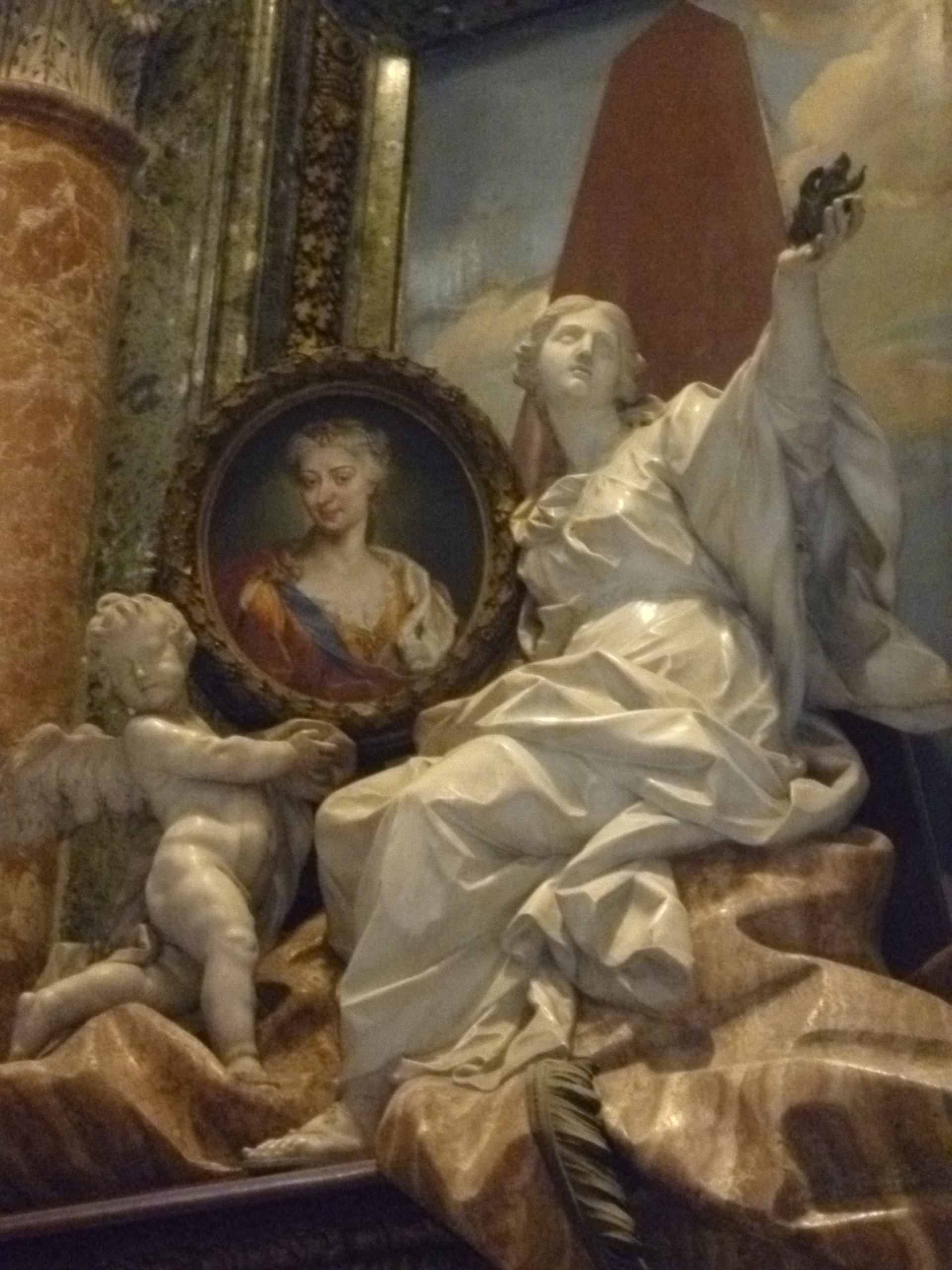
File:Maria Clementina Sobieski Memorial.JPGIn addition to being the 12th anniversary of the 9/11 attacks in the United States, this is the 330th anniversary of the Battle of Vienna, at which King Jan Sobieski of Poland led the combined imperial and Polish forces to defeat the Ottoman Empire Believe it or not, there's a connection between September 11, 1683 and the long English Reformation: Maria Clementina Sobieska, the granddaughter of King Jan Sobieski married James Francis Edward Stuart:

Being one of Europe's wealthiest heiresses, she was betrothed to James Francis Edward Stuart. King George I of Great Britain was opposed to the marriage because he feared that the union might produce heirs to James Francis Edward's claim to his thrones. To placate him, the Holy Roman Emperor Charles VI arrested Maria Clementina while on her way to Italy to marry James Francis Edward. She was confined in Innsbruck Castle but eventually the guards were deceived and Maria Clementina escaped to Bologna, Italy, where, for safety from further intrusions, she was married by proxy to James who was in Spain at that time.

Maria Clementina's father, James Louis Sobieski, approved her escape declaring that, as she became engaged to James Francis Edward she ought to "follow his fortune and his cause".

Maria Clementina and James Francis Edward were formally married on 3 September 1719 in the Chapel of episcopal palace of Montefiascone, Italy in the Cathedral of Santa Margherita. Following their marriage, James and Maria Clementina were invited to reside in Rome at the special request of Pope Clement XI, who acknowledged them as the King and Queen of England, Scotland and Ireland.

The Pope provided them with a papal guard of troops, gave them the Palazzo Muti in the Piazza dei Santi Apostoli in Rome to live in, plus a country villa at Albano. The Catholic Church also provided them with an annual allowance of 12,000 crowns out of the papal treasury. The Popes Clement XI and Innocent XIII considered James and Maria Clementina the rightful and, more importantly, Catholic King and Queen of England, Scotland and Ireland: the cousin of Pope Innocent XIII, Francesco Maria Conti, from Siena, was here the Gentiluomo di Camera (the chamberlaine) in the little Roman Jacobite court.

The married life of James and Maria Clementina proved turbulent and unhappy. Soon after their second child's birth (Henry Benedict), Maria Clementina left him and went to live in Rome in the convent of St. Cecilia. She accused her husband of adultery and he said it was sinful to leave him and her children. (Their first son was Charles Edward, aka Bonnie Prince Charlie.) It was more than two years before they reconciled.

Maria Clementina died at the early age of 32 on 18 January 1735. She was interred with full royal honors in St. Peter's Basilica in Rome. Pope Clement XII ordered that she have a state burial. Pope Benedict XIV commissioned Pietro Bracci (1700–1773) to sculpt a monument to her memory, which was erected in the Basilica.

More on the Battle of Vienna, September 11 to 12, 1683, here.

Monday, July 2, 2012

Note the Date: June 29, 2012

Last Friday, June 29 was the Solemnity of Sts. Peter and Paul. Pope Benedict XVI celebrated Mass at the Vatican and presented the Pallium to Archbishops from around the world, including a few from the United States. At an event and on a feast so important to one of the great marks of the Catholic Church, our apostolicity, the choir of the Anglican Westminster Cathedral sang:

Westminster Abbey’s Choir sang for Pope Benedict XVI, with the Cappella Musicale Pontificia ‘Sistina’, the Sistine Chapel Choir, at the Papal Mass marking the Solemnity of St Peter and St Paul in St Peter’s Basilica, Rome, on Friday 29th June, a historic occasion of great significance for Anglican-Catholic relations.

The service was broadcast live across the world and was the first time in its 500-year history that the Sistine Chapel Choir had sung alongside another choir during a service.

The Abbey Choir was invited to Rome by Pope Benedict XVI, following his visit to the UK in September 2010, during which he attended an ecumenical service of Evening Prayer at Westminster Abbey. This reciprocal visit is a further fruit of the Pope’s visit to Great Britain and is a powerful symbol of the communion already achieved between the Anglican and Catholic churches.

The Dean of Westminster, The Very Reverend Dr John Hall said: ‘It is not hard to detect behind this invitation from His Holiness a papal project to restore some of the Church’s musical tradition to the liturgy. The experience of participating in these liturgies in Rome has enriched the Abbey and its Choir and the Anglican tradition of worship.’

The Papal Mass is an important annual liturgy presided over by Pope Benedict XVI, during which the Pallium (an ecclesiastical vestment symbolising Papal authority) is imposed on new Metropolitan Archbishops from around the world.


The evening before, the Sistine Chapel Choir and the Westminster Abbey Choir performed a concert:

Both choirs began by singing Palestrina’s Tu es Petrus and Magnificat.

The Abbey choir then sang O Clap Your Hands (Gibbons), Hear My Prayer (Purcell), I Love The Lord (John Harvey), Hymn to the Mother of God (Tavener), and Laudibus in Sanctis (Byrd).

The Sistine Chapel Choir sang Tu es Petrus (Mawby). This was the first piece of Anglican music the Sistine choir has ever sung and the composer, Colin Mawby, was in the audience. Both choirs then sang Palestrina’s Credo.

The concert was attended by Cardinal Tarcisio Bertone, SDB, Cardinal Secretary of State to His Holiness Pope Benedict XVI, who said afterwards that the concert was ‘a tangible sign of our will to walk side by side.’

Even the Associated Press noticed this effort of Pope Benedict XVI to use culture as a means of finding something in common between the Catholic Church and the Church of England:

Benedict himself was behind the decision to invite Westminster to Rome, so awed by the quality of the choirboys when they sang for him at Westminster Abbey during his September 2010 visit. He specifically asked that the choirs be united as one, rather than alternate during the performance as is commonly done, said the Very Rev. John Hall, dean of Westminster Abbey.

Palombella, the Sistine choirmaster, jumped at the chance, eager to open up his choir to outside influences and shed the Sistine's reputation as a historical relic closed to innovation.

"These meetings are good for both Sistine and Westminster," he said in an interview. "Because it makes us learn the precision and detail of the English choirs, and it makes the English learn the warmth and intensity that the Italian choir has."

We can be certain that Pope Benedict XVI as a musician knew the challenge and the opportunity this tremendous musical collaboration entails. This blog posts several excerpts from the Mass last Friday. The Catholic Westminster Cathedral Choir in London also specializes in Palestrina's music and has recorded his Tu Es Petrus Mass.