Showing posts with label Kansas. Show all posts

Sunday, January 22, 2017

To Give Glory to God: Beautiful Catholic Churches


Patti Armstrong writes for The National Catholic Register about beautiful churches built in North and South Dakota built in the nineteenth and early twentieth centuries by German immigrants:

Many of the Catholic churches in North Dakota and South Dakota bespeak the legacy of Catholic German immigrants who worked hard and worshipped even harder.

Four of them in particular are notable because they tower above small prairie towns, too large for their shrinking communities, but too magnificent not to maintain.

The early settlers in the Dakota Territory erected beautiful churches similar to the ones they had left behind in Europe. They wanted places of worship to glorify God and to last for generations.

In the Diocese of Bismarck, North Dakota, are: St. Mary’s in Richardton, Sts. Peter and Paul in Strasburg and St. Mary’s in Hague. Their total populations are 548; 392; and 67 respectively, according to the 2014 census poll. Hoven, South Dakota, home to St. Anthony of Padua, has 407 residents.

The churches are relics of the pre-Vatican II era, where people worshipped alongside a multitude of angels and saints captured in stained-glass windows, statues and paintings. Although they still function as active parishes, the churches have also become tourist destinations. Motorists detour off highways, and busloads of pilgrims come to see this Old World beauty surviving in the New World.

Their operation and maintenance costs are not practical, but the Catholic Church is about faith, beauty, courage and sacrifice.


The comment about keeping churches open even when the costs are prohibitive reminded me of some churches in Kansas that are kept open, often by the laity, even though they aren't active parishes now. Last February I visited St. Martin of Tours in Piqua, Kansas (pictured above) and many years ago my parents and I took a tour of the German/Volga German churches around Hays, Kansas. The Cathedral of the Plains, St. Fidelis Catholic Church, in Victoria is still a parish church, but Holy Cross in Pfeifer is maintained by a charitable foundation and the church is open every day for visitors. St. Joseph Church in Liebenthal is still an active parish of the Diocese of Dodge City, as is St. Anthony's in Schoenchen, although on a limited basis.

The church of St. Francis (not of Assisi, but St. Francis de Hieronymo, a Jesuit saint) in St. Paul, Kansas is still an active parish in the Diocese of Wichita; the pastor is from Burma. It is a beautiful church and a tremendous part of the history of Catholics in Kansas. This site describes all that it had been when the Jesuits and then Passionists had organized first a mission and then a monastery and retreat house. 

These churches were built by poor people, struggling to make their homesteads prosper, who wanted to see the same beauty in the New Country as they'd known in the Old when they went to Mass or to Confession, or a new baby's baptism, or a wedding--or a funeral. They wanted to give glory to God.Some of the artwork and decoration they scrimped and saved for was costly at the time but it is priceless today. These churches are monuments and memories of the German (or Irish or Italian or Polish) immigrants' faith and devotion. It may be inevitable that the population in the parishes declines to the point that they have to be moved or consolidated and certain churches closed, but it's wonderful when the laity help to maintain the closed churches, even though they may be empty (no Blessed Sacrament reserved in the Tabernacle). 

Wednesday, August 17, 2016

Two Assumptions


I attended Mass twice for the Solemnity of the Assumption on Monday, August 15. My husband and I went to Noon Mass at the Cathedral of the Immaculate Conception, which was very well attended, even though the bishops in the USA had removed the obligation to attend on this Holy Day because it fell on a Monday (!). The choir director and organist ought to be a little concerned, because we sang "Immaculate Mary", Parisian Plain Chant, and "Hail, Holy Queen" without their assistance quite ably.

Then I drove to Pilsen, Kansas in Marion County to attend Low Mass in the Extraordinary Form at the Church of St. John Nepomucene, which was the home parish of Servant of God Emil Kapaun. St. John Nepomucene is the patron saint of Czechoslovakia and of confessors--he was martyred because he refused to reveal the confession of the queen to her husband, King Wenceslaus IV of Bohemia. Thus, the patron saint of the church, one of the four churches in the Holy Family Parish of Marion County, is depicted with his finger on his lips at the High Altar:


The side altars were beautiful too:


And the exterior of the church, facing the westward setting sun:


And here is the statue depicting Chaplain Kapaun helping a wounded soldier:


The horizon:


Our Lady, assumed into Heaven, pray for us!
St. John Nepomucene, pray for us!
Servant of God Father Emil Kapaun, pray for us!

Finally, the old Fina Gas Station (I should have stopped to see what the prices were the last time gas was pumped there, but I wanted to reach Kansas 15 before it was completely dark):

Friday, February 26, 2016

Stations of the Cross on the Road

On Friday, February 12, as I drove to Fort Scott, I listened to the Wyoming Catholic College CD of The Way of the Cross: Meditations by John Henry Cardinal Newman (recorded in 2009 before his beatification), which also includes musical selections performed by the Wyoming Catholic College choir. You may purchase the CD from the college's webstore. EWTN has the texts of Blessed John Henry Newman's meditations here.

I also stopped at St. Martin of Tours in Piqua, Kansas. Although there is no active Catholic parish there anymore, Catholics in the area maintain the church and keep it open for visitors (including a nice WC). It was chilly in the church, but the light was good inside and here are some pictures. First, the exterior--I wish I could have taken a picture of the church as it appeared on the side of the highway, with the bell tower rising above the plains:


A view of the altar and sanctuary from the choir loft and a close up of the crucifix:


And two of the lovely Stations of the Cross:


The reminder above the Pieta is "Save Your Soul":


Speaking of the bell tower, how about climbing this stairway to heaven from the choir loft? (two wooden ladders nailed together!):


And the patron saint himself, St. Martin of Tours:


You might notice the poinsettia flowers; that's because Mass is offered usually (I saw a folder from a funeral Mass in the choir loft) just once a year: on Christmas Eve. The rest of the year it is maintained as an oratory, a place of prayer.

Finally, I'll close this photo post with an interesting sight in Fort Scott: the doorway to the Scottish Rite Temple with the cross and the pelican:


The Scottish Rite Temple closed in 2014 due to declining membership and financial losses, according to this Fort Scott Tribune story.

All pictures (c) 2016 Stephanie A. Mann. Taken with Canon PowerShot S95, my husband's nice point and shoot (for me) camera.

Friday, February 12, 2016

Driving Eastward on the Friday after Ash Wednesday

Unlike John Donne, I am going the right direction as I travel on a Lenten Friday, east toward Fort Scott, Kansas.

Of course, I'm referring to John Donne's poem, "Good Friday, 1613, Riding Westward":

Let mans Soule be a Spheare, and then, in this,
The intelligence that moves, devotion is,
And as the other Spheares, by being growne
Subject to forraigne motion, lose their owne,
And being by others hurried every day,
Scarce in a yeare their naturall forme obey:
Pleasure or businesse, so, our Soules admit
For their first mover, and are whirld by it.
Hence is't, that I am carryed towards the West
This day, when my Soules forme bends toward the East.
There I should see a Sunne, by rising set,
And by that setting endlesse day beget;
But that Christ on this Crosse, did rise and fall,
Sinne had eternally benighted all.
Yet dare I'almost be glad, I do not see
That spectacle of too much weight for mee.
Who sees Gods face, that is selfe life, must dye;
What a death were it then to see God dye?
It made his owne Lieutenant Nature shrinke,
It made his footstoole crack, and the Sunne winke.
Could I behold those hands which span the Poles,
And tune all spheares at once peirc'd with those holes?
Could I behold that endlesse height which is
Zenith to us, and our Antipodes,
Humbled below us? or that blood which is
The seat of all our Soules, if not of his,
Made durt of dust, or that flesh which was worne
By God, for his apparell, rag'd, and torne?
If on these things I durst not looke, durst I
Upon his miserable mother cast mine eye,
Who was Gods partner here, and furnish'd thus
Halfe of that Sacrifice, which ransom'd us?
Though these things, as I ride, be from mine eye,
They'are present yet unto my memory,
For that looks towards them; and thou look'st towards mee,
O Saviour, as thou hang'st upon the tree;
I turne my backe to thee, but to receive
Corrections, till thy mercies bid thee leave.
O thinke mee worth thine anger, punish mee,
Burne off my rusts, and my deformity,
Restore thine Image, so much, by thy grace,
That thou may'st know mee, and I'll turne my face.


My road, Highway 54, actually goes through the old railroad towns along the way, in counties Sedgwick, Butler, Greenwood, Woodson, Allen, and Bourbon. Thus, I'll drive through or alongside El Dorado, Prospect, Rosalia, Eureka, Neal, Toronto, Yates Center, Piqua, Gas, La Harpe, Moran, and Bronson before I reach Fort Scott. 

Piqua piques my interest because it is the birthplace of Buster Keaton and there is a beautiful church, St. Martin of Tours, maintained by the Catholics nearby. I will pay tribute to The Great Stone Face while I visit Piqua. His parents were in vaudeville and his mother Myra gave birth to Joseph Frank while they were on the road. Bronson, Kansas has a Civil War memorial, so I might stop by the city park to take a photo. 

Each of these towns and cities has a history and it has been fun to spend some time on the internet to find out a little about each. For instance, Gas, which is just a few miles east of Iola, was indeed named for its raison d'etre, natural gas. Rosalia was named by the first postmaster after his wife and was platted in 1883. John C. Woods, a native Wichitan who served as an executioner (hanging Frank, von Ribbentrop, and others) at the Nuremberg trials, is buried in Toronto. Debra Dean Barnes, Miss America 1968, was born and raised in Moran, Kansas.

Once I arrive in Fort Scott, I'll check into my hotel, reconnoiter about town, and then meet the other speakers at the History and Heretics Symposium for dinner. I'll publish updates on my drive east soon.

Tuesday, January 8, 2013

Adventure and Kansas: A Book Review

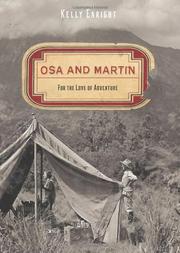
Cover art for OSA AND MARTIN
I was born and have grown up in Kansas and my father was born and raised in southeastern Kansas; therefore I have often been in the Chanute, Kansas area, but I have never visited the Osa and Martin Johnson Safari museum. Isn't that so often the way? When you live near "tourist" destinations, you never go to them! Even after reading this book, Osa and Martin: For the Love of Adventure by Kelly Enright, I'm not that ready to drive to Chanute for the opportunity to explore the museum's exhibitions.

Although the author provides a great narrative of the events and activities of the adventures of Osa and Martin Johnson in Africa, photographing natives and wild animals, I never felt the drive behind their efforts, except that they could not stay put in civilization. In fact, their adventures seemed superficial and Enright does not fully explain the impact of their adventures. Each safari is the same mixture of failure and success--cameras don't work, cars break down, animals won't cooperate; Osa saves Martin's life, a new guide comes through, Martin gets a great shot of elephants. I wanted to know why these problems occurred--what were the technical limitations of the cameras they used, for example. I also wondered about the real influence of the Johnson's work in filming animals and natives in Africa and beyond--other than the curiosity of the the movie goers, what effect did they have? How would wildlife experts or environmentalists judge their efforts today? How well does their work hold up to current viewing? In Enright's telling, the different safari trips and the materials the Johnsons produced (films, vaudeville shows, animals brought home as pets and zoo animals, etc) flow together without real distinction.

Enright's best work is her description of Martin Johnson's first adventure with Jack London, the great writer. The weakest section is Osa's life after Martin dies in a commercial, domestic airline crash. Osa seemed adrift after the man she married when she was 16 is gone--has a couple of bad relationships and abuses alcohol and yet continues the trailblazing path of her partnership with her husband through books and a television series.

I do think the book would have benefitted from a separate photographic section, with better quality prints--the pictures included on the pages of the text are rather small and the details hard to make out. There's a great adventure story there somewhere, but this book didn't convey that adventure to me.

Note: I checked this book out from the public library.