Antonio Ghislieri became Pope Pius V in 1566 and died in 1572. According to this site, he
~~was a professor of philosophy and theology for years, and served [the Dominican] order and the Church in several high offices: Provincial Superior; Inquisitor at Corno and Bergamo; Bishop of Sutri and Nepi; cardinal; Grand Inquisitor, Bishop of Mondovi and elected Pope Pius V in a modest ceremony on January 17, 1566, his 62nd birthday.
~~Pope Pius V was a great reformer, committed to eradicating simony, the buying or selling of ecclesiastical pardons or offices, and nepotism from the Roman Curia. To numerous relatives who rushed to Rome with the hope of some privilege, Pope Pius V gave comment that a relative of the pope can consider himself sufficiently rich if he is not indigent.
~~Pope Pius V published the catechism of the Council of Trent and an improved edition of the Missal and Breviary. The Pontiff tried to make Rome truly a holy city and punished immorality severely. The rigid discipline that Pope Pius V imposed on the Church was the constant norm of his own life.
~~Pope Pius V promoted several pastoral reforms in the wake of the Council of Trent: The obligation of residence for bishops, the cloister of religious, celibacy and holiness of life of priests, bishops' pastoral visits, the increase of missions, and the correction of liturgical books.
~~Pope Pius V excommunicated Queen Elizabeth I in 1570, an act which heightened the persecution of Catholics in England, but it also did much to strengthen Catholics.*
~~In 1571 a huge Muslim fleet threatened Christendom. Don Juan of Austria led an outnumbered Christian fleet to fight the Muslim navy. Pope Pius V entrusted the Christian fleet to Our Lady.
On October 7, 1571, the Christian fleet won a decisive battle in the Bay of Lepanto. Pope Pius V wished to institute a special feast to honor the Blessed Virgin’s assistance in securing the victory and the safety of Christendom. The feast was to be celebrated on October 7, and Pope Pius V called it the feast day of Our Lady of Victory.
~~A man of great austerity and prayer, Pope Pius V died on May 1, 1572. He suffered much, his prayer was: "Lord increase my pains, but increase my patience too."
He was canonized in 1712. On his feast day, May 5, Romans still gather at his shrine to venerate a great pope and a holy man.
*Last year, a reader chided me for not challenging this statement. Of course, I have posted before on the issues of this Papal bull and discussed it in Supremacy and Survival: How Catholics Endured the English Reformation. Lately, I've been reading a book on Christian England: From the Reformation to the 18th Century by an Anglican author, David L. Edwards; while he still considers Regnans in Excelsis to be a tactical error on the Pope's part, he does note that it made Catholics in England face a choice between the Established Church of England and the universal Catholic Church, between the authority of the monarch in religious matters and the authority of the Pope. Edwards notes that otherwise, the relative ease with which Church Papists were sliding into conformity with the Anglican church would have meant the end of Catholicism in England. So, the Papal Bull did both increase the government persecution of Catholics AND strengthen Catholic resolve to be true to their faith.
Tuesday, January 17, 2012


Monday, January 16, 2012
Devotion, Destruction, and the English "Deformation"
The Wall Street Journal featured this online article by Barrymore Laurence Scherer, whom I used to hear make presentations during the Texaco Sponsored Met Opera broadcasts, about an exhibition of medieval alabasters at the Princeton University Art Museum--with a definite connection to the English Deformation, I mean English Reformation:
Medieval luxury came in various materials and forms, alabaster carvings among them, and a new show at the Princeton University Art Museum reveals the intimate beauty and expressiveness of this art. "Object of Devotion" highlights a selection of 60 Medieval English alabaster panels and freestanding sculptures from the vast collection of London's Victoria & Albert Museum. Touring for the first time in North America, these carvings of holy figures and narrative scenes were produced for churches, royal chapels and domestic altars in England and exported to the Continent. And they represent an English industry that thrived from about 1350 to 1530, after which the Protestant Reformation's ban on religious imagery, combined with the Dissolution of the Monasteries in England by King Henry VIII, not only ended the demand for such works but also led to their outright destruction.
According to the museum website:
The dates of the sculptures range from ca. 1370 through 1530, when the Protestant Reformation put an end to the creation of new religious art.
The exhibition draws attention to the “alabastermen,” specialists in the English Midlands, around Nottingham, who sculpted the stone mined there, prized for its high quality. The subjects were chosen to appeal to churchmen, aristocrats, and wealthy non-aristocratic patrons. The relatively small works were assembled to form entire altarpieces recounting the lives of Christ and the Virgin Mary, or used as devotional works dedicated to the most revered saints. The exhibition examines the working methods of the sculptors, the exportation of much of their work to the European continent, and the stylistic evolution and different levels of quality of the sculptures. Object of Devotion also chronicles the abrupt end of the alabaster-carving tradition in England at the time of the Reformation, when works in English churches were defaced or destroyed during outbursts of Protestant iconoclasm and the alabastermen sold off their stock in continental Europe.
Mr. Barrymore Laurence Scherer (I love that name!) likes the exhibition, which will be travelling on after Princeton:
Admittedly, the rendering of the figures may appear somewhat stiff and naive compared to contemporaneous Italian work by Lorenzo Ghiberti, Donatello and others, yet within their formulas these alabasters often reveal remarkable visual imagination. A panel representing "The Ascension of Christ into Heaven" (c. 1380-1400) features a group of astonished apostles gazing upward as Christ, represented only by his bare feet and lower part of his robe, ascends like the tail of a rocket into a stylized cloud. Similarly, a vigorous "St. Christopher" (c. 1450-80) fords a stream, his toes protruding from the carved band representing the flowing water. While the panel's overall linear carving suggests the crisp style of Albrecht Dürer's woodcuts a few decades later, the simplified planes of the saint's head, torso and drapery seem to anticipate the streamlined neo-classicism of Art Deco half a millennium in the future.
These works often convey considerable human emotion as well, especially those pieces inspired by themes taken not from the Bible but from such popular compendia of saintly lore as Jacobus de Voragine's "The Golden Legend," compiled in the late 13th century. For instance, in a panel of "The Beheading of St. Catherine" carved between 1450 and 1470, the figure of the blindfolded saint is brutally thrust downward toward the chopping block by the executioner's foot, yet the gentleness with which she seems to feel her way is heartrending, recalling the groping for the block of the tender, blindfolded figure in Paul Delaroche's Romantic painting of "The Execution of Lady Jane Grey," one of the 19th-century favorites in London's National Gallery.
Throughout, the exhibition conveys a lively sense of religious belief amongst the people and within the clergy in late-Medieval England while vividly revealing the sophistication of life and commerce that flourished on the sea-girt isle before, during and after the Wars of the Roses.
In addition to the show itself is the beautifully illustrated exhibition catalog, including essays by several eminent scholars in the field and full-page images of the individual works, which deserves to become a popular reference book on this genre of Medieval art.
So, Henry VIII, in addition to plundering the monasteries, executing some of the greatest men in his country, destroyed a livelihood. That fact fits well the picture drawn by W.G. Hoskins in The Age of Plunder.
Medieval luxury came in various materials and forms, alabaster carvings among them, and a new show at the Princeton University Art Museum reveals the intimate beauty and expressiveness of this art. "Object of Devotion" highlights a selection of 60 Medieval English alabaster panels and freestanding sculptures from the vast collection of London's Victoria & Albert Museum. Touring for the first time in North America, these carvings of holy figures and narrative scenes were produced for churches, royal chapels and domestic altars in England and exported to the Continent. And they represent an English industry that thrived from about 1350 to 1530, after which the Protestant Reformation's ban on religious imagery, combined with the Dissolution of the Monasteries in England by King Henry VIII, not only ended the demand for such works but also led to their outright destruction.
According to the museum website:
The dates of the sculptures range from ca. 1370 through 1530, when the Protestant Reformation put an end to the creation of new religious art.
The exhibition draws attention to the “alabastermen,” specialists in the English Midlands, around Nottingham, who sculpted the stone mined there, prized for its high quality. The subjects were chosen to appeal to churchmen, aristocrats, and wealthy non-aristocratic patrons. The relatively small works were assembled to form entire altarpieces recounting the lives of Christ and the Virgin Mary, or used as devotional works dedicated to the most revered saints. The exhibition examines the working methods of the sculptors, the exportation of much of their work to the European continent, and the stylistic evolution and different levels of quality of the sculptures. Object of Devotion also chronicles the abrupt end of the alabaster-carving tradition in England at the time of the Reformation, when works in English churches were defaced or destroyed during outbursts of Protestant iconoclasm and the alabastermen sold off their stock in continental Europe.
Mr. Barrymore Laurence Scherer (I love that name!) likes the exhibition, which will be travelling on after Princeton:
Admittedly, the rendering of the figures may appear somewhat stiff and naive compared to contemporaneous Italian work by Lorenzo Ghiberti, Donatello and others, yet within their formulas these alabasters often reveal remarkable visual imagination. A panel representing "The Ascension of Christ into Heaven" (c. 1380-1400) features a group of astonished apostles gazing upward as Christ, represented only by his bare feet and lower part of his robe, ascends like the tail of a rocket into a stylized cloud. Similarly, a vigorous "St. Christopher" (c. 1450-80) fords a stream, his toes protruding from the carved band representing the flowing water. While the panel's overall linear carving suggests the crisp style of Albrecht Dürer's woodcuts a few decades later, the simplified planes of the saint's head, torso and drapery seem to anticipate the streamlined neo-classicism of Art Deco half a millennium in the future.
These works often convey considerable human emotion as well, especially those pieces inspired by themes taken not from the Bible but from such popular compendia of saintly lore as Jacobus de Voragine's "The Golden Legend," compiled in the late 13th century. For instance, in a panel of "The Beheading of St. Catherine" carved between 1450 and 1470, the figure of the blindfolded saint is brutally thrust downward toward the chopping block by the executioner's foot, yet the gentleness with which she seems to feel her way is heartrending, recalling the groping for the block of the tender, blindfolded figure in Paul Delaroche's Romantic painting of "The Execution of Lady Jane Grey," one of the 19th-century favorites in London's National Gallery.
Throughout, the exhibition conveys a lively sense of religious belief amongst the people and within the clergy in late-Medieval England while vividly revealing the sophistication of life and commerce that flourished on the sea-girt isle before, during and after the Wars of the Roses.
In addition to the show itself is the beautifully illustrated exhibition catalog, including essays by several eminent scholars in the field and full-page images of the individual works, which deserves to become a popular reference book on this genre of Medieval art.
So, Henry VIII, in addition to plundering the monasteries, executing some of the greatest men in his country, destroyed a livelihood. That fact fits well the picture drawn by W.G. Hoskins in The Age of Plunder.
Sunday, January 15, 2012
January 15, 1559 and Today

Her first Parliament would establish the Via Media of the Church of England while the Convocation of Bishops as constituted by the late Reginald Cardinal Pole, Archbishop of Canterbury, almost to the man, refused to swear the Oaths of Supremacy and Uniformity demanded by it. Elizabeth appointed Matthew Parker, who had been one of her mother's chaplains, as her Archbishop of Canterbury--she was, after all, Supreme Governor of the Church, as determined by Parliament. The bishops, priests and officials at the universities of Oxford and Cambridge who refused to take her oaths and follow his leadership would be deposed from their positions, exiled or imprisoned.
Today, on January 15, 2012, the Ordinariate of Our Lady of Walsingham will celebrate its first year: "Monsignor Newton will preside at this commemoration celebration, which has been organised by Fr Christopher Pearson and the Marylebone Ordinariate Group, and to which all are invited.The music for the event has been chosen to reflect some of the familiar repertoire of the Anglican Choral Tradition and will include works by Sir Charles Hubert Hastings Parry, Sir Charles Villiers Stanford, Henry Balfour Gardiner and Sir Edward Elgar." Last year on this date, the Vatican announced the formation of this Ordinariate for groups of Anglicans in England, including entire congregations.
The very church hosting this Evensong & Benediction has a fascinating history: St. James, Spanish Place. The parish website explains the descriptive addition "Spanish Place" to the saint's name:
 The visitor to St James's Church is often puzzled to know why a church which stands in George Street, W1, should have derived a kind of secondary title from a street called Spanish Place which can be found opposite the Presbytery door. The explanation is that St James's, Spanish Place, like so many of the older parishes in the Westminster diocese, can trace its origin to the penal times and to the benefactions of a friendly Catholic embassy. And this is perhaps the reason why, despite the magnificence of the church, there is within an atmosphere that breathes our Catholic past.
In the reign of Elizabeth I the Bishops of Ely let their palace and chapel in Ely Place to the Spanish Ambassador, and until the reign of Charles I it was occupied by the representative of the Court of Spain. During this period the chapel was freely used by English Catholics and became a place of sanctuary for them.
A rather fascinating juxtaposition of events--and even location, eh?
Saturday, January 14, 2012
J.R.R. Tolkien versus Ivo Andrić?
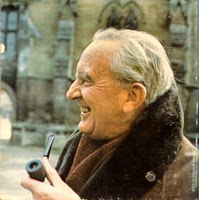
 Elena Maria Vidal features this story on her Tea at Trianon blog: why the Nobel Prize committee passed on J.R.R. Tolkien and instead chose Ivo Andrić in 1961! Now it seems like a very shortsighted choice, and it was my first reaction too. But when I looked at the life and works of Ivo Andrić it made me think twice:
Ivo Andric was born in the village of Dolac, near Travnik, in 1892. After spending his youth in his native Bosnia, which was at the time part of the Austro-Hungarian Empire, he studied philosophy at the Universities of Zagreb, Vienna, and Cracow. His studies were interrupted by the outbreak of the First World War, at the beginning of which he was jailed for his anti-Austrian activities. After receiving a doctorate in letters from the University of Graz in 1923, he entered the Yugoslav diplomatic service. The last diplomatic post he held was that of Yugoslav minister in Berlin. When Germany invaded Yugoslavia in 1941, Andric returned to Belgrade and lived there in seclusion throughout the Second World War. He has continued to reside in the Yugoslav capital.
Andric started his literary career as a poet. In 1914 he was one of the contributors to Hrvatska mlada lirika (Young Croatian Lyrics). At the end of the war he published two books of lyrical prose - one of them entitled Nemiri (Anxieties), 1919 - which, written in the form of a diary, reflect Andric's experiences of the war and his imprisonment. There followed a long period in which Andric concentrated on the writing of short stories. His first novella, Put Alije Djerzeleza (The Trip of Alija Djerzelez), published in 1920, early manifests a dominant trait of his creative process. Andric takes his material from the life of Bosnia, but through this local material he presents universal human problems. In the period between the two world wars Andric published three books of short stories under the same title, Pripovetke (Stories), 1924, 1931, 1936.
During the Second World War, in the leisure imposed on him by the circumstances, Andric wrote his three large works, all of which were published in 1945: Na Drini cuprija (The Bridge on the Drina), Travnicka hronika (Bosnian Story), and Gospodjica (The Woman from Sarajevo).
The first two of these works - both of them chronicles rather than novels in the strict sense - deal, like most of Andric's work, with Bosnia and her history. The author describes the life of this region in which East and West have for centuries clashed with their interests and influences, a region whose population is composed of different nationalities and religions. Andric is at his best when he limits himself to his native Bosnia and her people.
In Gospodjica and Nove pripovetke (New Stories), 1948, Andric presented present-day people and problems. He dealt with the psychology of the wealthy, with the war and postwar periods, and with the formation of a new society. But in Prokleta avilija (Devil's Yard), 1954, Andric returned to his favorite milieu and described the experiences of a Bosnian Franciscan, Fra Peter, who is put in an Istanbul jail, being wrongly accused of plotting against Ottoman rule. In 1960 Andric published another collection of stories, Lica (Faces). He has also written several essays, prominent among which is Zapisi o Goji, (Notes on Goya), 1961.
He also wrote a doctoral dissertation on the effects of Turkish rule on Bosnian spirituality; read more about his works here. Here are two of his poems reflecting on his imprisonment in 1914, translated into English:
1914
In the semi-darkness and silence
Night want of dream, day want of peace.
My soul was lightly forgetting
In a wreath of wounds.
But this morning, with the first rays of the sun
Memory squealed with a horrible voice
And the blood gushed from every wound:
They brought me a jug of water
And for the first time, in horror,
I perceived on the dark water
My image, sunken, pale, and evil.
****************************************
A Promenade
This morning they took me out into the sun.
The masts of some ship behind the wall,
good and satisfying sunny minutes,
and nothing else to be seen.
But just the thought that by that same sun
your glowing paths are also lit -
and like the liquid gold of eyesight
the tears followed in a steady stream.
I closed my eyes.
When I returned, i found my cell
dark and damp, and the guard - with his sword
and a consoling face -
thought, the poor thing, that I was weeping for the sun.
Ivo Andric died on March 13, 1975.
Solid Historical Fiction Background
 I have no idea about the quality of this historical novel as fiction (thriller fiction at that), but the author of The Crown, Nancy Bilyeau, has the right idea about the situation of the nuns who were removed from their convents after the Dissolution of the Monasteries:
One spring day in 1539, twenty-six women were forced to leave their home— the only home most had known for their entire adult lives. The women were nuns of the Dominican Order of Dartford Priory, in Kent. The relentless dissolution of the monasteries had finally reached their convent door. Having no choice, Prioress Joan Vane turned the priory over to King Henry VIII, who had broken from Rome.
What the women would do with their lives now was unclear. Because Dartford Priory surrendered to rather than defied the crown, some monies were provided. Lord Privy Seal Thomas Cromwell, the architect of the dissolution that poured over a million pounds into the royal treasury, had devised a pension plan for the displaced monks, friars and nuns. According to John Russell Stowe’s History and Antiquities of Dartford, published in 1844, Prioress Joan received “66 pounds, 13 shillings per annum.” She left Dartford and was not heard from again—it’s thought she lived with a brother.
Sister Elizabeth Exmewe, a younger, less important nun, received a pension of “100 shillings per annum.” This was the amount that most Dartford nuns received. The roaring inflation of the 1540s meant that such a pension would probably not be enough to live on after a few years—but there was never a question of its being adjusted.
Some of the thousands of monks and friars who were turned out of their monasteries in the 1530s became priests or teachers or apothecaries. But nuns—roughly 1,900 of them at the time of the Dissolution--did not have such options. “Those who had relatives sought asylum in the bosom of their own family,” wrote Stowe with 19th century floridity. Marriage was not an option. In 1539, the most conservative noble, the Duke of Norfolk, introduced to Parliament “the Act of Six Articles,” which forbade ex-nuns and monks from marrying. The act, which had the approval of Henry VIII, became law. The king did not want nuns in the priory but he did not want them to marry either. There was literally no place for them in England.
In his historical novels The King's Achievement and By What Authority?, Monsignor Robert Hugh Benson depicts the impact of the Dissolution of the Monasteries on one English family, as Mary Torridon is evicted from her convent in the former and then lives with her sister and brother-in-law in the latter, still praying her office and observing her religious life as much as possible. In my survey of the English Reformation, I also address the fate of these nuns, with their other option of going into exile on the Continent to join convents or establish convents there, in Supremacy and Survival: How Catholics Endured the English Reformation. When I spoke to the Serra Club (a Catholic lay organization that prays for and assists religious vocations) last November, I mentioned that Henry VIII had denied his people a very personal freedom: discerning a religious vocation and fulfilling God's will that one live in a convent or monastery.
Friday, January 13, 2012
"What's Wrong with the World?" Asks the Eighth Day Institute

With "An Inkling of a Response" from C.S. Lewis, J.R.R. Tolkien, G.K. Chesterton & Co.--while remembering G.K.'s reply to the same question: "I am."
So, while I can't go next week to Fr. Longenecker's conference on English Catholicism in Greenville, South Carolina, I can attend this conference at the end of January here in Wichita, with keynote speaker Ralph Wood from Baylor University:
Ralph C. Wood, University Professor of Theology and Literature at Baylor University in Waco, Texas, holds B.A. and M.A. degrees from Texas A&M University-Commerce, as well as M.A. and Ph.D. degrees from the University of Chicago. From 1971-97 he taught on the faculty of Wake Forest University, in Winston-Salem, North Carolina, where he was the John Allen Easley Professor of Religion. At Baylor, he teaches in both the Great Texts program and the Department of Religion. He serves as an editor-at-large for the Christian Century and as a member of the editorial board of the Flannery O’Connor Review.
His major book, first published in 1988 and still in print from the University of Notre Dame Press, is entitled The Comedy of Redemption: Christian Faith and Comic Vision in Four American Novelists (Flannery O’Connor, Walker Percy, John Updike, and Peter De Vries). He is also the author of Contending for the Faith: The Church’s Engagement with Culture (Baylor, 2003); The Gospel According to Tolkien: Visions of the Kingdom in Middle-earth (Westminster John Knox, 2004); and Flannery O’Connor and the Christ-Haunted South (Eerdmans, 2004).
Also presenting: Warren Farha, Proprietor of Eighth Day Books, Stan Cox, and my friend Jackie Fremin. If you are in the area, please try to attend.
So, while I can't go next week to Fr. Longenecker's conference on English Catholicism in Greenville, South Carolina, I can attend this conference at the end of January here in Wichita, with keynote speaker Ralph Wood from Baylor University:
Ralph C. Wood, University Professor of Theology and Literature at Baylor University in Waco, Texas, holds B.A. and M.A. degrees from Texas A&M University-Commerce, as well as M.A. and Ph.D. degrees from the University of Chicago. From 1971-97 he taught on the faculty of Wake Forest University, in Winston-Salem, North Carolina, where he was the John Allen Easley Professor of Religion. At Baylor, he teaches in both the Great Texts program and the Department of Religion. He serves as an editor-at-large for the Christian Century and as a member of the editorial board of the Flannery O’Connor Review.
His major book, first published in 1988 and still in print from the University of Notre Dame Press, is entitled The Comedy of Redemption: Christian Faith and Comic Vision in Four American Novelists (Flannery O’Connor, Walker Percy, John Updike, and Peter De Vries). He is also the author of Contending for the Faith: The Church’s Engagement with Culture (Baylor, 2003); The Gospel According to Tolkien: Visions of the Kingdom in Middle-earth (Westminster John Knox, 2004); and Flannery O’Connor and the Christ-Haunted South (Eerdmans, 2004).
Also presenting: Warren Farha, Proprietor of Eighth Day Books, Stan Cox, and my friend Jackie Fremin. If you are in the area, please try to attend.
How I Wish I Could Attend!!
 Father Dwight Longenecker promotes this "English Catholicism Day Conference" to be held at his parish church, Our Lady of the Rosary. Joanna Bogle and Joseph Pearce will be the special guests on Saturday, January 21, in a day-long, packed down and overflowing day of presentations, prayer, and fellowship:
8:30 a.m. - Registration and Refreshments
9:00 - Deacon Ballard - Opening Comments - Why English Catholicism is Important for Americans Today
9:15 - Fr Longenecker - Merry Ole' England - Life in the English Middle Ages
9:45 - Joanna Bogle - Feasts and Seasons - How to Celebrate the Catholic Faith English Style
10:30 - Break
10:45 - Joseph Pearce - The Jolly Prophet - The Importance of G.K. Chesterton Today
11:30 - Fr Longenecker - C.S. Lewis and J.R.R.Tolkien - Conversion and Catholicism
12:00 noon - Lunch - Book Signings
12:45 p.m. - Holy Rosary Before the Image of Our Lady of Walsingham
1:15 - Joseph Pearce - Searching for Shakespeare - Was Shakespeare Catholic?
2:00 - Break
2:15 - Joanna Bogle - Catholicism in Tension - The Catholic Church in Britain Today
3:00 - Plenary Session - Questions
3:15 - Deacon Ballard - Closing Comments
3:30 - Departure
4:00 - Confessions, Eucharistic Adoration and Benediction
5:15 - Parish Vigil Mass
9:00 - Deacon Ballard - Opening Comments - Why English Catholicism is Important for Americans Today
9:15 - Fr Longenecker - Merry Ole' England - Life in the English Middle Ages
9:45 - Joanna Bogle - Feasts and Seasons - How to Celebrate the Catholic Faith English Style
10:30 - Break
10:45 - Joseph Pearce - The Jolly Prophet - The Importance of G.K. Chesterton Today
11:30 - Fr Longenecker - C.S. Lewis and J.R.R.Tolkien - Conversion and Catholicism
12:00 noon - Lunch - Book Signings
12:45 p.m. - Holy Rosary Before the Image of Our Lady of Walsingham
1:15 - Joseph Pearce - Searching for Shakespeare - Was Shakespeare Catholic?
2:00 - Break
2:15 - Joanna Bogle - Catholicism in Tension - The Catholic Church in Britain Today
3:00 - Plenary Session - Questions
3:15 - Deacon Ballard - Closing Comments
3:30 - Departure
4:00 - Confessions, Eucharistic Adoration and Benediction
5:15 - Parish Vigil Mass
I would really like to attend, but alas, flights, prices, schedules, and life won't allow it! If you are in the area, you really should go.
Wednesday, January 11, 2012
Blessed William Carter, Dr. Gregory Martin, and a Cloud of Witnesses
 Today's English Catholic martyr's story reveals some of the debates and conflicts between Catholics during the Elizabethan era. The Jesuits and a group of secular or seminary priests called the Appellants disagreed about the divided loyalties of Catholics in England and what they could do about them. You might remember this was an issue brought up in the recent study of St. Margaret Clitherow's martyrdom. Some thought that Catholics could attend Church of England services sometimes: to be part of the only Christian community openly available to them and to avoid the recusancy fines. They would abstain from the Anglican holy communion, ignore Anglican/Reformed preaching, and remain true to Catholic doctrine, sacraments, and devotions. They would certainly be loyal to their queen Elizabeth I in temporal matters but remain true to the Catholic Church in spiritual and religious matters--except that by attending the Church of England services, they paid manifestly public "lip service" to her governance of the Church of England! The Jesuits and others like St. Margaret Clitherow who agreed with them followed the restrictions of Will in Rodgers & Hammerstein's Oklahoma (but without the accent): "With me it's all er nuthin'/Is it all er nuthin' with you?/It cain't be "in between"/It cain't be "now and then"/No half and half romance will do!"
The reason for this background is the title of the book Blessed William Carter printed and for which he was arrested, tortured, and executed: Dr. Gregory Martin's "A Treatise of Schisme: Shewing, that Al Catholikes Ought in Any Wise to Abstaine Altogether From Heretical Conunenticles, to Witt, Their Prayers, Sermons, &c". According to wikipedia, Dr. Gregory Martin (c. 1542 to 28 October 1582)
was an English Catholic scholar, the translator of the Douai Version of the Bible from the Latin Vulgate. In preparing the translation he was assisted by several of the other scholars then living in the English College, Douai, but Gregory Martin made the whole translation in the first instance and bore the brunt of the work throughout.
He was born in Maxfield, parish of Guestling, near Winchelsea, in Sussex, and entered as one of the original scholars of St. John's College, Oxford, in 1557. Among those who entered at the beginning was Edmund Campion, the Jesuit martyr; at this period of his life, he conformed to the Established Anglican Church, and was ordained as a deacon. Gregory Martin was his close friend throughout his Oxford days, and himself remained a Catholic. When he found it necessary to quit the university, he was tutor in the family of the Duke of Norfolk, where he had among his pupils Philip Howard, Earl of Arundel, also subsequently martyred. During his residence with the Duke, Martin wrote to Campion, warning him that he was being led away into danger by his ambition, and begging him to leave Oxford. It is said that it was in great measure due to this advice that Campion migrated to Dublin in 1570, and accepted a post in the university there.
In the meantime, Gregory Martin left the house of the Duke of Norfolk, and crossing the seas, presented himself at Dr. Allen's College at Douai as a candidate for the priesthood, in 1570. During his early days there, he wrote once more to Campion, and they met at Douai, Campion was now a professed Catholic, and he received minor orders and the subdiaconate, after which he proceeded to Rome and eventually entered the Society of Jesus. Having finished his theology, Gregory Martin was ordained priest in March, 1573. Three years later he went to Rome to assist Allen in the foundation of the English College there, known by the title of the "Venerabile".
Martin remained two years, during which time he organized the course of studies at the new college; when he was recalled by Allen to Reims, where the college had moved from Douai in consequence of political troubles. Martin and Campion met for the last time, when the latter made a short stay at Reims in the summer of 1580, on his way to the English Mission. It was during the four years after his return from Rome that Gregory Martin's settled to a Catholic translation of the Bible. The Reformers continually quoted their versions; Allen wanted to meet them on their own ground. He determined to attempt the work at his college, and deputed Martin to undertake the translation. Thomas Worthington, Richard Bristowe, William Rainolds, and Allen himself were to assist in revising the text and preparing suitable notes to the passages which were most used by the Protestants. It was accuracy of rendering which was chiefly needed by the controversial exigencies of the day.
Martin's translation was made from the Vulgate, and is full of Latinisms, so that it has little of the rhythmic harmony of the Anglican Authorized Version: but in accuracy and scholarship, it was superior to the English versions which had preceded it, and it is understood to have had influence on the translators of King James's Version. In many cases in which they did not follow the Douai, the editors of the Revised Version have upheld Martin's translation. The Reims New Testament first appeared in 1582. The Old Testament was not published till more than a quarter of a century later. This, however, was solely due to want of funds. It was not called for with such urgency, and its publication was put off from year to year. But it was all prepared at the same time as the New Testament, and by the same editors. Martin was found to be in consumption. In the hope of saving his life, Allen sent him to Paris, but the disease was past cure. He returned to Reims to die, and he was buried in the parish church of St. Stephen. Allen preached the funeral discourse, and erercted a long Latin inscription on the tomb of his friend.
The following is a list of Martin's works:
"Treatise of Schisme" (Douai, 1578)
"Discovery of the Manifold Corruptions of the Holy Scripture by the Heretikes of our Daies" (Reims, 1582)
Reims Testament and Douay Bible
"Treatise of Christian Peregrination" (Reims, 1583)
"Of the Love of the Soul" (St. Omer, 1603)
"Gregorius Martinus ad Adolphum Mekerchum pro veteri et vera Græcarum Literarum Pronunciatione" (Oxford, 1712)
Today's martyr, Blessed William Carter was born in London, 1548; suffered for treason at Tyburn on 11 January 1584. Son of John Carter, a draper, and Agnes, his wife, he was apprenticed to John Cawood, queen's printer, on Candlemas Day, 1563, for ten years, and afterwards acted as secretary to Nicholas Harpsfield, last Catholic archdeacon of Canterbury, then a prisoner. Note that Harpsfield wrote an early biography of Thomas More, left England during the reign of Edward VI for Louvain, returned during the reign of Mary I and participated in heresy trials, and finally, opposed the ordination of Matthew Parker as Archbishop of Canterbury, for which he was imprisoned in the Fleet with his brother John. Therefore, William Carter was very brave, associating with an imprisoned cleric who had refused the Oath of Supremacy!
When Harpsfield died (after release from prison on grounds of ill health) Carter married and set up a press on Tower Hill. Among other Catholic books he printed a new edition (1000 copies) of Dr. Gregory Martin's "A Treatise of Schisme", in 1580, for which he was at once arrested and imprisoned in the Gatehouse. Before this he had been in the Poultry Compter--a small prison run by a Sheriff in the City of London--from 23 September to 28 October 1578. He was transferred to the Tower, 1582, and paid for his own diet there down to midsummer, 1583. Having been tortured on the rack, he was indicted at the Old Bailey--the central criminal court in England—on 10 January 1584, for having printed Dr. Martin's book, in which was a paragraph where confidence was expressed that the Catholic Hope would triumph, and a pious Judith would slay Holofernes. This was interpreted as an incitement to slay the queen. His wife died while he was in prison.
He was beatified in 1987 by Blessed Pope John Paul II.
Printing 1000 copies of Martin's book?--that seems a considerable press run. Evidently he knew there were customers for that book. Carter was a well-to-do man, as he was able to pay for his room and board in prison for perhaps a year. The government tortured him to discover names of any "Judiths" out there ready to behead "Holofernes"--if they had found any evidence of a conspiracy they would have used better evidence than the interpretation of a certain line in a book! But that was the atmosphere of fear and suspicion at that time.
Tuesday, January 10, 2012
"Once I Was a Clever Boy" on Archbishop Laud
 John Whitehead on this blog discusses execution of William Laud, Archbishop of Canterbury on January 10, 1645:
Archbishop William Laud was judicially murderd by the Long Parliament on January 10th 1645. It is in no way unreasonble to see him as a martyr, although officially the Church of England has never recognised him as such - I don't think he made it to the rather curious calendar contained in Common Worship in 2000. [N.B.: St. Mary's the Virgin at Oxford did include him on the plaque honoring the "Reformation" martyrs, Catholic, Puritan, and Anglican.]
He has, of course, always been esteemed by High Anglicans. Whether he can really be classed as an Anglo-Catholic is open to debate. I think he is more what one would term a High Anglican or a Catholic Anglican, and believed in the branch theory. His Arminian (if that is what it was) base does not, I think, quite follow on from the Elizabethan Church Papists, although I am not sufficiently versed in the subject to make a definite assertion as to the influences that formed him. He did of, of course, belong to St John's College, here in Oxford, which had strong Papistical inclinations stemming from its founder Sir Thomas White. . . .
Lord "Power Corrupts" Acton Born
 John Emerich Edward Dalberg-Acton was born on 10 January 1834--much of what I know of Lord Acton is in his connections with John Henry Newman, The Rambler magazine, and the issues of Papal Infallibility at the First Vatican Council. He was very much opposed to ultramontanism, with its emphasis on the authority and the powers of the Pontiff. Acton always opposed the centralization of power, it seems--even supporting the Confederacy over the Union in the American Civil War for the sake of states' rights.
 (I know he did not say that "power corrupts" but that "power tends to corrupt".)
Lord Acton seems to have been such a brilliant and knowledgable historian that he was not able really to write a sustained work that matched his genius, at least according to Hugh Chisholm: "Lord Acton has left too little completed original work to rank among the great historians; his very learning seems to have stood in his way; he knew too much and his literary conscience was too acute for him to write easily, and his copiousness of information overloads his literary style. But he was one of the most deeply learned men of his time, and he will certainly be remembered for his influence on others."
The Acton Institute provides some interesting links to works by and about Lord Acton here, including his great unfinished work on the History of Freedom.
Subscribe to:
Posts (Atom)