Showing posts with label Salisbury Cathedral. Show all posts

Saturday, September 23, 2017

John Jewel, RIP and His "Apologia"

John Jewel was the Anglican bishop of Salisbury; born on May 24, 1522, he died on September 23, 1571.

His most famous work is The Apology of the Church of England which was originally written in Latin with the title Apologia pro ecclesia Anglicana, as this introduction to the work, posted at Project Canterbury, reminds us:

The great interest of Jewel's "Apology" lies in the fact that it was written in Latin to be read throughout Europe as the answer of the Reformed Church of England, at the beginning of Queen Elizabeth's reign, to those who said that the Reformation set up a new Church. Its argument was that the English Church Reformers were going back to the old Church, not setting up a new; and this Jewel proposed to show by looking back to the first centuries of Christianity. Innovation was imputed; and an Apology originally meant a pleading to rebut an imputation. So, even as late as 1796, there was a book called "An Apology for the Bible," meaning its defence against those who questioned its authority. This Latin book of Jewel's, Apologia Ecclesiae Anglicanae--written in Latin because it was not addressed to England only--was first published in 1562, and translated into English by the mother of Francis Bacon, whose edition appeared in 1564. That is the translation given in this volume. The book has since had six or seven other translators, but Lady Ann Bacon's translation was that which presented it in Queen Elizabeth's time to English readers, and it had the advantage of revision by the Queen's Archbishop of Canterbury, her coadjutor in the establishment of the Reformed Church of England, Matthew Parker. It was published, with no name of author or translator on the title-page, as "An Apologie or answere in defence of the Churche of Englande, with a briefe and plaine declaration of the true Religion professed or used in the same." The book was prefaced by a letter, "To the right honorable learned and vertuous Ladie, A. B." [Ann Bacon] "M. C. wisheth from God grace, honoure, and felicitie," where M. C. signifies Matthew Cantuar, Matthew Parker, Archbishop of Canterbury, whom Lady Ann Bacon had made her judge, and whose judgment, the letter says, her book had singularly pleased.

Lady Ann Bacon was the second daughter of Sir Anthony Cooke, who was tutor to King Edward VI. Sir Anthony gave to his five daughters a most liberal education. His eldest daughter, Mildred, married Sir William Cecil, afterwards Lord Burleigh, while Ann became the second wife of the Lord Keeper, Sir Nicholas Bacon. Their father had made Mildred and Ann two of the most learned women in England.

John Jewel was forty years old when he wrote the "Apology." He was born in Devonshire in 1522, on the 24th of May, at the village of Buden, near Ilfracombe. He studied at Oxford, where he became tutor and preacher, graduated as B.D. in 1551, and was presented to the rectory of Sunningwell. At the accession of Queen Mary he bowed to the royal authority, but he was a warm friend and disciple of Peter Martyr, who had come to England in 1547, at the invitation of Edward VI., to take the chair of Divinity at Oxford. On the accession of Queen Mary, Peter Martyr (who was born at Florence in 1500, and whose family name was Vermigli) returned to Strasburg, and went thence to Zurich, where he died in 1562. Jewel, repenting of his assent to the new sovereign's authority in matters of religion, followed his friend Peter Martyr across the water, and became vice-master of a college at Strasburg. Upon the accession of Elizabeth, in 1588 (sic, should be 1558), Jewel came back, and he was one of the sixteen Protestants appointed by the Queen to dispute before her with a like number of Catholics.

In 1559 John Jewel was appointed a commissioner for securing, in the West of England, conformity with the newly-arranged Church service, and he had to see that the Queen's orders were obeyed in the churches of his native county. Before the end of the same year he was consecrated Bishop of Salisbury. He was most zealous in performance of all duties of his charge. To his good offices young Richard Hooker owed his opportunity of training for the service of the Church. Among Jewel's writings, this Apology or Defence of the Church of England was the most important; but he worked incessantly, and shortened his life by limiting himself to four hours of sleep, taken between midnight and four in the morning. Bishop Jewel died on the 21st of September, 1571 (sic, other sources concur on September 23), before he had reached the age of fifty.

His Apologia did not go without a response: Thomas Harding, who had been the treasury of Salisbury, debated with Jewel on Anglican doctrines and its sources. The Catholic Encyclopedia has this entry:

Controversialist; b. at Combe Martin, Devon, 1516 d. at Louvain, Sept., 1572. The registers of Winchester school show that after attending Barnstaple school he obtained a scholarship there in 1528, being then twelve years old. If this information be correct, he was three years younger than is commonly stated. He went to New College, Oxford, in 1534, was admitted a Fellow in 1536, and took his Master's degree in 1542, in which year he was appointed Hebrew professor by Henry VIII. Having been ordained priest he became chaplain to Henry Grey, Marquess of Dorchester and afterwards Duke of Suffolk. He at first embraced the Reformed opinions, but on the accession of Mary he declared himself a Catholic, despite the upbraidings of his friend Lady Jane Frey, and the events of his later life proved his sincerity. In 1554 he took the degree of Doctor of Divinity and was appointed prebendary of Winchester, becoming treasurer of Salisbury in the following year. He also acted as chaplain and confessor to Bishop Gardiner. When Elizabeth became queen he was deprived of his preferments and imprisoned (Sander, "Report to Cardinal Moroni"). Subsequently he retired to Louvain to escape persecution. There he served St. Gertrude's church and devoted himself to study and to his long controversy with Jewel, the Bishop of Salisbury and champion of Protestantism.

In 1564 he published "An answere to Maister Juelles Challenge", Jewel having undertaken to conform to the Catholic Church if any Catholic writer could prove that any of the Fathers of six centuries taught any of twenty-seven articles he selected. Jewel replied first in a sermon (which Harding answered in a broadsheet "To Maister John Jeuell", printed at Antwerp in 1565) and then in a book. Against the latter Harding wrote "A Rejoindre to M. Jewel's Replie" (Antwerp, 1566) and "A Rejoindre to M. Jewel's Replie against the Sacrifice of the Mass" (Louvain, 1567). Meanwhile he had become engaged in a second controversy with the same author, and, in his confutation of a book entitled an "Apologie of the Church of England" (Antwerp, 1565), he attacked an anonymous work, the authorship of which Jewel admitted in his "Defence of the Apologie of the Churche of Englande". Harding retorted with "A Detection of Sundrie Foule Errours, Lies, Sclaunders, corruptions, and other false Dealinges, touching Doctrine and other matters uttered and practized by M. Jewel" (Louvain, 1568). In 1566 Pius V appointed Harding and Dr. Sander Apostolic delegates to England, with special powers of giving faculties to priests and of forbidding Catholics to frequent Protestant services. Harding was of great assistance to his exiled fellow-countrymen and to Dr. Allen in founding the English College at Douai. He was buried (16 Sept., 1572) in the Church of St. Gertrude, Louvain.

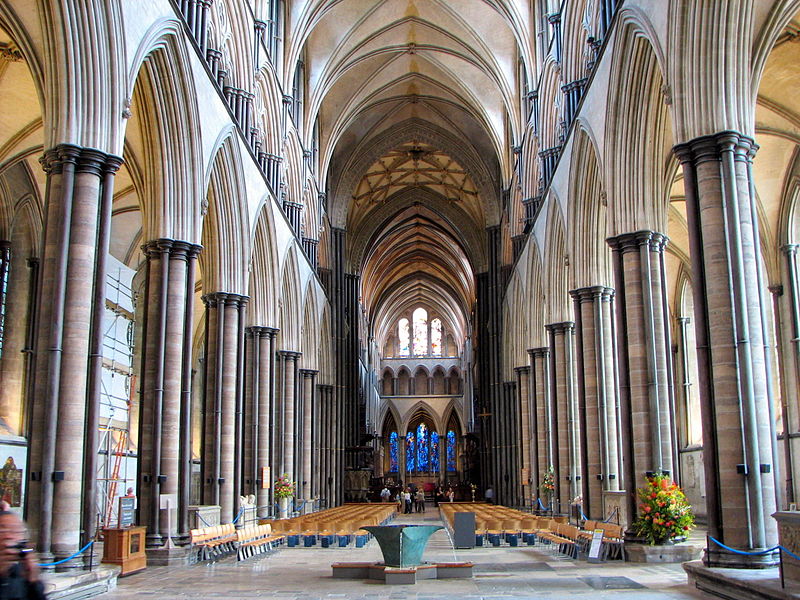
Image Credit of Salisbury Cathedral photograph from Wikipedia Commons.

Friday, September 6, 2013

The English Reformation at Salisbury Cathedral


Salisbury Cathedral will host a Winter Lecture Series focused on the English Reformation and how it transformed the church in England:

Salisbury Cathedral’s Winter Lecture series, which runs from October 2013 – March 2014, focusses (sic) on the Reformation and immediate post-Reformation period when the church in England developed into a uniquely national church. The six eminent speakers will explore different aspects of what happened and why. The final lecture, which takes place in Lent, will consider Easter, looking at the Biblical authority for the festival and how the modern church will be celebrating the events of Holy Week.

The series begins on Friday 18 October with Trevor Cooper describing What happened to English parish churches after the Reformation? On Monday 18 November Giles Mandelbrote speaks on The Making of the English Bible. On Tuesday 7 January Tim Tatton-Brown discusses Salisbury Cathedral and the Reformation – the architectural changes. The lecture on Tuesday 25 February has Timothy Hone looking at Reformation Music and all who attend this lecture are invited to attend Evensong at 5.30pm during which the music will link with the lecture. The series ends on Tuesday 25 March with David Catchpole and Tom Clammer exploring Easter: the biblical tradition and the modern liturgy.

The Cathedral's news release for the series contains some great details about each lecture, for example:

Reformation Music - Timothy Hone Timothy Hone explores the changing religious positions of the sixteenth and early seventeenth centuries, and considers the musical developments which occurred, not just in the context of the Chapel Royal, but to see what might have happened in the provincial cathedrals and at Salisbury in particular. We will see how two extreme positions, during the reigns of Edward VI and Mary, found a balance during the reign of Elizabeth I. In particular, we will look at the music of Tallis and Byrd whose compositions reveal a conflict between their public music for the Anglican rite and their own private faith, revealed in much of their music with Latin texts.
Timothy Hone came to the Department of Liturgy and Music at the Cathedral after 25 years as a Cathedral musician. His interest in the relationship between music and liturgy began as an undergraduate when his dissertation on the Laudian revival at Peterhouse, Cambridge (where he was Organ Scholar) was awarded the William Barclay Squire Prize. He uses insights from his practical experience to put research into context, combining insights from a number of academic approaches.


The first speaker, Trevor Cooper, is with an organization looking at the past, present, and future of churches in England, including concerns about how historic Anglican churches (many of which were once Catholic churches) can be maintained as congregations decline.

This looks like a fascinating series. The lecture I chose to highlight would be my choice to attend, with Choral Evensong of Tallis and Byrd selections.

Image credit: wikipedia commons.

Sunday, June 9, 2013

Constable's "Salisbury Cathedral from the Meadows"--"Dangers Past"?

Richard Cork writes about John Constable's 1829 painting of "Salisbury Cathedral from the Meadows" in this weekend's The Wall Street Journal:

Widely admired by John Constable's friends as his finest painting, "Salisbury Cathedral From the Meadows" has now been saved for the U.K., bought from the children of the late Barclays Bank director Lord Ashton of Hyde. The price with tax concessions amounts to £23.1 million ($35.5 million), and the rescue package includes £15.8 million from the Heritage Lottery Fund. This dramatic canvas, now on view at Tate Britain, will travel among several major museums across the U.K.

Unlike Constable's spirited little oil sketches, the Salisbury Cathedral painting is a large, carefully designed and vigorously handled canvas he worked on for several years. When exhibited at the Royal Academy in 1831, it was accompanied by a quotation from James Thomson's poem "Summer," which refers to a "danger past" before describing how "a glittering robe of joy…invests the fields and nature smiles revived." Yet the painting is far from joyful; it is one of Constable's most turbulent images. . . .

Devoted to the Anglican Church, Constable was worried about its future. So Salisbury Cathedral is not allowed to dominate this painting in a smug, triumphant way. The largest form confronting us here is the ancient tree on the left, and it seems shaken by the impact of the storm. It may even be in danger of falling into the impenetrable darkness beyond, where a small church tower and houses look threatened by the black sky.

No wonder the dog isolated in the muddy foreground stares back at this tree. It must be wondering where the storm will strike next. Lightning flashes to the left of the cathedral spire, and the man in the wooden cart looks hunched, as if bracing himself for another apocalyptic downpour. The three horses pulling his cart through the water appear burdened by their task. Directly behind the cart, a tiny cottage is being smothered by a tangle of foliage growing over its vulnerable white wall and orange roof. As for the withered stump of a willow on the far right, it is perilously close to the water's edge.

And what were the dangers faced by the Anglican Church in 1829, that Constable should depict such a great Gothic cathedral under a cloud? Catholic Emancipation, of course. Compare the 1829 image of the cathedral (at the WSJ site) to this 1825 view, in which the cathedral is much more substantial (even though the cows in the foreground are a little distracting):

 
This painting of "Salisbury Cathedral from the Bishop's Grounds", features the current Bishop of Salisbury, John Fisher and his wife on the left--the bishop commissioned the painting and then requested a copy with a brighter sky behind the cathedral.

Sunday, December 11, 2011

The Cathedral Church of the Blessed Virgin Mary

In the octave of the Feast of the Immaculate Conception and since St. Osmund of Salisbury's feast day was last Sunday (replaced by the Second Sunday of Advent, of course), it's a good idea to look at Salisbury Cathedral in the Sunday Shrine Series. Built from 1220 to 1258, it is one of those unusual cathedrals that has a unified style: Early English Gothic. Many cathedrals display a series of styles from Norman to Early Gothic to Pointed and Flamboyant, but Salisbury has only one style, which of course has been repaired and restored through the years.

It is from Salisbury that we have received the Sarum Rite, attributed in this Catholic Herald article to St. Osmund of Salisbury, William the Conqueror's Chancellor:

St Osmund (d 1099) was chaplain and then chancellor to William the Conqueror after the Norman Conquest.

If, however, his early career was dedicated principally to secular affairs, there is no question of his devotion to religion in the latter part of his life as Bishop of Salisbury.

A monk at Malmesbury called him “an orthodox bishop, a man of humility, worthy to be honoured and praised for his wisdom and holiness”.

Osmund has been held responsible for the introduction of the Sarum Rite, based on Norman models. With its elaborate attention to ceremony and its particular prayers, this Rite was widely used in southern England, Wales, Scotland and even in parts of Ireland until formally abolished by Elizabeth in 1559. Its influence, however, may still be detected in the Anglican Book of Common Prayer.


This program from a concert held earlier this year at New York City's Episcopalian Trinity Church, however, mentions Richard Poore, the Bishop of Salisbury who began the construction of The Cathedral Church of the Blessed Virgin Mary in 1220, as an important person in the development of the Sarum Rite:

In 1220, Richard Poore, the bishop of Salisbury, began the construction of a spectacular new cathedral for his diocese. He called it “The Cathedral Church of the Blessed Virgin Mary,” known and loved today as Salisbury Cathedral.

Aside from overseeing the early years of the construction of the cathedral, Bishop Poore also devoted himself to enriching and documenting the liturgy to be carried out within it, weaving architecture and liturgy into a single fabric. Poore wrote two new volumes detailing the liturgical practice at Salisbury, the Ordinale and Consuetudinarium (which spelled out the ceremonial he planned) that carried over and elaborated on liturgical customs of the past.

Within decades, this “Sarum Use” (“Sarum” is derived from “Sarisburia,” the name the Domesday Book (1086) gives to Salisbury) had become renowned for its splendor, complexity, and —dare one say?— The polyphonic embellishments to this gorgeous ceremonial—seldom performed in church today— are some of the most exquisite beauties of any age.


More about Salisbury Cathedral from the official website, including detail about Ken Follett's novel Pillars of the Earth.

Image source.