Showing posts with label Fasting a Source of Trial. Show all posts

Friday, February 25, 2022

Preview: "Fasting a Source of Trial" on the Son Rise Morning Show

On Monday, February 28, we'll continue our discussions of seasonal sermons of Saint John Henry Newman, now moving into the Season of Lent, which starts on Ash Wednesday, March 2, on the Son Rise Morning Show. We'll be on the air at my usual time, about 6:50 a.m. Central/7:50 a.m. Eastern time. Please listen live on EWTN Radio or on your local EWTN affiliate.

Since Pope Francis has urged us to fast and pray for peace in Ukraine (for Russia to cease waging war against the people and government of Ukraine), it seems appropriate to focus on fasting with one of Newman's Parochial and Plain Sermons, "Fasting a Source of Trial", which Newman preached on the First Sunday of Lent, March 4, 1838.

The gist of the sermon is: 
  • Jesus fasted for 40 days in the desert after His Baptism by John in the Jordan; 
  • we imitate Him when we observe Lent for 40 days; 
  • fasting is hard; 
  • we may face some temptations when we fast but that doesn't mean we shouldn't fast;
  • we can only fast through God's grace; we cannot rely solely on our will and human effort
  • the example of Jesus and God's promises to protect us from sin and death should comfort us.

"And when He had fasted forty days and forty nights, He was afterward an hungered." Matt. 4:2.

Distinguishing between Our Lord's Fast in the Desert and our Lenten penitence, which includes fasting, Newman begins the sermon, emphasizing that Love must inspire our fasting and penitence:

THE season of humiliation which precedes Easter lasts for forty days in memory of our Lord's long fast in the wilderness. . . . We fast by way of penitence, and in order to subdue the flesh. Our Saviour had no need of fasting for either purpose. His fasting was unlike ours, as in its intensity, so in its object. And yet when we begin to fast, His pattern is set before us; and we continue the time of fasting till in number of days we have equaled His.

There is a reason for this: we must do nothing except with Him in our eye. As He it is, through whom alone we have the power to do any good thing, so unless we do it for Him it is not good. From Him our obedience comes, towards Him it must look. He says, "Without Me ye can do nothing." [John 15:5.] No work is good without grace and without love. . . .

Even in our penitential exercises, Christ has gone before us to sanctify them to us. He has blessed fasting as a means of grace, in that He has fasted; and fasting is only acceptable when it is done for His sake. Penitence is mere formality, or mere remorse, unless done in love. If we fast without uniting ourselves in heart to Christ, imitating Him, and praying that He would make our fasting His own, would associate it with His own, and communicate to it the virtue of His own . . . [then] we beat the air and humble ourselves in vain.

Newman acknowledges that fasting is harder for some than it is for others and does not always or immediately produce the effect we want it to in our spiritual lives:

And this is singularly the case with Christians now, who endeavour to imitate Him; and it is well they should know it, for else they will be discouraged when they practice abstinences. It is commonly said, that fasting is intended to make us better Christians, to sober us, and to bring us more entirely at Christ's feet in faith and humility. This is true, viewing matters on the whole. On the whole, and at last, this effect will be produced, but it is not at all certain that it will follow at once. On the contrary, such mortifications have at the time very various effects on different persons, and are to be observed, not from their visible benefits, but from faith in the Word of God. Some men, indeed, are subdued by fasting and brought at once nearer to God; but others find it, however slight, scarcely more than an occasion of temptation. For instance, it is sometimes even made an objection to fasting, as if it were a reason for not practising it, that it makes a man irritable and ill-tempered. I confess it often may do this.

Fasting and abstinence can make it hard to pray and can even be a source of temptation to sin. Newman explores the mystery of this trial/temptation, citing the desert fathers and perhaps alluding to Saint Anthony the Great:

It is undeniably a means of temptation, and I say so, lest persons should be surprised, and despond when they find it so. And the merciful Lord knows that so it is from experience; and that He has experienced and thus knows it, as Scripture records, is to us a thought full of comfort. I do not mean to say, God forbid, that aught of sinful infirmity sullied His immaculate soul; but it is plain from the sacred history, that in His case, as in ours, fasting opened the way to temptation. And, perhaps, this is the truest view of such exercises, that in some wonderful unknown way they open the next world for good and evil upon us, and are an introduction to somewhat of an extraordinary conflict with the powers of evil. Stories are afloat of hermits in deserts being assaulted by Satan in strange ways, yet resisting the evil one, and chasing him away, after our Lord's pattern, and in His strength; and, I suppose, if we knew the secret history of men's minds in any age, we should find a remarkable union in the case of those who by God's grace have made advances in holy things, a union on the one hand of temptations offered to the mind, and on the other, of the mind's not being affected by them, not consenting to them, even in momentary acts of the will, but simply hating them, and receiving no harm from them. So far persons are evidently brought into fellowship and conformity with Christ's temptation, who was tempted, yet without sin.

[Saint Anthony, as described by Saint Athanasius of Alexandria (Newman's great hero) once endured a tremendously violent temptation by a host of demons. After he had fought them off, God came to his aid. Anthony asked Him where He'd been during the temptation and God told him He was with Anthony all the time, sustaining him!]

So Newman concludes from those examples that when we fast, we must rely on Jesus and take comfort in thoughts of His fast and temptation in the desert:

Let it not then distress Christians, even if they find themselves exposed to thoughts from which they turn with abhorrence and terror. Rather let such a trial bring before their thoughts, with something of vividness and distinctness, the condescension of the Son of God. For if it be a trial to us creatures and sinners to have thoughts alien from our hearts presented to us, what must have been the suffering to the Eternal Word, God of God, and Light of Light, Holy and True, to have been so subjected to Satan, that he could inflict every misery on Him short of sinning? . . . 

[One has gone] before us more awful in His trial, more glorious in His victory. He was tempted in all points "like as we are, yet without sin." (Hebrews 4:15) Surely here too, Christ's temptation speaks comfort and encouragement to us.

Newman cites Psalm 91: "He shall give His Angels charge over Thee, to keep Thee in all Thy ways" and "A thousand shall fall beside Thee, and ten thousand at Thy right hand, but it shall not come nigh Thee" as reminders that "we have nothing to fear while we remain within the shadow of the throne of the Almighty."

Then he offers this final encouragement:

Therefore let us be, my brethren, "not ignorant of their devices (2 Cor 2:11);" and as knowing them, let us watch, fast, and pray, let us keep close under the wings of the Almighty, that He may be our shield and buckler. Let us pray Him to make known to us His will,—to teach us our faults,—to take from us whatever may offend Him,—and to lead us in the way everlasting. And during this sacred season, let us look upon ourselves as on the Mount with Him—within the veil—hid with Him—not out of Him, or apart from Him, in whose presence alone is life, but with and in Him—learning of His Law with Moses, of His attributes with Elijah, of His counsels with Daniel—learning to repent, learning to confess and to amend—learning His love and His fear—unlearning ourselves, and growing up unto Him who is our Head.

Saint John Henry Newman, pray for us!
Saint Anthony of the Desert, pray for us!
Saint Athanasius of Alexandria, pray for us!

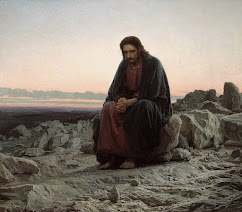
Image Credit (public domain): Christ in the Wilderness by Ivan Kramskoy, 1872.
Image Credit (public domain): The Temptation of Saint Anthony, 1487–88, by the young Michelangelo, copying Martin Schongauer's engraving

Sunday, February 21, 2021

Happy Birthday to Saint Newman; New Edition of "Anglican Difficulties"

Today is the 220th anniversary of Saint John Henry Newman's birth in the City of London. Our local Lovers of Newman group will meet this afternoon and read together (out loud) a Parochial and Plain Sermon: "Fasting a Source of Trial". We will, however, also celebrate his 220th birth anniversary with a cake: a red velvet cake (appropriate for a Cardinal I think), so our fasting won't be that much of a trial!

"And when He had fasted forty days and forty nights, He was afterward an hungered." Matt. iv. 2.

THE season of humiliation, which precedes Easter, lasts for forty days, in memory of our Lord's long fast in the wilderness. Accordingly on this day, the first Sunday in Lent, we read the Gospel which gives an account of it; and in the Collect we pray Him, who for our sakes fasted forty days and forty nights, to bless our abstinence to the good of our souls and bodies.

We fast by way of penitence, and in order to subdue the flesh. Our Saviour had no need of fasting for either purpose. His fasting was unlike ours, as in its intensity, so in its object. And yet when we begin to fast, His pattern is set before us; and we continue the time of fasting till, in number of days, we have equalled His.

There is a reason for this;—in truth, we must do nothing except with Him in our eye. As He it is, through whom alone we have the power to do any good {2} thing, so unless we do it for Him it is not good. From Him our obedience comes, towards Him it must look. He says, "Without Me ye can do nothing." [John xv. 5.] No work is good without grace and without love. . . .

I also have news of a volume being added to the Newman Millennium Edition: his lectures on Anglican Difficulties from Gracewing Publishers:

Originally published in 1850 and revised in 1876, John Henry Newman's
Lectures on Difficulties Felt by Anglicans in Submitting to the Catholic Church is a series of twelve talks that the convert gave at the London Oratory in King William Street before an audience of Catholics, Anglo-Catholics, Protestants and intrigued sceptics. The stated purpose of the talks might have been "to clear away from the path of an inquirer objections to Catholic truth," especially Anglo-Catholic inquirers, but the book is also a witty meditation on the Church and the World, a ruthlessly satirical study of the Oxford Movement, or what Newman called "the Movement of 1833"; an autobiographical dress rehearsal for the Apologia pro Vita Sua; and a piece of masterly prose. Richard Holt Hutton, Newman's finest contemporary critic regarded it as marked "in manner and style... by all the signs of his literary genius... the first of his books... in which the measure of his literary power could be adequately taken."

Neglected for over a century by many who regarded its hard-hitting criticism of the National Church of England as unforgivable, the book can now be seen as profoundly cautionary. If one of its animating themes is to show how worldly establishments travesty "the Ark of Salvation," Newman's
Anglican Difficulties has perennial appeal. Indeed, it is an anatomy of the false and brazen things that lie at the heart of all such establishments.

This is the first critical edition of the book to include an editor's introduction with an overview and summaries of the lectures, the book's critical reception, a definitive text of the 1876 edition, textual variants, annotations explicating the text's historical, theological, and literary references, and a comprehensive index.

“Edward Short's critical edition of Anglican Difficulties sheds fascinating new light on John Henry Newman's lectures of 1850. This is a lively, well-researched, well-written edition, which all faithful readers of Newman will enjoy." – Ian Ker, author of
John Henry Newman: A Biography (1988)

The Editor, Edward Short, sent me a link to this excerpt from his introduction to this volume, explaining why it is an important book today, and not just as an example of Newman's great skill and style as a writer:

. . . First and foremost, it is a far-ranging meditation on one of Newman's most abiding and insistent themes, the Church and the World, a theme which he would take up not only in his sermons but in Arians of the Fourth Century (1832), An Essay on the Development of Christian Doctrine (1845), Loss and Gain (1847), Callista (1850), and The Idea of a University (1875). It is a reaffirmation of the unity of the Church. It is an inquiry into the varieties of Erastianism, which, as Newman shows, presents a continual threat to the integrity of the Church's unique mission in the world.

It is a meditation on the nature of history, proof that the best historians are not always those who call themselves historians. "History is at this day undergoing a process of revolution; the science of criticism, the disinterment of antiquities, the unrolling of manuscripts, the interpretation of inscriptions, have thrown us into a new world of thought," Newman wrote in Lecture V, "characters and events come forth transformed in the process; romance, prejudice, local tradition, party bias, are no longer accepted as guarantees of truth; the order and mutual relation of events are readjusted; the springs and the scope of action are reversed."

Please read the rest there.

Short has also promised me a review copy!

Happy birthday, Saint John Henry Newman--and pray for us!