Sunday, May 11, 2014

Stations of the Cross in the Easter Season

The Church of the Blessed Sacrament recently acquired and restored a set of Stations of the Cross that had once been in the Cathedral of the Immaculate Conception here in Wichita, Kansas. Some parishioners hung them in the church on Friday last week and I went to pray the Stations of the Cross that afternoon. They replaced a set of stations that depicted just the face of Jesus at each station--so where before we had a rather minimalist interpretation of the Way of the Cross, now we have a set of dramatic vignettes. These new/old stations show each scene with Jesus at the center, of course, but with many other characters in the background or the foreground.

After I prayed the Stations, I went back around to take some pictures in the available light of the late afternoon (in a church on a north/south axis) with my husband's Canon S95. The pictures that turned out best, because of the angle at which I was taking them (perhaps four feet above my head), were those in which I zoomed in on a portion of the scene. As I viewed and re-viewed these stations, I noticed these details. From the Seventh Station: Jesus Falls the Second Time, see the dog growling at Jesus:

 
This was in the darkest part of the church in the late afternoon so it's a little grainy. From the Eighth Station: Jesus Meets the Women of Jerusalem: He stretches out His hand in blessing even as the soldiers are moving on from this meeting:


The sky in the background of the Tenth Station, Jesus is Stripped of His Garments, is beautiful:


Notice the argument beginning over Pilate's sign to be placed above Jesus on the Cross (do not say that "He is King of the Jews"; say that "He Said He was King of the Jews"--and Pilate's reply, What I have written, I have written) in the background of the Eleventh Station as Jesus is Nailed to the Cross:


Joseph of Arimathea and Nicodemus consult in the background as the Blessed Virgin Mary, St. John, and St. Mary Magdalen mourn the death of Jesus in the Deposition station (the Thirteenth Station):

 
I think these Stations of the Cross complement the stained glass windows above them which depict different parables from the Gospels. The general style of garments and the colors in both the windows and the paintings match well.
 
It can seem strange to pray the Stations of the Cross and meditate on Christ's Passion and Death during the Easter Season, but it is true that without Good Friday there can be no Easter Sunday and without Easter Sunday, Good Friday has no meaning or purpose. Throughout the Easter Season, the readings from the Acts of the Apostles describe how St. Peter and the Apostles, and St. Paul preach how Jesus was crucified, died, and rose from the dead--and is alive, the Savior of the world!

Friday, May 9, 2014

The Tsar's Four Daughters: OTMA

During David Lean's epic Doctor Zhivago, the doctor/poet and his family escape the city for their country estate (but have to live in the servant's quarters because the local Communist organization has claimed the manor house for the People and the Party). They receive a newspaper with the story about the execution of the Tsar and his entire family and wonder why all of them had to die. Doctor Zhivago states that because it makes it clear there's no going back.

I have read and re-read Helen Rappaport's recounting of the last days of the family at Ekaterinburg and the eventual discovery of their bodies, confirmation of their DNA matches, and canonization as martyrs in the Russian Orthodox Church. In fact, it was the depth of religious feeling that Rappaport uncovered in the family, and in the four daughters especially, that impressed me. Rappaport tells the story of how the family attended their final Divine Liturgy; the priest who sang the service recounted an extraordinary event and changes in the family:

According to the liturgy governing a low Mass, at a determined moment, the following prayer must be read: May the souls of the departed rest in peace with Thy saints. I do not know why he did it, but my deacon, instead of merely reading the prayer, began to chant it. [This prayer is never sung except at funerals.] I followed suit, though somewhat irritated at his violation of the canons. We had barely begun when we heard, behind us, the noise of the whole imperial family throwing themselves on their knees.... At the end of the service they all approached to kiss the Cross and the deacon gave the Blessed Bread to both Emperor and Empress.... The deacon and I left in silence.... Suddenly, in front of the School of Fine Arts, the deacon said to me, Do you know, something has happened to them. As his words corresponded exactly to what I was, thinking, I stopped and asked him why he thought so. I am sure, he said; they seem so changed, and not one of them sang today. He was right, because for the first time, on July 14, not one of the Romanovs accompanied us by singing.

In her new book, Four Sisters: The Lost Lives of the Romanov Grand Duchesses, Helen Rappaport focuses on Olga, Tatiana, Maria, and Anastasia, the young women who were horribly murdered in the cellar at Ekaterinburg on July 7, 1918. The author was interviewed in the April issue of the BBC History Magazine and commented on how devoutly Christian the four sisters were.

From the author's website:

The four captivating young Romanov sisters were perhaps the most photographed and talked about young royals of the early twentieth century. And with good reason; they were much admired for their happy dispositions, their looks, and their devotion to their parents and sick brother. From an early age they were inevitably at the centre of unceasing gossip about the dynastic marriages they might make. But who were they really beyond the saccharine image perpetuated by those now familiar photographs of them as pretty girls in white dresses and big hats? What were their personal hopes, dreams and aspirations and how did they interact with each other and with their parents? What was life really like within the highly insular Imperial Family and how did they really feel about their mother’s obsessive and all consuming love for their spoilt brother Alexey? 

Over the years, the story of the four Romanov sisters and their tragic end in a basement at Ekaterinburg in 1918 has clouded our view of them, leading to a mass of sentimental and idealized hagiography. They are too often seen merely as set dressing, the beautiful but innocuous background to the bigger, more dramatic story of their parents – Russia’s last Tsar and Tsarina, Nicholas and Alexandra. They are perceived as lovely, desirable and living charmed lives. But the truth is somewhat different.

For most of their short lives the four Romanov sisters were beautiful birds in a gilded cage, shut away at their palaces at Tsarskoe Selo or Livadia as a reaction to the fear of terrorist attacks on the Imperial Family. In reality the sisters had few friends and were largely cut off from the real world outside and the normal life experiences of other girls – that is, until everything changed in 1914. Suddenly, with Russia’s entry into the war, the girls had to grow up fast.

In a deliberate echo of the title of Chekhov’s play, Four Sisters sets out to capture the joy as well as the insecurities and poignancy of those young lives against the backdrop of the dying days of late Imperial Russia, drawing on previously unseen and unpublished letters, diaries and memoirs of the period.

The book is also the subject of a forthcoming documentary ‘Russia’s Lost Princesses’, which the author has been working on with Silver River Productions for BBC2. A transmission date will be announced soon.

The book is scheduled for release in the USA in June from St. Martin's Press (with a different, less Chekhovian title: The Romanov Sisters). It looks like an interesting book, although it seems from reviews in the U.K. that the book reveals more about the Tsarina, Alexandra Feodorovna and her control over the family, than it does about the four daughters (between 17 and 22 when they were murdered). That's certainly the view of the reviewer in The Telegraph. The reviewer in The Guardian notes the same "family dynamic" but also that the entire royal family would have been so much happier if they hadn't been reigning over the Russian Empire (the Tsar's dream is to be a farmer in England!):

Olga, Tatiana, Maria and Anastasia are bright, wilful girls who are devoted to their parents and to their precious little brother Alexey. The tsarevitch appeared just when Nicholas was despairing of ever providing the country with a male heir, and the girls grow up conspiring to keep his constantly life-endangering haemophilia a secret from the nation. Anxious to protect her son and fearing the moral iniquity of St Petersburg society, Alexandra keeps her children secluded in their countryside palace. The "girlies" (as Alexandra persists in calling them) long for news of "outside life" but have little interest in court intrigues. They are delighted when they can wander around an English village with money of their own to spend.

For all four sisters, the ideal life would be one of quiet middle-class domesticity with a soldier husband. Infantilised by Alexandra, they are allowed to run wild with the soldiers who escort them on their annual holiday to Crimea. Even as teenagers, they play boisterous games of hide and seek with the handsome young officers; at one stage 10 people crammed into a wardrobe. Everything changes in the first world war when Alexandra, Olga and Tatiana train as nurses (typically modest, they take the titles of Sister Romanova numbers 1, 2 and 3). Now at last the girls have the contact with the outside world they have longed for as they change dressings and help with operations. But again it's the ordinariness they most love. "It's only at our hospital that we feel comfortable and at ease," Olga tells one of her patients.


As both reviewers note, since we know the end of the story, these young, beautiful lives are very sad in their promise and its thwarting.

Thursday, May 8, 2014

Happy Birthday to Thomas B. Costain!

According to this Time Magazine article preview from 1952:

Novelist Thomas Costain has taught history to more people outside the classroom than any professional historian has ever taught inside. His swashbuckling sagas, The Black Rose and The Moneyman, not only gave readers a bowing acquaintance with the courts of Kublai Khan and medieval France, but made Costain himself the contemporary king of historical romance.

The article goes on to express disappointment with the novel under review, The Silver Chalice. You might recall that Paul Newman consistently expressed disappointment in his performance in the movie based on that novel about the cup Jesus used at the Last Supper!

Thomas Bertram Costain was born on May 8, 1885 in Canada.

When I was in high school I read all of his books: and I mean all of his books: history, historical fiction, biography, etc. I have not read them for a long time and perhaps need to review them after the passage of so many years. As I recall the pattern of his historical fiction is that he created a fictional character, usually a male, who interacted with the main true historical character. The fictional protagonist always had some disability or detrimental distinction that set him apart from his family or social class: a limp, bastardy, poverty, etc.The protagonist becomes almost a sidekick to the historical character, who can even be a rival for the romantic relationship the protagonist wants to have with the main female character. This pattern does not reply to all his novels, however, because he wrote about a great variety of eras and several very different types of stories:

For My Great Folly is set during the reign of James I and is about English buccaneers.

Ride with Me is set during the Napeoleonic wars in Spain and Russia.

The Black Rose, perhaps his most famous novel (made into a movie with Tyrone Power in the lead role) is set in China as the protagonist travels with Bayaan of the Baarin, one of Kublai Khan's generals

High Towers is set in French Canada and New Orleans, with the LeMoyne family as the historical characthers

The Moneyman is about Jacques Coeur, Charles VII's financier

Son of a Hundred Kings is set in nineteenth century Canada and is about an orphan trying to find out his parentage (many think he is rich and noble!)

The Silver Chalice is the other most famous novel--Loyola Classics published a new edition with an introduction by Peggy Noonan 

The Tontine is an almost Dickensian work about a lottery: the survivor wins and Costain follows the story of each of the ticket holders through life

Below the Salt is a medieval time travel novel to England while King John  and the barons are in conflict and the Magna Carta is at is center

The Darkness and the Dawn is about Attila the Hun and beautiful horses

The Last Love is about Napoleon at St. Helena and Betsy Balcome

Costain also wrote popular history: a four volume work on the Plantagenet Dynasty in England; the history of the French Regime in Canada, and even the story of Alexander Graham Bell and the telephone. My paperback copies of The Conquerors, The Magnificent Century, The Three Edwards, and The Last Plantagenets fell apart from constant reading.

He died on October 8, 1965. You may read contemporary opinions of his works at Kirkus Reviews, but I will remember all the enjoyment I had reading all his books, found in used bookstores or in new paperback editions.

Happy birthday, Thomas B. Costain! Thank you!

Catholic Liturgical Beauty and Anti-Catholicism

I've read this letter from John Adams to his wife, describing the Catholic (Tridentine Rite) Mass, in which he sums up the experience: "Here is everything which can lay hold of the eye, ear, and imagination–everything which can charm and bewitch the simple and ignorant." The same sentiments were often expressed at the Court of St. James when Henrietta Maria or Catherine of Braganza's chaplains celebrated Mass--the Protestant onlookers were shocked by the incense, candles, music, art, and beauty in the service of the worship of God (evidently they had not read the Book of Revelation!). 

Oxford Movement converts were often chastised by their relatives and friends remaining on the Anglican side of the Tiber for falling for the beauty and sensuousness of Catholic worship. Gerard Manley Hopkins, for instance, responded to those charges by pointing out how simple the liturgies were in most Catholic churches. Low Mass would have been the norm, with far fewer "smells and bells". The Catholic rebuilding projects of the mid-to late-nineteenth century included great artistic structures by Hansom and Pugin but they also included small parish churches in simple buildings.

This attraction-repulsion pattern--outside viewers acknowledging the beauty and its attractiveness while expressing distaste and disgust for its sensual appeal--continued in nineteenth century America, as demonstrated in Ryan K. Smith's Gothic Arches, Latin Crosses: Anti-Catholicism and American Church Designs in the Nineteenth Century, published by the University of North Carolina Press in 2006:

Crosses, candles, choir vestments, sanctuary flowers, and stained glass are common church features found in nearly all mainline denominations of American Christianity today. Most Protestant churchgoers would be surprised to learn, however, that at one time these elements were viewed with suspicion as foreign implements associated strictly with the Roman Catholic Church. Blending history with the study of material culture, Ryan K. Smith sheds light on the ironic convergence of anti-Catholicism and the Gothic Revival movement in nineteenth-century America.

Smith finds the source for both movements in the sudden rise of Roman Catholicism after 1820, when it began to grow from a tiny minority into the country's largest single religious body. Its growth triggered a corresponding rise in anti-Catholic activities, as activists representing every major Protestant denomination attacked "popery" through the pulpit, the press, and politics. At the same time, Catholic worship increasingly attracted young, genteel observers around the country. Its art and its tangible access to the sacred meshed well with the era's romanticism and market-based materialism.

Smith argues that these tensions led Protestant churches to break with tradition and adopt recognizably Latin art. He shows how architectural and artistic features became tools through which Protestants adapted to America's new commercialization while simultaneously defusing the potent Catholic "threat." The results presented a colorful new religious landscape, but they also illustrated the durability of traditional religious boundaries.


Smith quotes one Protestant minister's confusion: "Why do we abuse the papists, and then imitate them?" John Adams certainly did not want to imitate them--he was uncomfortable with either the Episcopalian or Presbyterian church service or meeting and much preferred Congregational or Independent services.

Wednesday, May 7, 2014

The Last Years of the Last Catholic Queen Consort of England

Queen Mary Beatrice of Modena died on May 7, 1718--after living in exile since the "Glorious" Revolution of 1688. She had known great trouble throughout her life after marrying James, the Duke of York. Exiled during the Popish Plot and the Exclusionist Crisis in 1678, she had endured her husband's affairs, including one with Catherine Sedley even as they were in exile. She, like Catherine of Aragon before her, had also experienced several pregnancies that ended in miscarriages, stillbirths, or infant death. Finally, she bore her son James Francis Edward Stuart, and her success led their final exile and fall--or at least, was a contributing cause because the English feared a Catholic heir--so off she and her infant son went to exile in France. Then James II joined her, with his Court in exile, at St. Germain-en-Laye.

She served briefly as her son's regent when James II died in 1701 and would not accede to Scottish demands that her son, James III, renounce Catholicism for the throne of Scotland--but compromised on restrictions of the number of Catholic priests in England and leaving the Church of England intact when he should succeed William of Orange. Perhaps Mary of Modena erred in not allowing the young king to go Scotland in 1702 and she ended her regency when he turned 16.

Mary of Modena remained at St. Germain-en-Laye but also spent time at the Convent of the Visitation nuns at Chaillot in Paris (destroyed, of course). She had wanted to be a nun before her marriage in 1673 and thus her attraction to the convent, where she met the former mistress of Louis XIV, Louise de la Valliere. Her daughter Louisa Maria had been born in France in 1692, but died in 1711 of smallpox--and the loss her daughter, along with the departure of her son after the Treaty of Utrecht removed French support of his claim to the throne, devastated her. She was buried in the Convent of the Visitation and thus her grave has been lost.

The Tablet, perhaps in less bitter days, published this review of Carola Oman's The Saintly Queen Mary of Modena in 1962:

The Queen Consorts of England were for the most part nonentities but two were, and are still, candidates for at least beatification, and for the same reason—the source of their holiness was the Sacrament of Marriage, Catherine of Aragon in defence of the bond, Mary of Modena in devotion to it. To the shame of the nation, each was discarded for opposite reasons, Catherine for failing to provide a male heir (she lost two in infancy) and Mary for, at long last, succeeding—she had four miscarriages and lost three girls and a boy in infancy before the birth of James Francis Edward, on Trinity Sunday, 1688. His survival, against all odds, secured the Catholic Succession and that tipped the scales, already heavily weighted by his father's indiscreet zeal for the Faith. James II had to go. It had been said of his grandfather, Henri IV, that Paris was worth a Mass. History has taken no note of the remark of the Bishop of Rheims, as he watched the exiled James come out of Notre Dame: "There is a good man, he has renounced three Kingdoms for a Mass."

Tuesday, May 6, 2014

What didn't happen--per Leanda de Lisle


Leanda de Lisle, author of Tudor: Passion. Manipulation. Murder. The Story of England's Most Notorious Royal Family (the U.S. title) considers what could have happened if Henry VIII would have been granted the decree of nullity he sought:

In 1533, Henry VIII broke with Rome and claimed power over Church and state in England. This enabled him to get the marriage annulment Pope Clement VII had denied him. But what if Clement had overcome the great doctrinal obstacles of Catholic teaching and granted it? Would there have been a Protestant Reformation in England? And how might the history of the dynasty have then unfolded?

In 1527, when Henry first requested his annulment, he and his people were among the most contented Catholics in Europe, and loyal to the papacy. Henry had even written a book (with some help) condemning Luther’s attacks on papal authority. But Henry had long believed himself to be more than a mere secular monarch. Granted his annulment he would not have broken with Rome, but his ego would still have needed to be satisfied in this regard.

It would have pleased Henry to see the humanist scholar John Fisher made a cardinal and invited to the Council of Trent in 1535 (as Fisher was, shortly before being executed for his loyalty to Rome). Through Fisher, and later English cardinals, England would have helped shape the reformation of the Catholic Church. At home, the price of Henry’s loyalty would have been an Anglican Church, in communion with Rome, building on its own traditions, with the crown exercising greater power in the appointment of bishops, a concession granted to the kings of France.

Henry would have continued to take part in public discussions on theology, closed failing monasteries and addressed superstitious practises, in line with his humanist Catholic ideals. There would have been no Pilgrimage of Grace—the great rebellion in England triggered by opposition to the Reformation. But Henry would still have confronted “heretics” especially in areas with close trading contacts with Europe (he burned Lutherans until he died).

I find that note about Bishop John Fisher at the Council of Trent fascinating. As I read John O'Malley's book on that great council, I was surprised at how actively Henry VIII opposed the convening of it, because he and his ally King Francis I were determined to thwart their common enemy, the Emperor Charles V.

She also has some interesting "counter facts" about the reign of Henry VIII's son and heir by Anne Boleyn, Henry IX, and his cooperation with Reginald Cardinal Pole, were the latter elected pope as he almost was in 1550:

The Tudors were conservative and ruthless in temperament, and had Reginald Pole been elected Pope in 1550, as he nearly was, he could have persuaded Henry IX to institute an Inquisition to police orthodoxy in England. Henry’s kingdom would thus have been spared France’s Wars of Religion. But disgust at the suffering of fellow countrymen burned at the stake would also fuel English anticlericalism. This Henry IX would have exploited in any quarrels with the Pope on matters of ecclesiastical authority, a cause close to Pole’s heart, and one over which English kings had quarrelled with popes before.

In other areas, however, Pole and Henry IX would have continued to find agreement. On reform, Henry IX, influenced by his Boleyn inheritance, but also backed by Pole, would commission an orthodox bible in English (as Mary I actually did). In 1560 Henry IX would have helped to crush the Protestant Reformation in Scotland, a country eventually absorbed by dynastic marriage, and conquest, with future Tudors encouraging elite marriages with Scottish and Irish families to create a sense of Britain.

Read the rest here--what do you think?

Monday, May 5, 2014

King St. Henry VI?

 
Desmond Seward writes about the veneration of Henry VI in spite of his failings as a monarch in the April issue of the BBC History Magazine. According to the article, which is not available free on-line of course, pilgrimage to his tomb at Windsor rivaled and even eclipsed the pilgrimage traffic to Canterbury and St. Thomas a Becket's tomb. He was never canonized even though Henry VII supported his  cause for sainthood and Henry VIII maintained devotion to him. This blog from the College of St. George at Windsor Castle provides some of the same background as Seward highlights:
 
The tomb of Henry VI became the object of veneration and the scene of miracles of healing attracted many pilgrims.  Miracles attributed to the King included those connected with one of his treasured relics – an old hat – the King’s Medicine against Headache.   Relics were kept at Windsor until the Reformation.  The metal collecting box for alms still stands beside the tomb. . . .

Henry VI was not considered a successful king but rather a good and holy man widely regarded as a saint.   His one lasting achievement was in education, founding Eton College and King’s College, Cambridge.  At Windsor we commemorate his birthday with the ceremony of the Lilies and Roses.  Boys from Eton College attend an obit service together with representatives from Eton and King’s to lay lilies and roses on the tomb of Henry VI while special prayers are said.

“Let Thy blessing O Lord, be upon the Colleges of Thy servant King Henry VI and as Thou has appointed unto them diversities of gifts, grant then also the same spirit, so that they may together serve Thee to the welfare of Thy realm, the benefit of all men, and Thy Honour and Glory; through Jesus Christ Our Lord”.

Seward notes that one reason Henry VI was held in veneration was his mistreatment and death: not accused or tried, but simply murdered in the Tower of London. Known for his piety, leniency and charity, Henry's death seemed so undeserved. Although Henry VII may have supported his Lancastrian cousin's cause for political reasons, it seems clear that the source of devotion to Henry was lay piety--at least two men condemned to death prayed to Henry and reported that he prevented their being hanged to death by placing his hand between their necks and the rope!

Although he was a failure as a monarch, Henry VI successfully founded two great institutions: King's College, Cambridge (The King's College of Our Lady and St. Nicholas at Cambridge), and Eton (The King's College of Our Lady at Eton besides Windsor), both in 1441. Seward also describes Henry's devotional life, as he was dedicated to spiritual reading, prayer, and monastic retreat--it seems he might have been a better monk than monarch.

I look forward to the May issue of the BBC History Magazine as it will feature an article by Jessie Childs about recusants during Elizabeth I's reign, based upon her book, God's Traitors!

Sunday, May 4, 2014

Peter Paul Rubens and the "Counter-Reformation"


The Wall Street Journal reviews this new book on the Catholic art Peter Paul Rubens created in Flanders as part of the Catholic Church's famous effort to revive religious art in the service of reviving religious devotion and doctrine. The cover of the book is well chosen, as it presents an obviously Catholic and Marian interpretation of St. John's vision of the Woman Clothed with the Sun, fleeing the dragon that threatens to devour her and her baby, Jesus Christ (Mary, the Mother of God!). But according the WSJ reviewer, the author of The Catholic Rubens begins with Ruben's famous Deposition from the Cross in Antwerp Cathedral, because Sauerländer wants to emphasize Rubens' work in situ, not in a museum:

Today most of the significant altar paintings by Rubens (1577-1640) have been transplanted to art museums. There, scholars have concentrated on their formal qualities and more overt religious subjects. Often overlooked are the additional meanings tied to the pictures' original ecclesiastical settings.

This lacuna has now been brilliantly filled by Willibald Sauerländer in "The Catholic Rubens: Saints and Martyrs." An esteemed historian of medieval Christian art, Mr. Sauerländer follows the ways in which Rubens's pictorial inventions accorded with the doctrinal changes set in motion by the Council of Trent (1545–63). 

"The Catholic Rubens" begins with the artist's most famous altarpiece, "The Deposition" (1611-14), still at the Antwerp Cathedral. Since it serves as a model for understanding Rubens's religious genius, it is considered at length. . . .

In keeping with ecclesiastical tradition, the center panel offers a major episode from the Passion, the crucified Christ's lifeless body being taken down from the cross. Clearly working in concert with Rome's goal of the renewed veneration of holy persons, Rubens portrays differing figures beginning the process of carrying Jesus' body to the tomb. The Virgin Mary too is present, standing on the left. Rubens's innovations are seen here in the way he brings the scene toward the viewer and sets the body on a bold corner-to-corner diagonal, with the participants gathered around to receive it. 

"The Deposition" is only one of 20-some altarpieces of saints and martyrs discussed by Mr. Sauerländer in this amazing book. These include Rubens's church commissions for pictures about the Disciples, early Christians St. Paul and St. Stephen (the first martyr). His lingering caveat is that Rubens's narratives "belong to an order of terrestrial and celestial things that is deeply foreign . . . to us." To the secular world, perhaps, but the import of Rubens's "Deposition" is still familiar to many of the faithful.

 
I visited Antwerp Cathedral during a trip to Belgium when my husband went there for business. I went on a bus tour which included a stop at a diamond store! and then dropped us off at the Grand Place. Great as the Deposition is, I was most inspired by the Resurrection of Christ, with Our Lord striding forth from the tomb, with the soldiers huddling in darkness while He is radiant!
 
Christ is Risen! Truly He is Risen! Happy Third Sunday of Easter!
 
More about the book here--and remember that this Catholic Rubens was one of Charles I's favorite painters!

Friday, May 2, 2014

Walter Pidgeon, Action Hero!

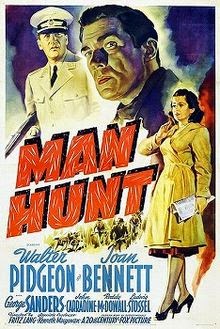
I stayed up past my bedtime Wednesday night to watch Man Hunt through to its conclusion. I had never thought of Walter Pidgeon as an action hero, but he is tall enough and physical enough for sure, as Captain Alan Thorndike, famous big game hunter. Joan Bennett plays the Vivien Leigh role as a "streetwalker" as in Waterloo Bridge. George Sanders plays Major Quive-Smith, the SS Officer who has Thorndike tortured, tries to murder him in Germany, and then tracks him down to London and Lyme Regis.

The movie was issued in 1941, in an age of neutrality toward Germany and the National Socialist Party. Throughout the film, the issue of neutrality and even appeasement is important, as Thorndike was caught while seeming to attempt Hitler's assassination. He insists that he was just testing to see if he COULD kill Hitler, something that Quive-Smith does not believe. He wants Thorndike to sign a confession implicating the British government in the assassination attempt. Thorndike refuses and the plot goes on from there, with our hero in constant danger, and our heroine, Jerry Stokes, shares that danger after she saves him and falls in love with him.

The director of the movie is Fritz Lang of Metropolis fame, who had left Nazi Germany--Hitler both admired and hated Lang's talents, destroying some of his movies and then offering him an official role in Germany's film industry. Lang was Jewish (but his estranged wife was a Nazi party member) so he was probably right not to accept the office.

The New York Times liked the movie in its 2009 DVD release:

As propaganda “Man Hunt” is a movie of undisguised practical aims. During a confrontation in Quive-Smith’s office the German contemptuously tells his captive, “You’re symbolic of the English race.” Thorndike answers, “I’m beginning to think that you’re symbolic of yours!” — one of the lines that apparently roused the fury of Hollywood’s self-censorship board, the Production Code Administration, which objected to the picture’s lack of “balance.” (The administration also insisted that a sewing machine be placed in Bennett’s apartment to suggest that this young woman of suspiciously independent means was in fact a seamstress.) As agitprop the film could not be more effective: during its climax Thorndike finds a way to continue his stalking under more official circumstances, and the audience yearns to go along with him.

And yet, seen again in this excellent restoration from 20th Century Fox Home Entertainment, “Man Hunt” has the timeless quality of a work of pure imagination. Each image contains what the German critic Frieda Grafe called “the hidden geometry” of Lang’s work: that mysterious tendency of shots to resolve themselves into intersecting planes (the banked floors that seem to be rising to meet lowered ceilings), the crisscrossing lines of force traced by streets and the angles of buildings, the circles and squares and triangles that emerge from the décor and seem to dominate the tiny human figures. One of the film’s most prominent characters is an inanimate object, a brooch in the shape of an arrow that passes from Pidgeon to Bennett to Sanders and back to Pidgeon again.

I have to admit I did not notice all the angles and geometry noted above--I did think the pace of the story was excellent and the touches of humor welcome. As far as the propaganda goes, if the Production Code Administration had trouble with Man Hunt, how it must have struggled letting The Mortal Storm be produced and distributed!

Peter O'Toole played the role of Captain Thornton in 1976's Rogue Male for the BBC (with Alistair Sim--Scrooge--as his brother). O'Toole's character was named Captain Robert HUNTER.

Thursday, May 1, 2014

Anticipation on the Son Rise Morning Show

The Feast of the Martyrs of England and Wales is May 4, which is on the Third Sunday of Easter this year. I will be on the Son Rise Morning Show to discuss this feast tomorrow morning, Friday, May 2 at 7:45 a.m. Eastern Time (6:45 a.m. Central), in anticipation of the date, if not the Feast, this year.

Every year, there seems to be some confusion about when this feast is celebrated: October 25 or May 4. The root of the confusion is that originally, when Pope Paul VI canonized the Forty Martyrs of England and Wales, the feast was on October 25--but it has never been celebrated on the universal Roman Calendar for all Catholics. Then in 2010, the Vatican approved changes to the Liturgical Calendar for the U.K., as this article from The Catholic Herald archives notes:

The feast of the English Martyrs is celebrated on May 4. The 40 martyrs canonised under Paul VI in 1973, previously celebrated on October 25, are celebrated with the 85 beatified Martyrs of the Reformation and the other martyrs of the 16th and 17th century. The feast coincides with the Church of England celebration of English saints and martyrs of the Reformation.

These are a significant group of saints in British Catholicism and include St Margaret Clitherow, the butcher’s wife from York who became a Catholic at the age of 18 and was arrested for harbouring a priest. She was crushed to death under a large door loaded with weights. St John Haughton (sic), St Robert Lawrence, St Augustine Webster, and St Richard Reynolds (sic) were Carthusian monks executed at Tyburn on May 4 1535.

St Cuthbert Mayne, another martyr, was a young man from Devon who went to St John’s College, Oxford, in the late 1500s, where he met St Edmund Campion and eventually became a Catholic.


Choosing the date of May 4 was appropriate, since the first martyrs, which also included Blessed John Haile, were executed for refusing to swear to Henry VIII's supremacy over the the Church of England on that date in 1535. To explain the two (sic) notations above: St. Richard Reynolds was not a Carthusian monk, he was from the Briggitine House of Syon; St. John's name is usually spelled Houghton (the Spanish artist Zurbaran painted the portrait above in the 17th century.) The "other martyrs of the 16th and 17th centuries" includes those beatified by Pope Leo XIII in 1895 and Pope Pius XI in 1929 who have not been canonized. Even this date, however, is not on the universal Roman Calendar, and I wonder why. Groups of martyrs from Vietnam, Korea, and Africa are on the Roman Calendar, after all.

Without any detail on their website, it appears that the Charterhouse will celebrate its annual commemoration of the Carthusian martyrs on Monday, May 5. In years past, this has been an ecumenical Evensong service, with Catholic and Anglican bishops remembering the three Carthusian priors hung, drawn, and quartered on May 4, 1535. 

More about the Martyrs of England and Wales tomorrow on the Son Rise Morning Show and on Sunday, May 4th.