Showing posts with label Mary. Show all posts

Monday, September 9, 2019

September 9, 1587: A Catholic Martyr from Scotland

Blessed George Douglas is one of the 85 Martyrs of England and Wales, executed on September 9, 1587. He was born in Edinburgh, Scotland, and according to Volume 1 of the Lives of the English Martyrs, 1583-1588, edited by Edwin H. Burton, D.D. and J.H. Pollen, SJ, he was aided in his exile in France by Mary, Queen of Scots:

George Douglas was of the house of Douglas of Bongedward now Bonjedburgh, of which family the Earl of Angus was the head. He was born in Edinburgh somewhere about 1540, his father John Douglas being a burgess of that city. Archibald Douglas, "the Parson of Glasgow," was his kinsman and coeval ; they were companions as scholars under John Douglas, sometime Archbishop of St. Andrews.

From the earlier examination [in 1570-1571] we learn that George Douglas ''was sometime a 'graye Freer' [sic: Friar] in Edinborough [sic]". About the year 1556 he betook himself to France where he tarried six years, and was maintained upon the exhibition (or pension) of the Queen of Scots as long as he tarried there. He was meantime made priest at Notre Dame ''by the testimonial of the Queen of Scots."

Then, when Father Douglas had gone to England as a missionary priest, he wrote to his patron in 1570-1571 (she had been in Elizabeth I's "care" since 1568) and his letter brought him to the attention of the authorities (he had been serving as tutor in a couple of households):

This he did, and his Latin letter, which is not signed, is still preserved. The letter is little more than an expression of his gratitude to Mary 'because you nourished me in the bountiful academy of Paris," and of sympathetic consolation in her trials, "with the assistance of the divine grace, your sorrow will be turned into joy". But the letter was seized and brought to Francis Cave, a Justice, in whose judgment its writer "seemeth to myselyke the usage of the quene's majestic towardes the quene of Scottes, & also of our relligion used here in Inglond contrary to the honour of the quene's majestic & the laws of her realm". He accordingly examined Douglas, and sent the examination with the letter up to London to the Earl of Huntingdon, Lord Lieutenant of Leicestershire, with the suggestion that if he "confer with Mr. Secretary or some other of the Council, & peruse his letters, I think you will find that he deserves punishment". Meanwhile Cave detained Douglas in the jail.

Mary was held in South Yorkshire in 1570-1571. Evidently, Douglas was released. Burton and Pollen believe that the Father George Douglas described above with his connection to Mary, Queen of Scots, was the same Father George Douglas executed on September 9, 1587 in York:

This martyr's name is found in Wilson's Catalogue, the appendix to his English Martyrologe, published at St. Omer's in 1608, and is included in nearly all subsequent lists of the martyrs. What is known for certain concerning him is found in the Collectanea of Father Christopher Grene, S.J., who tells that he suffered at York on 9 September, 1587. The substance of what Father Grene had ascertained is as follows. At Ripon George Douglas fell into a discussion in which he asserted that the offspring of priests are illegitimate, and denied that the State bishops were real bishops. For this he was denounced, examined and imprisoned for about the space of a year. He was put in the stocks and then kept in irons in a dark dungeon. . . .

Finally tried, and refusing to accept Queen Elizabeth I as the supreme governor of the Church in England, he was condemned to death. Blessed George Douglas endured a horrific execution:

Commending himself unto God, he was cast off the ladder, and the sheriff commanded to cut the rope. The topman not being hasty, one of the bailiffs with his halbert burst the rope asunder, and the martyr fell on his back, and quickly sat up. Then came two butcherly slaves, the one took hold of his feet, and the other of the rope, and so strangling him, and trailing him to the fire, ripped him. He offered to put his hand to the place, and to rise up, but was held down for all his struggling. His tongue was heard to go. Thus cruelly this holy martyr died, and was executed for the profession of the Catholic faith, September 9, 1587. He is described as "a learned man, sharp in speech ; a stout champion, who handled Catholic controversy with much force. Marvellous stout, and zealous to suffer anything for Christ's sake."

Tuesday, April 23, 2019

St. Philip Howard's Maternal Grandfather


Henry FitzAlan, grandfather of St. Philip Howard, was born on April 23, 1512. He was the 12th Earl of Arundel and the last FitzAlan to hold that title, which upon his death on February 24, 1580, was inherited by Philip through his mother, Mary FitzAlan, Henry's third daughter, who had married Thomas Howard, the 4th Duke of Norfolk. FitzAlan served Henry VIII, Edward VI, Mary I, and Elizabeth I to various degrees of success and failure, sometimes in grave danger, according to the 1911 Encyclopedia Britannica entry:

He was one of the twelve counsellors nominated in Henry VIII.’s will to assist the executors, but he had little power during the protectorship of Somerset or the ascendancy of Warwick (afterwards duke of Northumberland), and in 1550 by the latter’s device he was accused of embezzlement, removed from the council, confined to his house, and fined £12,000—£8000 of this sum being afterwards remitted and the charges never being proved. Subsequently he allied himself with Somerset, and was implicated in 1551 in the latter’s plot against Northumberland, being imprisoned in the Tower in November. On the 3rd of December 1552, though he had never been brought to trial, he signed a submission and confession before the privy council, and was liberated after having been again heavily fined. As Edward’s reign drew to its close, Arundel’s support was desired by Northumberland to further his designs on the throne for his family, and he was accordingly reinstated in the council and discharged of his fine. In June 1553 he opposed Edward’s “device” for the succession, which passed over his sisters Mary and Elizabeth as illegitimate, and left the crown to the children of the duchess of Suffolk, and alone of the council refused the “engagement” to support it, though he signed the letters patent. On the death of Edward (July 6, 1553) he ostensibly joined in furthering the duke’s plans, but secretly took measures to destroy them, and according to some accounts sent a letter to Mary the same evening informing her of Edward’s death and advising her to retreat to a place of security. Meanwhile he continued to attend the meetings of the council, signed the letter to Mary declaring her illegitimacy and Lady Jane Grey’s right to the throne, accompanied Northumberland to announce to Jane her accession, and urged Northumberland to leave London and place himself at the head of the forces to attack Mary, wishing him God-speed on his departure. In Northumberland’s absence, he gained over his fellow-councillors, and having succeeded with them in getting out of the Tower, called an assembly of the corporation and chief men of the city, denounced Northumberland, and had Mary proclaimed queen, subsequently riding off to join her with the Great Seal at Framlingham. On the 20th of July he secured Northumberland at Cambridge, and returned in triumph with Mary to London on the 3rd of August, riding before her with the sword of state. 

Rewarded for his assistance:

He was now made a privy councillor and lord steward, and was granted several favours and privileges, acting as high constable at the coronation, and obtaining the right to create sixty knights. He took a prominent part in various public acts of the reign, was a commissioner to treat for the queen’s marriage, presided at the trial of the duke of Suffolk, assisted in suppressing Wyatt’s rebellion in 1554, was despatched on foreign missions, and in September 1555 accompanied Philip to Brussels. The same year he received, together with other persons, a charter under the name of the Merchant Adventurers of England, for the discovery of unknown lands, and was made high steward of Oxford University, being chosen chancellor in 1559, but resigning his office in the same year. In 1557, on the prospect of the war with France, he was appointed lieutenant-general of the forces for the defence of the country, and in 1558 attended the conference at the abbey of Cercamp for the negotiation of a peace. He returned to England on the death of Mary in November 1558, and is described to Philip II. at that time as “going about in high glee, very smart” and with hopes of marrying the queen, but as “flighty” and of “small ability.”

Things did not go smoothly for him under Elizabeth I because he was a staunch Catholic:

He was reinstated in all his offices by Elizabeth, served as high constable at her coronation, and was visited several times by the queen at Nonsuch in Surrey. As a Roman Catholic he violently opposed the arrest of his co-religionists and the war with Scotland, and in 1560 came to blows with Lord Clinton in the queen’s presence on a dispute arising on those questions. He incurred the queen’s displeasure in 1562 by holding a meeting at his house during her illness to consider the question of the succession and promote the claims of Lady Catherine Grey. In 1564, being suspected of intrigues against the government, he was dismissed from the lord-stewardship and confined to his house, but was restored to favour in December. In March 1566 he went to Padua, but being summoned back by the queen he returned to London accompanied by a large cavalcade on the 17th of April 1567. Next year he served on the commission of inquiry into the charges against Mary, queen of Scots. 

He got involved in Norfolk's plots to become Mary, Queen of Scots' fourth husband (even though the Earl of Bothwell, imprisoned in Denmark, was still alive), and worked with Philip II of Spain to overthrow Elizabeth:

Subsequently he furthered the marriage of Mary with the duke of Norfolk, his son-in-law, together with the restoration of the Roman Catholic religion and government, and deposition of Elizabeth, in collusion with Spain. He made use of the incident in 1568, of the seizure of treasure at Southampton intended for Philip, as a means of effecting Cecil’s overthrow, and urged upon the Spanish government the stoppage of trade. He is described in 1569 to Philip as having “good intentions,” “whilst benefiting himself as he was very needy.” In January he alarmed Elizabeth by communicating to her a supposed Spanish project for aiding Mary and replacing her on her throne, and put before the queen in writing his own objections to the adoption of extreme measures against her. In June he received with Norfolk and Lumley 6000 crowns from Philip. In September, on the discovery of Norfolk’s plot, he was arrested, but not having committed himself sufficiently to incur the charge of treason in the northern rebellion he escaped punishment, was released in March 1570, and was recalled by Leicester to the council with the aim of embarrassing Cecil. He again renewed his treasonable intrigues, which were at length to some extent exposed by the discovery of the Ridolfi plot in September 1571. He was once more arrested, and not liberated till December 1572 after Norfolk’s execution.

He is fortunate to have died in bed after being nursed by his eldest daughter, Jane Lumley, Baroness Lumley at Arundel Castle, before she predeceased him in 1578. He was buried in the chapel. His son and heir Henry had died in 1556; Jane and John Lumley, Baron Lumley had no children; and Thomas Howard, the 4th Duke of Norfolk and his son-in-law having been executed on June 2, 1572, Philip Howard became the 13th Earl of Arundel. Sometimes Henry is designated the 19th Earl of Arundel and Philip the 20th.

Tuesday, September 4, 2018

King James I's Grandfather, RIP


On September 4, 1571, King James I/VI's paternal grandfather died. His son Henry Stuart, Lord Darnley, consort of Mary, Queen of Scots, had been murdered almost four and a half years earlier--this image depicts his younger son, Charles, himself, and his wife Margaret (Douglas), and young James VI (who was not even a year old when his father died) praying for the soul of Henry.

Matthew Stewart, 4th Earl of Lennox was the 4th Earl of Lennox (sic), and leader of the Catholic nobility in Scotland. He was the son of John Stewart, 3rd Earl of Lennox. His grandson was James VI of Scotland.

The Lennox Stewart lands lay mostly north of the Clyde, but the family also had close connections with nobles from the west highlands and the Isles. Matthew´s younger brother Robert Stewart was nominated bishop of Caithness in 1541, though he was never consecrated. They had also gained renown in France; Lennox´s uncle Robert Stewart, seigneur d´Aubigny (c.1470–1544), had moved to France in the 1490s and there enjoyed a distinguished military career.


He had various marriage prospects:

Although Lennox had come to Scotland possibly with the prospect of marriage to Mary of Guise, by September Lennox had been offered the chance to marry Margaret Douglas, daughter of Margaret Tudor and half-sister of the deceased James V. Meanwhile François I continued to regard him as an ambassador of France, and when the French king finally sent representatives (Jacques de la Brosse and Jules de Menage) to Scotland they were strictly instructed to liaise with Lennox and to place all their trust in him. Thus they went to Dumbarton in late September and unloaded the entire contents (weapons, powder, presents, and money) of their seven vessels into the castle´s keeping. Just how much was brought by them is not certain, but during their embassy they promised pensions of over 2500 crowns of the sun and their total costs came to 41,700 livres tournois. None of the money was ever seen again: Lennox was becoming a very rich and well-armed man. The money and supplies were not intended for the earl´s personal use, however, and by commandeering them he was weakening the French cause in Scotland, faced as it was by a party backed by England. Lennox´s reluctance to co-operate with potential allies in Scotland itself worked to the same effect. Presumably it was in the hope of retaining his loyalty that Mary of Guise proposed that he should marry her daughter, Queen Mary, on condition of his handing over the French money and supporting the Franco-Scottish alliance. It was not until November 1543 that the French appreciated how damaging to their cause his actions had become.

He finally arranged the marriage of his son to Mary:

He returned to Scotland upon Elizabeth I of England´s urging during the marriage negotiations of Mary, Queen of Scots, in 1564. He quickly took up his position as the most powerful lord in the Glasgow area and was instrumental in the marriage of his son, Lord Darnley, to Mary. Whether Elizabeth had intended this (in order to eliminate the threat of a continental marriage), as is sometimes conjectured, remains doubtful. Elizabeth reacted with disapproval and had Lennox´s wife confined in the Tower of London. By August 1565, William Cecil had heard that Darnley´s insolence had driven Lennox from the Scottish court.

After Darnley was murdered early in 1567, Lennox was the most ardent pursuant of justice against the lords who had conspired in the murder. He also became the main witness against Mary.

In 1570, Lennox became regent for his grandson, James VI, but the queen´s party declared war against him. He was shot dead next year in a skirmish when the queen´s party attacked Stirling. The raid on Stirling on 4 September 1571 was led by the Earl of Huntly, Claude Hamilton, and the lairds of Buccleuch and Ferniehurst. Early reports said he was killed by his own side. William Kirkcaldy of Grange said the shot was fired by the queen´s party, and another account names David Bochinant as the assassin.

Friday, July 6, 2018

Tomorrow: Mary, Queen of Scots on the Radio

Yesterday, I recorded a discussion with Deal Hudson for his Church and Culture program on Ave Maria Radio:

Times: Saturday, 3:00-5:00 pm EST; Sunday, 7:00-9:00 am EST (my segment will air at 4:00 pm Saturday and 8:00 a.m. Sunday--EST)!

Church and Culture engages all aspects of our culture with the aim of discussing “cultural apologetics.” Culture is discussed from a Catholic perspective in order to provide opportunities for Catholics to introduce the faith to others through a book, a movie, a TV show, a piece of music, a political issue, or an artist, among other things. The Church speaks through culture, and while there is much in our culture to be avoided, there is much that can witness to the Catholic faith. On each program, Dr. Hudson interviews noted experts in their fields, providing insight and guidance in our evangelical engagement with the culture.


He and I discussed Mary, Queen of Scots, Elizabeth I, the Scottish Reformation and the English Reformation--all in an hour!!

We will follow up with a general overview on the English Reformation in a few weeks.

Listen live here.

Thursday, February 8, 2018

Chesterton and Mary, Queen of Scots

Mary, the former Queen of Scotland, was executed on February 8, 1587. Tomorrow night, our Greater Wichita American Chesterton Society local society will meet to discuss two essays by Chesterton from the Ignatius Press edition of Lepanto: one on Cervantes and the other on Mary, Queen of Scots. The second essay is titled "If Don John of Austria Had Married Mary, Queen of Scots".

Chesterton wrote more about Mary of Scotland: in a 1931 book of biographies called Revaluations and in an article in the Illustrated London News about the Casket Letters, those letters that allegedly implicated Mary in the murder of her second husband, Henry Stuart, Lord Darnley. The biographical essay is in the volume In Defense of Sanity: The Best Essays of G.K. Chesterton, also from Ignatius Press, edited by Joseph Pearce, Aidan Mackay, and Dale Ahlquist.

In the essay we'll discuss tomorrow, Chesterton picks up on the notion that the hero of Lepanto, Don John of Austria, wanted to rescue Mary, marry her, and restore her to the throne of Scotland--and of course, reign with her there and in England after Elizabeth I died. Chesterton thinks marriage would have been good for both Mary and John and for Scotland, England, Europe, and the Catholic Church:

For Don John: And to the career of Don John it would have given a climax and a clue of meaning which its merely military successes could not give; and handed his name down in history and (what is much more important) in legend and literature, as a happier Antony married to a nobler Cleopatra. And when he looked into her eyes he would not have seen only bright chaos and the catastrophe of Actium, the ruin of his ships and his hopes of an imperial throne; but rather the flying curve and crescent of the Christian ships, sweeping to the rescue of the Christian captives, and blazed upon their golden sails the sunburst of Lepanto. . . . 

For Mary: If ever there was a woman who was manifestly meant, destined, created, and as it were crying aloud to be carried off by Don John of Austria, or some such person, it was Mary Queen of Scots. If ever there was a woman who went to seed for want of meeting any sort of man who was anything like her equal, it was she. . . . She never met a complete man; and Don John was very complete. . . .

For Europe and Christendom: There was a moment when all Christendom might have clustered together and crystallised anew, under the chemistry of the new culture; and yet have remained a Christendom that was entirely Christian. There was a moment when Humanism had the road straight before it; but, what is even more important, the road also straight behind it. It might have been a real progress, not losing anything of what was good in the past. The significance of two people like Mary Stuart and Don John of Austria is that in them Religion and the Renaissance had not quarrelled; and they kept the faith of their fathers while full of the idea of handing on new conquests and discoveries to their sons. They drew their deep instincts from medieval chivalry without refusing to feed their intellects on the sixteenth-century learning; and there was a moment when this spirit might have pervaded the whole world and the whole Church. There was a moment when religion could have digested Plato as it had once digested Aristotle. For that matter, it might have digested all that is soundest in Rabelais and Montaigne and many others; it might have condemned some things in these thinkers; as it did in Aristotle. Only the shock of the new discoveries could have been absorbed (to a great extent indeed it was absorbed) by the central Christian tradition. What darkened that dawn was the dust and smoke from the struggles of the dogmatising sectaries in Scotland, in Holland, and eventually in England. But for that, on the Continent, the heresy of Jansenism had never so much over-shadowed the splendour of the Counter-Reformation. And England would have gone the way of Shakespeare rather than the way of Milton; which latter degenerated rapidly into the way of Muggleton.

If this sounds interesting, and you are in the Wichita area, we will meet on the second floor of Eighth Day Books at 6:30 p.m. tomorrow (February 9) to discuss. Refreshments will be served.

Saturday, June 17, 2017

June 17, 1567: Mary Queen of Scots Imprisoned

After her army lost the Battle of Carberry Hill on the 15th of June, Mary of Scotland was taken as a prisoner to Loch Leven Castle. As this website notes:

Mary was taken here in mid-June 1567 after her defeat at Carberry Hill by Lords Lindsay and Ruthven, under her half-brother's instructions, Lord Moray. The castle was the property of Sir William Douglas, Moray's half-brother, where he lived with his wife, children, mother, another of his brother and another youngster. The mother was Margaret Erskine, known as Lady Douglas, who had married his father, Robert Douglas. Robert Douglas had died at the battle of Pinkie Cleugh in 1547 but Margaret had borne him seven children. Before her marriage, Margaret had been the mistress of Mary's father, James V, and six children were born out of the relationship. Margaret always resented Mary's presence on the throne, when her own son, Moray could have been there instead. The other son on the island was George Douglas, young and handsome, who fell in love with Mary from the start and would later help her escape from Lochleven. The other youth, a boy between fourteen and sixteen years of age, was Willie or "Wee Douglas", reputed to be an orphaned cousin but possibly an illegitimate son of William Douglas. Willie Douglas was also bewitched by the Queen and played an important part in her escape.

It is on this island that Mary gave birth for the second time. It is disputed at what stage of pregnancy she was. Mary herself allegedly said that she was seven months pregnant in July, which would mean that she was already with Bothwell months before Darnley's murder. The second dispute is over what happened to the child. The most widely accepted theory as narrated by Claude Nau, her secretary who wrote under her authority, is that there were stillborn twins who were buried on the island. Nevertheless, another version, found in Castelnau's memoirs, is that Mary gave birth later to a daughter who was smuggled out of Lochleven and sent to France. Mary's French relatives would have sent her to a convent in Soissons where she became a nun. Although improbable, the story is not impossible. Whatever the truth, Mary did fall very ill on the island, and it was in this weakened and vulnerable state that Moray sent Lords Ruthven, Melville and Lindsay to present her with abdication papers. She was forced to sign them under threat from Lindsay on 24 July 1567. Forever wanting to see the good in people, Mary continued her plea to Moray who deceitful as always, maintained that he kept her in Lochleven for her own safety. On 22 August, he was made Regent.

She would escape on May 2, 1568, aided by Willie Douglas and George Douglas. Mary gathered a new army to regain the throne from Moray and her one year old son, but was defeated again at the Battle of Langside on May 13 that year. Archibald Campbell, 5th Earl of Argyll was the commander of her army and he continued to support her for a time but eventually allied himself with the regency of Matthew Stewart, 4th Earl of Lennox in 1571. Mary fled to England, hoping for Elizabeth's help and ended up her cousin's prisoner for years.

The paintingMary, Queen of Scots Escaping from Loch Leven Castle is by William Craig Shirreff:

In 1805, this painting won a student prize for Shirreff while he was at the Trustees’ Academy. He chose an episode from the life of Mary, Queen of Scots which had been related by Gilbert Stuart in his influential ‘History of Scotland’ (1783). In a letter to his father the young artist wrote: "I have taken the point of time when Lord Seaton is receiving Mary from the boat, and young George Douglas handing her on and one of the attendants holding the horse that the Queen is to ride on. I am very pleased with it myself." By the early nineteenth century, Mary was a popular romantic heroine. William Lizars, one of Shirreff’s friends, engraved this painting after the young artist’s premature death.

I find this genre of historical paintings so fascinating: the artist imagines a historical scene and depicts it to whatever degree of verisimilitude he or she finds appropriate (dress, props, etc). The artist's efforts tell us more about his or her own era than the event or era depicted. Mary, Queen of Scots was an incredibly romantic and tragic figure in the early 19th century. Schiller's play, Maria Stuart, had influenced her historical reputation--and Donizetti's 1835 opera would continue that romanticizing trend.

Shirreff wants to depict her beauty and her charm--indeed, her effect on men--in this painting. I think he succeeded (and so did he!).

Monday, March 10, 2014

Thomas Howard, 4th Duke of Norfolk Born

The surname Howard comes up often on this blog, and just like any other post on the Howard family, our challenge today is to keep all the people named Thomas, Henry, Elizabeth, Anne, Margaret, and Mary straight, not to mention the Earls, Dukes, and Lords so that the whole story makes sense and we can understand the impact of all these relationships and plots!

Here goes:

Today's Howard was born on March 10, 1536. He was the grandson of Thomas Howard, the 3rd Duke of Norfolk, who was uncle to two of Henry VIII's consorts, Anne Boleyn (Elizabeth Howard married Thomas Boleyn) and Catherine Howard (Edmund Howard's daughter).

The 4th Duke of Norfolk's father was Henry Howard, the Earl of Surrey, who was executed just days before Henry VIII died. Thomas Howard the 4th thus succeeded to the family title when his grandfather died in 1554. His mother, by the way, was Frances de Vere of Oxford.

John Foxe, the great Protestant martyrologist and hagiographer, was a teacher of today's Thomas Howard. Howard and his brother Henry Howard, lst Earl of Northampton were under the care of their evangelical aunt, Mary Howard FitzRoy, Duchess of Richmond and Somerset, widow of Henry FitzRoy, Henry VIII's only recognized illegitimate son. Howard continued to patronize Foxe, but Howard also began to involve himself in political efforts to promote Catholicism in England. (His brother Henry would be known as a crypto-Catholic and fall out of Elizabeth's favor.) Note that when Thomas Howard the 3rd was released from the Tower of London at the beginning of Mary I's reign he told John Foxe to find new employment.

Thomas Howard the 4th married thrice and the fourth marriage he attempted got him into big trouble, to say the least. His first wife was Mary FitzAlan, heiress to the Arundell estates. Their son was Philip Howard, 20th Earl of Arundell and Catholic martyr/saint. (Mary died after his birth in 1557.)

His second wife was a widow-heiress, Margaret Audley (Lady Jane Grey's first cousin). Their eldest son, another Thomas Howard, later 1st Earl of Suffolk, was one of Queen Elizabeth's admirals in the battle against the Spanish Armada and survived to serve James I for many years. The younger son was William Howard, who would be imprisoned as a Catholic by Elizabeth I like his half-brother Philip.

His third wife was another widow, Elizabeth Leyburne Dacre, whose first husband was Thomas Dacre, 4th Baron Dacre. Elizabeth Leyburne's family were recusant Catholics. By her first marriage she had three daughters and Thomas Howard the 4th arranged marriages between her three daughters and his three sons after her death in 1567:

Anne Dacre married Philip Howard (their son was named Thomas)
Elizabeth Dacre married William Howard
Mary Dacre married Thomas Howard, 1st Earl of Suffolk (and died soon after)

Thomas Howard the 4th's sister Jane was married to Charles Neville, 6th Earl of Westmoreland, a Catholic peer in the North of England. Neville joined Thomas Percy, the 7th Earl of Northumberland in the Northern Rebellion against Elizabeth I in 1569.

Jane Howard Neville encouraged her brother to marry the former Queen of Scotland who was now Elizabeth's prisoner or guest, having sought refuge in 1568, hoping for assistance in regaining her throne. But Elizabeth first wanted to find out if Mary was at all implicated in the murder of Henry Stuart, Lord Darnley. So by November of 1569, Mary's position was precarious--and this idea of the Earl Marshall of England marrying the Catholic threat to Elizabeth's throne, while the North of England was rebelling, led to Thomas Howard the 4th's imprisonment in the Tower of London.

At the same time, of course, Mary, the ertswhile Queen of Scot was still Elizabeth's most likely successor, since she had rejected the claims of the Grey family. Since Elizabeth was not married, and did not seem likely to be married, any discussion of or action that might influence the succession was very dangerous, as the surviving Grey sisters, Catherine and Mary, found out when they married without Elizabeth's approval.

In the meantime, of course, the Northern Rebellion had fallen apart; Percy and Neville had fled to Scotland and Elizabeth's retribution on the rebels was proceeding apace. Evidently, imprisonment in the Tower somehow led Thomas Howard the 4th to greater designs against Queen Elizabeth. Upon his release he became involved in the Ridolfi Plot of 1570 which aimed at executing the Queen and placing Mary, Queen of Scots (and her consort, Thomas I, King of England?) on the throne. The plot was discovered by Elizabeth's spy network and Thomas Howard the 4th was executed for treason on June 2, 1572. His lands and titles were forfeit to the throne, of course.

His son Philip Howard, however, would succeed to his maternal grandfather's title, the Earl of Arundel, when Henry FitzAlan died in 1580--but he ended up dying in the Tower of London, perhaps just because Elizabeth feared a Howard in exile, supported by the Pope and Catholic monarchs. Nevertheless, Elizabeth restored Thomas Howard, 1st Earl of Suffolk to the blood in 1584 and he served her in various offices and efforts, including the trial of Robert Devereux, the Earl of Essex, but ended up leaving office under James I in some disgrace. Thomas Howard the 4th's youngest son, William Howard became a Catholic in 1584, lived in retirement and recusancy in Naworth Castle, Cumberland and died in 1640.

Tuesday, July 30, 2013

The Second Earl of Southampton Succeeds


Upon the death of his father, Thomas Wriothesley, the First Earl, five year old Henry Wriothesley became the Second Earl of that title on July 30, 1550. His mother, the former Jane Cheney, as a devout Catholic and remained so in spite of changes in the official religion of England. When Henry was baptized, both Henry VIII and the Princess Mary were godparents, and his mother was effectively his guardian until he came of age (in spite of a gentleman being named his official guardian), raising him in the Catholic faith.

Although he was raised Catholic, his noble family standing shielded him from the normal disabilities, fines, and other punishments of the Recusant era. He married Mary Browne, the daughter of Anthony Browne, 1st Viscount Montagu, who also remained Catholic during the succeeding Tudor changes of official religion. Browne remained as Sheriff and MP during Edward VI's reign, but took leadership positions during Mary I's reign, including travel to Rome during negotiations with Pope Julius III to reinstate Catholicism in England. Note that Browne protested the acts of Elizabeth I's first Parliament to establish the Church of England.

It was Henry Wriothesley's connection to Thomas Howard, the Fourth Duke of Norfolk and the latter's plans to marry the deposed Mary, Queen of Scots in 1569 (around the same time as the Northern Rebellion) that plunged both Wriothesley and his father-in-law into trouble with Elizabeth I. Add to that the heightened tension for Catholics in England caused by the Papal Bull of 1570, with the choice of loyalty to the Church or loyalty to the Queen, and it's no surprise that the Second Earl of Southampton spent some time in the Tower of London. This site notes that it might have been from 1571 to 1574. Then he returned to Hampshire in positions of trust--but, was suspected of having sheltered St. Edmund Campion in 1581--and died on October 4, 1581.

Henry's son Henry became the Third Earl of Southampton, Shakespeare's patron, who also spent some time in the Tower; his daughter Mary married into another Catholic noble family as the first wife of Thomas Arundell, 1st Baron Arundell of Wardour (and he spent some time in the Tower because he was a Catholic too!).  After the Fourth Earl of Southamption died in 1667, the title was extinct, because Thomas Wriothesley had only daughters from three marriages.

Interestingly, I find no portrait of the Second Earl on-line at the National Portrait Gallery in London--eleven of son and ten of his grandson, but none of him! The image above is a photo of his tomb in St Peter's Church, Titchfield, Hampshire, with his mother's tomb above, from wikipedia commons. As you might surmise, St. Peter's Church was the family church, obtained from the Court of Augmentations by Thomas Wriothesley, the First Earl, upon the suppression of the Premonstratensian Ab­bey on December 28, 1537--the family tombs occupy the South Chapel.

Thursday, September 20, 2012

Traitors and A Poet: The Babington Plot

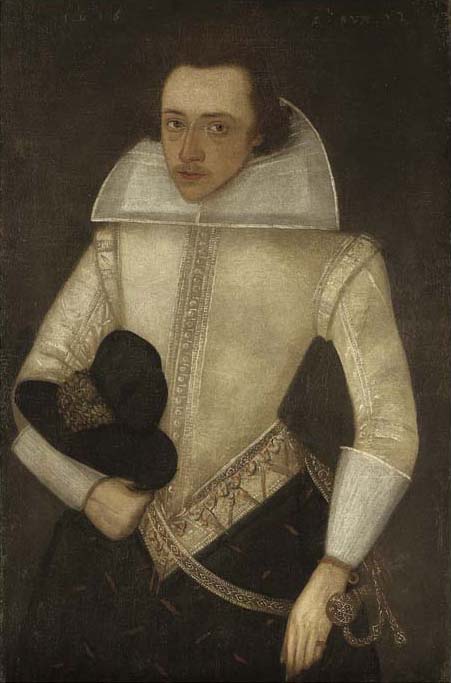
File:Portrait of young gentleman said to be Anthony Babington.jpg Anthony Babington (the portrait is from Wikipedia commons) was executed at St. Gile's Field on September 20, 1586, along with a Jesuit priest, John Ballard and several other conspirators--Chidiock Tichborne, Thomas Salisbury, Henry Donn among them. As traitors, of course, they were hung, drawn and quartered, but their executions and sufferings were so extreme--especially considering their relative youth--that the onlookers began to have sympathy for them. Queen Elizabeth ordered that the rest of the traitors to be executed were to be hung until dead (then cut up per the standard operating procedure).

Babington involved the imprisoned Mary, Queen of Scots in his plot to assassinate Elizabeth and bring Mary to the throne of England and this led to her execution within months. Beyond the plot's murderous intent, the disturbing aspect of this conspiracy is that Elizabeth's spymaster, Sir Francis Walsingham, knew about the plot because he had a double agent in place who also served as an agent provocateur. There is an element of entrapment--especially regarding Mary's replies to correspondence--in Walsingham's handling of the matter. As the BBC History site notes:

Walsingham loathed Mary and everything she stood for, and vowed to bring her down. It was to take him almost 20 years. But when he discovered in 1586 that she was corresponding with a group of Catholics led by the young Anthony Babington, he seized his chance.

For the first stage of his plan, Walsingham used a spy named Gifford to act as a double agent. Gifford persuaded the local brewer to encourage Mary to use him as a secret means of communicating with the outside world. By establishing a system whereby Mary's personal letters were carried in and out of Chartley (her current residence) hidden in a beer barrel, Walsingham was able to intercept and decode her correspondence. The relatively simple code used by Mary was quickly deciphered, and translations were provided for Elizabeth. These letters were then resealed and sent on to their destination or delivered to Mary in prison. And so the plot progressed.

Walsingham, meanwhile, was biding his time. Luckily for him, Babington and his friends were enthusiastic but inexperienced plotters and were happy to discuss their plans in public. It was therefore not difficult for the authorities to keep track of their movements. Having outlined his plans to Mary, Babington now tried to secure her participation in the plot. This was the moment Walsingham had been waiting for. When the vital letter from Mary asking for details was intercepted, a postscript was forged in her hand asking for the identities of the plotters. The names were duly supplied, and their fate was sealed. Mary's involvement in the plot had been proven, and a gallows was drawn on the page by the decoding expert. Walsingham could now move in for the kill.

Young Chidiock Tichborne wrote an elegy while in the Tower which gained some fame with its haunting contrasts (note that all but one of the words is but one syllable and "fallen" could be pronounced as one by elision):

Tichborne’s Elegy
Written with His Own Hand in the Tower Before His Execution

My prime of youth is but a frost of cares,
My feast of joy is but a dish of pain,
My crop of corn is but a field of tares,
And all my good is but vain hope of gain;
The day is past, and yet I saw no sun,
And now I live, and now my life is done.

My tale was heard and yet it was not told,
My fruit is fallen and yet my leaves are green,
My youth is spent and yet I am not old,
I saw the world and yet I was not seen;
My thread is cut and yet it is not spun,
And now I live, and now my life is done.

I sought my death and found it in my womb,
I looked for life and saw it was a shade,
I trod the earth and knew it was my tomb,
And now I die, and now I was but made;
My glass is full, and now my glass is run,
And now I live, and now my life is done.

The Tichborne family was solidly, adamantly, recusantly Catholic: Chideock's cousins Father Thomas Tichborne and his brother Nicholas were executed (because Thomas was a Catholic priest and his brother helped him to escape, in 1602 and 1601, respectively).

Tuesday, September 20, 2011

Anthony Babington and His Eponymous Plot

Anthony Babington was executed at St. Gile's Field on September 20, 1586, along with a Jesuit priest, John Ballard and several other conspirators--Chidiock Tichborne, Thomas Salisbury, Henry Donn among them. As traitors, of course, they were hung, drawn and quartered, but their executions and sufferings were so extreme--especially considering their relative youth--that the onlookers began to have sympathy for them. Queen Elizabeth ordered that the rest of the traitors to be executed were to be hung until dead (then cut up per the standard operating procedure).

Babington involved the imprisoned Mary, Queen of Scots in his plot to assassinate Elizabeth and bring Mary to the throne of England and this led to her execution within months. Beyond the plot's murderous intent, the disturbing aspect of this conspiracy is that Elizabeth's spymaster, Sir Francis Walsingham, knew about the plot because he had a double agent in place who also served as an agent provocateur. There is an element of entrapment--especially regarding Mary's replies to correspondence--in Walsingham's handling of the matter.

Young Chidiock Tichborne wrote an elegy while in the Tower which gained some fame with its haunting contrasts (note that all but one of the words is but one syllable):

Tichborne’s Elegy
Written with His Own Hand in the Tower Before His Execution

My prime of youth is but a frost of cares,
My feast of joy is but a dish of pain,
My crop of corn is but a field of tares,
And all my good is but vain hope of gain;
The day is past, and yet I saw no sun,
And now I live, and now my life is done.

My tale was heard and yet it was not told,
My fruit is fallen and yet my leaves are green,
My youth is spent and yet I am not old,
I saw the world and yet I was not seen;
My thread is cut and yet it is not spun,
And now I live, and now my life is done.

I sought my death and found it in my womb,
I looked for life and saw it was a shade,
I trod the earth and knew it was my tomb,
And now I die, and now I was but made;
My glass is full, and now my glass is run,
And now I live, and now my life is done.