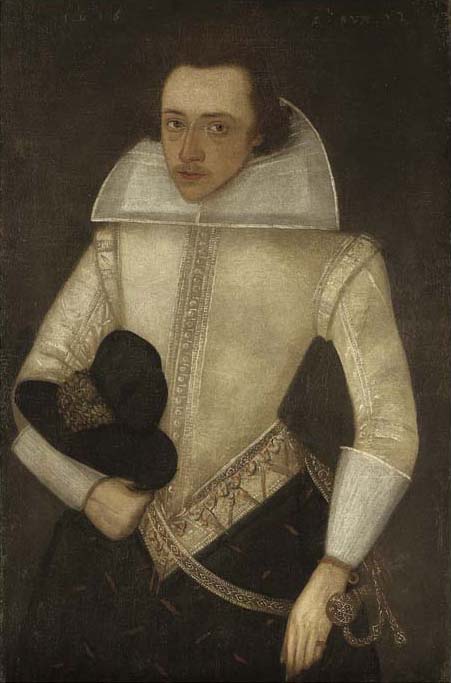
Showing posts with label Chidiock Tichborne. Show all posts

Wednesday, September 20, 2017

Chidiock Tichborne to His Wife


Margaret Bowen collected Some Famous Love Letters, published in 1937 and included Chidiock Tichborne's to his wife, written the night before his execution on September 20, 1586. She describes him as:

A Roman Catholic gentleman who joined the Babington Conspirators in their desperate attempt to free Mary Queen of Scots and set her on the English Throne; these men were mostly high-minded fanatics, and though Tichborne and five others undertook to assassinate Elizabeth, they were influenced by the Papal Ban on a woman considered by the Catholics as a heretic usurper and believed that they were acting under Heavenly guidance. It would be difficult to believe evil of the writer of the following letter penned in prison shortly before facing a barbarously cruel death.

The letter:

To the most loving wife alive, I commend me unto her, and desire God to bless her with all happiness, pray for her dead husband, and be of good comfort, for I hope in Jesus Christ this morning to see the face of my Maker and Redeemer in the most joyful throne of His glorious kingdom. Commend me to all my friends, and desire them to pray for me, and in all charity to pardon me, if I have offended them. Commend me to my six sisters, poor desolate souls, advise them to serve God, for without Him no goodness is to be expected. Were it possible, my little sister Bab, the darling of my race, might be bred by her, God would reward her; but I do her wrong I confess, that hath by my desolate negligence too little for herself, to add a further charge unto her. Dear wife forgive me, that have by these means so much impoverished her fortunes; patience and pardon, good wife I crave—make of these our necessities a virtue, and lay no further burthen on my neck than hath already been. There be certain debts that I owe, and because I know not the order of the law, piteous it hath taken from me all, forfeited by my course of offence to Her Majesty, I cannot advise thee to benefit me herein, but if there fall out wherewithal, let them be discharged for God's sake. I will not that you trouble yourself with the performance of these matters, my own heart, but make it known to my uncles, and desire them, for the honour of God and ease of their soul, to take care of them as they may, and especially care of my sisters' bringing up the burthen is now laid on them. Now, Sweet-cheek, what is left to bestow on thee? A small jointure, a small recompense for thy deserving, these legacies following to be thine own. God of His infinite goodness give thee grace always to remain His true and faithful servant, that through the merits of His bitter and blessed passion thou mayst become in good time of His kingdom with the blessed women in heaven. May the Holy Ghost comfort thee with all necessaries for the wealth of thy soul in the world to come, where until it shall please Almighty God I meet thee, farewell loving wife, farewell the dearest to me on all the earth, farewell!

By the hand from the heart of thy most faithful loving husband.

This Elegy was enclosed with the letter:

My prime of youth is but a frost of cares,
My feast of joy is but a dish of pain,
My crop of corn is but a field of tares,
And all my good is but vain hope of gain;
The day is past, and yet I saw no sun,
And now I live, and now my life is done.

My tale was heard and yet it was not told,
My fruit is fallen, and yet my leaves are green,
My youth is spent and yet I am not old,
I saw the world and yet I was not seen;
My thread is cut and yet it is not spun,
And now I live, and now my life is done.

I sought my death and found it in my womb,
I looked for life and saw it was a shade,
I trod the earth and knew it was my tomb,
And now I die, and now I was but made;
My glass is full, and now my glass is run,
And now I live, and now my life is done.

More about the poem here.

The Tichborne family was solidly, adamantly, recusantly Catholic: Chidiock's cousins Father Thomas Tichborne and his brother Nicholas were executed (because Thomas was a Catholic priest and his brother helped him to escape, in 1602 and 1601, respectively). They have both been declared Venerable but have not been included among those beatified. More about the Chidiock family here and more about the Babington family, including the family's chantry chapel, here.

Tuesday, September 20, 2016

The Tichborne Traitors

Chidiock Tichborne was a Babington Plot conspirator against Elizabeth I (seen in the Pelican Portrait by Nicholas Hilliard, which symbolizes her love for her country--the pelican mother would pierce its own breast and feed her young with her blood) and he was brutally executed on September 20, 1586 at St. Giles Field, along with other conspirators. The night before he wrote his own elegy and sent it to his wife Agnes:

My prime of youth is but a frost of cares,
My feast of joy is but a dish of pain,
My crop of corn is but a field of tares,
And all my good is but vain hope of gain;
The day is past, and yet I saw no sun,
And now I live, and now my life is done.

My tale was heard and yet it was not told,
My fruit is fallen and yet my leaves are green,
My youth is spent and yet I am not old,
I saw the world and yet I was not seen;
My thread is cut and yet it is not spun,
And now I live, and now my life is done.

I sought my death and found it in my womb,
I looked for life and saw it was a shade,
I trod the earth and knew it was my tomb,
And now I die, and now I was but made;
My glass is full, and now my glass is run,
And now I live, and now my life is done.


Chidiock's uncle, Nicholas Tichborne, had also betrayed his monarch because of his obdurate recusancy, as Francis Aidan Gasquet describes in his Hampshire Recusants: A Story of Their Troubles in the Time of Queen Elizabeth (1895):

In the year 1589, Nicholas Tichborne of Hartley Maudit, three miles from Alton, died. He had been in the gaol of Winchester for nine years a prisoner, as he says himself in his petition for relief "for not repairing unto my parish church," or as the Sheriff puts it, "in execution for a great sum of money due unto Her Majesty by reason of his recusancy." We have a glimpse of his sad condition in a letter written by him in 1585. In October of that year, orders were sent down to the officials in the various counties to demand from each recusant gentleman or woman one "light horse" for the queen's service, or £25 in money. George Cotton, apparently, was the only one in this part of the country who was " contented " to furnish the horse. Poor Nicholas Tichborne pleaded "non-ability" to do what was required. "I and such other recusants," he writes, "have reported ourselves, notwithstanding our recusancy, to be as good subjects as any other Her Majesty's subjects, which before God I do acknowledge and profess. And hereupon. Her Majesty having present service for certain light horsemen to be sent into Flanders, Her Majesty's will and pleasure is to require of me to have a light horse in readiness, with all the furniture thereunto belonging, by the 26th day of the month of October, or else £25". "I," he continues, "am a younger brother and son of a younger brother," and had only one little farm, "for the maintenance of myself, my poor wife and eight young children." The "lease whereof with all such goods as I had upon the same was sold by Robert White, Esq., late Sheriff of the said county, and the money for the same was paid into the receipt of Her Majesty's Exchequer, to Her Majesty's use in the Michaelmas term in the 25th year of Her Majesty's reign." . . . Tichborne declares that since he has been in prison and all his little property taken away, his family has lived upon the alms of the charitable. He is sorry he is unable to do anything in the way of finding the horse to show " his loyalty and true obedience to Her Majesty . . . He was left consequently in the Winchester Gaol till he died, as I have said, in 1589. The Bishop of the diocese, Dr. Cooper, refused to allow his body to be buried in any church or cemetery, declaring that his conscience would not permit him to suffer a papist to be buried in any of his churches or cemeteries. By the advice of an old Catholic the body was carried to the summit of a hill about a mile from the city and interred in the old disused cemetery of St. James, now known in Winchester as the Catholic Cemetery.

Nicholas' sons, Thomas and Nicholas were executed like Chidiock, but are considered martyrs--they were not part of a conspiracy, but were a Catholic priest present in England (Father Thomas) and a Catholic layman assisting a Catholic priest (Nicholas). They have both been declared Venerable by the Church but have not been beatified in either of the large groups in the 19th and 20th centuries.

From the Catholic Encyclopedia, Venerable Thomas Tichborne:

Born at Hartley, Hampshire, 1567; martyred at Tyburn, London, 20 April, 1602. He was educated at Rheims (1584-87) and Rome, where he was ordained on Ascension Day, 17 May, 1592. Returning to England on 10 March, 1594, he laboured in his native county, where he escaped apprehension till the early part of 1597. He was sent a prisoner to the Gatehouse in London, but in the autumn of 1598 was helped to escape by his brother, Ven. Nicholas Tichborne, and Ven. Thomas Hackshot, who were both martyred shortly afterwards. Betrayed by Atkinson, an apostate priest, he was re-arrested and on 17 April, 1602, was brought to trial with Ven. Robert Watkinson (a young Yorkshire man who had been educated at Rome and ordained priest at Douai a month before) and Ven. James Duckett, a London bookseller. On 20 April he was executed with Ven. Robert Watkinson and Ven. Francis Page, S.J. The last named was a convert, of a Middlesex family though born in Antwerp. He had been ordained at Douai in 1600 and received into the Society of Jesus while a prisoner in Newgate. Ven. Thomas Tichborne was in the last stages of consumption when he was martyred.

Note that Watkinson, Page and Duckett have been beatified (in 1929 by Pope Pius XI). Why not Thomas Tichborne?


b. at Hartley Mauditt, Hampshire; suffered at Tyburn, London, 24 Aug., 1601. He was a recusant at large in 1592, but by 14 March, 1597, had been imprisoned. On that date he gave evidence against various members of his family. Before 3 Nov., 1598, he had obtained his liberty and had effected the release of his brother, Venerable Thomas Tichborne, a prisoner in the Gatehouse, Westminster, by assaulting his keeper. He is to be distinguished from the Nicholas Tichborne who died in Winchester Gaol in 1587. [His father, as described above]

With him suffered Venerable Thomas Hackshot (b. at Mursley, Buckinghamshire), who was condemned on the same charge, viz. that of effecting the escape of the priest Thomas Tichborne. During his long imprisonment in the Gatehouse he was "afflicted with divers torments, which he endured with great courage and fortitude."

According to the English government at the time, all four of these men were in some way traitors. Nicholas, the father, refused to accept the Elizabethan religious settlement by not going to the Anglican services held each Sunday in his formerly Catholic church. He and his family lost all of their material possessions because of his refusal. He could be considered a martyr in chains. His wife, Mary (Myll) must have been just as loyal to the Catholic faith and his sons also remained true. Note, however, that Nicholas (the younger) must have wavered a bit, because in 1597 he "gave evidence against various members of his family". Nevertheless, he helped his brother, Father Thomas, escape from prison a year or so later. Then they were both recaptured, tried, and sentenced to death.


Chidiock's father, Peter, was also a recusant, who spent time in jail for not paying his fines and refusing to attend Anglican services. Chidiock, however, joined in the conspiracy to kill Elizabeth I and place Mary, the former Queen of Scots, on the throne. Reports are that the executions by hanging, drawing and quartering were so cruelly carried out on September 20, 1586 that Elizabeth I ordered the next round of conspirators to be hung by the neck until dead before beheading and quartering. Chidiock was only 24 years old; his youth and agony evidently moved the spectators.

The Babington Plot finally sealed Mary of Scotland's fate, and she was executed in February of 1587. 

Thursday, September 20, 2012

Traitors and A Poet: The Babington Plot

File:Portrait of young gentleman said to be Anthony Babington.jpg Anthony Babington (the portrait is from Wikipedia commons) was executed at St. Gile's Field on September 20, 1586, along with a Jesuit priest, John Ballard and several other conspirators--Chidiock Tichborne, Thomas Salisbury, Henry Donn among them. As traitors, of course, they were hung, drawn and quartered, but their executions and sufferings were so extreme--especially considering their relative youth--that the onlookers began to have sympathy for them. Queen Elizabeth ordered that the rest of the traitors to be executed were to be hung until dead (then cut up per the standard operating procedure).

Babington involved the imprisoned Mary, Queen of Scots in his plot to assassinate Elizabeth and bring Mary to the throne of England and this led to her execution within months. Beyond the plot's murderous intent, the disturbing aspect of this conspiracy is that Elizabeth's spymaster, Sir Francis Walsingham, knew about the plot because he had a double agent in place who also served as an agent provocateur. There is an element of entrapment--especially regarding Mary's replies to correspondence--in Walsingham's handling of the matter. As the BBC History site notes:

Walsingham loathed Mary and everything she stood for, and vowed to bring her down. It was to take him almost 20 years. But when he discovered in 1586 that she was corresponding with a group of Catholics led by the young Anthony Babington, he seized his chance.

For the first stage of his plan, Walsingham used a spy named Gifford to act as a double agent. Gifford persuaded the local brewer to encourage Mary to use him as a secret means of communicating with the outside world. By establishing a system whereby Mary's personal letters were carried in and out of Chartley (her current residence) hidden in a beer barrel, Walsingham was able to intercept and decode her correspondence. The relatively simple code used by Mary was quickly deciphered, and translations were provided for Elizabeth. These letters were then resealed and sent on to their destination or delivered to Mary in prison. And so the plot progressed.

Walsingham, meanwhile, was biding his time. Luckily for him, Babington and his friends were enthusiastic but inexperienced plotters and were happy to discuss their plans in public. It was therefore not difficult for the authorities to keep track of their movements. Having outlined his plans to Mary, Babington now tried to secure her participation in the plot. This was the moment Walsingham had been waiting for. When the vital letter from Mary asking for details was intercepted, a postscript was forged in her hand asking for the identities of the plotters. The names were duly supplied, and their fate was sealed. Mary's involvement in the plot had been proven, and a gallows was drawn on the page by the decoding expert. Walsingham could now move in for the kill.

Young Chidiock Tichborne wrote an elegy while in the Tower which gained some fame with its haunting contrasts (note that all but one of the words is but one syllable and "fallen" could be pronounced as one by elision):

Tichborne’s Elegy
Written with His Own Hand in the Tower Before His Execution

My prime of youth is but a frost of cares,
My feast of joy is but a dish of pain,
My crop of corn is but a field of tares,
And all my good is but vain hope of gain;
The day is past, and yet I saw no sun,
And now I live, and now my life is done.

My tale was heard and yet it was not told,
My fruit is fallen and yet my leaves are green,
My youth is spent and yet I am not old,
I saw the world and yet I was not seen;
My thread is cut and yet it is not spun,
And now I live, and now my life is done.

I sought my death and found it in my womb,
I looked for life and saw it was a shade,
I trod the earth and knew it was my tomb,
And now I die, and now I was but made;
My glass is full, and now my glass is run,
And now I live, and now my life is done.

The Tichborne family was solidly, adamantly, recusantly Catholic: Chideock's cousins Father Thomas Tichborne and his brother Nicholas were executed (because Thomas was a Catholic priest and his brother helped him to escape, in 1602 and 1601, respectively).

Tuesday, September 20, 2011

Anthony Babington and His Eponymous Plot

Anthony Babington was executed at St. Gile's Field on September 20, 1586, along with a Jesuit priest, John Ballard and several other conspirators--Chidiock Tichborne, Thomas Salisbury, Henry Donn among them. As traitors, of course, they were hung, drawn and quartered, but their executions and sufferings were so extreme--especially considering their relative youth--that the onlookers began to have sympathy for them. Queen Elizabeth ordered that the rest of the traitors to be executed were to be hung until dead (then cut up per the standard operating procedure).

Babington involved the imprisoned Mary, Queen of Scots in his plot to assassinate Elizabeth and bring Mary to the throne of England and this led to her execution within months. Beyond the plot's murderous intent, the disturbing aspect of this conspiracy is that Elizabeth's spymaster, Sir Francis Walsingham, knew about the plot because he had a double agent in place who also served as an agent provocateur. There is an element of entrapment--especially regarding Mary's replies to correspondence--in Walsingham's handling of the matter.

Young Chidiock Tichborne wrote an elegy while in the Tower which gained some fame with its haunting contrasts (note that all but one of the words is but one syllable):

Tichborne’s Elegy
Written with His Own Hand in the Tower Before His Execution

My prime of youth is but a frost of cares,
My feast of joy is but a dish of pain,
My crop of corn is but a field of tares,
And all my good is but vain hope of gain;
The day is past, and yet I saw no sun,
And now I live, and now my life is done.

My tale was heard and yet it was not told,
My fruit is fallen and yet my leaves are green,
My youth is spent and yet I am not old,
I saw the world and yet I was not seen;
My thread is cut and yet it is not spun,
And now I live, and now my life is done.

I sought my death and found it in my womb,
I looked for life and saw it was a shade,
I trod the earth and knew it was my tomb,
And now I die, and now I was but made;
My glass is full, and now my glass is run,
And now I live, and now my life is done.