Showing posts with label stained glass. Show all posts

Wednesday, August 24, 2016

Stained Glass: Sacred Heart in Colwich


We drove out to Colwich, Kansas on Saturday to visit a fruit stand and then stopped in Sacred Heart Catholic Church for a visit to the Blessed Sacrament and morning prayer. We noted how the stained glass windows closer to the altar and sanctuary seemed to be older--definitely in a different style than the windows depicting the Beatitudes further back in the nave.

The Holy Family at work (detail):


The death of St. Joseph (patron saint of happy, holy deaths), also a detail:


This picture of St. Anne and the Blessed Virgin window shows the architectural structure around the image of Mary and her mother:


And this window dedicated to the Blessed Virgin Mary:


Three of the four windows at the front of the church had that green background and architectural frame--the St. Joseph window had a blue background and different architecture at the top, so must have been added or perhaps replaced an older window.

The beatitude windows were definitely added later with very different artwork and design.This one depicts one of the American Martyrs, perhaps St. Isaac Jogues, SJ with the beatitude, "Blessed are they who suffer persecution for justice sake".


These churches built by German immigrants always impress me and my husband--the artistry, the care, the love lavished upon the parish church shines through as surely as the sun through the stained glass windows. I could not find any history of the church or how the stained glass windows were procured or designed. We plan to visit several rural churches in the area this fall.

Thursday, October 15, 2015

No Schadenfreude Allowed: "C and E" C of E Churches?


With the decline of Anglican church attendance and population shifts, many Anglican churches might have to close except for Christmas, Easter, and other special "hire" dates, according to this story from The Telegraph:

Historic village churches across England could be closed down except on holy days such as Christmas and Easter under radical plans being considered by the Church of England to cope with decline.

A major report on the future of the 16,000 Anglican places of worship in England acknowledges that parts of the centuries-old parish system may soon no longer be “sustainable” as existing congregations age and overall numbers dwindle.


It discloses that one in four rural parishes – or about 2,000 churches – now have fewer than 10 regular worshippers and half would now be unable to muster even 20 on a Sunday.

At the same time parishes collectively spend about £160 million a year on maintaining their buildings, which include almost half of all the grade one listed buildings in the country.

Rural churches have been hit not only by a general decline in religious observation but long-standing population shifts leaving some once-thriving parishes effectively marooned in the midst of fields.

Thus these churches will become "C and E" C of E churches.

Looking at the list of churches maintained or supported by the Churches Conservation Trust, many of these parish churches would have been Catholic before the English Reformation (281 out of 363 were built in the 16th century and earlier). I've just picked one from the 14th century, St. Mary the Virgin in Shrewsbury, Shropshire (see the glorious pictures there):

The spire of St Mary’s is one of the tallest in England and for over 500 years it has dominated the skyline of Shrewsbury's old town. In 1739, showman Robert Cadman attempted to slide from it, head first, using a rope and a grooved breastplate. His engraved obituary stands outside the west door. 

The church is now the only complete Medieval church in Shrewsbury. It dates from Saxon times and has beautiful additions from the 12th-century onwards. Inside, the atmosphere is peaceful with the soaring stone arches giving way to the church's great treasure - its stained glass. 

There are panels in glorious colour including the world-famous 14th-century 'Jesse window’ filled with figures of Old Testament kings and prophets, and scenes from the life of St Bernard - a Medieval cartoon strip that shows him ridding flies from an abbey, riding a mule and curing the sick. 

No other church in the country has a collection to equal it. Most of the glass was brought from elsewhere, much of it from Europe, by two remarkable clergymen, and installed in St Mary’s during the 18th - and 19th-centuries. 

Warmth and richness is also provided by superb Victorian coloured tiles on the floor; and lifting your eyes upwards, you will see the wonderful 15th-century carved oak ceiling of the nave, with a profusion of animals, birds and angels. 

Other details delight you wherever you look: an ancient font, Medieval stone carving on the arcades, interesting monuments...The beauty and variety of this church and its contents, all on a grand scale, blend into an uplifting and memorable whole.


From that description you'll note the beauty that was added to the church long after the Reformation era. Nevertheless, the Catholics of Shrewsbury had endured the changes--the iconoclastic destruction--not only of the fabric of their parish church but of the Catholic Sacraments and rituals over the course of the Reformation (the stripping of the altars). While this church may have been spared the utterly destructive forces of the English Civil War, we know that others were wrecked, but then perhaps restored by High Church Tractarians in the 19th century. Hundreds of parishioners, first Catholic and then Anglican, gave their tithes to their parish to maintain these churches. Former parishioners are buried there, World War I dead are remembered there, etc.

So no rejoicing in the misfortune of others here (that's what Schadenfreude means), although I regret that the break from the universal Catholic Church occurred in the first place. Sometimes I see suggestions that the Church of England should return the churches that once were Catholic to the Catholic Church, but how practical that would be I don't know--is there a Catholic population in the area to attend Mass, maintain the artistic unity of the building, build up the parish life? As the Churches Conservation Trust site notes, some of these churches have "lost" their villages, so probably not. Perhaps it is part of the penance of the English Reformation that the C of E is responsible for these churches with funds raised by lotteries and two pound donations.

Tuesday, September 1, 2015

Blessed John Henry Newman in Lincoln, Nebraska


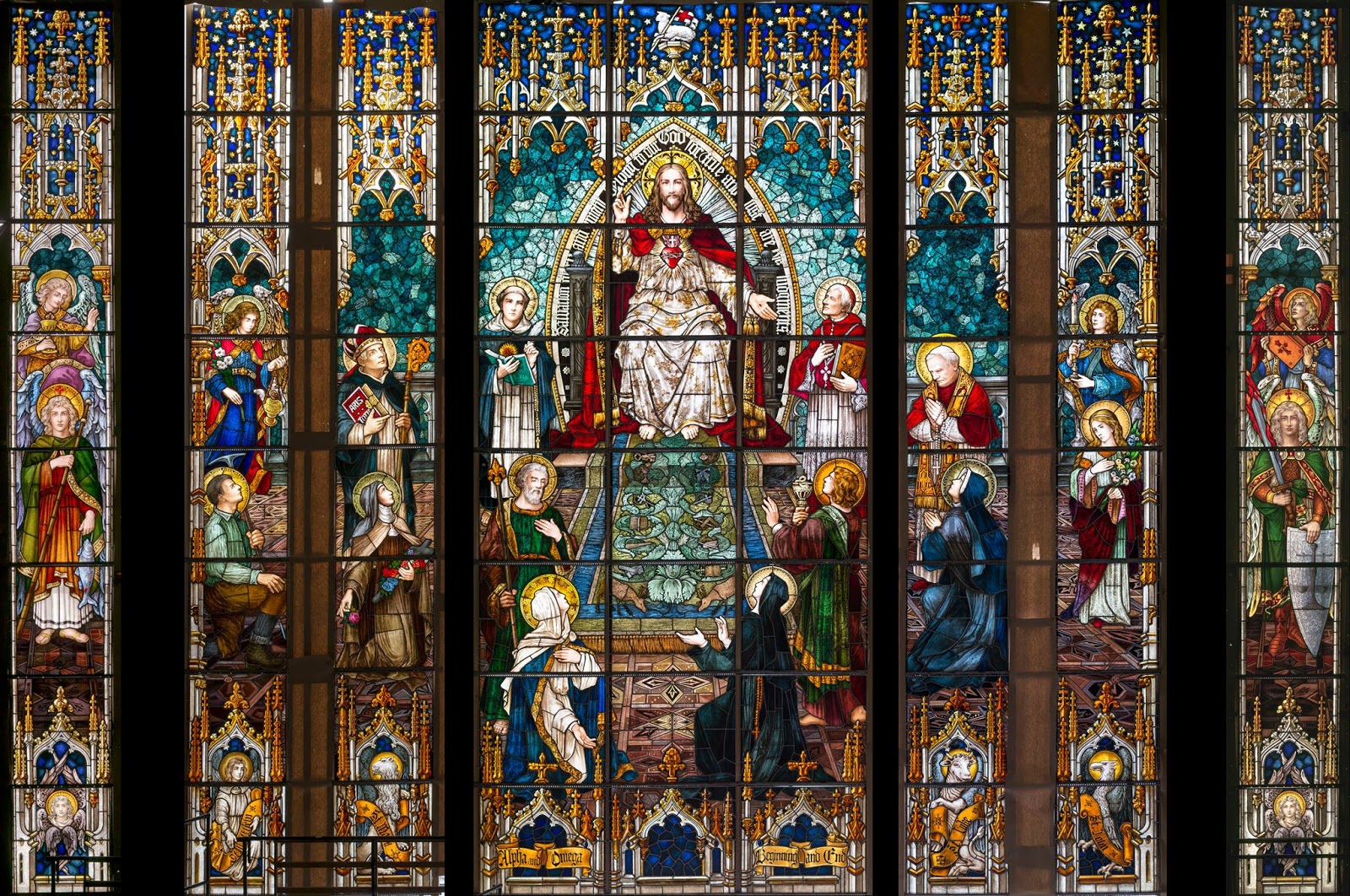
Earlier this year, Bishop Conley of Lincoln, Nebraska was on a brief speaking tour to discuss "Beauty, Culture, and the New Evangelization"; one of the stops was the Eighth Day Institute in January. During that lecture, he spoke about the new Newman Center church (not chapel) his diocese was building on the campus of the University of Nebraska-Lincoln. He wanted it to be beautiful--and chose the Gothic style of architecture as a tribute to Newman and A.W. Pugin (I teased him that Newman would not approve since he did not agree with Pugin's medieval style but preferred the classical basilica style of the early centuries in Rome--see page 5 of the article I've linked). You can see some more pictures here in this newspaper story about the church.

The cover of the July 2015 issue of the Adoremus Bulletin features a picture of the stained glass window above the Altar and behind the Rood, with this commentary by Bishop Conley:

We illustrate the indebtedness of our center to both St. Thomas Aquinas and Blessed John Newman in the stained glass window above the high altar. It’s the largest stained glass window installed in a Catholic Church in 100 years. It was built in Munich by Franz Mayer & Company. Measuring 20x24 feet, it pictures Christ on the heavenly throne surrounded by angels and saints that have to do with either learning or working with youth. To his right is St. Thomas, the Angelic doctor and great teacher of the faith, and to his left is Blessed John Henry Newman, who is the patron of Newman Centers, Catholic campus ministries and the apostolate to college students. The window also includes St. Albert the Great . . . a teacher of St. Thomas renowned in his own right for his contributions to philosophy and theology, and St. John Paul II, a great icon for the youth. The window also shows Blessed Giorgio Frassati and St. Therese of the Little Flower. All these figures in the window depict something related to young people, to the teaching or evangelizing of the youth.” – Bishop James D. Conley, Bishop of the Diocese of Lincoln

The issue contains more commentary and pictures. And here is another view of the stained glass (at the bottom of the page).


Road trip! I call shotgun!

Monday, March 30, 2015

Music for Holy Week from the Chapel of King's College, Cambridge

We venerate the wood of thy Cross, O thou who lovest mankind, for upon it thou, the life of all, was nailed. 

O Saviour, thou hast opened Paradise to the thief who turned to thee in faith, and thou hast counted him worthy of blessedness when he confessed to thee crying, 'O Lord remember me!' 

Accept us like him, as we cry: ‘We all have sinned, in thy merciful kindness despise us not.’ 

Feast of the Exaltation of the Cross; Orthodox. 

King's College, Cambridge is releasing a series of videos made inside the College Chapel featuring the stained glass windows depicting scenes of the Passion:

The films will feature Philharmonia Voices in a specially recorded performance of Grier’s Sword in the Soul, a seven-movement Passiontide sequence for choir, organ and virtuoso cello solo.

Interwoven with the footage of the Grier performance, and using it as a driving narrative force, the films explore the Passion story as portrayed in the famous stained glass windows.

The films focus on the majestic sequence of windows at the East end of the Chapel, which depict a dramatic succession of scenes including Christ before Pilate, Christ carrying the cross, his nailing to the cross, the crucifixion on Golgotha, and finally the deposition from the cross.

By exploring the windows in high resolution, the films will show the extraordinary detail of the stained glass in a way that is almost impossible for anyone viewing the windows from the floor of the Chapel.

The seven films last between two and five minutes, each one exploring a different aspect or episode of the Holy Week narrative. They will be released one by one on the King’s College website during the course of Holy Week in 2015, starting on Palm Sunday, 29 March, and culminating on Holy Saturday, 4 April.


The text of Sword in the Soul is here. More about the composition:

Grier’s Sword in the Soul was originally written in 1991 for a BBC Radio 4 broadcast, but it has not yet been commercially recorded. The imagery of the work’s sung texts, drawn from sources as diverse as the Orthodox liturgy and a 14th -century lyric poem, is particularly striking, making its 7- movement structure particularly well-suited to this visual treatment as a succession of contrasting video tableaux. As a BBC Radio 4 commission for Passiontide broadcast, Sword in the Soul was deliberately written by Grier in his most accessible and ravishing style, and this project will build on the work’s original aims by again ‘broadcasting’ it to a wide audience in Passiontide via the online release of the videos over Holy Week. 

This project is part of the 500th anniversary celebrations at the Chapel.

Saturday, April 5, 2014

The Canterbury Clerestory Windows at The Cloisters


The Metropolitan Museum of Art is hosting an exhibition of stained glass from Canterbury Cathedral at The Cloisters:

This exhibition of stained glass from England's historic Canterbury Cathedral features six Romanesque-period windows that have never left the cathedral precincts since their creation in 1178–80.

Founded in 597, Canterbury Cathedral is one of the oldest Christian structures in England. It was an important pilgrimage site in the Middle Ages—as witnessed by Geoffrey Chaucer'sCanterbury Tales, a literary masterpiece from the fourteenth century—and is also the cathedral of the Archbishop of Canterbury, the leader of the Church of England and the Anglican Communion worldwide. Recent repairs to the stonework of the magnificent historic structure necessitated the removal of several delicate stained-glass windows of unparalleled beauty. While the restoration of the walls has been undertaken, the stained glass has also been conserved.

The windows shown at The Cloisters are from the clerestory of the cathedral's choir, east transepts, and Trinity Chapel. The six figures—Jared, Lamech, Thara, Abraham, Noah, and Phalec—were part of an original cycle of eighty-six ancestors of Christ, the most comprehensive stained-glass cycle known in art history. One complete window (Thara and Abraham), rising nearly twelve feet high, is shown with its associated rich foliate border.

Masterpieces of Romanesque art, these imposing figures exude an aura of dignified power. The angular limbs, the form-defining drapery, and the encompassing folds of the mantles all add a sculptural quality to the majestic figures. The glass painting, which is attributed to the Methuselah Master, is striking for its fluid lines, clear forms, and brilliant use of color.

Blue Heron is performing at The Cloisters on Palm Sunday, April 13--both performances are sold out!

In 1541, following Henry VIII's dissolution of the monasteries, Canterbury Cathedral was re-founded as a secular cathedral. The works in the program are drawn from a set of partbooks commissioned by Canterbury from the singer and scribe Thomas Bull, then at Magdalen College, Oxford, in order to supply the cathedral's new choir of professional singers (including the youthful Thomas Tallis) with a complete repertoire of Masses, Magnificats, and votive antiphons. The centerpiece of the program is the Missa Spes nostraby Robert Jones (fl. 1520–35), a wonderful and wholly obscure composer whose only two surviving works appear in Bull's partbooks.

Radiant Light: Stained Glass from Canterbury Cathedral at The Cloisters closes on May 18, 2014--makes me want to book a flight to New York! My husband took the picture above when we visited Canterbury Cathedral many years ago.

Friday, March 28, 2014

Sunday Evening at St. Ambroise

In search of some coffee, something sweet, and some people watching, we walked down the street to Rue Voltaire on Sunday during our Paris visit, and found L'Eglise de St. Ambroise:


St. Ambroise was built between 1863 and 1868 and was consecrated on December 7, 1910. I'm not sure why there was such a gap between construction and consecration--the Franco-Prussian War, the Paris Commune and its aftermath?--but it was consecrated on the patron saint's feast day (St. Ambrose of Milan)! The architect, Theodore Ballu, also designed St. Trinite and led the reconstruction efforts on Tour St. Jacques. Inside, we found beautiful stained glass and one most wonderful side chapel:


As you might suppose, there were stained glass windows depicting St. Augustine of Hippo, St. Ambrose's most famous convert, and St. Monica. The chapel dedicated to Our Lady contained beautiful stained glass windows (and there a matching chapel dedicated to St. Joseph):


Finally, my husband took this artistic shot of the shadows and the sunset (please note all these photographs are (C) Mark U. Mann, 2014):


We did find a cafe on the corner next to the church and enjoyed some treats and lots of people watching. There was a couple and a friend, I presumed, sitting and chatting at one of the cafe tables while their little girl played with a little plastic doll with long yellow hair. She kept dunking the doll in her glass of water--I'm not sure what she was trying to get out of the doll with such torture. We watched one family wheel their luggage by our table and go down the steps of the St. Ambroise metro (line 9). The father lagged behind, checking on something in the pocket of his suitcase while the mother and daughter waited at the top of the steps. Perhaps they'd been visiting relatives in the area and were heading off to Gare de Lyon for a train ride on the TGV home in the south of France? Other families rose up from the metro, and walked by the cafe with babies in carriages, dogs on leashes, and children in hand (and one in the womb!), going home after their Sunday excursions. Eventually we walked back to our apartment after experiencing an early Sunday evening in a Parisian neighborhood--nary a word of English around us.