Showing posts with label Bishop James D. Conley. Show all posts

Thursday, February 25, 2016

Blessed John Henry Newman on Friendship


Bishop James Conley of Lincoln, Nebraska, quoted Newman in a talk given to teachers in his diocese, "reprinted" in Crisis Magazine:

My spiritual patron, Blessed John Henry Cardinal Newman, said that friendship is a school of love, a school of Christian charity. He thought that human friendship teaches us, in a particular way, how to exercise universal charity.

Newman wrote that “the best preparation for loving the world at large, and loving it duly and wisely, is to cultivate an intimate friendship and affection towards those who are immediately about us.”

Friendship is a “school of Christian charity” because friendship makes demands upon us. Our friends are those who are most close to us, who share a vision, and a mission. Our friends are collaborators in the great work—the magnum opus—of our lives. But our friends, like us, are human beings. And relationships with human beings require forgiveness, forbearance, patience, and understanding. We learn those virtues by loving our friends. Newman says that

The real love of man must depend on practice, and therefore, must begin by exercising itself on our friends around us, otherwise it will have no existence. By trying to love our relations and friends, by submitting to their wishes, though contrary to our own, by bearing with their infirmities, by overcoming their occasional waywardness by kindness, by dwelling on their excellences, and trying to copy them, thus it is that we form in our hearts that root of charity, which, though small at first, may, like the mustard seed, at last even overshadow the earth.


Bishop Conley is quoting from Newman's Parochial and Plain Sermon "Love of Relations and Friends", based upon the verse from the First Letter of St. John: "Beloved, let us love one another, for love is of God." (4:7). Blessed John Henry Newman goes to demonstrate how observing the old adage that "charity (love) begins at home" has an influence on how we respond in charity (love) to our neighbor and even those we don't know but want to help:

Further, that love of friends and relations, which nature prescribes, is also of use to the Christian, in giving form and direction to his love of mankind at large, and making it intelligent and discriminating. A man, who would fain begin by a general love of all men, necessarily puts them all on a level, and, instead of being cautious, prudent, and sympathising in his benevolence, is hasty and rude; does harm, perhaps, when he means to do good, discourages the virtuous and well-meaning, and wounds the feelings of the gentle. Men of ambitious and ardent minds, for example, desirous of doing good on a large scale, are especially exposed to the temptation of sacrificing individual to general good in their plans of charity. Ill-instructed men, who have strong abstract notions about the necessity of showing generosity and candour towards opponents, often forget to take any thought of those who are associated with themselves; and commence their (so-called) liberal treatment of their enemies by an unkind desertion of their friends. This can hardly be the case, when men cultivate the private charities, as an introduction to more enlarged ones. By laying a foundation of social amiableness, we insensibly learn to observe a due harmony and order in our charity; we learn that all men are not on a level; that the interests of truth and holiness must be religiously observed; and that the Church has claims on us before the world. We can easily afford to be liberal on a large scale, when we have no affections to stand in the way. Those who have not accustomed themselves to love their neighbours whom they have seen, will have nothing to lose or gain, nothing to grieve at or rejoice in, in their larger plans of benevolence. They will take no interest in them for their own sake; rather, they will engage in them, because expedience demands, or credit is gained, or an excuse found for being busy. Hence too we discern how it is, that private virtue is the only sure foundation of public virtue; and that no national good is to be expected (though it may now and then accrue), from men who have not the fear of God before their eyes.

That reminded me of the goals of Blessed Frederic Ozanam and the Society of St. Vincent de Paul: not organized, systematic philanthropy, but personal, immediate charity from one Christian to another.

The first coat of arms at the top is Bishop Conley's, the second is Cardinal Newman's.

Tuesday, September 1, 2015

Blessed John Henry Newman in Lincoln, Nebraska


Earlier this year, Bishop Conley of Lincoln, Nebraska was on a brief speaking tour to discuss "Beauty, Culture, and the New Evangelization"; one of the stops was the Eighth Day Institute in January. During that lecture, he spoke about the new Newman Center church (not chapel) his diocese was building on the campus of the University of Nebraska-Lincoln. He wanted it to be beautiful--and chose the Gothic style of architecture as a tribute to Newman and A.W. Pugin (I teased him that Newman would not approve since he did not agree with Pugin's medieval style but preferred the classical basilica style of the early centuries in Rome--see page 5 of the article I've linked). You can see some more pictures here in this newspaper story about the church.

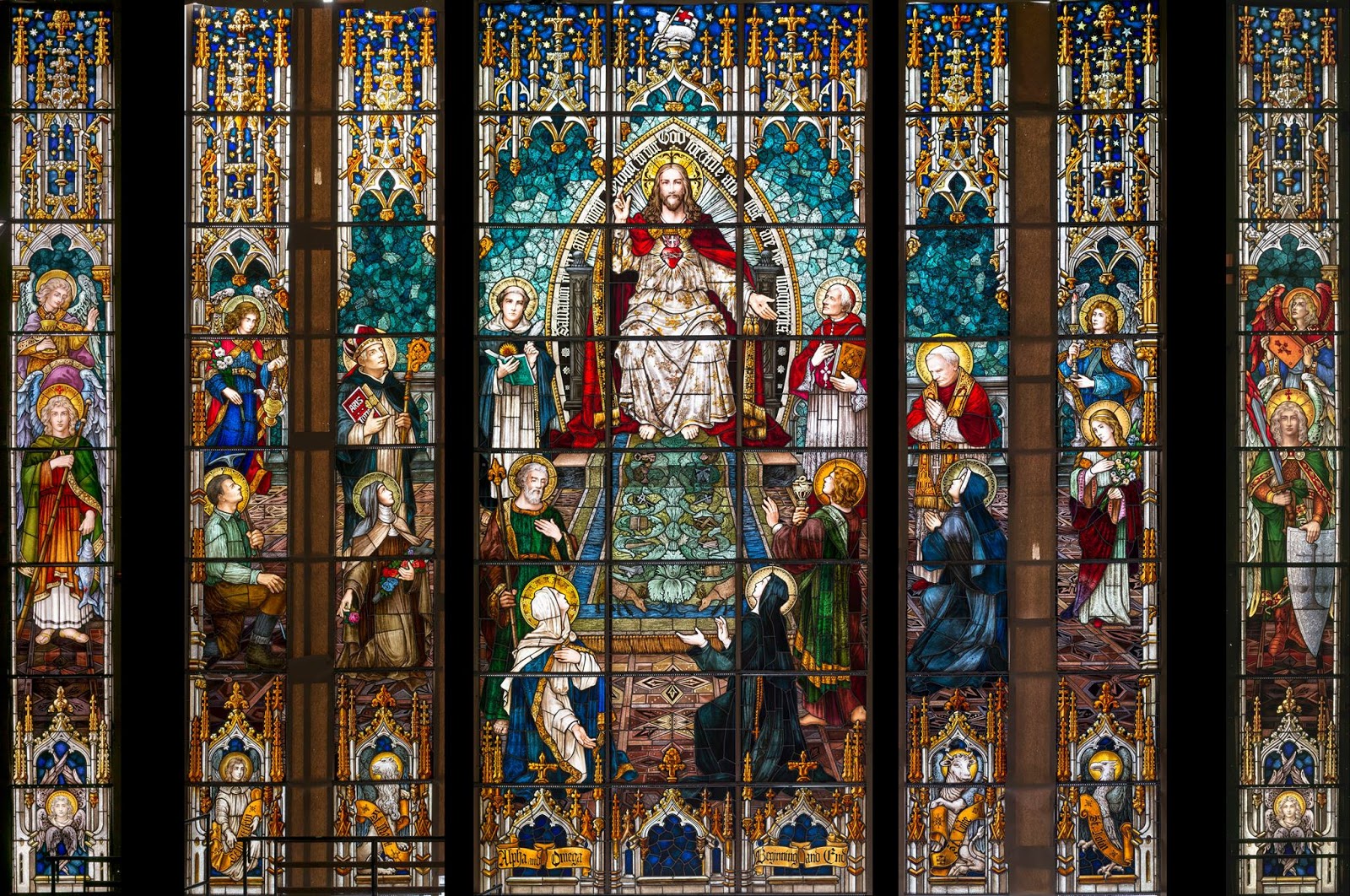
The cover of the July 2015 issue of the Adoremus Bulletin features a picture of the stained glass window above the Altar and behind the Rood, with this commentary by Bishop Conley:

We illustrate the indebtedness of our center to both St. Thomas Aquinas and Blessed John Newman in the stained glass window above the high altar. It’s the largest stained glass window installed in a Catholic Church in 100 years. It was built in Munich by Franz Mayer & Company. Measuring 20x24 feet, it pictures Christ on the heavenly throne surrounded by angels and saints that have to do with either learning or working with youth. To his right is St. Thomas, the Angelic doctor and great teacher of the faith, and to his left is Blessed John Henry Newman, who is the patron of Newman Centers, Catholic campus ministries and the apostolate to college students. The window also includes St. Albert the Great . . . a teacher of St. Thomas renowned in his own right for his contributions to philosophy and theology, and St. John Paul II, a great icon for the youth. The window also shows Blessed Giorgio Frassati and St. Therese of the Little Flower. All these figures in the window depict something related to young people, to the teaching or evangelizing of the youth.” – Bishop James D. Conley, Bishop of the Diocese of Lincoln

The issue contains more commentary and pictures. And here is another view of the stained glass (at the bottom of the page).


Road trip! I call shotgun!

Wednesday, April 22, 2015

Bishop Conley Talks About Beauty and Helps Design Beautiful Church in Nebraska

When Bishop Conley spoke at the Eighth Day Institute here in Wichita this January, he talked about the new church being built for the large number of Catholic students at the University of Nebraska-Lincoln campus. Now there's a story about the new church, with pictures of several features:

The resulting St. Thomas Aquinas Catholic Church and Newman Center is a bow to tradition and a beacon of hope and adoration of God in the heart of a secular campus.

The original mural of storm clouds behind the altar has been replaced with a massive, awe-inspiring stained glass window. At the center of the window is a youthful Christ with an exposed sacred heart. Fourteen saints and blesseds are gathered in adoration around Christ. Students hand-picked each of the men and women, with the exception of Saint Albert – the 13th century saint stands to the left of his student Saint Thomas Aquinas to depict the importance of student-teacher relationships.


The simple, gold tabernacle that used to stand alone behind the altar is now housed in a grand, repurposed 125-year-old altar of repose with gold, red, and blue detailing. An outdoor courtyard on the north side of the Church has been replaced with a Marian chapel.

A new dome floods the Church with natural light. The dome’s pendentives mirror those in St. Peter’s Basilica: depicting St. Longinus, St. Veronica, St. Andrew, and St. Helena.


Read and see the rest there

Also, Bishop Conley gave the last talk at The Catholic Artists Society and the Thomistic Institute series of lectures on The Art of the Beautiful: Redeeming Culture in Christ in March this year. You may hear all of the lectures from that series (and some other recordings) here. Bishop Conley presented some of the same material in January.

Monday, May 30, 2011

May 30, 1847

Mr. John Henry Newman, former Church of England clergyman, was ordained to the Catholic priesthood on Trinity Sunday, May 30, 1847 in Rome. (Bishop James D. Conley, Auxiliary Bishop of Denver, celebrates his third anniversary of ordination to the episcopate this year on the same date!--he was formerly pastor of my parish.) Newman had studied for ordination at the Propaganda Fidei. Part of his preparation had been the discernment of a particular path for his priestly vocation and he had chosen the Oratory of St. Philip Neri. This book by Placid Murray is very helpful to understanding why Blessed John Henry Newman decided to bring the Oratory Movement to England; for one thing he sought a community where his erstwhile Tractarians could be united.

When Pope Benedict XVI beatified Newman during his visit to England last September, he highlighted the Blessed's role as a priest in Birmingham:

While it is John Henry Newman’s intellectual legacy that has understandably received most attention in the vast literature devoted to his life and work, I prefer on this occasion to conclude with a brief reflection on his life as a priest, a pastor of souls. The warmth and humanity underlying his appreciation of the pastoral ministry is beautifully expressed in another of his famous sermons: "Had Angels been your priests, my brethren, they could not have condoled with you, sympathized with you, have had compassion on you, felt tenderly for you, and made allowances for you, as we can; they could not have been your patterns and guides, and have led you on from your old selves into a new life, as they can who come from the midst of you" ("Men, not Angels: the Priests of the Gospel", Discourses to Mixed Congregations, 3). He lived out that profoundly human vision of priestly ministry in his devoted care for the people of Birmingham during the years that he spent at the Oratory he founded, visiting the sick and the poor, comforting the bereaved, caring for those in prison. No wonder that on his death so many thousands of people lined the local streets as his body was taken to its place of burial not half a mile from here. One hundred and twenty years later, great crowds have assembled once again to rejoice in the Church’s solemn recognition of the outstanding holiness of this much-loved father of souls. What better way to express the joy of this moment than by turning to our heavenly Father in heartfelt thanksgiving, praying in the words that Blessed John Henry Newman placed on the lips of the choirs of angels in heaven:

Praise to the Holiest in the height
And in the depth be praise;
In all his words most wonderful,
Most sure in all his ways!
(The Dream of Gerontius).