Showing posts with label Northern Rebellion. Show all posts

Saturday, August 22, 2015

August Martyrs: Blessed Thomas Percy

Today's martyr is Blessed Thomas Percy, the seventh Earl of Northumberland, beatified in 1895. Pope Leo XIII made some interesting choices of English martyrs to beatify. For example, Blessed Thomas Percy's father, Sir Thomas Percy, executed for his part in the Pilgrimage of Grace, has not been beatified or canonized, even though "he also is considered a martyr by many". Often, when the proposed martyr was part of a military or other organized rebellion, his cause is "passed over" because the intention and purpose of his action is mixed with secular matters. Pope Leo also beatified Margaret Pole, and she was a victim for her Faith--her sons were caught up in matters that really mixed the sacred and secular. Reginald Pole in exile had angered Henry VIII with his attack against his marital and ecclesiastical actions, while her other sons were implicated in a plot against the monarch. Her execution was the result of Henry VIII's desire to destroy the Pole family. Pope Leo beatified Blessed John Felton and Blessed Thomas Plumtree, also in connection with the Northern Rebellion. Felton may be accused of inciting rebellion, but Father Plumtree was definitely martyred for his priesthood and the Catholic Faith.

There is a stained glass window depicting the martyr at Petworth in the Church of the Sacred Heart.


Earl of Northumberland, martyr, born in 1528; died at York, 22 August, 1572. He was the eldest son of Sir Thomas Percy, brother of the childless Henry Percy, sixth Earl of Northumberland, and Eleanor, daughter of Sir Guiscard Harbottal. When Thomas was eight years old his father was executed at Tyburn (2 June, 1537) for having taken a leading part in the Pilgrimage of Grace, and he also is considered a martyr by many. Thomas and his brother Henry were then removed from their mother's keeping and entrusted to Sir Thomas Tempest. 

In 1549, when Thomas Percy came of age, an Act was passed "for the restitution in blood of Mr. Thomas Percy". Shortly afterwards he was knighted, and, three years later, in Queen Mary's reign, he regained his ancestral honours and lands. Declared governor of Prudhoe Castle he besieged and took Scarborough Castle, which was seized by rebels in 1557. In reward the Earldom of Northumberland together with the Baronies of Percy, Poynings, Lucy, Bryan, and Fitzpane were restored to him. He was installed at Whitehall with great pomp, and soon after was named Warden General of the Marches, in which capacity he fought and defeated the Scots. In 1558 he married Anne Somerset, daughter of the Earl of Worcester, a valiant woman who subsequently suffered much for the Faith. 

On Elizabeth's accession the earl, whose steadfast loyalty to the Catholic Church was known, was kept in the North while the anti-Catholic measures of Elizabeth's first Parliament were passed. Elizabeth continued to show him favour, and in 1563 gave him the Order of the Garter. He had then resigned the wardenship and was living in the South. But the systematic persecution of the Catholics rendered their position most difficult, and in the autumn of 1569 the Catholic gentry in the North, stirred up by rumours of the approaching excommunication of Elizabeth, were planning to liberate Mary, Queen of Scots, and obtain liberty of worship. Earl Thomas with the Earl of Westmoreland wrote to the pope asking for advice, but before their letter reached Rome circumstances hurried them into action against their better judgment. After a brief success the rising failed, and Thomas fled to Scotland, where he was captured and, after three years, sold to the English Government. He was conducted to York and beheaded, refusing to save his life by abandoning his religion. He was beatified by Leo XIII on 13 May, 1895, and his festival was appointed to be observed in the Dioceses of Hexham and Newcastle on 14 November. His daughter Mary founded the Benedictine convent at Brussels from which nearly all the existing houses of Benedictine nuns in England are descended. 

About his widow, Wikipedia reports:

After the [Northern Rebellion] was put down by Baron Hunsdon's troops, Anne and Percy fled to Scotland where they sought refuge with Hector Graham of Harlaw, a Border outlaw. In June 1570, Anne gave birth to her daughter, Mary in Old Aberdeen. When Graham betrayed her husband to James Douglas, 4th Earl of Morton, she and her baby escaped to the Continent, arriving in Bruges on 31 August 1570, where she sought aid from Pope Pius V and King Philip II of Spain to raise money for her husband's ransom; the Pope gave her four thousand crowns and King Philip sent her six thousands marks. It was to no avail. Anne would spend the rest of her life as an exile in Flanders, while in 1572, Earl Morton sold her husband to Queen Elizabeth who had him publicly executed at York for treason.

In Liège while living on a pension provided by King Philip, she wrote and circulated Discours des troubles du Comte du Northumberland. She spent the next decade travelling from place to place in Flanders, maintaining contact with the other English Catholic exiles. In 1573, English agents described Anne as "one of the principal practitioners at Mechlin". In 1576, she was briefly expelled from the territory to placate Queen Elizabeth, but returned shortly afterwards. At one stage she endeavoured to arrange a marriage between Don John of Austria and the captive Mary, Queen of Scots. She left her three oldest daughters behind in England when she escaped after the failed Northern Rebellion. They were raised at Petworth by her late husband's brother, Henry Percy who had succeeded as the 8th Earl of Northumberland. He was married to Katherine Neville, the eldest daughter of her half-sister, Lucy. Her youngest daughter, Mary who had accompanied her to the Continent, became the prioress of the Benedictine convent in Brussels which she had herself founded.

In September 1591, Charles Paget, an exile in Antwerp, informed the Percy's that Anne had died and requested that they send her daughter Joan to Flanders to fetch her belongings. This had been only a ruse designed to enable Anne to see her daughter. In point of fact, Anne died of smallpox five years later on 17 October 1596 at a convent in Namur.

About the Benedictine convent his daughter Mary Percy founded:  Known as the Monastery of the Glorious Assumption. Founded by Lady Mary Percy in 1597/8; it was the first of the new foundations specifically for English women. The convent quickly attracted members, but a bitter dispute over the choice of confessor that continued many years affected recruitment. Once a resolution was reached the convent began to flourish again remaining in Brussels until forced to withdraw by the effects of the revolutionary wars in 1794. They arrived in Winchester in 1794 and remained there until they transferred to East Bergholt, Suffolk. (Per this site, studying the English religious orders in exile.) That study, funded by the Queen Mary University of London and the Arts & Humanities Research Council, also resulted in this book from Ashgate:

In 1598, the first English convent was established in Brussels and was to be followed by a further 21 enclosed convents across Flanders and France with more than 4,000 women entering them over a 200-year period. In theory they were cut off from the outside world; however, in practice the nuns were not isolated and their contacts and networks spread widely, and their communal culture was sophisticated. Not only were the nuns influenced by continental intellectual culture but they in turn contributed to a developing English Catholic identity moulded by their experience in exile. During this time, these nuns and the Mary Ward sisters found outlets for female expression often unavailable to their secular counterparts, until the French Revolution and its associated violence forced the convents back to England. This interdisciplinary collection demonstrates the cultural importance of the English convents in exile from 1600 to 1800 and is the first collection to focus solely on the English convents.

Thursday, August 22, 2013

August 22, 1553 and 1572


On August 22nd, 1553, John Dudley, the First Duke of Northumberland, was executed for his role in the attempted coup d'etat to place his daughter-in-law, Jane Dudley (nee Grey) on the throne, diverting the succession from Mary Tudor as Queen of England and Ireland.


On August 22nd, 1572, Thomas Percy, Seventh Earl of Northumberland, was executed for his role in the Northern Rebellion, which might have had the result of deposing Elizabeth I and placing Mary, the erstwhile Queen of Scots on the throne of England and Ireland (and Scotland).

What a fascinating circumstance, that two scions of the same household would die on the same date, with 19 years separating their executions! These two men have another thing in common: at the block both of them spoke strongly of their Catholic faith. John Dudley reverted to Catholicism while in the Tower of London--perhaps he hoped for mercy from Mary--and he publicly retracted and regretted the efforts of the Edwardine government to introduce Calvinist reforms, warning the people against listening to deceptive preachers teaching new things:

And one thing more good people I have to say unto you, which I am chiefly moved to do for discharge of my conscience; that is to warn you and exhort you to beware of these seditious preachers, and teachers of new doctrine, which pretend to preach God's word, but in very deed they preach their own fancies, who were never able to explicate themselves, they know not today what they would have tomorrow, there is no stay in their teaching; doctrine, they open the book, but they cannot shut it again. Take heed how you enter into strange opinions or new doctrine, which hath done no small hurt in this realm, and hath justly procured the ire and wrath of god upon us, as well may appear who so list to call to remembrance the manyfold plagues that this realm hath been touched with all since we dissevered ourselves from the catholic church of Christ, and from the doctrine which hath been received by the holy apostles, martyrs, and all saints, and used through all realms christened since Christ.

And I verily believe, that all the plagues that have chanced to this realm of late years since afore the death of king Henry the eight, hath justly fallen upon us, for that we have deuvded ourself from the rest of Christendom whereof we be but as a spark in comparison: Have we not had war, famine, pestilence, the death of our king, rebellion, sedition among ourselves, conspiracies? Have we not had sundry erroneous opinions sprung up among us in this realm, since we have forsaken the unity of the catholic Church? and what other plagues be there that we have not felt?

Thomas Percy was stubbornly recalcitrant, in the Elizabethan government's view, as a Catholic, not repenting of his betrayal of Elizabeth, but warning the English that they were schismatic. While he was in prison, and on the scaffold, he was urged to conform to the Church of England and thus save his life, but he declared himself a lifelong Catholic and would not budge. In defiance of the norms of executions, he did not repent of his sins against the queen or warn others against committing such sins after him--his only regret was for the common people who suffered for their zeal in defending the Catholic Church. He is one of the Ten Blessed Martyrs of Sussex and a stained glass window honors him in Sacred Heart Church, Petworth.

Saturday, April 27, 2013

Three Generations of Trouble: Henry Percy


Henry Percy, the 9th Earl of Northumberland AKA "The Wizard Earl" was born on April 27, 1564. His father was also named Henry Percy, but he was the 8th Earl of Northumberland, receiving that title when his brother, the Wizard Earl's uncle, Thomas Percy, 7th Earl of Northumbland was executed in 1572 for his leadership of the Northern Rebellion--and Thomas Percy was beatified by Pope Leo XIII as a martyr! The Wizard Earl's father died in the Tower of London, imprisoned there under suspicion of treason. His grandfather had also run afoul of the Tudor monarch of his era, as Sir Thomas Percy was executed by Henry VIII in 1537 for his involvement in the Pilgrimage of Grace (I'm not sure why he hasn't been beatified as a martyr if his son has been). I think we can see a pattern of trouble in this family's relationship to the Tudors--and it held true for the Wizard Earl during the reign of James I of England.

According to this website:

Henry Percy, the 9th or ‘Wizard’ Earl of Northumberland led an extraordinary life of a true Renaissance nobleman, despite his deafness and 15 years as a prisoner. He was a great scholar, became the patron of the English astronomer Thomas Harriot, the first man to map the surface of the moon before Galileo and earned his nickname ‘Wizard’ by experimenting in alchemy. He was a friend of Sir Walter Raleigh and their interest in the New World led them to consume great quantities of tobacco and potatoes. But it was on 4 November 1605, that the Earl’s fortunes declined literally overnight! A distant cousin, Thomas Percy, who was a staunch Roman Catholic, dined with the Earl at Syon before joining Guy Fawkes and his accomplices the next day, in the attempt to blow up the Houses of Parliament. As one of the principal ‘gunpowder plotters’, Thomas was shot trying to make his escape. Although innocent of the charges brought against him, the Earl was implicated through his association with Thomas and the fateful meeting at Syon. He was confined in the Tower of London for the next 15 years on the orders of King James I.

The 9th Earl was known as the Wizard Earl because of his great interest in science--even in alchemy--and his development of a great library. He was eventually released from the Tower and he died on November 5, 1632. Believe it--or not!
 
Alexander Rose's Kings in the North: The House of Percy in British History tells the story of this family and one reviewer summarized the generations of trouble and adventure they exemplify:
 
Over the past eight centuries, two earls and one duke have been killed in battle, most recently in 1940; one has been lynched by a mob; one beheaded for treason, one shot by government assassins, five incarcerated in the Tower for more or less prolonged periods, and one beatified by the Church of Rome. It is a striking record of public service or disservice, depending on your point of view. The Percys are still the owners of Alnwick Castle and Syon House, and are among the largest landowners in Britain. . . .
 
As soon as the Scottish menace faded in the 16th century, the Percys lost their power. The Tudors no longer needed a viceroy in the north. The sixth earl was ruined by Henry VIII, the seventh executed by Elizabeth, the eighth murdered in the Tower and the ninth abandoned politics for chemistry and astronomy. His successors abandoned the north altogether, and went to live on their Sussex and London estates. The modern fortunes of the family are due to Sir Hugh Smithson, who married the last Percy heiress in the 18th century, adopted her name, and re-established the family as a great northern dynasty.

Tuesday, March 5, 2013

Devotion to the Five Wounds of Christ

During my hour of Adoration before the Blessed Sacrament at Blessed Sacrament Church this Sunday, I prayed from A Prayer Book of Catholic Devotions: Praying the Seasons and Feasts of the Church Year, compiled by William G. Storey, DMS, Professor Emeritus of Liturgy and Church History at the University of Notre Dame and published by Loyola Press.


Among the devotions he includes for Lent is to the Five Wounds of Jesus, beginning with this hymn attributed to Thomas a Kempis and translated by John Mason Neale:

O love, how deep, how broad, how high,
How passing thought and fantasy,
That God, the Son of God should take
Our mortal form for mortals' sake.

For us to evil power betrayed,
Scourged, mocked, in purple robe arrayed,
He bore the shameful cross and death,
For us gave up his dying breath.

For us he rose from death again;
For us he went on high to reign;
For us he sent the Spirit here
To guide, to strengthen, and to cheer.

All glory to our Lord and God
For love so deep, so high, so broad:
The Trinity whom we adore
Forever and forevermore.

Then follows a little office of devotion to the Five Wounds. Dr. Storey also includes another devotion attributed to St. Clare of Assisi with prayers to each of the Five Wounds: one in each hand, one in each foot, and one in Our Savior's side.

As you might recall, devotion to the Five Wounds of Jesus was very popular in England before the Reformation and became a symbol of opposition to the Henrician and Elizabethan religious changes. Both the Pilgrimage of Grace and the North Rebellion used the banner of the Five Wounds.


More on this devotion here, from the aptly named Fish Eaters.

Saturday, September 8, 2012

Episode Six of "The English Reformation Today"!

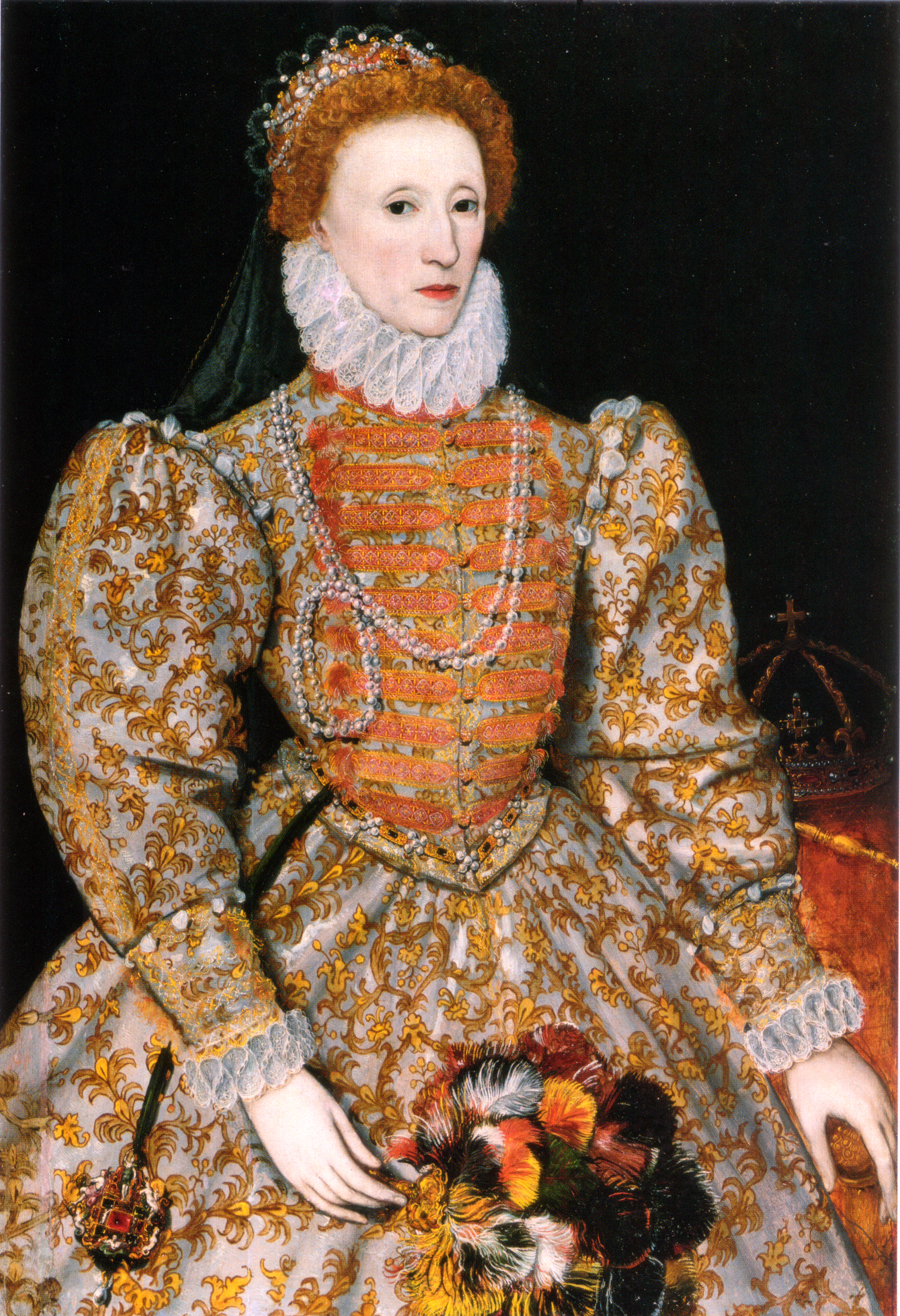
File:Darnley stage 3.jpgSince today is the Feast of the Nativity of the Blessed Virgin Mary, I'll begin this broadcast with the Collect for the Feast--and with the note that Elizabethan England celebrated the birth of the last Tudor monarch with more festivity than that of the Mother of God!

Starting with some biographical notes about Elizabeth Tudor (pictured at left: Wikipedia commons source), I'll then discuss her Reformation Parliament--Catholic resistance--the Via Media of the Church of England (39 Articles and the Book of Common Prayer. I'll also discuss how the compromise of the established church, between Calvinism and Catholicism, pleased no one, as "Puritans" were disappointed in the incomplete Reform and latent "Popishness" of the Church of England.

Then recusancy and resistance, rebellion and martyrdom will occupy much of the broadcast, as I discuss The Northern Rebellion, Pope St. Pius V's Papal Bull "Regnans in Excelsis", and the choice Catholics faced: loyalty to country; loyality to Church. The efforts of missionary priests; their dangerous missions; the laity's way of dealing with recusancy and conformity--those issues are very important and highlight the struggles and sacrifices of Catholics during Elizabeth's 45 year reign.

Next week, I'll wrap up the discussion of Elizabeth by looking at the diplomatic struggles she faced with Mary, Queen of Scots and Philip II of Spain--in the religious context of the 16th century, including war in the Spanish Netherlands, the Spanish Armada, reaction to its failure, war in Ireland, and the succession. This Virgin Queen left no offspring to follow her on the throne, so James VI of Scotland, Mary of Scotland's son, comes south in 1603 when Elizabeth dies.

Supremacy and Survival: How Catholics Endured the English Reformation is an excellent resource for understanding this reign, although I do say so myself.  welcome all listeners of Radio Maria US to my blog, whether you're listening on one of their radio stations or on line or through one of their apps.  I invite you to call in with questions and comments toll-free at 866-333-MARY(6279). Just a reminder, too, that podcasts of previous episodes of The English Reformation Today are available on the Radio Maria US website.

Wednesday, August 22, 2012

Martyr of the Northern Rebellion: Blessed Thomas Percy


Earl of Northumberland, martyr, born in 1528; died at York, 22 August, 1572. He was the eldest son of Sir Thomas Percy, brother of the childless Henry Percy, sixth Earl of Northumberland, and Eleanor, daughter of Sir Guiscard Harbottal. When Thomas was eight years old his father was executed at Tyburn (2 June, 1537) for having taken a leading part in the Pilgrimage of Grace, and he also is considered a martyr by many. Thomas and his brother Henry were then removed from their mother's keeping and entrusted to Sir Thomas Tempest.

In 1549, when Thomas Percy came of age, an Act was passed "for the restitution in blood of Mr. Thomas Percy". Shortly afterwards he was knighted, and, three years later, in Queen Mary's reign, he regained his ancestral honours and lands. Declared governor of Prudhoe Castle he besieged and took Scarborough Castle, which was seized by rebels in 1557. In reward the Earldom of Northumberland together with the Baronies of Percy, Poynings, Lucy, Bryan, and Fitzpane were restored to him. He was installed at Whitehall with great pomp, and soon after was named Warden General of the Marches, in which capacity he fought and defeated the Scots. In 1558 he married Anne Somerset, daughter of the Earl of Worcester, a valiant woman who subsequently suffered much for the Faith.

On Elizabeth's accession the earl, whose steadfast loyalty to the Catholic Church was known, was kept in the North while the anti-Catholic measures of Elizabeth's first Parliament were passed. Elizabeth continued to show him favour, and in 1563 gave him the Order of the Garter. He had then resigned the wardenship and was living in the South. But the systematic persecution of the Catholics rendered their position most difficult, and in the autumn of 1569 the Catholic gentry in the North, stirred up by rumours of the approaching excommunication of Elizabeth, were planning to liberate Mary, Queen of Scots, and obtain liberty of worship. Earl Thomas with the Earl of Westmoreland wrote to the pope asking for advice, but before their letter reached Rome circumstances hurried them into action against their better judgment. After a brief success the rising failed, and Thomas fled to Scotland, where he was captured and, after three years, sold to the English Government. He was conducted to York and beheaded, refusing to save his life by abandoning his religion. He was beatified by Leo XIII on 13 May, 1895, and his festival was appointed to be observed in the Dioceses of Hexham and Newcastle on 14 November. His daughter Mary founded the Benedictine convent at Brussels from which nearly all the existing houses of Benedictine nuns in England are descended.

About his widow, Wikipedia reports:

After the [Northern Rebellion] was put down by Baron Hunsdon's troops, Anne and Percy fled to Scotland where they sought refuge with Hector Graham of Harlaw, a Border outlaw. In June 1570, Anne gave birth to her daughter, Mary in Old Aberdeen. When Graham betrayed her husband to James Douglas, 4th Earl of Morton, she and her baby escaped to the Continent, arriving in Bruges on 31 August 1570, where she sought aid from Pope Pius V and King Philip II of Spain to raise money for her husband's ransom; the Pope gave her four thousand crowns and King Philip sent her six thousands marks. It was to no avail. Anne would spend the rest of her life as an exile in Flanders, while in 1572, Earl Morton sold her husband to Queen Elizabeth who had him publicly executed at York for treason.

In Liège while living on a pension provided by King Philip, she wrote and circulated Discours des troubles du Comte du Northumberland. She spent the next decade travelling from place to place in Flanders, maintaining contact with the other English Catholic exiles. In 1573, English agents described Anne as "one of the principal practitioners at Mechlin". In 1576, she was briefly expelled from the territory to placate Queen Elizabeth, but returned shortly afterwards. At one stage she endeavoured to arrange a marriage between Don John of Austria and the captive Mary, Queen of Scots. She left her three oldest daughters behind in England when she escaped after the failed Northern Rebellion. They were raised at Petworth by her late husband's brother, Henry Percy who had succeeded as the 8th Earl of Northumberland. He was married to Katherine Neville, the eldest daughter of her half-sister, Lucy. Her youngest daughter, Mary who had accompanied her to the Continent, became the prioress of the Benedictine convent in Brussels which she had herself founded.

In September 1591, Charles Paget, an exile in Antwerp, informed the Percy's that Anne had died and requested that they send her daughter Joan to Flanders to fetch her belongings. This had been only a ruse designed to enable Anne to see her daughter. In point of fact, Anne died of smallpox five years later on 17 October 1596 at a convent in Namur.

Pope Leo XIII made some interesting choices of English martyrs to beatify. For example, Blessed Thomas Percy's father, Sir Thomas Percy, executed for his part in the Pilgrimage of Grace, has not been beatified or canonized, even though "he also is considered a martyr by many". Often, when the proposed martyr was part of a military or other organized rebellion, his cause is "passed over" because the intention and purpose of his action is mixed with secular matters. Pope Leo also beatified Margaret Pole, and she was a victim for her Faith--her sons were caught up in matters that really mixed the sacred and secular. Reginald Pole in exile had angered Henry VIII with his attack against his marital and ecclesiastical actions, while her other sons were implicated in a plot against the monarch. Her execution was the result of Henry VIII's desire to destroy the Pole family. Pope Leo beatified Blessed John Felton and Blessed Thomas Plumtree, also in connection with the Northern Rebellion. Felton may be accused of inciting rebellion, but Father Plumtree was definitely martyred for his priesthood and the Catholic Faith.

As to Mary Percy's Benedictine convent:  Known as the Monastery of the Glorious Assumption. Founded by Lady Mary Percy in 1597/8; it was the first of the new foundations specifically for English women. The convent quickly attracted members, but a bitter dispute over the choice of confessor that continued many years affected recruitment. Once a resolution was reached the convent began to flourish again remaining in Brussels until forced to withdraw by the effects of the revolutionary wars in 1794. They arrived in Winchester in 1794 and remained there until they transferred to East Bergholt, Suffolk. (Per this site, studying the English religious orders in exile.)

Wednesday, August 8, 2012

Blessed John Felton and Son on the Son Rise Morning Show

I'll be on the Son Rise Morning Show this morning at 6:45 a.m. Central/7:45 a.m. Eastern to discuss Blessed John Felton and his son, Blessed Thomas Felton.

Blessed John Felton (executed 8 August 1570) was an English Catholic martyr, who was executed during the reign of Elizabeth I:

Almost all of what is known about Felton's background comes from the narrative of his daughter, Frances Salisbury. The manuscript that holds her story has a blank where his age should be, but it does say that he was a wealthy man of Norfolk ancestry, who lived at Bermondsey Abbey near Southwark. He "was a man of stature little and of complexion black". His wife had been a playmate of Elizabeth I, a maid-of-honour to Queen Mary and the widow of one of Mary's auditors (a legal official of the papal court).

Felton was arrested for fixing a copy of Pope Pius V's Bull Regnans in Excelsis ("reigning on high"), excommunicating Queen Elizabeth, to the gates of the Bishop of London's palace near St. Paul's. This was a significant act of treason as the document, which released Elizabeth's subjects from their allegiance, needed to be promulgated in England before it could take legal effect. The deed brought about the end of the previous policy of tolerance towards those Catholics who were content occasionally to attend their parish church while keeping their true beliefs to themselves. . . . 
[this policy had already ended, and not just with the Northern Rebellion of 1569; the fines for recusancy had been mounting because the government was becoming frustrated with how Catholics were holding out against conformity]

The law records say that the act was committed around eleven at night on 24 May 1570, but Salisbury claims it happened between two and three in the morning of the following day, the Feast of Corpus Christi. Felton had received the bulls in Calais and given one to a friend, William Mellowes of Lincoln's Inn. This copy was discovered on 25 May and after being racked, Mellowes implicated Felton, who was arrested on 26 May. Felton immediately confessed and glorified in his deed, "treasonably declar[ing] that the queen . . . ought not to be the queen of England", but he was still racked as the authorities were seeking, through his testimony, to implicate Guerau de Spes, the Ambassador of Spain, in the action. Felton was condemned on 4 August and executed by hanging four days later in St. Paul's Churchyard, London. He was cut down alive for quartering, and his daughter says that he uttered the holy name of Jesus once or twice when the hangman had his heart in his hand. He was beatified in 1886 by Pope Leo XIII.

His son, Blessed Thomas Felton, was a Franciscan friar, born about 1567 at Bermondsey Abbey, Surrey, was in his youth page to Lady Lovett. Afterwards he was sent to the English College at Rheims, where he received the first tonsure from the hands of the Cardinal de Guise, archbishop of Rheims, in 1583. He then entered the order of Minims, but being unable to endure its austerities he returned to England. On landing in England Fleton was arrested, brought to London, and committed to the Poultry Compter. About two years later his aunt, Mrs. Blount, obtained his release through the interest of some of her friends at court. He attempted to return to France, but was again intercepted and committed to Bridewell. After some time he regained his liberty, and made a second attempt to get back to Rheims, but was rearrested and recommitted to Bridewell, where he was put into "Little Ease" and otherwise cruelly tortured. He was brought to trial at Newgate, just after the defeat of the Spanish Armada, and was asked whether, if the Spanish forces had landed, he would have taken the part of Queen Elizabeth. His reply was that he would have taken part with God and his country. But he refused to acknowledge the queen to be the Supreme Head of the Church of England, and was accordingly condemned to death. The next day, 28 August 1588, he and another priest, named James Claxton or Clarkson, were conveyed on horseback from Bridewell to the place of execution, between Brentford and Hounslow, and were there hanged and quartered. Like his father, he was beatified in 1886 by Pope Leo XIII.

The Minims or Order of Minim Friars were founded by St. Francis of Paola in Italy during the fifteenth century. The "austerities" mentioned above include not just the usual vows of chastity, poverty, and obedience, but a vow of a "Lenten way of life"--constant abstinence from meat and dairy products.

On the other hand, if you like Paulaner beer from Munich, that's from a former Minim friary! The Son Rise Morning Show will surely enjoy such detail from me this morning--I'll be talking to Matt Swaim since Brian Patrick is out of town at EWTN and you can listen live and find podcasts (a couple of days after the show airs) here.

Thursday, July 26, 2012

Blessed George Swallowell, Layman

I posted earlier this week on St. John Boste and Blessed John Ingram--today is the anniversary of the death of Blessed George Swallowell on July 26, 1594 in Darlington. He was a layman and former Anglican minister and was condemned to death for the crime of becoming a Catholic, which was not just a felony punishable by hanging, but an act of treason--according to Parlimentary statute--punishable by drawing, hanging, and quartering.

This story provides some excellent background to the situation of Catholics in Durham, especially after the Northern Rebellion, when many showed themselves most ready and willing to return to the Catholic faith. About today's martyr, the author, Chris Lloyd notes:

George Swalwell - his name is often spelled Swallowell - was born in Darlington in 1564. He became a clerk at Trimdon in 1575 and, after he was ordained in 1577, became a curate there. A few years later he moved on to work and teach in the parish of Houghton-le-Spring.

In 1590, his work caused him to visit a Catholic languishing in Durham Jail because of his faith. They fell into argument during which George saw the light and converted to Catholicism. Rather than keep it hidden, he rushed to the pulpit in Houghton and announced that he had hitherto been in error, that there was "no true mission" in Protestantism and so he quit the church on the spot. He was arrested and thrown in Durham Jail.

He came to trial a year later and was reprieved. However, the authorities decided to have another go at him in 1594. They had lost the only witness, known as Willie, who had heard George's pulpit pronouncement, but a fellow called Finch testified that he had once heard Willie tell the story, and this was enough. On Tuesday, July 23, George was sentenced to death for treason. He stood in the dock with two other accused Catholics, Father John Ingram, of Warwickshire, and Father John Boste, of Penrith. Poor Mr Boste had already done time in the Tower of London, where he had been stretched on the rack at least four times "in a manner that rendered him a permanent cripple".

When the death sentence was announced, George immediately reconverted to Protestantism and promised to do whatever the judge said if he could keep his life. But Mr Boste fixed him with a steely stare and asked: "George Swalwell, what hast thou done?" George immediately converted back once more to Catholicism, and the judge ordered that he be hanged, drawn and quartered at Darlington.

On July 24, Mr Boste was executed at Durham; on July 25, Mr Ingram was executed at Gateshead; on July 26, it was George Swalwell's turn.

Here are some details of Blessed George Swallowell or Swalwell's execution, from the same article:

"Upon the day designed for execution, he was brought two miles off the place on foot, and then was put into a cart, where he lay on his back with his hands and eyes up to heaven, and so he was drawn to the gallows," records Bishop Richard Challoner in his 1741 book, Memoirs of the Missionary Priests.

The gallows had been erected on Bakehouse Hill, between the Market Square and Tubwell Row. "To terrify him the more, they led him by two great fires, the one made for burning his bowels, the other for boiling his quarters," says Challoner.

Four priests accompanied him on the walk across the Market Square to the gallows, beseeching him to reconvert yet again to the Protestant faith. He would not listen, and they became so fed up with him that they beat him with a rod to make him climb the ladder to his death more quickly.

The rope was put around his neck and "Mr Swalwell desired if there were any Catholics there they would say three paters, three aves and the creed for him, and so making the sign of the cross, he was turned off the ladder". He was cut down before he lost consciousness "and the hangman, who was but a boy, drew him along by the rope yet alive, and there dismembered and bowelled him, and cast his bowels into the fire". "Then the hangman cut off his head and held it up saying: 'Behold the head of a traitor!' His quarters, after they were boiled in the cauldron, were buried in the baker's dunghill."

Wednesday, January 4, 2012

Blessed Thomas Plumtree, 1570 Martyr

Blessed Thomas Plumtree, formerly of Corpus Christi College at Oxford, served as chaplain to the Northern Rising of Thomas Percy, Earl of Northumberland and Charles Neville, Earl of Westmoreland. He officiated at the Mass in Durham Cathedral on December 4, at which clergy and people who had conformed to the new religion were reconciled to the old faith. With the establishment of the Church of England at the beginning of Elizabeth I's reign, Father Plumtree had been forced first from his rectorship at Stubton and then from his role as schoolmaster by the requirements of the Oath of Supremacy, etc. He was charged with having said Mass and offered freedom if he renounced his Catholicism, on the scaffold in the Durham Castle marketplace!--which he refused. Pope Leo XIII declared him a martyr and beatified him in 1886. The Catholic Church of St. Cuthbert in Durham mentions him in the history of their church.

For more information about the Northern Rising, see my review of a recent study of the rebellion.