Showing posts with label Newman Centers. Show all posts

Friday, October 6, 2023

Preview: Why St. John Henry Newman Should be on the USA's Liturgical Calendar

We're going to interrupt our series on the Mementoes of the English Martyrs and Confessors on the Son Rise Morning Show on Monday, October 9 to discuss the feast of Saint John Henry Newman. I'll be on the show at my usual time, around 6:50 a.m. Central/7:50 a.m. Eastern, to talk with Anna Mitchell or Matt Swaim.

Please listen live here or listen to the podcast at your convenience here.

Saint John Henry Newman died on August 11, 1890 and usually his feast would be celebrated on the date of his death, but it was already the feast of Saint Clare of Assisi. So the anniversary of his joining the Catholic Church on October 9 in 1845 was chosen instead when his beatification was announced.

In England and Wales October 9 is celebrated as a Feast now (with the Gloria recited or sung at Mass). There were already three optional memorials on October 9 (St. Denis and Companions, St. John Leonardi, and St. Paulinus of York, an English saint) before his canonization in 2019, meaning that either the Weekday or Ordinary Time, or the memorial of one of those three saints, could be celebrated. The English Bishops moved those three optional memorials to October 10 to make room for Newman's Feast on October 9. (The Anglican Ordinariate of the Chair of St. Peter in the United States also celebrates this Feast day.)

I propose that the United States Conference of Catholic Bishops do something similar to make room for Newman on our Liturgical Calendar and offer three reasons, in ascending order of importance. 

At this time, his feast is not on the Liturgical Calendar at all, not even as an optional memorial.

I'm not going to be greedy enough to propose his feast as a Feast in the USA, but as the Memorial, thus the only feast to be celebrated on October 9--and that St. Denis and St. John Leonardi be moved as optional memorials on October 10.

My three reasons: First:

Newman and the New Evangelization: After teaching a graduate class on Newman and the New Evangelization for our local Newman University the past two summers, I'm convinced that he is an excellent patron saint for this project, which includes the Eucharistic Revival, to renew the faith of Catholics, particularly the laity. 

Newman offers many insights into how to revive and re-enforce Catholics' belief in what they believe and what the Church teaches, and to integrate it more firmly in their lives. He encouraged both growth of knowledge of the truths of the Catholic Faith and the actions that demonstrated that knowledge and belief. As he told the Little Brothers of the Oratory in Birmingham:

I want a laity, not arrogant, not rash in speech, not disputatious, but men who know their religion, who enter into it, who know just where they stand, who know what they hold and what they do not, who know their creed so well that they can give an account of it, who know so much of history that they can defend it. I want an intelligent, well-instructed laity. I wish you to enlarge your knowledge, to cultivate your reason, to get an insight into the relation of truth to truth, to learn to view things as they are, to understand how faith and reason stand to each other, what are the bases and principles of Catholicism and where lies the main inconsistencies and absurdities of the Protestant theory. I have no apprehension you will be the worse Catholics for familiarity with these subjects, provided you cherish a vivid sense of God above and keep in mind that you have souls to be judged and saved. In all times the laity have been the measure of the Catholic spirit; they saved the Irish Church three centuries ago and they betrayed the Church in England. You ought to be able to bring out what you feel and what you mean, as well as to feel and mean it; to expose to the comprehension of others the fictions and fallacies of your opponents; to explain the charges brought against the Church, to the satisfaction, not, indeed, of bigots, but of men of sense, of whatever cast of opinion.

By preparing those Little Brothers of the Oratory with vibrant knowledge and conviction of the Faith, Newman wanted them to use their personal influence to help others gain that assurance. Quoting an earlier work from his Anglican days (The Tamworth Reading Room letters of 1841) in the Grammar of Assent (1870), he proposed:

The heart is commonly reached, not through the reason, but through the imagination, by means of direct impressions, by the testimony of facts and events, by history, by description. Persons influence us, voices melt us, looks subdue us, deeds inflame us. Many a man will live and die upon a dogma: no man will be a martyr for a conclusion.

He dedicated an entire sermon to this theme, "Personal Influence, the Means of Propagating the Truth" as an Anglican, so it was a constant in his life that he wanted to prepare Christians to share their Faith effectively through formal education, sermons, literature, friendships, and arguments and apologetics--in that order. Thus they would be able to move others to embrace the Truth.

I'm not alone in this belief about Newman and the New Evangelization: Bishop Robert Barron, Bishop James Conley, the late Father Ian Ker, and many others have observed this.

My Second Reason: 

The Newman Centers at secular universities in the USA: Since the first Newman Club was founded at the University of Pennsylvania in 1893--just three years after his death!--Newman Centers at secular universities have provided students with Holy Mass and the other Sacraments, continuing religious education, social activities, a place a study, etc. The National Catholic Register just published an article about them last month.

As the Newman Ministry website notes:

Over 80% of students stop practicing the faith in college—that’s most of the campus! The problem is, many students struggle to find great friends that share their faith.

It can be overwhelming to walk onto a new campus with no friends. There’s so many opportunities and decisions to make. Faith usually isn’t at the top of the list.

That’s where we come in. Newman Ministry connects students with a Catholic community on campus, so their faith thrives in college and beyond.

So Saint John Henry Newman has had an influence in the USA since the late 19th century through these campus centers for Catholics, even though not all of them still use his name. I attended the Newman Center at Wichita State University and learned about Saint John Henry Newman there (it now does not use his name, but that's still the way I think of it!).

My Third Reason: 

Newman's Miracles

Both the miracle accepted for his Beatification in 2010, and the miracle accepted for his Canonization in 2019 occurred in the United States of America, and both of them through the influence of EWTN!

Deacon Jack Sullivan had watched a program on then-Venerable John Henry Newman on EWTN and decided to ask Newman's intercession for his back problems:

“They were discussing not only Newman’s teachings, but the process of beatification,” Sullivan explained to EWTN. “At the end of the program, they had on screen an address of the Oratory in Birmingham [England] and they said, ‘if you receive any Divine favors, please contact that Oratory.’

“I happened to have a piece of paper and a pen on the table in front of me and I wrote it down. Then, I thought, ‘If I wrote it down, I might as well pray to Newman.”

“I prayed, ‘Please Cardinal Newman, help me with God so that I might walk and go back to classes and be ordained.’”

After a later surgery that found greater damage to his spine than thought:

On August 15, 2001, four days after his surgery, Sullivan again prayed to Cardinal Newman.

“I felt tremendous heat and a tingling feeling all over that lasted for five or 10 minutes,” Sullivan said. “After I experienced this, I immediately stood up straight. I was able to walk, not with a walker or cane, but on my own, without any difficulty or pain. I walked all over the hospital, just joyful. I never needed any pain medication after that.”

Melissa Villalobos was inspired by the same program to ask Newman's intercession in the second miracle:

Melissa Villalobos lives near Chicago. As a college student at Washington University in St Louis she met her husband-to-be David Villalobos, and it was there that she also first came across the Newman Center, which she had assumed was named after a rich benefactor.

Soon after graduating in 2000, she watched a TV show on EWTN called ‘Newman At 2000’. In 2010 she watched the Beatification of Cardinal Newman on EWTN, and remembers being very moved. She was given a prayer card with the face of Newman, and she began to read his works on the Internet and her devotion to him grew, so that she would turn in prayer often to ask him for favours and inspiration. . . 

When she was pregnant with her fifth child, Gemma, Villalobos began to experience bleeding from uterus. During a particularly dangerous hemorrhage, she prayed:

"Please Cardinal Newman make the bleeding stop!” As soon as she had finished her sentence the bleeding stopped. She immediately thanked Cardinal Newman, convinced that she had been healed by his intercession. She was then able to hurry downstairs and check on her children with no further bleeding.

On a visit to the doctor later that very same day, 15 May, he confirmed with an ultrasound that Melissa had been cured of her condition, and her placenta was no longer torn. The bleeding never returned. . . .

These two miracles are further evidence of devotion to Newman in the United States.

There's at least one more reason I've thought of: the many American converts, especially from the Episcopalian church, who have been influenced by Saint John Henry Newman. Like the late Thomas Howard, Holly Ordway, Father Dwight Longenecker, Deacon Scott Carson, Monsignor Jeffrey Stinson, etc., etc., many have attested to Newman's influence on them. Just peruse the stories collected on the Coming Home Network website and you'll see what he has meant to converts in the 20th and 21st centuries in the United States.

Finally, I do have a very personal reason for this proposal: after studying the works of Saint John Henry Newman since I first learned about him as a college sophomore, writing about him, teaching about him, and praying for his intercession, I'd like to attend a daily Mass on his feast day on October 9 in the next year or so.

Saint John Henry Newman, pray for us!

Tuesday, September 1, 2015

Blessed John Henry Newman in Lincoln, Nebraska


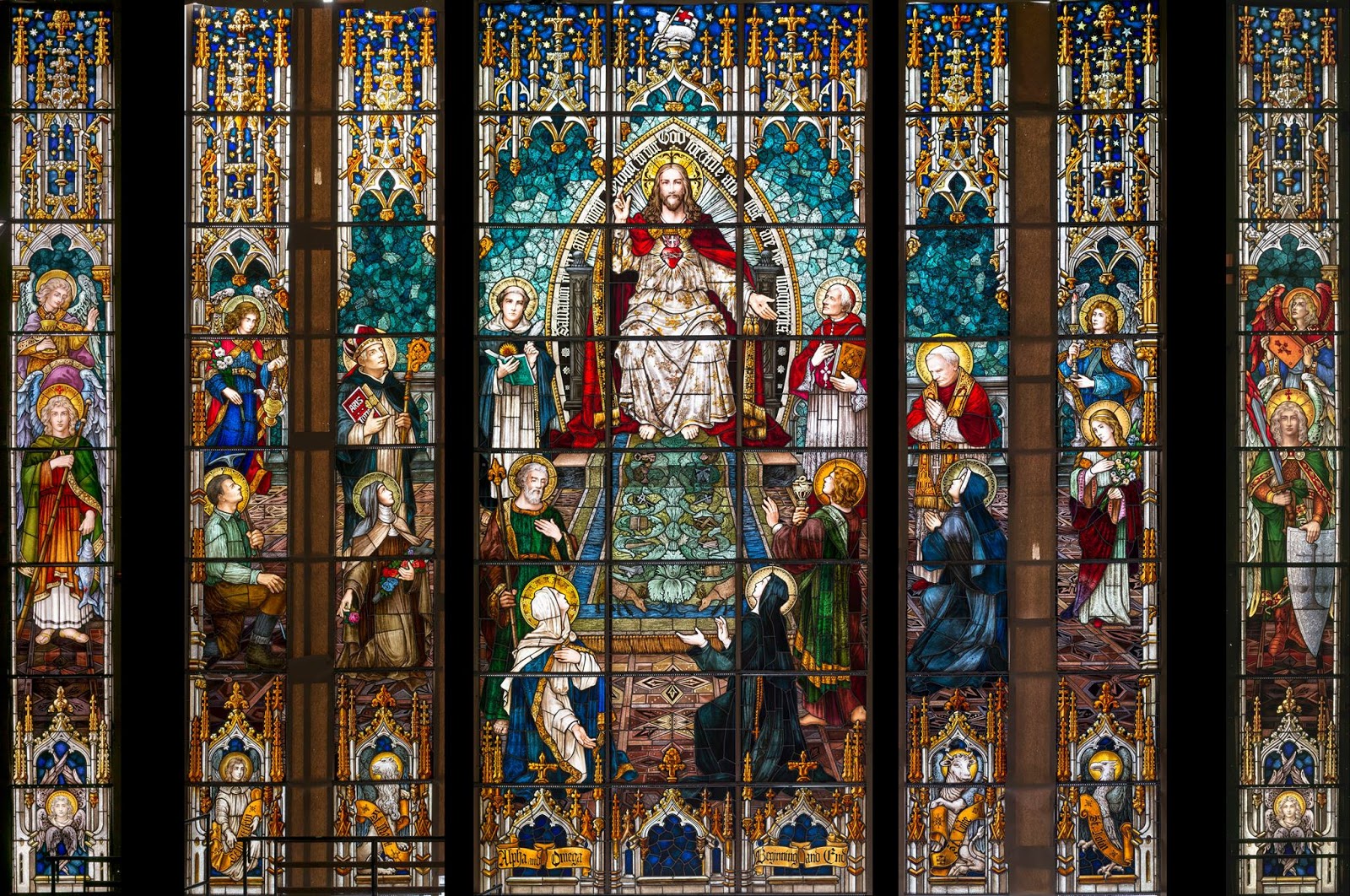
Earlier this year, Bishop Conley of Lincoln, Nebraska was on a brief speaking tour to discuss "Beauty, Culture, and the New Evangelization"; one of the stops was the Eighth Day Institute in January. During that lecture, he spoke about the new Newman Center church (not chapel) his diocese was building on the campus of the University of Nebraska-Lincoln. He wanted it to be beautiful--and chose the Gothic style of architecture as a tribute to Newman and A.W. Pugin (I teased him that Newman would not approve since he did not agree with Pugin's medieval style but preferred the classical basilica style of the early centuries in Rome--see page 5 of the article I've linked). You can see some more pictures here in this newspaper story about the church.

The cover of the July 2015 issue of the Adoremus Bulletin features a picture of the stained glass window above the Altar and behind the Rood, with this commentary by Bishop Conley:

We illustrate the indebtedness of our center to both St. Thomas Aquinas and Blessed John Newman in the stained glass window above the high altar. It’s the largest stained glass window installed in a Catholic Church in 100 years. It was built in Munich by Franz Mayer & Company. Measuring 20x24 feet, it pictures Christ on the heavenly throne surrounded by angels and saints that have to do with either learning or working with youth. To his right is St. Thomas, the Angelic doctor and great teacher of the faith, and to his left is Blessed John Henry Newman, who is the patron of Newman Centers, Catholic campus ministries and the apostolate to college students. The window also includes St. Albert the Great . . . a teacher of St. Thomas renowned in his own right for his contributions to philosophy and theology, and St. John Paul II, a great icon for the youth. The window also shows Blessed Giorgio Frassati and St. Therese of the Little Flower. All these figures in the window depict something related to young people, to the teaching or evangelizing of the youth.” – Bishop James D. Conley, Bishop of the Diocese of Lincoln

The issue contains more commentary and pictures. And here is another view of the stained glass (at the bottom of the page).


Road trip! I call shotgun!

Wednesday, April 22, 2015

Bishop Conley Talks About Beauty and Helps Design Beautiful Church in Nebraska

When Bishop Conley spoke at the Eighth Day Institute here in Wichita this January, he talked about the new church being built for the large number of Catholic students at the University of Nebraska-Lincoln campus. Now there's a story about the new church, with pictures of several features:

The resulting St. Thomas Aquinas Catholic Church and Newman Center is a bow to tradition and a beacon of hope and adoration of God in the heart of a secular campus.

The original mural of storm clouds behind the altar has been replaced with a massive, awe-inspiring stained glass window. At the center of the window is a youthful Christ with an exposed sacred heart. Fourteen saints and blesseds are gathered in adoration around Christ. Students hand-picked each of the men and women, with the exception of Saint Albert – the 13th century saint stands to the left of his student Saint Thomas Aquinas to depict the importance of student-teacher relationships.


The simple, gold tabernacle that used to stand alone behind the altar is now housed in a grand, repurposed 125-year-old altar of repose with gold, red, and blue detailing. An outdoor courtyard on the north side of the Church has been replaced with a Marian chapel.

A new dome floods the Church with natural light. The dome’s pendentives mirror those in St. Peter’s Basilica: depicting St. Longinus, St. Veronica, St. Andrew, and St. Helena.


Read and see the rest there. 

Also, Bishop Conley gave the last talk at The Catholic Artists Society and the Thomistic Institute series of lectures on The Art of the Beautiful: Redeeming Culture in Christ in March this year. You may hear all of the lectures from that series (and some other recordings) here. Bishop Conley presented some of the same material in January.

Wednesday, February 6, 2013

More about the Newman School of Catholic Thought

After my post on Father Ian Ker's upcoming visit to Wichita for the Cardinal Newman Week lecture at Newman University, I wanted to share more about the Newman School of Catholic Thought. These conferences, held at the Newman Centers at Wichita State University and Pittsburg State University during the 1970's and then revived at WSU during the 1990's, and now moribund.

The first Newman School of Catholic Thought I attended had been organized by St. Paul's Parish-Newman Center chaplain Father Joseph Gorentz. He was not able to be there, however, because he was hospitalized with brain cancer. It was held in January of 1979 and Bishop David Maloney from the Diocese of Wichita spoke briefly at the beginning of the five days of conferences by four great speakers. Father Stephen Almagno, Mr. Lyman Stebbins, founder of Catholics United for the Faith, Dr. John Crosby, then at the University of Dallas--these three presented on aspects of Newman's life and works; Father Charles Taylor spoke about the Newman Center movement in the United States.

Those five days were probably the most formative of my life, setting me in the direction of trying to obtain the best liberal arts education possible at a secular university without a theology department (pace Newman's Idea of a University model), informing my dedication to studying Church history and understanding Church doctrine and dogma to be faithful to it, and sparking my  interest in the English Reformation. From those January 1979 days to the upcoming Cardinal Newman Week lecture, I've attended many presentations about Blessed John Henry Newman--and given a few myself.

Two high school friends (who were attending the University of Kansas) and I went to Pittsburg, Kansas for a Newman School of Catholic Thought at the St. Pius X Newman Center there one summer a couple of years later, and then the Newman Schools endured a hiatus for a time. When I worked at the Gerber Institute for Catholic Studies at then Kansas Newman College, I helped organize a Newman School in 1997 with Dean Hudson, the Visiting Chair of the Institute, and David B. Warner, then with the Denver Archdiocese (who has since died). Perhaps the Newman School of Catholic Thought will revive again at WSU!

Wednesday, October 5, 2011

Newman Center Presentation Next Week

The St. Paul Parish/Newman Center at Wichita State University is very dear to me, as I've noted before. It was there that I made an adult commitment to practicing my Catholic faith as fully and truly as God's grace and my cooperation makes possible--where I met my husband Mark--where I discovered Blessed John Henry Newman--where I made some great friends--where I learned to love beauty, history, literature, the good, the true and the beautiful. All in a Catholic student center! (And we had dances, too!)

I'll be going back there next week (Wednesday, October 12) to make a presentation on "Church History and Apologetics", giving the students--WSU/the Newman Center has welcomed a big freshman class from the local Catholic high schools this year--some tools for understanding Church History and answering common objections. My presentation is part of a series on "Catholicism for College Students". I'm sure the Newman Center would welcome any "student" who wants to learn more about the Catholic Church!

Also, please pray to Blessed John Henry Newman that I present the Truth about the Catholic Church with charity and clarity. Thank you!

Friday, July 22, 2011

The Newman Renaissance

The National Catholic Register proclaims a Newman Renaissance in the USA, referring to Blessed John Henry Newman:

To the casual observer, there is little connection between a 19th-century convert from London named John Newman and the Catholic culture of 21st-century United States.

Yet, across the American landscape, the life of Newman, now Blessed Cardinal Newman, as of September 2010, has touched off a cultural fire that shows no signs of dying out.


This “Newman Renaissance” lighting up American art and education burns especially bright in the efforts of four organizations: Corpus Christi Watershed, the Cardinal Newman Society, the National Institute for Newman Studies and the Newman Connection.

Corpus Christi Watershed has worked with the Birmingham Oratory to produce a series of "documentary shorts providing online tours of the Oratory, including the Cardinal’s Room and Library as well as the parish church and its chapels."

My husband and I met at the St. Paul's Parish/Newman Center on the campus of Wichita State University--and we just recently attended a great fundraiser for the center--so we know the Newman renaissance on secular university campuses is essential. The Newman Connection is providing a social network presence on the web to assist those centers and share best practices.

The website of The National Institute for Newman Studies proclaims its raison d'etre:

In an effort to enhance and extend the reach of John Henry Newman's life, thought, and spirituality, a study and research institute has been developed to bring his teachings to the community of Newman scholars as well as to today's pluralistic and diverse society. Located in the heart of Pittsburgh's cultural and university center, The National Institute for Newman Studies serves as North America's definitive resource of information on John Henry Newman.

And finally, The Cardinal Newman Society is a controversial organization, and I think that is a good thing. It was founded in 1993:

The mission of The Cardinal Newman Society is to help renew and strengthen Catholic identity in Catholic higher education.

The Society seeks to fulfill its mission by assisting and supporting education that is faithful to the teaching and tradition of the Catholic Church; producing and disseminating research and publications on developments and best practices in Catholic higher education; advising students, alumni, trustees, campus officials, faculty and others engaged in renewing and strengthening the Catholic identity of Catholic colleges and universities and Church-affiliated ministries at non-Catholic colleges and universities; and studying and promoting the work of our patron, John Henry Cardinal Newman, especially as it relates to Catholic higher education and the unity of faith and reason.


At the end of the Register article, the writer Dan Lord asks,

The question still remaining to be answered is: Why is Cardinal Newman, as opposed to some other holy man or woman of the Church, surfacing as the new model for Catholics in America? Certainly he was known by his contemporaries as a lover and collector of books, as a brilliant writer, and as a man with a passion for higher education, and all of the Americans involved with the organizations that have been founded in his honor readily acknowledge their attraction to these facets of Newman’s life.

The answer to that question is found in Newman's search for Truth and his joy in finding Him.