Showing posts with label Ian Ker. Show all posts

Wednesday, September 19, 2012

Catholic Revival in English Literature


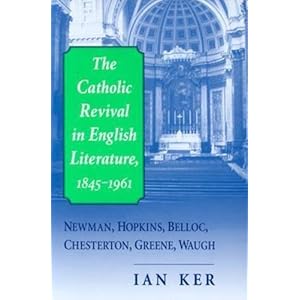
The Catholic Revival In English Literature,1845-1961: Newman, Hopkins, Belloc, Chesterton, Greene, WaughSeveral years ago, I read Father Ian Ker's The Catholic Revival in English Literature, 1845-1961: Newman, Hopkins, Belloc, Chesterton, Greene, Waugh from the University of Notre Dame Press:

The Catholic Revival in English Literature, 1845–1961 presents a thorough discussion of the six principal writers of the Catholic revival in English literature—Newman, Hopkins, Belloc, Chesterton, Greene, and Waugh. Beginning with Newman’s conversion in 1845 and ending with Waugh’s completion of the triology The Sword of Honor in 1961, this book explores how Catholicism shaped the work of these six prominent writers.

John Henry Newman claimed in The Idea of a University that post-Reformation English literature was overwhelmingly Protestant and that there was no prospect of a Catholic body of literature. Describing this claim as “happily lacking in prescience,” Ian Ker persuasively argues that Newman, Hopkins, Belloc, Chesterton, Greene, and Waugh succeeded in producing a substantial body of literature written by Catholics who wrote as Catholics. These revivalists were not so much influenced by traditional themes of guilt, sin, and ceremony, as they were attracted to unexpected facets of Catholicism. The idea of a Catholic priest as a craftsman is a recurring motif, as is the celebration of the ordinariness and objectivity of Catholicism.

Ker’s compelling and intelligent reading of these six major writers will appeal to anyone with an interest in nineteenth- and twentieth-century English literature, or the relation between literature and theology.

Now I have, but have not yet commenced to read, Adam Schwartz's The Third Spring: G.K. Chesterton, Graham Greene, Christopher Dawson, and David Jones from Catholic University of America Press:
 
For most of modern history, Roman Catholics in Britain were a "rejected minority," facing hostility and estrangement from a culture increasingly at odds with traditional Christianity. Yet British Catholicism underwent a remarkable intellectual and literary renewal, especially in the twentieth century, drawing a disproportionate number of the age's leading minds into its ranks. The Third Spring unravels this paradox of a renascent Catholic culture within a post-Christian society. It does so through detailed profiles of the spiritual journeys and religious and cultural beliefs of four seminal members of that twentieth-century revival: G. K. Chesterton, Graham Greene, Christopher Dawson, and David Jones.

Although these four authors came from different backgrounds and wrote primarily in different genres, each converted to Roman Catholicism as an adult and made his new faith the foundation of his intellectual and artistic work. All of them judged the Church to be the last corporate voice of orthodox Christianity in a hitherto unmatched irreligious climate of opinion; and they concluded that the Roman Catholic vision of human nature, thought, history, and art was truer and richer than proposed by prevailing secularism. They thus built on the nineteenth-century "Second Spring" of British Catholicism proclaimed by John Henry Newman to create a fresh assertion of Roman Catholicism, one suited to an era of unprecedented unbelief: a Third Spring.

This book is the first detailed examination of these four authors as part of a Roman Catholic, counter-modern community of discourse. It is informed by extensive research in the writers' works, scholarship on them, and their personal papers. This study is also distinguished by its careful attention to the authors' cultural and religious contexts, and to the psychology and theology of conversion. It will therefore deepen understanding, and correct some misconceptions, of each man's spiritual development and his thought, while revealing the twentieth-century Catholic literary revival to be a distinct movement in both British and Roman Catholic thought.

And the author of The Third Spring here reviews yet another book on Catholics and English Literature: The Pen and the Cross: Catholicism and English Literature, 1850 to 2000 by Richard Griffiths from Continuum (2010):

Although The Pen and the Cross provides some insight into British Catholic imaginative writing and its historical context, its sympathies for favored literary critical models and for modernist and progressive theology preclude it from presenting a comprehensive portrait of the Catholic renascence or from appreciating what made it distinctive. . . .

As accurate as Griffiths’s descriptions of the nature and history of British Catholic intellectual life are, his analysis of them is marred by his interpretive frameworks. Griffiths shows a marked preference for writers whose work reveals “acceptance of modern trends in literature,” regarding them as a “refreshing departure.” His treatments of novels therefore privilege realistic fiction, which twentieth-century critics typically considered the foremost arena of forward-looking artistry. But this emphasis presents a grave problem for a synthetic investigation of Catholic literature. Although Griffiths claims correctly that realistic fiction has been the “dominant strain” in British Catholic narrative prose, he admits and discusses the substantial Catholic presence in other such genres, including historical fiction, detective stories, and fantasy. Yet his examination excludes utterly the finest Catholic fabulist, J. R. R. Tolkien.

Tuesday, September 13, 2011

New Chesterton Biographies in The New Criterion

Last week I saw Father Ian Ker's new biography of Chesterton at Eighth Day Books (the greatest bookstore in the world, that's all, right here in Wichita, Kansas)*. It is a massive tome! Roger Kimball comments on Father Ian Ker's book and William Oddie's book, Chesterton and the Romance of Orthodoxy:

Some of his recent admirers have endeavored to fill the gap. A serious “Collected Works” by Ignatius Press got going in 1986 and, as of this writing, is nearing its fortieth stout volume. Chesterton and the Romance of Orthodoxy, William Oddie’s recent study of Chesterton’s development, and G. K. Chesterton, the new brick-like 750-page biography by Ian Ker, the authoritative biographer of Cardinal Newman, are models of academic diligence. These stately tomes are bulletins in what seems to be a renaissance of interest in (to adopt Oddie’s shorthand) GKC. Both make large claims for their subject. Cardinal Newman was canonized last year; why not Chesterton next? Ker nominates Chesterton as “the successor of the great Victorian ‘sages,’ and particularly Newman,” and suggests that we place him in the pantheon of English literary critics alongside Dr. Johnson, Matthew Arnold, and Ruskin.

I can envision Chesterton in a niche next to Dr. Johnson and Arnold; seeing him next to Newman is more difficult. Worldliness is not necessarily at odds with holiness; I wonder, though, about ruddiness. (Quoth Chesterton: “And Noah he often said to his wife when he sat down to dine/ ‘I don’t care where the water goes if it doesn’t get into the wine.’ ”) Chesterton was assuredly devout. But he fought as many social and political battles as he did literary or religious ones. And in that arena he did not always distinguish himself. One tort that has shadowed him for decades is the charge of anti-Semitism. Auden, in the preface to his anthology of Chesterton’s nonfictional prose, admits that, though he always enjoyed Chesterton’s poetry and fiction, he had avoided his nonfictional prose because of his reputation as an anti-Semite. Ker, in his extensive index, has a longish entry devoted to “Chesterton, anti-Semitism of, alleged.” The adjective is meant to be extenuating. Kerr’s (sic)conclusion is that “he was anti-Jewish just as he was anti-Prussian, but only in the sense that he associated Jews with capitalism and international finance, just as he associated Prussians with barbarism and military aggression.” Ker seems to regard this as an exoneration. I think Auden is right that Chesterton cannot be “completely exonerated.” . . .

Chesterton’s anti-Semitism shouldn’t be overstated. It existed, and was abetted by his brother and by Hilaire Belloc, who seemed to regard government corruption as a largely Jewish concession. But, as John Gross notes in his splendid pages on Chesterton in The Rise and Fall of the Man of Letters, anti-Semitism did not obscure Chesterton’s “fundamental decency.” “He hated oppression; he belonged to the world before totalitarianism.” And it is also worth noting that he was one of the very first in England to attack Hitler and Hitlerism.


*Shameless promotion alert here/full disclosure: Eighth Day Books very kindly reviewed Supremacy and Survival: How Catholics Endured the English Reformation when it came out and has included it in their annual catalog--

We present here a remarkable synthesis. At once a devout Catholic writing primarily but not exclusively for Catholics, a writer of limpid prose, and a skilled chronicler, Stephanie Mann shows how to write accurate and trustworthy history while unabashedly staking a claim about wrongs and rights and final judgment on matters. Her territory is the English Reformation and the subsequent fortunes of Catholics in England up through the twentieth century. It's a cavalcade of momentous persons and periods and movements, never losing its connecting thread of conflict between Church and State, and whether public order ever trumps freedom of faith and conscience. Find in this book vivid accounts of Henry VIII and the wives (three Catherines, two Anne's, and one Jane). There are lucid accounts of the reigns of Mary and her half-sister Elizabeth I, James VI, and Charles I. The English Civil War, the Puritans and Cromwell, and the Restoration are given due attention. But Mann isn't writing mere political history. She is at her best when describing the interfacing cultural and religious climates: the lukewarmness-dangerous to all sides-of the eighteenth century, the Oxford movement and conversion of Newman in the nineteenth, and the influence of literary and intellectual figures such as Chesterton, Benson, and Anscombe in the twentieth. With its extensive glossary of persons and terms, timeline of events, study questions and bibliography, Supremacy and Survival is a marvelous resource for teachers. But it is also a book for common readers, forcing the question to all of what kind of faith creates a willingness-sometimes even joyful willingness-to accept hanging, drawing and quartering and other hideous tortures, for its sake.

Also, I've worked at Eighth Day Books twice! (between full-time jobs)!

Friday, June 3, 2011

Newman's Idea of a University

In April, Father Ian Ker delivered a lecture at the Catholic University of America explaining Newman's great work on University education:

Rev. Ian Ker described Cardinal John Henry Newman’s book The Idea of a University as “the one classic on university education” in an April 27 lecture titled “Newman’s Idea of a University — Some Misunderstandings.”

However, Father Ker — one of the world’s leading experts on Newman and a senior research fellow in theology at Oxford University — noted that Newman’s work has been misinterpreted in some ways.

Newman, who was beatified by Pope Benedict XVI on Sept. 19, 2010, was the rector at the Catholic University of Ireland from 1854 to 1858. The book, which was published in 1873, was written in two parts at different times: one on university teaching (1852) and one on university subjects (1858).

In his book, Newman wrote that liberal education was the principal goal of a university. Newman’s definition of a liberal education, Father Ker noted, is not a liberal arts education as it is understood today, but “a real cultivation of the mind.”

“The heart of his philosophy of education was to use one’s mind, to think,” said Father Ker.


He concluded his lecture with a reminder of the continuing relevance of Newman's vision of university:

In the end, Father Ker noted that all universities have changed since Newman’s time but that does not mean that his ideas are irrelevant today.

“The fundamental principles of Newman are still of value,” he said. “If you stray too far from them, you can’t be a university.”

While preparing for his new role as president of CUA, Garvey read The Idea of a University. The book inspired Garvey in his selection of the inaugural year theme “Intellect and Virtue: The Idea of a Catholic University.” This lecture was part of a series of events related to that theme.

Father Ker is generally recognized as the leading authority on the life and thought of Newman. He has written and edited more than 20 books about Newman, including the Oxford critical edition of The Idea of a University and John Henry Newman: A Biography. He is also the author of The Catholic Revival in English Literature 1845-1961 and Mere Catholicism.

In introducing Father Ker, Monsignor Kevin Irwin, dean of the School of Theology and Religious Studies, described the scholar as “breaking news” in the United Kingdom as his new book, G. K. Chesterton: A Biography, was just published there last week.


More on Fr. Ian Ker at CUA here. More on the Chesterton biography here.