Thursday, April 6, 2017

Maud Green and Two of Henry VIII's Wives

Today is the anniversary of Maud Green's birth on April 6, 1492. According to the Tudor Times, she was:

the daughter and co-heiress of Sir Thomas Green of Green's Norton in Northamptonshire. She was married at around the age of 16 to Sir Thomas Parr, whilst her sister, Anne, was married to Sir Thomas Parr's step-father, Sir Nicholas Vaux.

Maud was appointed as a Lady-in-Waiting to Queen Katharine of Aragon. It was unusual for a knight's wife to be a Lady-in-Waiting, as opposed to a Gentlewoman of the Bedchamber, but perhaps the two women got on well, or it may have been in recognition of the fact that Sir Thomas was third cousin to the King. In between her duties at Court, Maud gave birth to three children who survived and a further two who did not.


One of those three surviving children was Catherine Parr, whom Maud may have named after her mistress. She was widowed at age 25 and arranged the marriages of her son, William and daughters Catherine and Anne:

Maud remained in the service of Queen Katharine, but died, aged about forty on 1 st December 1531. In her Will, made in 1529 she gives donations to the orders of friars, and then requests the payments of the debts incurred for the marriages of her children. She then gives detailed instructions on bequests of jewelry to her daughters, including pictures of the King (Henry VIII) and Queen (Katharine of Aragon) to her daughter Katherine.

What a bequest!

More about the Vaux family connection here.

Image credit: This portrait originally and now identified as Catherine Parr was wrongly identified as Lady Jane Grey for decades.

Tuesday, April 4, 2017

A Brief Review of A Very Brief History

Historian Jack Scarisbrick reviews a book by John Guy for The Catholic Herald:

Thomas More: A Very Brief History, by John Guy, is a lively and learned little book, but I do not quite understand what it is trying to do. It consists of a 40-odd page potted biography of More, which is very well done but covers mostly familiar ground, and a further 40-odd pages of essays (four of them) on various ways in which More and his writings have been treated down the centuries since his martyrdom. But the two halves really do not cohere. And placing eight pages of full-colour illustrations between them only increases the incoherence.

Those four essays include an intriguing account of how the famous wall-hanging by Holbein depicting More and his family was copied and “edited” over the ages. Another tells the inside story of how the canonisation of More and Fisher was eventually achieved in 1935 – even though neither had certified miracles to their credit (as a wit observed, they were “excused their practicals”).

And then there is a piece on how More’s reputation, at its height thanks to Robert Bolt’s play and then film, A Man for all Seasons, has recently been savaged by Hilary Mantel’s bitter Wolf Hall – though it was surely RW Chambers’s life of More, first published in 1935, which truly made him a national figure, and Geoffrey Elton in the 1960s who first tried to debunk him (attributing his hair shirt, etc and persecution of heretics to repressed sexuality).

Please read the rest there. The book is published by the Society for Promoting Christian Knowledge (SPCK).

Monday, April 3, 2017

At the Spiritual Life Center this July

I'll be one of the presenters at the Spiritual Life Center's Summer Symposium 2017, Thursday, July 13 through Saturday, July 15:

"Conversion and Conscience: Freedom, Will, and Truth in the Human Quest for Meaning"

The Summer Symposium is an opportunity for presenters and participants to gather for prayer, celebration, and intellectual exchange. The symposium begins with a keynote banquet, and continues with two full days consisting of morning prayer, Holy Mass, and lectures in four pillar content areas (Doctrine, Spirituality, Literature, and Catholic Living).

This year’s theme is "Conversion and Conscience: Freedom, Will, and Truth in the Human Quest for Meaning" and will feature lectures by Dr James Madden, professor of philosophy at Benedictine College, Fr. Thomas Hoisington, priest in residence at St. Mary's Parish in Garden Plain, Fr. Joshua Lollar, priest at St. Nicholas Orthodox Church in Lawrence, and Stephanie Mann, local author of "Supremacy and Survival: How Catholics Endured the English Reformation."

The life of Christ provides us with a model for obedience: In the person of Jesus, human will was perfectly aligned with divine will. But, with lives filled with distraction and cross-pressures, and minds filled with confusion and doubt, how are we to follow in his example? How can we overcome the dissenting voices around us, and the sinful impulses within us, which tempt us to follow the example of the world, rather than the example of our Lord? Utilizing Christological, philosophical, and historical perspectives, this symposium will provide insights into ways our forebears have pursued authentic human liberty by focusing on the transcendent, even in the midst of persecution.

I'll be talking about "St. Thomas More: Conscience and Martyrdom" and "Blessed John Henry Newman: Conscience and Conversion", on Saturday. At the Thursday evening keynote banquet, I'll give a brief talk on the Pre-Raphaelite painting, "The Awakening Conscience" by William Holman Hunt. More info to come soon.

Sunday, April 2, 2017

St. John Payne and His Pains


On April 2, 1582, Father John Payne, who had come to England with Father Cuthbert Mayne, to serve the Catholics of England, was martyred at Chelmsford, Colchester, Essex:

St. John Payne was an English Catholic Priest and Martyr. He was born in Peterborough in 1532. He was a mature man when he went to the English College at Douai in 1574. The Archbishop of Cambrai ordained him a Priest on April 7, 1576. Shortly after being ordained, he left for the English mission with another Priest, Cuthbert Mayne. Mayne headed for his native South West England, and Payne headed for Essex. In early July 1851, he and another who had come to England were arrested in Warwickshire while staying at the estate of Lady Petre. It was through the efforts of George “Judas” Eliot, a known criminal, murderer, rapist and thief, who made a career out of denouncing Catholics and Priests for bounty. After being examined at Greenwich, they were committed to the Tower of London on July 14th. Eliot was a Catholic, and had been employed in positions of trust in the Petre household where he had embezzled sums of money. He enticed a young woman to marry him, and then approached Fr. Payne. When he refused, Elliot was determined to make his revenge, and a profit as well, by turning him in.

Fr. John Payne was indicted at Chelmsford on March 22, on a charge of treason for conspiring to murder the Queen and her leading officers. John denied the charges, and affirmed his loyalty to the Queen in all that was lawful; contesting the reliability of the murderer Eliot how had turned him in. No attempt was made to corroborate Eliot’s story, which had been well rehearsed. The guilty verdict was a foregone conclusion. 


Note that George Eliot also gave false evidence against St. Edmund Campion and his companions in 1581. The "Lady Petre" mentioned was the widow of Sir William Petre, the former Anne Browne. The "other" who was arrested with Father Payne was Father George Godsalf, whom Payne had called back to the Catholic Church and who had been ordained at Douai in 1577. He was not executed by the Elizabethan regime, but held in prison for several years, finally released from Marshalsea in 1585 and dying in Paris in 1592.

Although the verdict was a foregone conclusion, authorities almost lost control of the execution:

At his execution, he was dragged from prison on a hurdle to the place of execution and first prayed on his knees for almost thirty minutes. He then kissed the scaffold, made a profession of faith, and publicly declared his innocence. He was called upon to repent of his treason, and again, Payne denied it. A Protestant minister shouted out that he knew of Payne’s treason, from his brother, years prior. Fr. Payne admitted that his brother was an earnest Protestant, but that he would never had said such a lie. Fr. Payne asked that his brother who was in the same vicinity, be brought in and asked. The execution proceeded and John Payne was at their mercy. What was supposed to be a smooth, quiet execution was anything but that. The crowd had become so sympathetic to John Payne that they hung on his feet to speed up his death and prevented the infliction of the quartering until he was dead. 

St. Cuthbert Mayne, with whom St. John Payne returned to England is the protomartyr of the recusant era, executed for treason in 1577 on November 29. Mayne and Payne: They are both among the 40 Martyrs of England and Wales. There is a parish named for St. John Payne in Colchester.

St. John Payne, pray for us!
St. Cuthbert Mayne, pray for us!

Image credit: Used by Permission: Ingatestone Hall, May 2003

Saturday, April 1, 2017

Foyle's Abbey


This is not an April Fool's joke. A Norbertine Abbey that was suppressed in the reign of Henry VIII has a new Titular Abbot. Christopher Foyle, owner of Foyle's Bookstore and of the remains of Beeleigh Abbey, Maldon in Essex, named the current abbot of  St. Philip's Chelmsford Priory, Abbot Hugh Allan o.praem to that honorary post last year. Foyle has also written a history of the Order and the Abbey, which is available at Foyle's Bookstore:

The first definitive and comprehensive guide to the house since Fowler and Clapham's work of 1922, and the slim guide published by W A Foyle in 1962. Christopher and Catherine Foyle are the current owners of Beeleigh Abbey which sits close by the banks of the upper tidal reaches of the River Chelmer near Maldon in Essex. The abbey is one of the most ancient continuously inhabited buildings in England.

In 'Beeleigh Abbey' Christopher Foyle has fulfilled a long term personal ambition. The book takes the reader from the founding of the Premonstratensian Order by St Norbert in 1119 and of the abbey in 1180, through medieval times.

It includes a local 'saint', a visit by King Edward I 'Long Shanks' and his Queen, Eleanor, the dissolution, intrigue at high levels of both medieval and Tudor politics, the murder by poisoning of an abbot, the beheading on Tower Hill of its first secular owner Sir Thomas Gates, buried treasure, tunnels, ghosts, archaeological digs, and the unfortunate neglect, and then the award winning restoration of the building, and the recent return of the Premonstratensian Order to the abbey in the person, no less, of its Abbot-General Thomas Handgraetinger from Rome, together with Father Hugh Allan the Prior of the new priory in Chelmsford, accompanied by some of his canons.

Of historical importance, Beeleigh Abbey is also a home with beautiful gardens, and in this book Christopher Foyle 'opens the doors' of his home through words and striking images and invites the reader to witness times past and times present.

You may see some photos and the table of contents on the Foyle's Bookstore website here. Prior/Abbot Allan and members of St. Philips visited their order's former abbey late last month and posted some pictures on Facebook.

British History Online provides these details about the suppression of Beeleigh Abbey, one of the smaller houses:

An inventory (fn. 38) of its goods was taken on 6 June by the king's commissioners. They consist of tapestry and other articles of furniture in the different chambers, viz., the great chamber, the children's chamber, the dining chamber, etc.; beds and bedding; malt and implements in the brewhouse; a table of alabaster at the high altar (valued at 13s. 4d.), with altar-cloths, mass-books, etc., in the choir; ornaments of the Lady chapel (including a pair of organs at 100s.), the Jesus chapel, the rood chapel, the chapel of St. Katharine and the vestry; articles in the kitchen, buttery and infirmary; and cattle, with some plate remaining in the hands of the commissioners. The goods were valued at £74 18s. 10d., besides cattle worth £31 15s. and corn worth £14 3s. 8d. The debts due to the house amounted to £32 11s. 2d., and those due by it to £121 18s. 4d., a strangely large amount in view of its prosperous condition a few years before. There were 129¾ ounces of plate, valued at £23 16s. 6d. An inventory was also taken of cattle left in the hands of Lancelot Madeson at the monastery on 24 July.

A complete rental of the possessions of the abbey, taken soon after the dissolution, is preserved. (fn. 39) The spiritualities amounted to £22 2s. yearly. The demesne lands of the abbey were valued at £30 0s. 4d., and the manor of Canons in Great Parndon at £16 2s. The net value of the whole of the temporalities was £145 15s. 2d. yearly, after deductions of £4 2s. 1½d. for rents, £2 13s. 4d. for the fee of the chief steward, £1 6s. 8d. for the fee of the understeward, and £3 6s. 8d. for the fee of the bailiff and collector; and exclusive of £22 2s. 8d. for the farm of lands called Jankenes Maldone in Hazeleigh, which had been granted to the queen by Act of Parliament. (fn. 40)This makes the net value of the abbey £189 19s. 10d., appreciably more than in the Valor.

Henry, earl of Essex, writing (fn. 41) to Cromwell on 13 January, before the dissolution, thanks him for his goodness to the abbot, though what is meant does not appear. On 23 March he writes (fn. 42) to ask Cromwell, inasmuch as the Act is passed that all places of religion being under 300 marks be wholly in his Grace's hands, to remind the king that the little house of Byleygh, of which he is founder, lies entirely within his own lands. He will give 1,000 marks, to be paid in three years, for its recovery, and promises that it shall never be used as a religious house again.

The earl did not get what he wanted. The possessions of the abbey were leased or granted away to various persons. The monastery itself with the mill there and the rectory of St. Peter, Maldon, were leased (fn. 43) on 8 January, 1537, to John Gate of Garnetts, High Easter; and on 15 July, 1540, the king, for £300, granted (fn. 44) to him in fee the monastery and various possessions in Beeleigh, Maldon, Woodham Walter, Langford, Ulting, Great Totham and Purleigh, and the rectories and advowsons of the vicarages of St. Peter and All Saints, Maldon, the whole being valued at £35 10s. 11½d. yearly, at a rent of 71s. 2d.

The Norbertines of St. Philip's Priory make this comment about their efforts: "to this day we strive to live according to the Rule of Our Holy Father Augustine and the inspiration of Our Holy Father Norbert, ready to be, as the motto of the Order states, 'ad omnes opus bonum parati', (prepared for every good work)."

St. Norbert, pray for us.
St. Augustine, pray for us.

Image credit: Norbert (on the right) receives the Augustinian Rule from Saint Augustine. From the "Vita Sancti Norberti," 12th-century manuscript. Public Domain.

Friday, March 31, 2017

A Memorial in Glasgow

St. John Ogilvie's feast was on March 10, but he's still in the news, as Catholics want to have a memorial to him in Glasgow where he was executed. According to the Catholic News Agency's story:

Four centuries after the martyrdom of St. John Ogilvie, Catholics in Scotland have launched a campaign to mark the place in Glasgow’s city center where he was executed for preaching the Catholic faith.

The Order of the Knights of St. Columba, a U.K.-based Catholic fraternal organization, is backing the effort, the Scottish Catholic Observer reports.

“There should be something,” said the order’s Supreme Knight Charlie McCluskey. “He’s the only Scottish martyr and there’s not even a plaque. Whether you are Catholic, Protestant, whatever, this was an historic event in the history of the city that should be marked.”

Glasgow's Archbishop is in favor of the memorial:

Archbishop Philip Tartaglia of Glasgow spoke of the saint in his March 10 homily, Scotland’s Sunday Herald reports.

“He died here in our city. He is an honorary Glaswegian. He belongs to Glasgow. And above all, his blood was shed for Christ here in Glasgow,” he said.

The archbishop noted the national shrine to the saint at St. Aloysius Church and a famous painting of him in Glasgow’s St. Andrew’s Cathedral.

Archbishop Tartaglia said the saint’s example is important at a time when Catholics face “more subtle forms of restricting religious freedom.”

Not to be contrary for the sake of being contrary, but I believe he should be honored because he was a martyr for the truth, upholding the Catholic faith, and the teachings of Jesus through His Church. St. John Ogilvie, SJ, did not think of his death as an "historic event"; he was dying for Jesus and His Church. He is an example for Catholics, today, I agree: he and others in his day were willing to sacrifice their lives for Jesus. There was nothing subtle about the restrictions against Catholics in 17th century Scotland and England, that's certain!

Thursday, March 30, 2017

A Great Book; A Tragic Story


When studying the long history of the English Reformation and its aftermath, one thought the student may have is, when so many priests and laymen and laywomen were willing to risk so much--their livelihoods, property, freedom, and even life--why did it take so long for Catholicism to revive in England? Of course, one answer is the power of the state and the burdens of those risks. It was difficult: all the penal and recusant laws, all the pressure to conform, all the danger, etc, made remaining loyal to the Catholic faith something extraordinary and for the few, humanly speaking. That's what my book is about: the power of the state against individual freedom of religion, what it costs the person and the Church.

The other answer, however, is that the Church made tactical errors; that for all the extraordinary efforts of missionary priests and the laity who protected them, Church leadership made some crucial political, organizational, and even disciplinary errors. Father Philip Hughes reviews those issues in this book, looking first at the Marian efforts to re-establish the Catholic Church with the papacy and hierarchy in England (during the reign of Mary I), then the long recusant period of missionaries, martyrs, and hopes of political conquest (during the reign of Elizabeth I), and finally the divisive disasters of the effort to bring on-site leadership to the clergy and the laity with the Archpriest controversy and the Bishops of Chalcedon failures (during the reigns of James I and Charles I).

Rome and the Counter-Reformation in England is divided into three parts, one for the leading figure of the eras described above: 1) Reginald Cardinal Pole; 2) William Cardinal Allen; 3) Richard Smith, Bishop of Chalcedon. For each man Hughes provides an insightful character sketch and analysis, noting his strengths and weaknesses. Those strengths and weaknesses contribute, of course, to each man's successes and failures.

Of Reginald Pole, Hughes demonstrates that for all his knowledge and love of Jesus and His Church, he lacked "irascible passion"; he was too ready to be a victim--and that he had "a temperament that instinctively turned from the hard, unpleasant realities of a problem to the ideal way in which it ought to be solved." (p. 43) Although Pole was a man of action and ready to promote reform and renewal, Hughes claims that he lacked audacity: he was not bold and he could not be stirred to righteous anger. Therefore, he wasn't able to take crucial action in a crisis. Nevertheless, Hughes does not blame the failure of the Marian revival and re-establishment of the Catholic Church in England on Pole's character; he acknowledges that time was the main factor. Mary and Pole died too soon to effect a long-lasting Catholic revival. They left great resources for Catholicism in England, however, in the good bishops they'd appointed, but they left also left the disastrous legacy of the burnings of Smithfield to the memory of Protestants in England. Unlike Eamon Duffy, who proposed that the prosecution of heretics was working in Fires of Faith, Hughes notes that even this effort was made ineffective by the too early deaths of Mary and Pole, especially without a Catholic heir. The other great legacy Mary and Pole left to Catholics in England was William Allen.

Of William Allen, Hughes notes two great weaknesses: First, he always thought of England as being what he experienced at Oxford during the Marian revival and what he saw when he went back to Lancashire in the early years of Elizabeth I's reign, a strong and loyal Catholicism. Second: he relied too much on the support of the Spanish Empire and the hopes of military invasion and overthrow of the Elizabethan regime. Allen's strength, however--and here Eamon Duffy would concur with Hughes, as demonstrated by his biography of William Allen in Reformation Divided--was that he recognized what the missionary priests needed to be able to make their forays into enemy territory. He prepared a seminary curriculum and lifestyle that prepared them: study of the Holy Bible, apologetics, Church history, especially English Church history, preaching in English, etc. The spiritual preparation of fasting twice a week for the conversion of England, use of St. Ignatius's Spiritual Exercises, frequent Confession as spiritual development, not merely juridical forgiveness of sins, and other spiritual devotions also prepared the priests for the moral and spiritual dangers they would face in the dangerous Catholic underground of England.

Hughes also provides an extensive analysis of the Catholic martyrs of Elizabethan reign to prove that they died for religion, not because of any treason against the state. Father Robert Persons, SJ, Allen's ally in many of his efforts, almost squares the triangle, as his influence on how the Catholic mission became divided between the Secular, non-order priests and the Regulars, especially the Jesuits and the Benedictines, provides the segue into the last era, when the idea of conquest was abandoned and the effort to gain toleration and stability took over.

That brings us to Richard Smith, Bishop of Chalcedon, whose greatest weakness was that he did not have a clear understanding of what his role was in the English mission. He was consecrated a bishop for England but the Regulars did not think he should have any control over them. Perhaps he was too insistent on control, but both he and the Archpriests appointed before him had little success in bringing order and consistency to the distribution of the missionary priests in England. Part of that blame lies in Rome, where there was division within the Curia. Pope Urban VIII unfortunately, it seems to Hughes, sided with the Regulars and reduced the powers of the Ordinary (Bishop) in England. With England on the cusp of the Civil War between King and Parliament, Catholics were leaderless and the missionary priests dependent on the laity to such an extent that there was conflict between incumbent chaplains in noble households and other priests who wanted their positions.

As Hughes states at the end of this book, we knew at the beginning that the Catholic mission had failed, but it's important to understand why. Mediatrix Press is to be congratulated for publishing this book with its introduction by Charles A. Coulumbe. There are, at least in the copy I purchased, however, too many typographical errors. Even some years are incorrect; incorrect words obviously used, and extra punctuation marks. I provided the publishers with a list of these errors as I found them, but I did not proofread the book for them! They mar an otherwise wonderful, thought-provoking reading experience. Although the book was first published in 1944, and Father Hughes even admits that he did not have access to all the primary sources he knew existed, his analysis and insights are still most valuable to anyone interested in the history of Catholicism in England during the Counter-Reformation era. Reading it makes me want to find and read Father Hughes' book on the aftermath of the Glorious Revolution: The Catholic Question, 1688-1829: a Study in Political History!

Wednesday, March 29, 2017

Blessed John Hambley, Pray for Us!

Just a reminder that I'll be on the Son Rise Morning Show during the EWTN hour this morning (5:00 to 6:00 a.m. Central Daylight Savings Time/6:00 to 7:00 a.m. Eastern DST) to talk about the Stations of the Cross, Blessed John Henry Newman's Meditation on the Ninth Station, and Blessed John Hambley! Listen live here. Remember that you can catch up with the podcasts on the Son Rise Morning Show here.

Then check out my latest blog for the National Catholic Register where I discuss those three subjects more completely than is possible in a brief radio interview, especially the story of Blessed John Hambley, who is remembered on the Roman Martyrology today:

All the priests who came to England knew that they could suffer imprisonment, torture, and horrendous execution. They had the example of their protomartyr, Father Cuthbert Mayne in 1577, and then of Fathers Edmund Campion, Ralph Sherwin, and Alexander Briant—and others—in 1581. Nearly every year they learned of another priest being martyred. The Venerable English College in Rome, where many priests studied, started the tradition of a seminarian preaching a sermon on martyrdom before the pope on the feast of St. Stephen, the first martyr. The founder of the Oratorians, St. Philip Neri, greeted the students in the streets with the salutation, “Salvete flores martyrum” (Hail! flowers of the martyrs).

But Father John Hambley, in spite of all these examples, was not ready to suffer. He had given up everything to become a Catholic and a priest, but the threat of physical suffering undid him, according to the 1914 edition of The Lives of the English Martyrs. He was born around 1560 in an Anglican family, but a Catholic friend encouraged him to read a book by Father Robert Persons, SJ and soon he became a Catholic. Because he had stopped attending Church of England services, he left his native Cornwall and then left England for the Continent. Hambley studied for the priesthood in Reims and was ordained on September 22, 1584. On April 6, 1585 he returned to England as a missionary priest under the guidance of Father John Cornelius, SJ (who would be martyred in 1594).

Before Easter in 1586, he was arrested in Taunton, Somerset, tried for being a priest, convicted, and sentenced to death. To save his life, Hambley promised to renounce his Catholic faith; then he escaped from prison. Recaptured on August 14, he faced the same horrible death of being hanged, drawn and quartered—and he fell again. He not only promised to become an Anglican, but he told the authorities everything he knew. Hambley told them about where he said Mass, who attended, who helped him; he told them the names of 15 other priests serving in England and others who are studying abroad. 

Strangely, the judges did not trust his statements, perhaps because he gave them so willingly, so Hambley was held in prison in Salisbury until the next public trials, the Assizes, in March of 1587. The judge asked him again if he was ready to renounce the Catholic faith, and Father Hambley said he was—his third fall. Awaiting release, he was given a letter; after he read it, he changed. The next day, he told the judge that he would not renounce the faith and that he regretted his weakness. This time, the threat of “a most cruel death” did not move him to cowardice, and he suffered execution bravely.

Blessed John Hambley, pray for us! Help us to be resolute in our Lenten devotions and in our journey to eternal life!

Tuesday, March 28, 2017

Three Falls and Martyrdom

I will be on the Son Rise Morning Show during the first local Cincinnati hour on Sacred Heart Radio this morning a little after 6:45 a.m. Central DST/7:45 a.m. Eastern DST to talk about Blessed John Hambley, one of the 85 Martyrs of England and Wales beatified by Pope St. John Paul II in 1987. The Son Rise Morning Show will then repeat the interview on Wednesday, March 29 during the earlier EWTN hour. March 29 is the date assigned to him on the Roman Martyrology: the date is uncertain but he was executed around Easter 1587 in Salisbury. He offers us a great example of repentance and resolution.

Listen live here today and here tomorrow--and also read my post at the National Catholic Register blog here tomorrow.

Father John Hambley fell three times on his way to the scaffold, denying his faith and even revealing information about who had assisted him and heard Mass when he celebrated it in the English Catholic underground. In my blog post I discuss how Jesus, in the Traditional Stations of the Cross, fell three times on the way to Calvary and Blessed John Henry Newman's interpretation of those three falls:

We are told in Holy Scripture of three falls of Satan, the Evil Spirit. The first was in the beginning; the second, when the Gospel and the Kingdom of Heaven were preached to the world; the third will be at the end of all things. . . .

These three falls--the past, the present, and the future--the Evil Spirit had in mind when he moved Judas to betray Our Lord. This was just his hour. Our Lord, when He was seized, said to His enemies, "This is your hour and the power of darkness." Satan knew his time was short, and thought he might use it to good effect. . . . he smote Him once, he smote Him twice, he smote Him thrice, each successive time a heavier blow.

The picture (c) 2017, Stephanie A. Mann, is of the Ninth Station in the Church of the Blessed Sacrament, Wichita, Kansas.

Monday, March 27, 2017

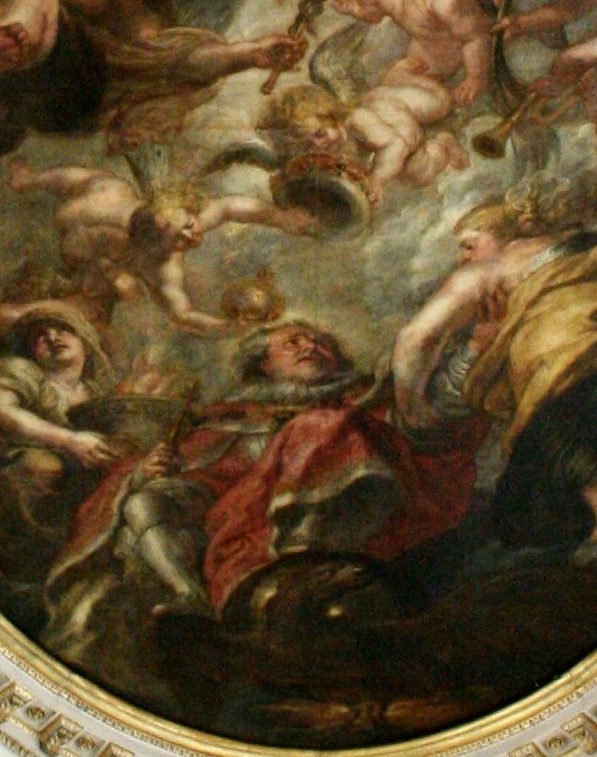
James VI and I, RIP

James VI and I of Scotland and England died on March 27, 1625 at Theobalds House. He was 58 years old; he had been the King of Scotland almost all of those 58 years (with regents when he was an infant and young boy, of course); he had just celebrated the 22nd anniversary of his accession as as King of England three days earlier.

This comparative book review discusses the changing reputation of James VI and I, who

. . . has been thoroughly reassessed in the past twenty years. The obvious target was David Willson's toxic treatment in
King James VI & I (Jonathan Cape; London, 1956). Jenny Wormald's seminal article 'James VI and I: Two Kings or One?' (History, 68 (1983), 187-209) challenged the hostile historiography which enveloped James, pondering how it was that the Scots and English held such different views of the same monarch. Wormald deconstructed the contemporary (primarily printed) sources that had shaped historians' treatment of the king, particularly polemics by Anthony Weldon, Arthur Wilson, and Francis Osborne. She emphasised their inherent English xenophobia, designed to further a project of Stuart vilification which began in the 1620s and rose to a fever pitch in the 1650s. Having set scholars the task of recovering the authentic James, many took up the call. The results have cast in a more favourable light James' effectiveness with religion, diplomacy, patronage and finance, and the governance of multiple kingdoms. The missing element in this revisionist project has been a full-length study of James capable of supplanting Willson.

Pauline Croft's
King James now offers the best overview. Croft brings two substantial strengths to her political study of James in his three kingdoms: an understanding of the period grounded in extensive experience as a published archival historian; and practice coming to grips with her subject in the classroom. Croft has published widely on the first decade of James' reign, with particular emphasis on parliament, finance, and Robert Cecil - her 'modern' study of Cecil is forthcoming. The devil is in the details with subjects like these and those details are in the Jacobean archives that Croft knows well. At the same time, while acknowledgments like Croft's which thank her students sometimes appear clichéd, no one who has taught James' reign can fail to appreciate how valuable the classroom or lecture hall is for working through an understanding of such a 'dauntingly complex' subject. Drawing on these strengths, Croft has produced an interpretive synthesis which is confident, agile, and judicious.

A generation of Scottish historians have fashioned an increasingly nuanced picture of James as king of Scots. We now have assessments of his education and formative years, the politics of his minority, his evolving notions of imperial kingship, and the long struggle to translate his political ideas into practice in the secular, religious, and territorial realms. This is Croft's starting point, which produces a credible assessment of James . . .

Croft's overall assessment of James is appropriately mixed. She recognises his good intentions in matters like Anglo-Scottish union, his openness to different points of view, and his agenda of a peaceful foreign policy within his kingdoms' financial means. His actions moderated frictions between his diverse peoples. Yet he also created new ones, particularly by supporting colonisation that polarised the crown's interest groups in Ireland, obtaining insufficient political benefit with his open-handed patronage, an unfortunate lack of attention to the image of monarchy (particularly after the image-obsessed regime of Elizabeth), pursuing a pro-Spanish foreign policy that fired religious prejudice and opened the door for Arminians within the English church, and enforcing unpalatable religious changes on the Scottish kirk. Many of these criticisms are framed within a longer view of James' reigns, including the legacy - now understood to be more troubled - which he left Charles I. Elements of all these judgments can be debated. With respect to Caroline Scotland, Charles should hardly be forgiven the Act of Revocation, his long-delayed and Anglocentric coronation at Holyrood, or the Laudian canons and prayer book of 1636-37. Yet in such debates we begin to approach an authentic appraisal of James that escapes both the hostile historiography of the past and worn-out frames of reference. We at last assess James on his own terms, as an imperial monarch governing multiple peoples and kingdoms.
Please read the rest there.
According to Martin J. Havran's 1962 book, The Catholics in Caroline England, Catholics were concerned about the forthcoming marriage between James's heir, Charles, and the French princess, Henrietta Maria. James died before the final, religious arrangements were made. Pope Urban VIII granted the necessary dispensations and Catholics thought again that they would be more free to practice their faith under the terms of the marriage agreement. Queen Henrietta Maria would have access to the Catholic Mass and Catholics at Court also hoped to have access to her chapel and worship, but after a time, Charles would not countenance that.

Image Credit: King James I being carried to heaven by angels, on the ceiling of the Banqueting House, painted by Peter Paul Rubens.