Friday, September 11, 2015

Three Events Next Week

Next week is filled with events I plan to attend:

The first, on Tuesday, September 15 is the inaugural meeting of the Sisters of Sophia group at The Ladder (the home of the Eighth Day Institute):

After almost seven years of Hall of Men meetings, it is time to offer something similar for the ladies.

Beginning September 15, the Sisters of Sophia will begin commemorating the company of wise women at the Ladder on the third Tuesdays of each month.

Doors open at The Ladder at 6:15, food will be served at 6:30, the Eighth Day Convocation will begin at 7:30, followed by a presentation on Holy Wisdom by Nyleen Lenk. We'll wrap up with Q & A from 8:15-8:30.

We look forward to seeing you!


The second, at the Spiritual Life Center, is the first in a series of talks under the title Docentium:

Docentium: A Catholic Voice for Freedom
Docentium is a new program designed to weave Catholicism and Culture together. New topic each month!

The Mission of Docentium is:

~To form and equip disciples of Christ with sound teaching, faithful to our Tradition
~To build comradery in shared belief and shared interest, in the context of a shared meal
~To inspire more courageous witness in our families, parishes, workplaces, and communities

Join us on the third Thursday of every month at the Spiritual Life Center for an evening of food, friendship, and learning. Doors open at 6 p.m., food is served at 6:30 p.m., and a lecture will be given on some topic related to religion and culture. The cost is $15 per person.

This first gathering occurs on “Constitution Day” [which] celebrates the anniversary of the historic day on which delegates to the Constitutional Convention signed the document in Philadelphia in 1787. Fr. Eric Weldon will give a presentation on Charles Carroll of Carrollton, the only Catholic signatory of the Declaration of Independence.


And the third is our monthly meeting the Wichita-Newton-Hutchinson chapter of the American Chesterton Society on Friday, September 18 at Eighth Day Books. Our reading is the next three more chapters in The Well and the Shallows: "Babies and Distributism", "The Three Foes of Family" and "The Don and the Cavalier". Our meeting starts and 6:30 p.m. around the table on the first floor between to the Chesterton/Tolkien/Sayers/Barfield shelves and the Patristics section! Good company all around!

Thursday, September 10, 2015

September Martyrs: St. Ambrose Barlow, OSB

From the English College of Valladolid in Spain:

ST. Ambrose BARLOW OSB was born in Barlow Hall near Manchester, in the year 1595. Son of Sir Alexander Barlow and Mary Brereton, he was baptised in November of the same year in Didsbury.

He received his first academic training in the College of St. Gregory at Douai, and on the 20th of September 1610 was admitted as a pupil of the Royal College of St. Alban in VALLADOLID. On completing the second year of philosophical studies, he returned to Douai, where in 1616, in the College of St. Gregory, he made his religious profession. The following year he was ordained a priest.

On going to England, he exercised his missionary ministry mainly in the south of the county of Lancashire. His way of living was said be very simple and apostolic, and his enthusiasm for his sacred trade such that he was nonchalant about the dangers of the religious persecution.

Several times he was stopped and incarcerated. On Easter Sunday, the 25th of April 1631, at the moment of ending a mass the Protestant vicar of EccIes and his followers, armed with sticks and shields, arrested him. He was dragged before a judge, and incarcerated.

On the 7th of September, after four months of detention, he was processed in Lancaster, before Sir Robert Heath who had received orders from the government to inflict on him the maximum punishment, as a deterrent to the Catholics who were very numerous in that county.

Upon the reading of the indictment, Father Ambrose, without more ado, admitted to being a priest and having exercised his apostolate in England for more than twenty years. The following day he was formally sentenced, and on Friday 10th of September 1641 he was stripped hung and quartered.

Pope Paul VI, on the 25th of October 1970, solemnly canonised him [among the 40 Martyrs of England and Wales].
 
Some of the background on his family is particularly interesting:
 
Ambrose was born at Barlow Hall, Chorlton-cum-Hardy, near Manchester in 1585. He was the fourth son of the nobleman Sir Alexander Barlow and his wife Mary, daughter of Sir Uryan Brereton. The Barlow family had been reluctant converts to the Church of England following the suppression of the Church of Rome in England and Wales. Ambrose's grandfather died in 1584 whilst imprisoned for his beliefs and Sir Alexander Barlow had two thirds of his estate confiscated as a result of his refusing to conform with the rules of the new established religion. On 30 November 1585, Ambrose was baptised at Didsbury chapel and went on to adhere to the Anglican faith until 1607, when he converted to Roman Catholicism.

In 1597, Ambrose was taken into the stewardship of Sir Uryan Legh, a relative who would care for him whilst he served out his apprenticeship as a page. However, upon completing this service, Barlow realised that his true vocation was for the priesthood, so he travelled to Douai in France to study at the English College there before attending the Royal College of Saint Alban in Valladolid, Spain.

I am thrilled to see that the Catholic church in Barlow, named for their local martyr, is celebrating a St. Ambrose Barlow Festival this Friday, Saturday, and Sunday!

Wednesday, September 9, 2015

September Martyrs: Blessed George Douglas

One of the 85 Martyrs of England and Wales: In his earlier years, George Douglas, of Edinburgh, Scotland, worked as a schoolmaster in the English county of Rutland. He subsequently journeyed overseas to Paris, where he studied for the priesthood and was ordained. There are uncertainties in the biographical details of his life, including the specific year of his ordination. He may have been a member of a religious congregation, perhaps the Franciscan Order, but this cannot be established. Father Douglas came to England about ten years after his ordination to serve the country’s Catholics persecuted under Queen Elizabeth I. It was while laboring thus that he was arrested a first time, but was thereafter released. He was arrested a second time at Ripton in the northern county of Yorkshire. Father Douglas was sentenced to death for “persuading to popery,” that is, for winning converts to the Catholic faith. At York he was executed by drawing and quartering on September 9, 1587, manifesting great fortitude during his torments. He was beatified by Blessed John Paul II in 1987, more than 400 years after his martyrdom.

If Father Douglas was found guilty, not of being a Catholic priest in England, but of "persuading to popery" under the 1581 “Act to retain the Queen’s Majesty’s Subjects in their due Obedience”, authorities must not have been able or thought it not necessary to prove that their prisoner was a Catholic priest. If they had proved him guilty of the latter, he was would have been sentenced as a traitor under the 1585 "An act against Jesuits, seminary priests, and such other like disobedient persons." Finding him guilty of bringing others to Catholicism was also to find him guilty of treason and thus he was hung, drawn, and quartered in York.

Blessed George Douglas, pray for us!

Tuesday, September 8, 2015

September Martyrs: A Franciscan Friar and Two Laymen

Franciscan Thomas Palaser or Palasor and two laymen, John Norton and John Talbot who had assisted him were executed on September 8, 1600, near the end of Elizabeth I's reign/life. According to the Royal English College of Valladolid, Spain:

BLESSED Thomas PALASER OSF was probably born in Ellerton-upon-Sway, near Richmond in the County of Yorkshire. He was seminarian at Rheims (France) and in VALLADOLID, where he was ordained a priest the year 1596. He was arrested shortly after returning to England, but escaped. He exercised his Mission in the north of the Country. Condemned for being a priest, he was stripped, hung, drawn and quartered in Durham, on the 8th of September 1600 (the same day as the Image of the Virgin "The Vulnerata" was solemnly received into the Chapel, before the wife of the King Philip III, Margarita Lady of Austria). More about "The Vulnerata" here.

He was beatified by Pope Saint John Paul II, on the 22nd of November 1987.

His two lay companions, Blessed John Norton and Blessed John Talbot, were also beatified that day, just as they shared the day of execution. Father Palaser was arrested in the home of John Norton, whose wife Margaret was also arrested. Norton, Mrs. Norton and Talbot were all found guilty of the felony of assisting a traitor, a Catholic priest. Mrs. Norton was not executed because she was pregnant at the time.

The College Prayer to Our Lady:
May our Lady Vulnerata and all our Martyr Saints intercede for us with the Lord, that our students and benefactors, past and present, may be helped and saved by him. Amen.

Monday, September 7, 2015

September Martyrs: Blesseds Corby and Duckett

From the Salford Liturgy Roman Martyrology: Blessed Ralph Corby, SJ, priest and martyr and Blessed John Duckett, priest and martyr
Martyred at Tyburn under Charles I in 1644. Ralph originated in the northeast and ministered in County Durham after his ordination, enjoying a lengthy ministry of 12 years until his arrest in July 1644. He was condemned at the Old Bailey and executed at Tyburn. John Duckett, executed with him, also worked in County Durham after his conversion to Catholicism and ordination.
 
Blessed Ralph Corby was born into a devout Irish Catholic family in Maynooth, Ireland, on March 25, 1598. All of Ralph's family took religious vows, including his parents who decided to do so after their children had alljoined various orders. Ralph's father became a Jesuit lay brother and his mother a Benedictine nun.

Ralph joined the Jesuits, along with his two brothers and volunteered for the perilous mission to minister in England at a time when it was illegal to be a Catholic priest.

He ministered covertly in the north of England, near Durham, for 12 years before he was discovered and subsequently sentenced to death.

Blessed Ralph was hanged, drawn, and quartered on September 7, 1644 at Tyburn, England. He was beatified by Pope Pius XI in 1929.
 
Blessed John Duckett was probably a grandson of Blessed James Duckett, born at Underwinder, in the parish of Sedbergh, Yorkshire, in 1603; died 7 September, 1644. He was ordained priest in 1639 and afterwards went to Paris where he studied three years in the College of Arras. He had an extraordinary gift of prayer, and while yet a student would spend whole nights in contemplation. On his way to the English mission, he spent two months in spiritual exercises, under the direction of his uncle, the Carthusian prior at Nieuport. He laboured for about a year in Durham and was taken near Wolsingham on his way to baptize two children, 2 July, 1644. The place which tradition declares to be that of his arrest is now marked by a tall stone cross. Carried to Sunderland, he was examined by a Parliamentary Committee of sequestrators, and placed in irons. He confessed his priesthood and was thereupon sent up to London with Father Ralph Corbie, S. J. (q. v.), who had been arrested about the same time near Newcastle-on-Tyne. They were committed to Newgate, and edified the crowds of Catholics who flocked to see them by their joyousness, their sanctity, and their longing to suffer for Christ. A reprieve for one of them having been obtained, each refused to take it for himself. On his way to execution, Duckett astonished all by his supernatural joy; comforting those who wept for him, he said smiling: "Why weep you for me who am glad at heart of this happy day?" His jailers even were so struck by his gladness that they exclaimed "assuredly this man dies for a good cause". He suffered with Father Corbie, at Tyburn. In a farewell letter to the Bishop of Chalcedon, he wrote on the eve of his martyrdom: "I fear not death, nor I contemn not life. If life were my lot, I would endure it patiently; but if death, I shall receive it joyfully, for that Christ is my life, and death is my gain. Never since my receiving of Holy Orders did I so much fear death as I did life, and now, when it approacheth can I faint?"

Saturday, September 5, 2015

Katherine Parr, RIP

Henry VIII's sixth wife and surviving widow, Catherine Parr, died on September 5, 1548. One of her biographers, Linda Porter, discusses the relationship between the monarch and his last wife for History Today:

It was noted that “the king espoused the queen privately and without ceremony”. The bridegroom was, however, enthusiastic as he took his vows “with a joyful countenance”. Henry was 52 years old and ailing. His new wife, Katherine Parr, was not quite 31, twice-widowed and an experienced stepmother. Surely this was a marriage born of common sense, where passion would play little part? The Victorians depicted it as the union of an irascible tyrant with a worthy matron. The truth, however, was very different.

Henry was looking for a wife, not a nurse or homemaker. He wanted a companion for his bed who might provide further heirs and could carry the role of queen consort impressively. Katherine, who had given up another man to marry the king, was well aware that her duties would definitely run to more than polite conversation and soothing the royal brow. Her determination to be a success led to a deep bond of affection between the royal couple which may, in 1546, have saved her life.

It is not surprising that Henry was drawn to the comely widow. She was a slim, attractive redhead whose unimpeachable reputation hid a sensual nature. Her other suitor, Sir Thomas Seymour (the king’s brother-in-law), had already realised this and probably Henry did, too.

Until now, the curtains around the marriage bed of Henry VIII and his last wife have remained firmly closed. Yet theirs was undoubtedly a sexual relationship. Katherine took seriously her vows to be “bonaire and buxom in bed and in board”. She took milk baths to keep her skin soft and the day after her wedding, she ordered “fine perfumes” for her bedchamber at Hampton Court. She was clearly determined to make her body and her bedchamber as enticing as possible.

Henry lumbering into view in his nightshirt must have been a daunting sight. A year before his final marriage it had been noted that he was “already very stout and daily growing heavier… three of the biggest men to be found could get inside his doublet”. Pain and the disease in his legs had left their mark on him. Between 1543 and 1545 he got through 300 pairs of hose a year. This was the man that Katherine had taken as her third husband. Very soon he doted on her – but could she possibly have loved him?

At the outset, almost certainly not. She married him for the advancement of her family and because he could not be refused. She was dutiful and keen to convince herself that her fate was God’s will. Yet Katherine was also a loving and optimistic woman, as well as intelligent. She knew the opportunity that had come her way and thought hard about how to turn it to her advantage.

Developing a good relationship with all three of the royal children was certainly important but at the heart of Katherine’s strategy was the king himself. Henry was not simply an overweight monster but a lonely and unhappy man after the disaster of his marriage to the foolish Katherine Howard. Katherine Parr recognised his need for love and attention. Circumstances permitted her to establish herself swiftly as a major influence in his life, as the plague kept them continuously outside the capital and in each other’s company for six months. It was an ideal foundation for their relationship. So the king showered her with jewels and beautiful clothes, entrusted the country to her regency while he fought the French one last time in 1544, and greatly hoped for children with her.


Porter might be ascribing a thought and decision-making process that we can't verify, but it does comport with Katherine's actions in reaching out to Mary and Elizabeth and mothering Edward.

Henry and Katherine shared many interests, from hunting and archery to music, masques and books. She was a graceful dancer and they both loved the Venetian Bassano brothers, musicians patronised by Katherine. Henry, a cultured man, was delighted to have a queen who commanded respect from ambassadors and with whom he could discourse. Both husband and wife were committed to the 16th-century belief in lifelong learning. Katherine brushed up her Latin and also began to edit and write religious books, as her commitment to advancing the cause of further reform grew. In 1545 she became the first queen of England to be published when copies of her Prayers or Meditations were produced by the king’s printers. Her influence over Henry seemed unshakeable.

Porter then goes on to describe the crisis in this marriage and its source: religious controversy in England between Catholics and Evangelicals. Read the rest there.

It seems that William P. Haugaard's 1969 article in the Renaissance Quarterly published by the University of Chicago Press, "Katherine Parr: The Religious Convictions of a Renaissance Queen" is one of the main resources for our understanding of Parr's religious beliefs and influences. I do find it fascinating that Katherine Parr's first published translation in 1544--while Henry was in France and she was Regent--was of Bishop John Fisher's Psalmi seu Precationes when Henry VIII had beheaded the holy bishop just nine years earlier. While Haugaard does not mention Fisher as the original author of the Psalms or Prayers in Latin, he does note that the private, devotional nature of the work meant it would not offend a Catholic, Lutheran, or Calvinist, and that it was popular, being reprinted during the reigns of Edward VI, Mary I, and Elizabeth I! The University of Chicago Press published Katherine Parr: Complete Works and Correspondence, edited by Janel Mueller in 2011, which includes the Psalms or Prayers and The Lamentation of a Sinner, Parr's more obviously Protestant work.

Katherine Parr, married four times and widowed three, died after bearing her first and only child, Mary. Linda Porter discussed the fate of that orphaned baby (after Parr's fourth husband, Thomas Seymour died) also in the virtual pages of History Today.

Thursday, September 3, 2015

Pope St. Gregory the Great

From EWTN's library:

One day, the story goes, Gregory was walking through the Roman slave market when he noticed three fair, golden-haired boys. He asked their nationality and was told that they were Angles. "They are well named," said Gregory, "for they have angelic faces." He asked where they came from, and when told "De Ire," he exclaimed, "De ira (from wrath)—yes, verily, they shall be saved from God's wrath and called to the mercy of Christ. What is the name of the king of that country?" "Aella." "Then must Alleluia be sung in Aella's land." Some modern historians have viewed the tale skeptically, claiming that the serious-minded Gregory would not have descended to punning. However, it seems unlikely that anyone would have taken the trouble to invent this delightful anecdote. Gregory was so touched by the boys' beauty, and by pity for their ignorance, that he resolved to go himself to preach the Gospel in their land. To this end, he obtained the consent of the Pope, and journeyed northwards with several monks. When the Roman people heard of this, they raised such an outcry at the loss of their favorite cleric that Pope Pelagius sent envoys to bring the party back. Later, when Gregory became pope, the evangelization of Britain became one of his most cherished projects. . . .

Of all his work, that which lay nearest his heart was the conversion of England. It is probable that the first move towards the sending of a Roman mission to England was made by Englishmen themselves. News reached Gregory that they had appealed to the bishops of Gaul for preachers, and their appeals had been ignored. In 596 he began to make far-reaching plans. His first act was to order the purchase of some English slaves, boys of seventeen or eighteen, who might be educated in a monastery in Italy for service in their own land. Since he wished the work of conversion to proceed forthwith, from his own monastery of St. Andrew he chose a band of forty monks to proceed to England under the leadership of their prior, the saintly Augustine. 

And don't forget:

Blessed Christopher Bales was born in Durham, England, and educated in Rome, Italy and Rheims, France. He was ordained in Douai, France in 1587. He returned to England in 1588 to minister to covert Catholics and used the name Christopher Evers. He was arrested and martyred (hanged, drawn, and quartered) on March 4, 1590 on Fleet Street in London for the crime of being a priest. He was beatified on December 15, 1929 by Pope Pius XI.

When he was tried under the Elizabeth statute making it an act of treason for a Catholic priest to be present in England, he asked the judge, "This only do I want to know, whether Saint Augustine [of Canterbury] sent here by [Pope] St. Gregory [the Great] was a traitor or not."

The answer: No.

His follow-up question: "Why then do you condemn me to death as a traitor? I am sent hither by the same see: and for the same purpose as he was. Nothing is charged against me that could not be charged against the saint."

They condemned him to death anyway. Blessed Christopher Bales spoke to the crowd on Fleet Street, proclaiming that his only treason--the government placed a placard on the gibbet proclaiming him a traitor in favor of invasion--was his priesthood. Blessed Nicholas Horner and Blessed Alexander Blake, two laymen, were executed on the same day at different locations because they had assisted the condemned priest in some way.

Pope St. Gregory the Great, pray for us. 
St. Augustine of Canterbury, pray for us. 
Blessed Christopher Bales, pray for us. 
Blessed Nicholas Horner, pray for us. 
Blessed Alexander Blake, pray for us.

Wednesday, September 2, 2015

Tomorrow's Feast of Pope St. Gregory the Great


How appropriate that a church in the Personal Ordinariate of the Chair of St. Peter in the USA would be named for Pope St. Gregory the Great who sent St. Augustine of Canterbury to England! This church, in Stoneham, Massachusetts, is celebrating their third anniversary tomorrow with a Solemn High Mass in the Ordinariate, AKA Anglican Use. Continuing the appropriateness of this festivity, they have selected Palestrina's Missa Tu Es Petrus as the music for the Mass, and will also include William Byrd's setting of Tu Es Petrus.

Matthew 16:18-19:

Tu es Petrus, et super hanc petram
Aedificabo Ecclesiam meam,
Et portae inferi non praevalebunt adversus eam:
Et tibi dabo claves
Regni coelorum.
Quodcumque ligaveris super terram,
Erit ligatum et in coelis;
Et quodcumque solveris super terram
Erit solutum et in coelis.

Happy Anniversary!

Tuesday, September 1, 2015

Blessed John Henry Newman in Lincoln, Nebraska


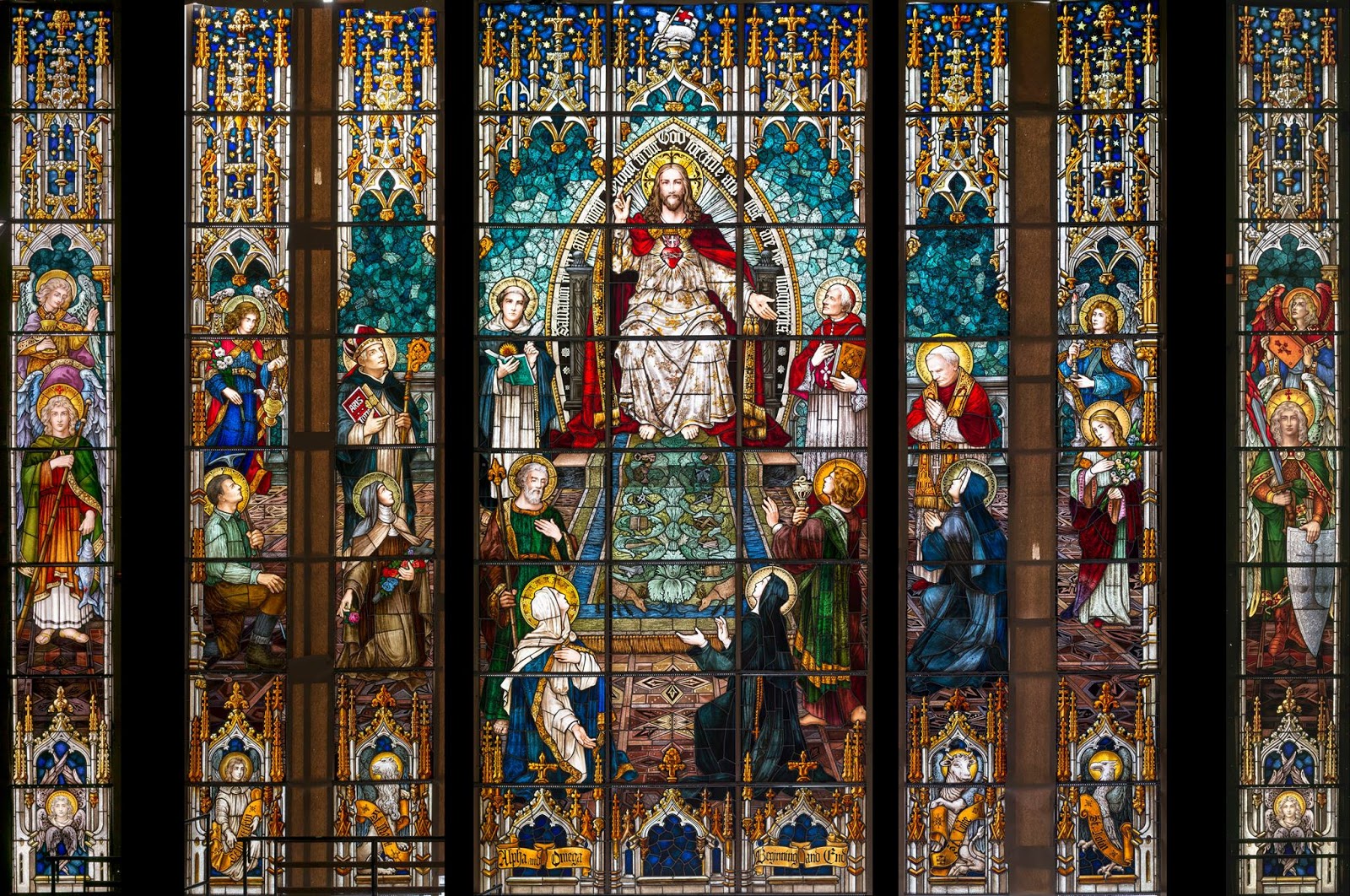
Earlier this year, Bishop Conley of Lincoln, Nebraska was on a brief speaking tour to discuss "Beauty, Culture, and the New Evangelization"; one of the stops was the Eighth Day Institute in January. During that lecture, he spoke about the new Newman Center church (not chapel) his diocese was building on the campus of the University of Nebraska-Lincoln. He wanted it to be beautiful--and chose the Gothic style of architecture as a tribute to Newman and A.W. Pugin (I teased him that Newman would not approve since he did not agree with Pugin's medieval style but preferred the classical basilica style of the early centuries in Rome--see page 5 of the article I've linked). You can see some more pictures here in this newspaper story about the church.

The cover of the July 2015 issue of the Adoremus Bulletin features a picture of the stained glass window above the Altar and behind the Rood, with this commentary by Bishop Conley:

We illustrate the indebtedness of our center to both St. Thomas Aquinas and Blessed John Newman in the stained glass window above the high altar. It’s the largest stained glass window installed in a Catholic Church in 100 years. It was built in Munich by Franz Mayer & Company. Measuring 20x24 feet, it pictures Christ on the heavenly throne surrounded by angels and saints that have to do with either learning or working with youth. To his right is St. Thomas, the Angelic doctor and great teacher of the faith, and to his left is Blessed John Henry Newman, who is the patron of Newman Centers, Catholic campus ministries and the apostolate to college students. The window also includes St. Albert the Great . . . a teacher of St. Thomas renowned in his own right for his contributions to philosophy and theology, and St. John Paul II, a great icon for the youth. The window also shows Blessed Giorgio Frassati and St. Therese of the Little Flower. All these figures in the window depict something related to young people, to the teaching or evangelizing of the youth.” – Bishop James D. Conley, Bishop of the Diocese of Lincoln

The issue contains more commentary and pictures. And here is another view of the stained glass (at the bottom of the page).


Road trip! I call shotgun!

Monday, August 31, 2015

Ten Reasons to Honor St. Edmund Campion: August 31, 1581

Fresh from his latest torture session, bereft of books or any sources but his memory and his wit, the Jesuit priest Edmund Campion debated, with other seminary priests, a group of Protestant divines on August 31, 1581. They all had a copy of his book, "Rationes Decem" and they could ask him questions, while he could only answer questions, not ask them. This was the first of four debates and was held in the Chapel of St. John in the Tower of London (the others were on September 18, 23, and 27--and were held in the private chambers of the Lieutenant of the Tower).  Campion had offered the challenge to hold debates in Oxford or Cambridge, but as a prisoner in the Tower of London he was only able to remind the Protestant divines of the unfairness of these interrogations. 

James V. Holleran recounts the story of these debates, records and reports of them in his 1999 book, A Jesuit Challenge: Edmund Campion's Debates at the Tower of London in 1581, published by Fordham University Press. As Holleran notes, Campion's "Brag" to the Queen's Council called for these debates and his "Ten Reasons" gave the debates their starting point. A brief summary of the Ten Reasons:

1. Protestants reject the parts of Scripture that don't support their doctrine.
2. Protestants distort the parts of Scripture to support their doctrine.
3. Protestants have a weak notion of the Church.
4. Protestants should accept Catholic teaching on the Mass, the Communion of Saints, and the authority of the Pope as Vicar of Christ in His Church.
5. The Fathers of the Church don't support Protestant views of the Church, the Eucharist, the Communion of Saints, and the authority of the Pope as Vicar of Christ in His Church.
6. Protestants ignore the authority of the Fathers of the Church, even of the Apostolic Fathers, since they can't find support for their doctrine in their lives and works.
7. Anticipating Blessed John Henry Newman: "To be deep in [Church] history is to cease to be a Protestant": Church History does not support Protestant doctrine of the Church, the Sacraments, the Priesthood, etc.
8. Some bad Protestant mottos (like "good works are mortal sins")
9. General weakness of Protestant arguments (as against clerical celibacy because marriage is a good thing), 
10. Catholicism is the True Christian religion, the Church founded by Jesus Christ on St. Peter and the Apostles (the Pope and the Bishops as their successors): for 1500 years, everyone agreed this was true.

The plan of the debates was to go through these Reasons with the Protestants asking Campion to defend his position. The debates did not go through all the Reasons because Campion did too well defending his position and the organizers did not want to allow Campion the opportunity the argument from history. Once he had the opportunity to remind the audience at the debates of England's Catholic history: monasticism, the close relationship with the Papacy, the saints of England, the Blessed Virgin Mary, Marian devotion (Our Lady of Walsingham), St. Augustine of Canterbury sent from the Pope to Canterbury, the beauty of the churches before desecration and destruction--as Campion would say after he and the other priests had been condemned to death, "In condemning us you condemn all your own ancestors--all the ancient priests, bishops and kings--all that was once the glory of England, the island of Saints, and the most devoted child of the See of Peter. For what have we taught, however you may qualify it with the odious name of treason, that they did not uniformly teach? To be condemned with these lights--not of England only, but of the world--by their degenerate descendants, is both gladness and glory to us." Te Deum Laudamus!

Here are some more resources on St. Edmund Campion from the Jesuit Institute, including the text of his "Brag" and a link to the Ten Reasons and this prayer:

Father,
throughout the ages you inspire heroic men and women
to preach your gospel
and proclaim the truth of your love.
We pray that the example of St Edmund Campion
may encourage us to stand up for what it right;
to hold to what is true;
and to love even those who persecute us,
for Christ's sake. Amen.