Showing posts with label the Rosary. Show all posts

Tuesday, June 2, 2020

Book Review: Lisa McClain's "Lest We Be Damned"

Clearly, I did not buy this book based on its cover!

From Routledge, Lest We Be Damned: Practical Innovation & Lived Experience Among Catholics in Protestant England, 1559–1642 was written by Lisa McClain. She is an "Assistant Professor of History and Director of Women's Studies at Boise State University. She studies popular religion during the Reformation era, and has authored articles in journals such as the Sixteenth Century Journal and the Journal of Religious History", according to Routledge. As the publisher blurbs the book:

Through compelling personal stories and in rich detail, McClain reveals the give-and-take interaction between the institutional church in Rome and the needs of believers and the hands-on clergy who provided their pastoral care within England. In doing so, she illuminates larger issues of how believers and low-level clergy push[ed] the limits of official orthodoxy in order to meet devotional needs.

Table of Contents (from my notes and including the subheads in the chapters):

Introduction
Chapter 1. "Knitting the Remnants": Catholic Challenges and Priorities in Protestant England
--A Changing Religious Environment: Penal Laws against the Practice of Catholicism
--How Many Catholics Were There?
--Who Was a Catholic?
--Catholic Priorities
   --Immanence
   --Saints, Priests, and Sacraments
   --Salvation
--Meeting Catholic Priorities
   --Evolving Goals
--Book Trade

Chapter 2. A "Church" Without a Church: English Catholics' Search for Religious Space
--Three Degrees of Separation
--Prisons
--Examinations, Trials, and Executions

Chapter 3. Using What's at Hand: English Catholic Reinterpretations of the Rosary
--Praying the Beads
--Sacraments Versus Sacramentals
--Obtaining the Beads
--Society of the Rosary
--Changing Role of the Rosary and Mary
--One of Many Emerging Views of Mary
   --Pre-Reform Use and Interpretation of the Rosary in England
   --In Contrast to Post-Tridentine Continental Portrayals of Mary

Chapter 4. Reclaiming the Body: Receiving the Benefits of the Mass in the Absence of Priests
--Functions of Catholic Sacraments
--Filling the Need
--Spiritual Reception of the Body of Christ
--Finding the Body
--Reclaiming the Body: Christ's and One's Own

Chapter 5. Lawyers, Jailbirds, Grocers, and Diplomats: Catholic Options for Piety and Community in London
--Inns of Court
--Prisons
--Catholic Geography of London
--Executions
--Relic Takers
--Merchants and Tradespeople
--Foreign Aid

Chapter 6. Katholic Kernow: Catholics of Cornwall
--Cornish Independence
--Cornwall's Celtic Past: "An Ancient Song, Lilting Before You Came"
--Lives of the Celtic Saints
--Celtic-Cornish Immanence: Places, People, and Things
   --Places
   --People
   --Things
--Cornish Catholic Participation in a Larger Catholic Community

Chapter 7. "Border of Wickedness?": Catholics in the Northern Shires
--A Convenient Partnership
--New Experiences in the North
--Protecting What was Theirs: Distinctive Attempts to Thwart Protestant Authority
--The Importance of the Borders
   --Border Instability
--Why and How Catholics Flowed Back and Forth Across the Border
   --Why Was This Possible?
   --How Was This Possible?
--Northern Catholic Identity and Community
--Conclusion

Chapter 8. From the Old Comes the New: Catholic Identities and Alternative Forms of Community
--English Catholic Identity: How English Catholics Perceived Themselves
--Identifying with Persecution and Martyrdom
--Building New Catholic Communities
--Communities of Prayer
--Communities of the Book
--Communities of the Living and the Dead
--Conjunctions of Identity and Community: How English Catholics Perceived their Relationship to Rome
--Increasing Frustration with Rome
--Oath of Allegiance Controversy

Conclusion

Notes
Select Bibliography
Index

McClain does present many compelling stories and much rich detail--sometimes repetitiously--in delineating the response of English Catholics to the loss of their churches, their parishes, their public devotional life, their communities, and most crucially, their Church's Sacraments. She carefully traces the changing circumstances of Catholics in England from the beginning of Elizabeth I's reign until the end of Charles I's reign, not strictly chronologically, but topically. For example, McClain notes that during the first years of Elizabeth's reign enforcement of the Acts of Uniformity (worship) and Supremacy (authority) was rather lax. She continues her examination of the development and variations in that enforcement during Elizabeth's reign by looking at the prisons in London, the distance and independence in Cornwall, and the distinctive issues of distance, the border with Scotland, and nobles' authority in the northern counties.

In another example of this topical treatment of changing circumstances during the period (1559 to 1642), she examines the controversy over the Oath of Allegiance during James I's reign but does not continue that theme into the reign of Charles I. So a reader should not expect a strictly chronological description of Catholic issues in England during this recusant period.

Because of my great devotion and interest in St. Robert Southwell, I was fascinated by her citation of his advice to Catholics during his time as a missionary priest to use their imaginations in their homes and in their environments. He encouraged them to dedicate rooms or areas in their houses to Jesus, to the Blessed Virgin Mary, to angels and saints; to use walking in fields or forests as pilgrimages to holy sites, to consecrate time and space to God in prayer and unity. These passages, cited from his Short Rule to a Good Life, accorded very well with what Anne R. Sweeney had written of St. Robert Southwell in Snow in Arcadia as images and imagination--inspired in him by the art and architecture of Counter-Reformation Rome--were so essential to his Ignatian poetic.

On the other hand, I was confused by her final statement about Blessed John Hambley, whose life and career she traces in two chapters (5 and 6): offering Mass at the Inns of Court in London and being born in Cornwall and leaving to become a missionary priest. She indicates that he died in prison in 1587 (p. 198) but he was hanged, drawn, and quartered on March 29 that year, according to martyrology.

McClain also alludes often to the trial and questioning of St. Margaret Clitherow, especially on the question, "What is the Church?" to which Clitherow had a good answer:
"It is that wherein the true word of god (sic) is preached which Christ langhs [launched] and left to his Apostles and they to their successors: ministering the seven sacraments which the same church has always observed, doctors preached, and martyrs and confessors witnessed. This is the church which I believe to be true."
McClain emphasizes the continuity recusant Catholics sought while they had to adapt to a great disruption: they could not practice their faith as they had done before (or as their parents and grandparents had done before Henry VIII's break from Rome) and yet they wanted to maintain the connection with the past because it was still alive and well in the world, just over the English Channel. At the same time that she emphasizes how they sought continuity, McClain explores how they had to change: praying the Rosary privately; reading their breviaries or Little Offices of the Blessed Virgin Mary in secret; if they did attend Anglican services to avoid paying the financially crippling fines, praying Catholic prayers; holding their rosaries in their pockets, etc.

Sometimes she stresses how far English Catholics were deviating from standard Catholic practice, but they were only doing so because it was the only thing they could do to maintain some continuity with the faith. When they couldn't attend Mass, confess their sins, receive Holy Communion, or even join their fellow citizens in the parish church their ancestors may have built and contributed to, they had to make Spiritual Communions, confess their sins to God and make a perfect act of contrition (declaring they never wanted to sin again!), join their intentions to Masses said on the Continent, etc. McClain notes that many of these devotions were based on late-medieval mystical piety, once considered rather dangerous because it bypassed the mediation of the ordained priesthood--but it was all that Catholics had, absent the regular ministrations of a priest, unless they were able to shelter their own chaplain, afford the fines, or benefit from friendly laxity in the enforcement of recusant laws. I think she might press this view of deviation too far, especially since it was Catholic priests recommending these practices to devout Catholics. They were not dissenting from Catholic teaching.

She does adopt what could be considered a controversial view of who was Catholic, accepting that Church Papists, those who outwardly conformed to the Church of England by attending services (not receiving Communion) but inwardly remained semi-faithful (?) to the Catholic Church were indeed still Catholic. In this, she could be following William Cardinal Allen's advice to the missionary priests he sent to England: if the laity confess attending an Anglican service as a sin, grant them absolution mercifully and gently, even if it's a sin they confess again and again (as most penitents do confess the same sins again and again).

Again, this study provides a great deal of detail: stories of arrests, imprisonments, conversations; data about books, martyrs, executions, prisons, embassy chapels; individual examples, etc, to develop a view of English Catholics' experience and life as a persecuted/prosecuted religious minority in a country that had once believed, prayed, and worshipped exactly as they did.

In her Conclusion, however, McClain tries to make more global claims of this history's significance in current situations of dissent within churches on doctrinal matters--something that never really occurs during this period among these Catholics--and the struggle to live in pluralistic societies, accommodating one another's beliefs and religious practices, bringing up book burnings, religiously inspired terrorism, all in the passive voice! ("Books are burned, martyrs are made, holy wars are declared, acts of religiously motivated terrorism proliferate"). Who burns the books, who executes the martyrs, who declares holy wars, who proliferates acts of religiously motivated terrorism? The passive voice avoids naming the actors. That's a lot of significance to cram into four paragraphs at the end of the book, especially when the purpose of the book was to help us understand the past, not necessarily help us understand the present, and especially when the situation, at least in the democratic West, is not that comparable.

I wish the book could have more illustrations and especially maps. And have a pretty cover!--but it's print on demand like so many scholarly books are now. It's an excellent resource, based on analysis of both primary and secondary sources, as McClain demonstrates familiarity with current scholarship.

Sunday, March 12, 2017

Lenten Posts: Saints and the Rosary


I haven't kept you up to date on my posts at the National Catholic Register (unless you've been clicking on the Other Publications tab and finding them yourself). Last Monday (March 6), they posted my reflection on the liturgical calendar, especially how the saints's feast days are effected during Lent:

Except for St. Joseph’s, all of the feasts of the saints during the 40 days of Lent are demoted to Commemorations—even St. Patrick’s (outside of Ireland, where it is a Holyday of Obligation). St. Joseph is so special that his feast is a Solemnity, and since March 19 is the Third Sunday of Lent in 2017, his feast has been moved to Monday, March 20. Otherwise, the penitential season of Lent takes precedence over the feasts of the saints. We often refer to a saint’s “feast” day even though the Church has a hierarchy to honor the saints, Our Lady, and especially Our Lord, in different ways. We might be tempted to think that it doesn’t matter, but the Church has reasons for these distinctions. . . .

Violet and White

The USCCB issues a liturgical calendar each year with notes about the adjustments made because of the date of Easter or just how dates fall on the Gregorian calendar vis-à-vis the Liturgical and Sanctoral calendars. When you look at the months of March and April this year until Palm Sunday, the liturgical color designated is Violet nearly every day, except for White on March 20 and March 25 (and the option of Rose on the Fourth Sunday of Lent). Looking at the calendar page in the March issue of Magnificat, you see the words Lenten Weekday predominating with the commemoration of the saints relegated to italics in the righthand column. During Mass for those Lenten Weekdays when there is a saint to be commemorated only the Collect for the saint will be used and the prayers and readings will be for the season.

Please read the rest there--and share if you like!

Just in time for the Second Sunday of Lent with the Transfiguration of Christ as the Gospel, the Register has published my post on praying the Luminous Mysteries of the Rosary during Lent:

When Pope St. John Paul II introduced the Luminous Mysteries of the Rosary in 2002, there’s no indication that he saw them as Lenten devotions. He proposed them in an Apostolic Letter on Oct. 10 that year “to bring out fully the Christological depth of the Rosary” by including “the mysteries of Christ's public ministry between his Baptism and his Passion”. In the almost 15 years since their introduction, the Luminous Mysteries have been included in most Rosary devotionals and meditation aids.

Some have resisted the option to use these mysteries for various reasons, some of which Pope John Paul anticipated in his letter: Mary, the Mother of God, is absent in all but one of the mysteries (the second); the addition of five more mysteries breaks the linkage between the 150 Aves and the 150 Psalms, and one of the mysteries is termed hard to meditate upon (the third). The five Luminous Mysteries are: 1) The Baptism of Jesus; 2) The Marriage Feast of Cana; 3) The Proclamation of the Kingdom; 4) The Transfiguration; 5) The Institution of the Eucharist. Pope St. John Paul II provided some guidance for meditation on each of these mysteries in his Apostolic Letter, noting that “we contemplate important aspects of the person of Christ as the definitive revelation of God” because “each of these mysteries is a revelation of the Kingdom now present in the very person of Jesus”.

A Luminous Lent


For Lent this year, I decided to alternate between the Luminous Mysteries and the Sorrowful Mysteries, starting on Ash Wednesday with the Sorrowful. Each of the Luminous Mysteries lends itself to a Lenten interpretation.

Please read the rest there--and Happy Transfiguration Sunday! The illustration is Carl Heinrich Bloch's (1834-1890), “The Transfiguration of Christ” from the Register post.

Saturday, March 11, 2017

The Martyr's Beads II: Blessed Thomas Atkinson

Coming the day after St. John Ogilvie's feast, and with another connection to the Rosary, I wanted to highlight Blessed Thomas Atkinson, who was executed on March 11, 1616 in York. He was 70 years old and had been serving in England as a missionary priest since 1588:

Thomas Atkinson, of Yorkshire, England, studied for the priesthood in Reims, France, where he was subsequently ordained in 1588 around the age of forty-two. Returning to England, he traveled about on foot to minister to his fellow Catholics, becoming a special friend of the poor among them. It was only after breaking a leg that the indefatigable priest resorted to traveling by horse instead. His labors in the service of persecuted Catholics became so well known that, to escape arrest by the Protestant authorities, he could only journey safely by night. In the end, he was betrayed by an informer and captured while staying at the home of a Catholic family. Then about seventy, Father Atkinson was led to prison together with the couple that had hosted him, and their children. The “incriminating evidence” found by the government officials in the priest’s possession consisted of Rosary beads and the text of an indulgence. Condemned to death by drawing and quartering, Father Atkinson is said to have faced death “with wonderful patience, courage, and constancy, and signs of great comfort.”

As Nathan Mitchell notes in The Mystery of the Rosary: Marian Devotion and the Reinvention of Catholicism, the Rosary--the beads of the Rosary--had become a marker "of recusant Catholic identity" and the beads "embodied what it meant to be a practicing Catholic in a time of religious strife and persecution." (p.5) Of course, one does not have to have a set of Rosary beans in hand to pray the Rosary and meditate on the life of Jesus and His Mother, one could use one's fingers! Father Atkinson's possession of an indulgence, which might have been--I don't find this detail in the sources I've looked--a papal document, would have been even more condemning for the court. In his book, Champions of the Rosary, Father Donald Calloway mentions that Father Atkinson was encouraging enrollment in the Confraternity of the Rosary and the the indulgence document he possessed gave details of indulgences obtained by praying the Rosary. Sources I've found also do not indicate whether or not Father Atkinson was offered James I's Oath of Allegiance.

Father Atkinson was beatified by Pope Saint John Paul II in 1987 as one of the Eight-five Martyrs of England and Wales. Obviously, as he had served his Catholic flock quietly for almost three decades he was no danger to the state. But he was captured during a period of James I's reign when fear of Catholicism was heightened and the Archbishop of Canterbury, George Abbott, was much in favor of persecuting Catholic priests. I also could not discover what happened to the family arrested with him. They may have been held in prison for some time, but James I did not want to make martyrs of lay people. Except for at the beginning of his reign in the transition from Elizabeth I, laymen or women who aided priests were not executed as often as they were during Elizabeth I's reign. They were fined and imprisoned, but not executed.

Thursday, March 9, 2017

The Martyr's Beads: St. John Ogilvie

In honor of St. John Ogilvie, SJ, I'll be on the Son Rise Morning today and tomorrow with Annie Mitchell to discuss the life and death of this great Scottish martyr: this morning at 7:45 a.m. Eastern/6:45 a.m. Central during one of the two local Ohio/Kentucky hours and tomorrow during the national EWTN hour.

The 400th anniversary of St. John Ogilvie's martyrdom was celebrated two years ago in Glasgow. While his mission to Scotland was more difficult than he thought it would be--he left to figure out what to do with his Jesuit superiors and then returned--at the end, through his martyrdom, and his Rosary, he effected a conversion. One of the spectators at his execution was moved first by Ogilvie's dignity in facing a horrible death and then by the seeming coincidence that the martyr's Rosary beads fell on him when he threw them into the crowd.

Baron John ab Eckersdorff described what happened to him on March 10, 1615 in Glasgow, Scotland:

I was on my travels through England and Scotland as it is the custom of our nobility being a mere stripling, and not having the faith. I happened to be in Glasgow the day Father Ogilvie was led forth to the gallows, and it is impossible for me to describe his lofty bearing in meeting death. His farewell to the Catholics was his casting into their midst, from the scaffold, his rosary beads just before he met his fate. That rosary, thrown haphazard, struck me on the breast in such wise that I could have caught it in the palm of my hand; but there was such a rush and crush of the Catholics to get hold of it, that unless I wished to run the risk of being trodden down, I had to cast it from me. Religion was the last thing I was then thinking about: it was not in my mind at all; yet from that moment I had no rest. Those rosary beads had left a wound in my soul; go where I would I had no peace of mind. Conscience was disturbed, and the thought would haunt me: why did the martyr's rosary strike me, and not another? For years I asked myself this question it followed me about everywhere. At last conscience won the day. I became a Catholic; I abandoned Calvinism; and this happy change I attribute to the martyr's beads, and to no other cause those beads which, if I had them now, gold could not tempt me to part with; and if gold could purchase them, I should not spare it.

Pope Paul VI canonized St. John Ogilvie in 1976. The Catholic News Agency recounts his mission to Scotland, his difficulties, and his torture:

John greatly desired to go back to his native country and encourage its return to the Catholic Church. He served for a time as a priest in France, while requesting to be sent back to Scotland. Others within his order made it clear to him that such a mission would be dangerous and unlikely to produce much fruit. In 1613, however, John obtained the assignment he desired.

He soon discovered the truth of the warnings he had received from other Jesuits, about the difficulty of Catholic evangelization in Scotland. Many members of the upper classes were not interested in returning to the Church, though he did carry out pastoral work among a largely poor population of Scots who had kept the faith. After a period in England he returned to France, seeking directions on how to proceed in light of his lack of success.

The French Jesuits ordered John back to Scotland, however, where he resumed his ministry to the underground Church as well as the smaller number of people interested in converting. His arrest came about when one potential “convert” turned out to be an informer, who had John arrested and interrogated.

The first criminal accusation St. John Ogilvie faced was that of celebrating Mass within the King’s realm. Unwilling to incriminate himself, he suffered two months of imprisonment. An iron bar was attached to his feet to prevent him from moving in his cell. Despite this ordeal, he strongly resisted pressure to give evidence against other Scottish Catholics.

Severe torture was then inflicted on John. His hair and fingernails were pulled out, and for a period of nine days he was prevented from sleeping by continual stabbing with sharp stakes. His jailers beat him, flung him to the floor of his cell, and shouted in his ears. Nothing, however, could make him renounce his faith or betray his Catholic countrymen to the authorities.

John’s tormentors were impressed by his fortitude, and by the surprising sense of humor that he showed in the face of the brutal punishments. But they could not spare his life, unless the Jesuit priest gave an acceptable response to a series of questions provided by King James I. John declared his loyalty to the king, but steadfastly rejected James’ claim to supremacy over the Church in religious matters. The priest was eventually convicted on a charge of high treason.

Attempts to ply John with bribery – in exchange for his return to Protestantism, and his betrayal of fellow Catholics – continued even as he was being led to his execution. His own defiant words are recorded: for the Catholic faith, he said, he would "willingly and joyfully pour forth even a hundred lives. Snatch away that one which I have from me, and make no delay about it, but my religion you will never snatch away from me!"

Asked whether he was afraid to die, the priest replied: “I fear death as much as you do your dinner.” 


He had been born into a Calvinist family, but had converted to Catholicism while visiting France, studying for the priesthood, becoming a Jesuit, and being ordained in Paris. 

Friday, June 12, 2015

The Rosary and Anachronism

I noticed this post on the English Historical Fiction Authors page about the use of beads in prayer and the term "rosary":

The image of a Catholic kneeling in prayer, rosary in hand seems timeless. Having a Dark Ages character rub the beads while murmuring a prayer wouldn't be an anachronism, would it?

Yes and no. Christians, and people of other faiths such as Hindus, Buddhists, and Muslims, have used beads to keep track of the prayers they were repeating. In the fourth century, Egyptian Abbot Paul used 300 pebbles that he would drop. (Would picking up all those little stones count as penance, too?)

By the seventh century, at least some of the faithful used strings of beads.


The author notes that the term "Rosary" was not used in English until 1547. 

Reading this post reminded me of an historical anachronism I found in a novel, Leonardo's Swans, set in Renaissance Italy. A character prays the Rosary and ends the decades with the Fatima prayer:  "O my Jesus, forgive us our sins, save us from the fires of hell, and lead all souls to Heaven, especially those in most need of Your Mercy". That prayer dates from the early twentieth century so a person in that era would not have added it to the recitation of the Rosary.

Another note for thinking about how Catholics have prayed the Rosary through the centuries: the Ave Maria ("Hail Mary") was just the two verses from St. Luke's Gospel, the first chapter (28 and 42) with the addition of the name Mary: Hail Mary, full of grace, the Lord is with thee (the Angel's greeting) and Blessed art thou among women, and blessed is the fruit of thy womb (her cousin Elizabeth's greeting). The second part--Holy Mary, Mother of God, pray for us sinners now and at the hour of our death--was a later addition, as was the name Jesus at the end of the second verse.

Anne Winston-Allen wrote Stories of the Rose, published by Penn State University Press, to trace the development and popularity of the Rosary prayer throughout the medieval period. Nathan Mitchell picks up the story of the Rosary and its importance to Catholic identity during the Counter- or Catholic Reformation period in his book The Mystery of the Rosary.

Wednesday, January 7, 2015

Sing we Yule til (Almost) Candlemas


We have put the lighted nativity of Baby Jesus, Mary, and Joseph back in storage (it's minimalist--no shepherds, Wise Men, angels, or barn animals), but are leaving our (artificial) Christmas Tree, lights, and other garland up until the end of January. Candlemas this year is on Monday (February 2) and the pre-Lenten Septuagesima season begins on Sunday, February 1, so it seems appropriate to take them all down on Saturday, January 31. Doesn't seem right to have the Christmas Tree and other decorations up when we are preparing for Lent! The lights of the tree are so festive during the usually cold and overcast days and early nights of January so we look forward to their glowing light in our living room.

As during the Advent and Christmas seasons, the commercial world is already preparing for St. Valentine's Day and Easter with candy and cards in the stores. With the Epiphany Season, as Blessed John Henry Newman reminded us, we are still celebrating the Incarnation and worshiping the newborn baby Jesus! This fifteenth century English Christmas carol modernized by William Henry Husk has an appropriate refrain:
Make we mirth
For Christ His Birth
And sing we Yule till Candlemas.
1. The first day of Yule we have in mind
How man was born all of our kind,
For He would the bonds unbind
    Of all our sin and wickedness.
2. The second day we sing of Stephen
That stoned was, and said up even
With Christ there he would stand in heaven,
    And crowned was for his prowess.
3. The third day 'longs to St. John,
That was Christ's darling, dearest one,
To whom He took, when He should gone,
    His dear mother for his cleanness.
4. The fourth day of the Children young
With Herod's wrath to death were throng,
Of Christ they cold not speak with tongue,
    But with their blood bare witness.
5. The fifth day hallowed St. Thomas,
Right as strong as pillar of brass,
Held up his church and slain was,
    For he stood fast in righteousness.
6. The eighty day took Jesu His name,
That saved mankind from sin and shame,
And circumcised was for no blame,
    But for example of meekness.
7. The twelfth day offered to Him Kings three,
Gold, myrrh, incense, these gifts free,
For God and man and king is He,
    And thus they worshipped his worthiness.
8. The fortieth day came Mary mild
Unto the Temple with her child,
To shew her clean that never was 'filed,
    And herewith ends Christmas.

One way to continue this celebration is suggested by the blogger at Silverstream Priory in Ireland: using the Rosary to meditate on the mysteries of Epiphany:

The Five Mysteries of the Epiphany correspond to the five great Epiphany Gospels given us by the Church (in the traditional calendar and Liturgy) on the day of the Epiphany, 6 January; on the feast of the Baptism of the Lord, 13 January; and on the Second, Third, and Fourth Sundays after Epiphany. Each of these Gospels presents a particular manifestation of the Divinity of Our Lord Jesus Christ.

1. Matthew 2:1-12, Our Lord makes himself known to the Magi by means of a star, and receives their adoration in Bethlehem.

And behold the star which they had seen in the east, went before them, until it came and stood over where the child was. And seeing the star they rejoiced with exceeding great joy. And entering into the house, they found the child with Mary his mother, and falling down they adored him. (Mt 2:9-11)

2. John 1:29-34 — At His Baptism in the Jordan by John, the Holy Ghost descends in the form of a dove, and the voice of the Father reveals Jesus as His Beloved Son, in whom He is well pleased.

Now it came to pass, when all the people were baptized, that Jesus also being baptized and praying, heaven was opened; And the Holy Ghost descended in a bodily shape, as a dove upon him; and a voice came from heaven: Thou art my beloved Son; in thee I am well pleased. (Lk 3:21-22)

3. John 2:1-11 — At the wedding feast in Cana of Galilee, Jesus, at His Mother’s bidding, changes water into wine.

And the wine failing, the mother of Jesus saith to him: They have no wine. And Jesus saith to her: Woman, what is that to me and to thee? my hour is not yet come. His mother saith to the waiters: Whatsoever he shall say to you, do ye. (Jn 2:3-5)

4. Matthew 8:1-13 — Jesus, with a word, cleanses a leper.

And behold a leper came and adored him, saying: Lord, if thou wilt, thou canst make me clean. And Jesus stretching forth his hand, touched him, saying: I will, be thou made clean. And forthwith his leprosy was cleansed. (Mt 8:2-3)

5. Matthew 8:23-27 — Jesus calms the raging sea.

And behold a great tempest arose in the sea, so that the boat was covered with waves, but he was asleep. And they came to him, and awaked him, saying: Lord, save us, we perish. And Jesus saith to them: Why are you fearful, O ye of little faith? Then rising up he commanded the winds, and the sea, and there came a great calm. (Mt 8:24-25)

Thursday, May 22, 2014

Blessed John Forest, Unique Among the Catholic Martyrs

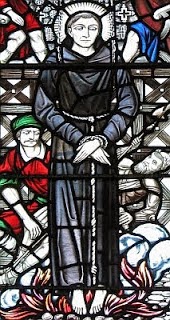
Blessed John Forest is unique among the Catholic martyrs of the English Reformation. He is what I would call a Supremacy Martyr, suffering for his refusal to recognize Henry VIII's supremacy over the Church of England, but he was found guilty, not of treason but of heresy--and thus burned alive in chains by the order of Thomas Cranmer, the Archbishop of Canterbury.

As one of the Observant Franciscans and as one of Queen Katherine of Aragon's chaplains and confessors, Blessed John Forest (beatified by Pope Leo XIII), was always opposed to what Henry VIII planned to do to resolve his "Great Matter", manipulating the Catholic Faith in England and attempting to do so in Rome to achieve his goal of marrying Anne Boleyn. The Thomas Abel mentioned below was another one of Katherine of Aragon's chaplains, executed along with two others (and three Zwinglians) two years later. Father Peto's sermon at Greenwich compared Henry VIII to Ahab and Anne Boleyn to Jezebel and occasioned threats from Thomas Cromwell that Peto and his defender Friar Elstow mocked as ineffective to those who did not fear death. Blessed John Forest endured imprisonment and a torturous death to defend the sanctity of marriage and unity of the one, holy, catholic and apostolic Church.

From the Catholic Encyclopedia, details about the blessed martyr's life and death:

Born in 1471, presumably at Oxford, where his surname was then not unknown; suffered 22 May, 1538. At the age of twenty he received the habit of St. Francis at Greenwich, in the church of the Friars Minor of the Regular Observance, called for brevity's sake "Observants". Nine years later we find him at Oxford, studying theology. He is commonly styled "Doctor" though, beyond the steps which he took to qualify as bachelor of divinity, no positive proof of his further progress has been found. Afterwards he became one of Queen Catherine's chaplains, and was appointed her confessor. In 1525 he appears to have been provincial, which seems certain from the fact that he threatened with excommunication the brethren who opposed Cardinal Wolsey's legatine powers. Already in 1531 the Observants had incurred the king's displeasure by their determined opposition to the divorce; and no wonder that Father Forest was soon singled out as an object of wrath. In November, 1532, we find the holy man discoursing at Paul's Cross on the decay of the realm and pulling down of churches. At the beginning of February, 1533 an attempt at reconciliation was made between him and Henry: but a couple of months later he left the neighbourhood of London, where he was no longer safe. He was probably already in Newgate prison 1534, when Father Peto [gave] his famous sermon before the king at Greenwich. In his confinement Father Forest corresponded with the queen and Blessed Thomas Abel and wrote a book or treatise against Henry, which began with the text: "Neither doth any man take the honour to himself, but he that is called by God as Aaron was.

On 8 April, 1538, the holy friar was taken to Lambeth, where, before Cranmer, he was required to make an act of abjuration. This, however, he firmly refused to do; and it was then decided that the sentence of death should be carried out. On 22 May following he was taken to Smithfield to be burned. The statue of "Darvell Gatheren" which had been brought from the church of Llanderfel in Wales, was thrown on the pile of firewood; and thus, according to popular belief, was fulfilled an old prophecy, that this holy image would set a forest on fire. The holy man's martyrdom lasted two hours, at the end of which the executioners threw him, together with the gibbet on which he hung, into the fire. Father Forest, together with fifty-three other English martyrs, was declared Blessed by Pope Leo XIII, on 9 December, 1886, and his feast is kept by the Friars Minor on 22 May.


The Guild of Blessed Titus Brandsma blog posted this information about the friar's correspondence with Katherine of Aragon:

“Most Serene Lady and Queen, my daughter most dear in the bowels of Christ, - When I read your letter I was filled with incredible joy, because I saw how great is your constancy in the Faith.

In this, if you persevere, without doubt you will attain salvation.

Doubt not of me that by any inconstancy I should disgrace my grey hairs.

Meanwhile I earnestly beg your steadfast prayers to God, for whose spouse we suffer torments, to receive me into His glory.

For it have I striven these four and forty years in the Order of St Francis.

Meanwhile do you keep free from the pestilent doctrine of the heretics, so that even if an angel should come down from Heaven and bring you another doctrine from that which I have taught you, give no credit to his words, but reject him; for that other doctrine does not come from God.

These few words you must take in lieu of consolation; but that you will receive from our Lord Jesus Christ, to whom I specially commend you, to my father Francis, to St Catherine; and when you hear of my execution, I heartily beg of you to pray for me to her.

I send you my rosary as I have but three days to live.”


Blessed John Forest, pray for us!

Thursday, March 6, 2014

Louisa May Alcott, RIP


Louisa May Alcott died on March 6, 1888. I read my first copy of Little Women (actually an abridged edition of  Little Women and Good Wives from Whitman Classics) so much when I was a child that the book fell apart. Sections of it fell out and I had to use a rubber band to keep the book together! (The image above is the cover of a recent Penguin edition.)

I also read Little Men, Jo's Boys, Eight Cousins, Rose in Bloom, Under the Lilacs, Jack and Jill, Hospital Sketches, and An Old Fashioned Girl. Several years ago, I investigated her Gothic novels and other fiction: A Long Fatal Love Chase (guess how that book ends!), Behind a Mask, The Inheritance, and Moods.

In Little Women and a few of the other children's books I noticed how Alcott sometimes used Catholic devotions. If you read Little Women you might remember when Amy has to stay at Aunt March's mansion while Beth is home ill with scarlet fever. Aunt March's French maid Esther tells her a little about the Rosary and urges Amy to set aside a place and take time every day for some meditation and prayer. Amy does pray in her chapel, but certainly does not use the Rosary Esther gives her, "feeling doubtful as to its fitness for Protestant prayers."

Rose in Bloom contains an extended discussion of saints and devotion when Rose and her cousin Charlie debate the merits of St. Francis of Assisi and St. Martin of Tours:

"Some of my saints here were people of one idea, and though they were not very successful from a worldly point of view while alive, they were loved and canonized when dead," said Rose, who had been turning over a pile of photographs on the table and just then found her favorite, St. Francis, among them.

"This is more to my taste. Those worn-out, cadaverous fellows give me the blues, but here's a gentlemanly saint who takes things easy and does good as he goes along without howling over his own sins or making other people miserable by telling them of theirs." And Charlie laid a handsome St. Martin beside the brown-frocked monk.

Rose looked at both and understood why her cousin preferred the soldierly figure with the sword to the ascetic with his crucifix. One was riding bravely through the world in purple and fine linen, with horse and hound and squires at his back; and the other was in a lazar-house, praying over the dead and dying. The contrast was a strong one, and the girl's eyes lingered longest on the knight, though she said thoughtfully, "Yours is certainly the pleasantest and yet I never heard of any good deed he did, except divide his cloak with a beggar, while St. Francis gave himself to charity just when life was most tempting and spent years working for God without reward. He's old and poor, and in a dreadful place, but I won't give him up, and you may have your gay St. Martin if you want him."

"No, thank you, saints are not in my line but I'd like the golden-haired angel in the blue gown if you'll let me have her. She shall be my little Madonna, and I'll pray to her like a good Catholic," answered Charlie, turning to the delicate, deep-eyed figure with the lilies in its hand.

"With all my heart, and any others that you like. Choose some for your mother and give them to her with my love."

So Charlie sat down beside Rose to turn and talk over the pictures for a long and pleasant hour. But when they went away to lunch, if there had been anyone to observe so small but significant a trifle, good St. Francis lay face downward behind the sofa, while gallant St. Martin stood erect upon the chimneypiece.

And later in the same novel, one of Rose's other cousins, Mac, compares Rose to the Blessed Virgin Mary:

"Lead Rosa--I'm going to take this child home, and if Uncle is willing, I'll adopt her, and she shall be happy!" cried Rose, with the sudden glow of feeling that always made her lovely. And gathering poor baby close, she went on her way like a modern Britomart, ready to redress the wrongs of any who had need of her.

As he led the slowly stepping horse along the quiet road, Mac could not help thinking that they looked a little like the Flight into Egypt, but he did not say so, being a reverent youth--only glanced back now and then at the figure above him, for Rose had taken off her hat to keep the light from baby's eyes and sat with the sunshine turning her uncovered hair to gold as she looked down at the little creature resting on the saddle before her with the sweet thoughtfulness one sees in some of Correggio's young Madonnas.


These references to saints and Madonnas coming from a Unitarian Universalist are rather surprising. Certainly when you know more about St. Martin of Tours than Rose (or Alcott), the contrast she and Charlie see between them is confusing. St. Martin of Tours, hermit and then bishop, certainly spent his days after that one gesture in the same efforts as St. Francis of Assisi, whom Alcott mistakenly calls a monk (when he was a friar). Notice too the emphasis on charity and works. Alcott's novels for young girls are filled with calls to charity for the poor, efforts for the abandoned and the orphaned. As this site notes, Alcott's Unitarian background emphasized duty far above the "outward forms and rite of religion":

When Louisa May Alcott was a young woman trying to find work in Boston, she met the Rev. Theodore Parker, a Unitarian minister. He and his wife were very helpful to her. She attended his Sunday Services and his evening discussion groups. Louisa May Alcott's [1888] biographer, Ednah D. Cheney, writes the following about Louisa's religion:

"In her journal at this time she speaks of her religious feelings, which the experiences of grief and despair and reviving hope had deepened. Louisa Alcott's was a truly religious soul; she always lived in the consciousness of a Higher Power sustaining and blessing her, whose presence was revealed to her through Nature, through the inspired words of great thinkers and the deep experiences of her own heart. She never led her life as an isolated possession which she was free to use for her own enjoyment or glory. Her father truly called her 'Duty's faithful child', and her life was consecrated to the duty she recognized as specially hers. But for outward forms and rites of religion she cared little; her home was sacred to her, and she found her best life there. She loved Theodore Parker, and found great strength and help from his preaching, and afterward liked to listen to Dr. Bartol; but she never joined any church."


Since she did not practice the ritual aspect of religion--not joining any church--Alcott unfortunately did not understand Catholic devotion. She depicts a rather romanticized and aesthetic view of Catholicism, at least when reflecting on prayers and devotions. Nevertheless, I enjoyed her books very much when I read and re-read them so many years ago.

Saturday, July 20, 2013

Pope Leo XIII, RIP

Pope Leo XIII died on July 20, 1903. He was born Gioacchino Vincenzo Raffaele Luigi on March 2, 1810 and elected as the Vicar of Christ on February 20, 1878. As this article from the Catholic Encyclopedia describes his papacy, he had great impact on the Catholic Church in England and left an important legacy for the universal Catholic Church with his many (12!) encyclicals on the Rosary, his ground-breaking social encyclical, Rerum Novarum, and other Catholic devotions, like the Prayer to St. Michael the Archangel:

Saint Michael the Archangel,
defend us in battle;
be our protection against the wickedness and snares of the devil.
May God rebuke him, we humbly pray:
and do thou, O Prince of the heavenly host,
by the power of God,
thrust into hell Satan and all the evil spirits
who prowl about the world seeking the ruin of souls.
Amen.


Sancte Michael Archangele,
defende nos in proelio;
contra nequitiam et insidias diaboli esto praesidium.
Imperet illi Deus, supplices deprecamur:
tuque, Princeps militiae Caelestis,
satanam aliosque spiritus malignos,
qui ad perditionem animarum pervagantur in mundo,
divina virtute in infernum detrude.
Amen.


As to his influence on the British Empire and Ireland, the Catholic Encyclopedia article notes:

Among the acts of Leo XIII that affected in a particular way the English-speaking world may be mentioned: for England, the elevation of John Henry Newman to the cardinalate (1879), the "Romanos Pontifices" of 1881 concerning the relations of the hierarchy and the regular clergy, the beatification (1886) of fifty English martyrs, the celebration of the thirteenth centenary of St. Gregory the Great, Apostle of England (1891), the Encyclicals "Ad Anglos" of 1895, on the return to Catholic unity, and the "Apostolicæ Curæ" of 1896, on the non-validity of the Anglican orders. He restored the Scotch hierarchy in 1878, and in 1898 addressed to the Scotch a very touching letter. In English India Pope Leo established the hierarchy in 1886, and regulated there long-standing conflicts with the Portugese authorities. In 1903 King Edward VII paid him a visit at the Vatican. The Irish Church experienced his pastoral solicitude on many occasions. His letter to Archbishop McCabe of Dublin (1881), the elevation of the same prelate to the cardinalate in 1882, the calling of the Irish bishops to Rome in 1885, the decree of the Holy Office (13 April, 1888) on the plan of campaign and boycotting, and the subsequent Encyclical of 24 June, 1888, to the Irish hierarchy represent in part his fatherly concern for the Irish people, however diverse the feelings they aroused at the height of the land agitation.

When Pope Leo XIII made Father John Henry Newman a Cardinal Deacon of the Church, he knew it was a controversial move--he called Newman "my cardinal" and said, "My cardinal! it was not easy, it was not easy. They said he was too liberal, but I had determined to honour the Church in honouring Newman. I always had a cult for him. I am proud that I was able to honour such a man."

May Pope Leo XIII, Gioacchino Vincenzo Raffaele Luigi, rest in the peace of Christ. Image credit from wikipedia commons.