Showing posts with label revisionist history. Show all posts

Friday, September 30, 2016

"This book will challenge everything you think you know about history."

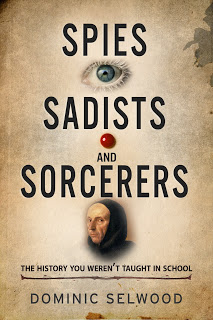
Dominic Selwood is an author and columnist, who has collected a series of columns offering different views of historical events into a book: Spies, Sadists and Sorcerers: The History You Weren't Taught in School (available on Kindle for $.99!).

Nancy Bilyeau interviews him on her blog, highlighting his revisionist view of the English Reformation, which certainly coincides with mine (and hers, too, I think).

Selwood's website provides generous excerpts from the book, including this "unintended Reformation" moment, discussing Walpurgisnacht and the saint it should be honoring:

It is pure coincidence that Walburga was canonized on May Day, thus giving her name to the festivities of the night before. But it is also strangely fitting, as popular belief in the healing properties of saints’ relics (and oils) is inseparable from our historical attachment to magic. 

And here is where something fascinating happens. As the Reformation swept away faith in popular and largely benign Christian miracles, it instead offered belief in a much darker magic —one that would quickly lead to the horror of the witch-craze and fantastical legends like the sabbaths on the Brocken. 

It is deeply ironic that the Protestant reformers, in abolishing what they saw as harmful superstitious claptrap, replaced it with terrifying magical fears that would end with the brutal and pointless murder of tens of thousands of innocent women. 

Before the Reformation there had, of course, been some scattered witch trials. But the same reforming theologians who lambasted what they saw as the crude and irrational magical beliefs underpinning the cult of saints and relics rapidly convinced themselves that hundreds of towns and villages were sheltering the foulest witches and demons, whose unnatural rites jeopardized the health and salvation of Christendom. They saw them flying on diabolical beasts, covering vast distances in the blink of an eye. They found on them folds of skin used for suckling demons in the form of familiars. They accused them of sexually molesting decent folk, invading their beds as lustful incubi and succubi. They were convinced they possessed infernal powers to see the past, the present (at great distance), and the future. But above all, they feared the witches were working ceaselessly to destroy their new, rational churches. 

As the reformers set about ridding the world of these devilish handmaidens, the great burnings began, peaking in the late 1500s and early 1600s, before petering out in the early 1700s. In that time, somewhere between 40,000 and 100,000 people (predominantly, but not exclusively, women) were torched alive on suspicion of practising magic.

Looks like a fascinating, if episodic, review of events in history seen from different angles.

Saturday, June 13, 2015

More Bad News about England (and me?)

Father Dwight Longenecker and Joseph Pearce just led a Catholic pilgrimage to England. Father Longenecker writes on his blog:

One of the most impressive things about this pilgrimage to England was the remembrance of a Catholic England that was not only brutally destroyed, but a destruction which, to this day, is covered up by a smokescreen of ignorance, propaganda and lies. Henry VIII is still presented in tourist information boards, cathedral guides and church leaflets as “the charismatic young King who reformed a corrupt church system of the Dark Ages.” His depredations, robbery, iconoclasm and cruelty is totally glossed over. Time and again the pilgrims were astounded to see how Mary Queen of Scots [and] Catherine of Aragon were ignored or sidelined–how Mary Tudor was still presented as “Bloody Mary” and Elizabeth I as “Good Queen Bess”. Happily our guide at the Tower was probably a Catholic and stressed how Elizabeth’s persecution of Catholics was far more severe and long lasting and pervasive than Mary’s persecution of Protestants ever was.

That this misrepresentation still continues with films like the two Elizabeth movies and the recent TV series Wolf Hall is shameful. Revisionist historians like Eamon Duffy, Jack Scarisbrick and Christopher Haigh have done their work and any researcher now has no excuse not to know the true history of the period, but of course that history doesn’t sell. So the blood of the English martyrs is ignored. The true horror of Tyburn Tree, Topcliffe’s torture chambers and 300 years of Catholic persecution in England–the longest and harshest in history–is swept under the carpet. Chief among the culprits, of course, are the Anglicans. They continue to present their laundered view of history–despite knowing full well what happened, and still (to my knowledge) there has been no formal attempt of repentance and sorrow for what happened similar to Pope St John Paul II’s famous Ash Wednesday service of repentance in the year 2000.

Reading this made me sad. I've tried on the popular level with my book, articles, this blog, radio interviews, a 13 week radio show (!), presentations, etc, etc, and so forth, for the past six years to tell this story. Duffy, Scarisbrick, and Haigh all wrote on an academic level to lay the foundation for a more accurate view of the history of the English Reformation, of course, but Father Longenecker is right that history does not sell or at least that historical revisionism doesn't sell. It's so much more easy to accept the common lies, the Black Legend, the party line, either because of prejudice or because it's hard to think about it a different way.

When I taught my class on St. Thomas More in May, I referenced George Weigel's comment from First Things on the commonly accepted view of the English Reformation and how the revisionist view still hasn't replaced the Whig version:

And because Britain’s literary high culture is still in thrall to the Whig view of British history, and seems oblivious to the deep transformation that’s taken place in English Reformation studies since Eamon Duffy’s extraordinary book, The Stripping of the Altars, was first published in 1992. There, Duffy demonstrated beyond cavil what Simon Schama alluded to in his Financial Times article on the BBC version of Wolf Hall: that Henry VIII was a proto-totalitarian who, with his Protestant heirs, imposed his version of Christianity on England against the will of the great majority of plain folk, who stubbornly clung to the old faith until the overwhelming power of the state extinguished most of English Catholic life, and “anti-popery” got set in cultural concrete as modern nation-building went forward in Britain—often funded by expropriated Catholic properties.

As I told the little group of friends cum students (including Rex the dog), reading that made me sad. Of course, I've been doing all this on a part-time basis, but I'm disappointed that the project and the message I think so important has been ignored. Thanks to all of you who follow my blog, have read my book, listened to interviews, liked my facebook page, followed me on twitter, etc. Your comments and encouragement are always welcome. 

Saturday, December 13, 2014

"How English history used to be told": Marshall's OUR ISLAND STORY

Andrew M. Brown discusses bias in English History for The Catholic Herald:

What are you supposed to do when you’re reading the gripping history book Our Island Story, by H E Marshall, to your children and you stumble into a bit that is fervently anti-Catholic? These passages crop up with monotonous regularity. For example, in the section dealing with Edward the Confessor, Marshall sneers at King Edward’s medieval piety, observing that “he thought more about building churches and buying relics or bones of holy men, long since dead, than of strengthening his castles and trying to make the lives of his people peaceful and happy”. All the priests are “rich” and all the monks “wicked”. Generally the picture is of the Middle Ages as backward and unenlightened. (But how backward can a culture have been that produced buildings of the lightness and beauty of our great cathedrals?)

That is how English history used to be told. They were the received assumptions – at least, until the current generation of historians known as the revisionists came along, most prominently Eamon Duffy, but also Jack Scarisbrick, Richard Rex and Peter Marshall.

Anti-Catholicism persists in historians’ circles, as the reaction to the revisionists demonstrates. As Duffy has written, the work of these mostly Catholic scholars is wrongly characterised in some quarters as the “grinding of papistical axes”.


Yet no one batted an eyelid when, previously, nearly all histories of the Reformation were written by Protestants. There is a list as long as your arm of them, including John Foxe in the 16th century, Gilbert Burnet in the 17th, James Froude in the 19th and, in the 20th, Sir Keith Thomas, A G Dickens, G G Coulton, A F Pollard and the Methodist Luther scholar Gordon Rupp.

Our Island Story is a very popular children's book by Henrietta Elizabeth Marshall. Civitas, "a community of researchers and supporters committed to discovering how best to strengthen democracy, uphold limited government, maintain personal freedom, achieve opportunity for all, and encourage free enterprise" has reissued the book with a foreword by Lady Antonia Fraser. Civitas provides some information about the author and her work:

Very little is known for certain about Henrietta Elizabeth Marshall. She was born in Scotland in 1867, the third daughter in a family of six children, and was warden of Queen Margaret Hall in Glasgow from 1901 to 1904. She was in Melbourne when Our Island Story was published in 1905, in Oxford from 1905 until 1908, and in Redlands, California, USA from 1913 until 1917.

All else about the author of Our Island Story remains shrouded in mystery, save for her abiding legacy to the world. This consists of a remarkable series of children’s books that she wrote, dealing for the most part with the history and literature of the British people at home and elsewhere in the world where they have settled in number.

Marshall never married and had no children. However, the subject matter of her books and the gentleness of their style suggest she may well have been a governess or private tutor to young children.

She died in London in 1941, having spent the last part of her life in straitened circumstances, but her genius as a storyteller and educator will live on for as long as boys and girls continue to be able to open the pages of her enchanting and informative books.

Her principal books, together with the dates each was first published, are:
Our Island Story: A History of England for Boys and Girls (1905); Stories of Robin Hood Told to Children (1905); Stories of Guy of Warwick Told to Children (1906); Stories of William Tell Told to Children (1906); Scotland’s Story: A History of Scotland for Boys and Girls (1906); Stories of Roland Told to the Children (1907); Our Empire Story: Stories of India and the Greater Colonies told to Boys and Girls (1908); Stories of Beowulf Told to the Children (1908); English Literature for Boys and Girls (1909); A History of France (1912); Through Great Britain and Ireland with Cromwell (1912); This Country of Ours (1917); and Kings and Things (1937).

Through Great Britain and Ireland with Cromwell? I wonder how she deals with Drogheda and Cromwell's stated anti-Catholicism AND anti-Anglicanism. 

Should a book like this, published with the express purpose of making history entertaining and easy to read, be accompanied by notes that provide greater context? If the books are not as informative as they are enchanting--or may even be deceiving when used in classrooms and schools, should they be corrected?

Brown suggests one method for a parent to use:

Without doubt, today’s revisionist historiography has acted as a necessary corrective to the dominant Protestant mode. And when reading Our Island Story, all I need to do is bowdlerise as I go along – skip or rewrite on the hoof when I come across an anti-papist belch about building churches and relics and all that murky medieval stuff. You can see how easily, if you were to give children a steady diet of this material unadulterated, an attitude of mind towards Catholicism would become ingrained. But it is very much a Victorian or Edwardian view that was carried over to the 20th century. Most importantly, it is wrong.

But again I wonder, especially when reading Civitas' explanation of why they wanted to republish the book:

But there was also a serious underlying purpose behind the decision to republish the book. Marshall knew all about the importance of the institutions of a free society, and explains thoroughly why we need to make sure the state cannot imprison people without trial, or force them to worship God in a particular way, or extract taxes without allowing people a say in the running of the country. Now that the teaching of institutional and political history is so weak in many schools, her message is of vital importance – and not only for the 7 to 11-year-olds the book is aimed at.

Does Marshall really make sure her readers know why "the state cannot imprison people without a trial" when the rights of Catholics were violated (Henry VIII having the Carthusians chained in prison, Edmund Campion and companions tortured in violation of English law during Elizabeth I's reign, etc) or why the state cannot "force them to worship God in a particular way" when it was the Catholic Mass that was outlawed (Edward VI and The Book of Common Prayer; Elizabeth I and the Act of Uniformity, recusancy laws, penal laws, etc)? I wonder.

Tuesday, May 27, 2014

Dominic Selwood on the English Reformation

Writing on his Telegraph blog about how history can be manipulated by the ruling party, Dominic Selwood writes:

So what about England? Has our constitutional monarchy and ancient tradition of parliamentary democracy protected our history from political manipulation? Can we rely on what we are taught and told, or are there myths we, too, have swallowed hook, line, and sinker?

Where better to start than with that most quintessentially English of events ­— the break with Rome that signalled the birth of modern England?

For centuries, the English have been taught that the late medieval Church was superstitious, corrupt, exploitative, and alien. Above all, we were told that King Henry VIII and the people of England despised its popish flummery and primitive rites. England was fed up to the back teeth with the ignorant mumbo-jumbo magicians of the foreign Church, and up and down the country Tudor people preferred plain-speaking, rational men like Wycliffe, Luther, and Calvin. Henry VIII achieved what all sane English and Welsh people had long desired ­– an excuse to break away from an anachronistic subjugation to the ridiculous medieval strictures of the Church.

For many in England, the subject of whether or not this was true was not even up for debate. Even now, the historical English disdain for all things Catholic is often regarded as irrefutable and objective fact. Otherwise why would we have been taught it for four and a half centuries? And anyway, the English are quite clearly not an emotional race like some of our continental cousins. We like our churches bright and clean and practical and full of common sense. For this reason, we are brought up to believe that Catholicism is just fundamentally, well … un-English.

But the last 30 years have seen a revolution in Reformation research. Leading scholars have started looking behind the pronouncements of the religious revolution’s leaders – Henry VIII, Thomas Cromwell, Thomas Cranmer, Hugh Latimer, Nicholas Ridley – and beyond the parliamentary pronouncements and the great sermons. Instead, they have begun focusing on the records left by ordinary English people. This “bottom up” approach to history has undoubtedly been the most exciting development in historical research in the last 50 years. It has taken us away from what the rulers want us to know, and steered us closer towards what actually happened.

Golly, you'd almost think he'd read my book!

I thought this was a particularly well-reasoned analysis of the violence of Henry VIII's imposition of his break from Rome:

The Tudor violence meted out to enforce the break with Rome was extreme, designed to deter by shock. For instance, one of Henry’s earliest victims was Sister Elizabeth Barton, a Benedictine nun. When she criticised Henry’s desire to marry Anne Boleyn, he had her executed, and her head spiked on London Bridge ­— the first and only woman ever to have suffered this posthumous barbarity.

Henry and his inner circle of politicians and radical clerics put to death hundreds of dissenters, pour encourager les autres. None of these people were plotting to kill him or destabilise his rule. Their “treason” was to oppose the destruction of their religion or the despoiling of their property. The brutal strangulation, emasculation, disembowelling, beheading, and quartering they endured as traitors was hideous, as was the total absence of any form of due process or justice.

Henry's use of attainder, meaning that the accused was never tried nor really even knew the charges against them, was brought up in an article by Suzannah Lipscomb in History Today, discussing whether or not Henry VIII was a tyrant:

Yet one of these laws, passed in 1539, ordered that royal proclamations would henceforth have the same status in law as statute. In other words, Henry used Parliament to eradicate the need for it and to make his word – quite literally – law. Similarly he condemned to death, through Parliament, an unprecedented number of people who were available for trial by the use of acts of attainder – acts of Parliament by which the accused was declared guilty and his property and life forfeited without trial or the need to cite precise evidence or name specific crimes. This is how Henry’s fifth wife, Katherine Howard, and first minister, Thomas Cromwell, Earl of Essex, were dispatched.

Blessed Margaret Pole, Blessed Adrian Fortescue, and Blessed Thomas Dingley were also all executed under a Bill of Attainder. They were not plotting to bring down Henry VIII's rule--but all three were wealthy Catholics. Henry was able to seize the treasure of the Knights of Jerusalem and the lands of Countess of Salisbury by bringing them to the block, making up conspiracies out of travels to the Continent and devotion to the Five Wounds of Christ.

But I think Selwood is wrong to ignore the fact that those burned at the stake during the reign of Mary I were not plotting to kill her or "destabilize" her rule either. Cranmer, of course, had been found guilty of treason against the rightful heir, and could have been beheaded. Certainly, the Catholic martyrs of the Elizabethan era who have been beatified and canonized were not plotting against Elizabeth.

Otherwise, Selwood provides an interesting and spirited summary of the revisionist history more or less accepted now about the English Reformation.

Monday, October 22, 2012

A Lecture Series and a Radio Interview

On November 2, 9 and 16, I will present a Film and Lecture Series at the Ladder, home of the Eighth Day Institute here in Wichita, Kansas:

From the 1534 Act of Supremacy proclaiming Henry VIII as Supreme Head and Governor of the Anglicans Ecclesiae to the late twentieth century revisionist interpretations of the English Reformation, the Church of England has occupied a fascinating and complex role in the history and heritage of Great Britain, and by extension of the British Empire, in even its former colony, the United States. This lecture and film series investigates the standard “Whig” interpretation of English history which placed the English Reformation in a timeline of progress, reform, and inevitability from the sixteenth century until the late twentieth century and its use as patriotic propaganda in the definition of “Englishness”. In juxtaposition to that view, the revisionist interpretation, with its popular roots in late eighteenth century histories by Lingard and Cobbett (and twentieth century contributions by Belloc and Hughes), controversially argues that the English Reformation was not so inevitable or so easily accomplished—and encountered heroic and enduring dissent.

November 2: The First Session includes an overview of the changing patterns of historical interpretation of the English Reformation, including academic and popular publications by A.G. Dickens, Christopher Haigh, and Eamon Duffy.

November 9: The Second Session examines By What Authority?, an historical novel published in 1904 by the former Anglican (son of an Archbishop of Canterbury!) and Catholic convert, Monsignor Robert Hugh Benson, exemplifying the Catholic confessional view.
 
November 16: The Third Session includes a showing of the 1937 film Fire over England, starring Laurence Olivier, Vivien Leigh, Flora Robson, and Raymond Massey, which contrasts English freedom and tolerance with Spanish intrigue and persecution. It concludes by addressing the connections between history and propaganda, interpretation and art.
 
More information about the Eighth Day Institute, which is associated with Eighth Day Books, which just celebrated its 24th Anniversary!
 
Earlier this month, I recorded an interview with Ian Rutherford of Aquinas and More Catholic Goods (St. Thomas Aquinas and St. Thomas More) for his Behind the Counter Catholic Radio Show. We discussed the history of the English Reformation and its relevance to us today. It will air on Saturday, November 3.

Thursday, September 6, 2012

More Life Than Biography: Chesterton on Cobbett

G.K. Chesterton's short life of William Cobbett, author of Rural Rides and The History of the Protestant Reformation in England and Ireland contains, of course, some of Chesterton's famous paradoxical turns of phrase. One of my favorites comes in the penultimate chapter, "The Rural Rider": "Even the most elementary sketches of Cobbett have tended to give too much of his biography and too little of his life." (p. 82 of the IHS Press edition).

Chesterton really enshrines paradox--or seeming contradiction--as the method of this study of William Cobbett, for he says: "It is the paradox of his life that he loved the past, and he alone lived in the future. . . . he seemed like a survival and a relic of times gone by. And he alone was in living touch with the times that were to come."

Certainly Cobbett's reinterpretation of the English Reformation expressed great contradiction; contradiction of all that Englishmen had been taught about the 16th century: “He seemed to be calling black white, when he declared that what was white had been blackened, or that what seemed to be white had only been whitewashed.” Cobbett called Elizabeth I, "Bloody Bess" and Mary I, "Good Queen Mary"--and people reading his work knew that Elizabeth I had been Bloody, "if pursuing people with execution and persecution and torture makes a person bloody" and that Mary I had been good, "if certain real virtues and responsibilities make a person good" -- as Chesterton notes, "It was not really Cobbett's history that was in controversy; it was his controversialism. It was not his facts that were challenged, it was his challenge."

Dale Ahlquist of the American Chesterton Society provides a "lecture" on Chesterton's William Cobbett here, noting that "Chesterton’s books about others are really about himself. The qualities he admired in these indeed admirable characters were qualities that we immediately recognize in Chesterton. This is especially true of William Cobbett." So if you are interested in knowing more about either Cobbett or Chesterton, I recommend this book.

Wednesday, August 29, 2012

Book Review: The Late Medieval English Church

Subtitle: Vitality and Vulnerability Before the Break with Rome, by G.W. Bernard.

Before I make my comments on this important study, here's a brief review from David Hamid, the Anglican bishop for the EU community:

G W Bernard, The Late Medieval English Church: Vitality and Vulnerability Before the Break with Rome, Yale (Hardcover; Kindle edition also available)

In his biography of Richard III, Paul Murray Kendall describes the late medieval English church as ‘rather like a fat whale stranded in a lagoon abounding in its food – not uncomfortable enough and too well fed, too inert, to try to move in any direction at all. Though pricked by the Lollards and stung by hostile criticism from the laity into holding tight to its privileges, the church was not sufficiently challenged to attempt or even imagine reform.’ This negative view of the late medieval English church is one that was widely accepted until recent times. It has been seen to be a key explanation for the English Reformation: that it occurred and took a Protestant direction because of popular discontent with the corruption and complacency of the Catholic Church of England in the late fifteenth and early sixteenth centuries. This account of the causes of the Reformation has been challenged in recent years by a number of historians, notably by Professor Eamon Duffy in his book The Stripping of the Altars. It is challenged again by G W Bernard, the Professor of Early Modern History at the University of Southampton, in this new book. In his view the English church of the late Middle Ages was a church marked by vibrant faith and great energy. He explores the structure of the church, the nature of royal control over it, the role of the bishops and other clergy, the intense devotion and deep-rooted practices of the laity, the existence of anti-clerical sentiment, and the prevalence of heresy. He argues that the Reformation was not inevitable, nor was it caused by the fact the church was corrupt, superstitious or outdated. The late medieval church had its vulnerabilities, but paradoxically these were often a sign of its great vitality. This is a book that needs to be read by anyone who is interested in the history of the English Church and the background to the English Reformation. The question it raises, like the work of Eamon Duffy before it, is why, if the pre-Reformation church was so vibrant, did the English Reformation take place?

And here are the author's own comments about his interpretation of Henry VIII and the English Reformation, from his page on the University of Southampton website:

My study is in two parts. The first is a consideration of the condition of the church on the eve of the Reformation. In common with many scholars in the last two decades, I came to question the tenaciously held orthodoxy view of the late medieval church as riddled with abuses and thus an easy and inevitable and justified target of reformers. My own developing interest in parish church architecture - especially the rebuilding of churches in the perpendicular style - reinforced my conviction that there was an extraordinary vitality in the life of a late medieval church very much cherished by an overwhelming majority of laypeople. And yet such an approach seemed somehow insufficient, a deficiency crystallised for me by Eamon Duffy's Stripping of the Altars (1992), doubtless against the writer's intentions. The central problem is that it makes the subsequent reformation inexplicable: how could so vital and so popular a church be overturned?

The answer, it has increasingly seemed to me, is that the late medieval church was characterised not just by vitality but by vulnerability, and that perception has guided my researches on such themes as the bishops, the clergy, confraternities and chantries. My published paper on pilgrimage shows how I am exploring this counterpoint between vitality and vulnerability. More broadly the vitality of practices such as pilgrimage must be measured against the level of theological knowledge of those who took part in them. How much did lay religious activity reflect mere social conformity, how far deep conviction and genuine understanding? How mechanical and superstitious was late medieval lay piety, and how far did that leave the church highly vulnerable to criticism from an Erasmian or protestant approach? One of my principal claims is that the church was in many respects a 'monarchical church', a theme I have explored for the century after the break with Rome in a paper in History. By that I mean that the interests and ambitions of monarchs tended to be predominant, and also that monarchs saw themselves, and were seen by their subjects, as the guardians of the spiritual well-being of the church within the realm. In many ways such close association with the monarchy was a source of strength for the church, but in other respects - for example the involvement of leading churchmen in secular government - it left the church ill prepared to resist the hostility of Henry VIII.

You can see both from the Anglican bishop's review and Bernard's own remarks that Eamon Duffy's work seems to haunt this book--and indeed Peter Marshall makes that point in his review of this book in the Literary Review:

The Late Medieval English Church does not quite bill itself as an extended commentary on Eamon Duffy's work, but that is the clear subtext. The book is notable for its focused attention to areas of late medieval religious life that Duffy chose not to consider in detail: the role played by bishops, the state of the religious orders, the significance of Lollardy. . . . But Bernard's superbly researched and coherently argued study is far from being either a hatchet job on Duffy or an atavistic reversion to Protestant instincts about pre-Reformation Catholicism. We could reasonably characterise (sic; Literary Review is published in Edinburgh!) its overall thesis as 'yes, but . . . '.

Sometimes that "yes, but . . ." thesis bothers me as Bernard goes back and forth with questions about how we in the 21st century should judge how well the laity, nuns, monks, priests and bishops lived up to the ideals and standards of the Catholic Church in the late medieval era. Bernard tells us what contemporary critics of the Church in England tell us now about how some abuses were regarded, and then points out how seldom the abuses occurred--a priest behaving badly stood out and created such alarm and outcry because relatively few priests behaved badly, considering the population of the time. Yes, some of the bishops were not present in their dioceses, but they were serving the King, they made arrangements for vicars to cover their duties, and when they did go home, they regretted their absences and repaired any damage as soon as possible. Yes, some of the monks and nuns left their cloister, but they were landlords too and needed to oversee their tenants, distribute charity, or in the case of an Abbot, attend Parliament in the House of Lords. These abuses don't answer Bishop Hamid's question at all--they don't automatically mean that the English people would reject the Catholic Church once Henry VIII broke away from the Pope and Cromwell and Cranmer started introducing reforms to the liturgy and closing the monasteries, convents, and friaries.

Bernard discusses the "monarchical" nature of the Catholic hierarchy, serving the Tudor monarch and basically obeying his demands on church matters--although the bishops sometimes balked. But as Peter Marshall notes in that Literary Review article, French and Spanish rulers had as much control and there was no state led Reformation in either country. Bernard is fair and effective in his analysis of the vitality and vulnerability of the Catholic Church in England before the Henry VIII's Break from Rome/the English Reformation, but he doesn't solve the mystery yet of how the English people accepted religious change at the hands of its monarch with compliance, even though that compliance was not easy, immediate, or complete. Although Bernard fills in gaps that Duffy might have left (he did not claim to be comprehensive in The Stripping of the Altars), we still have a historical mystery, it seems.

I think the real solution is in human nature, not historical causes and effects.It's just easier to go along with the legitimate secular authority that has the means here and now to force you to do what it says to do: drop the pinch of incense in Rome; whitewash the Last Judgement in London; buy the HHS mandated insurance in Wichita. Father George Rutler wrote an article called "Post-Comfortable Christianity and the Election of 2012"--I'm not citing it for political/election year reasons--and he points out "The surrender will not come by a sudden loss of faith in Transubstantiation or doubts about Papal Infallibility. It will happen smoothly and quietly, as the raptures of the Netherworld always hum victims into somnolence, by the cost factor of buying out of government health insurance." And he continues,

As the bishops, by the acknowledgement of many of their own number, failed to articulate the cogency of doctrines on contraception and other moral issues, so will they now, despite the best intentions, not be able to stem the radical attrition among native Catholics whose eyes are on mammon, and among recent immigrants whose privileges are guaranteed only if they vote for opponents of the Church. The general election of 2012 may rally the fraction of conscientious Catholics among the sixty million or so sympathetic Catholics. If their influence is not decisive, and the present course of federal legislation accelerates, encouraged by a self-destructive appetite for welfare statism on the part of ecclesiastical bureaucrats, the majority of Catholics with tenuous commitments to the Faith will evaporate, as did the lapsed baptized in North Africa during the oppression of the emperor Diocletian.

Most of us (in the sixteenth or the twenty-first century) are just too dependent on our comforts and like to get along. Martyrs are the exceptions that test that rule and shock us because they will risk their lives.