Showing posts with label reputations. Show all posts

Monday, March 27, 2017

James VI and I, RIP

James VI and I of Scotland and England died on March 27, 1625 at Theobalds House. He was 58 years old; he had been the King of Scotland almost all of those 58 years (with regents when he was an infant and young boy, of course); he had just celebrated the 22nd anniversary of his accession as as King of England three days earlier.

This comparative book review discusses the changing reputation of James VI and I, who

. . . has been thoroughly reassessed in the past twenty years. The obvious target was David Willson's toxic treatment in
King James VI & I (Jonathan Cape; London, 1956). Jenny Wormald's seminal article 'James VI and I: Two Kings or One?' (History, 68 (1983), 187-209) challenged the hostile historiography which enveloped James, pondering how it was that the Scots and English held such different views of the same monarch. Wormald deconstructed the contemporary (primarily printed) sources that had shaped historians' treatment of the king, particularly polemics by Anthony Weldon, Arthur Wilson, and Francis Osborne. She emphasised their inherent English xenophobia, designed to further a project of Stuart vilification which began in the 1620s and rose to a fever pitch in the 1650s. Having set scholars the task of recovering the authentic James, many took up the call. The results have cast in a more favourable light James' effectiveness with religion, diplomacy, patronage and finance, and the governance of multiple kingdoms. The missing element in this revisionist project has been a full-length study of James capable of supplanting Willson.

Pauline Croft's
King James now offers the best overview. Croft brings two substantial strengths to her political study of James in his three kingdoms: an understanding of the period grounded in extensive experience as a published archival historian; and practice coming to grips with her subject in the classroom. Croft has published widely on the first decade of James' reign, with particular emphasis on parliament, finance, and Robert Cecil - her 'modern' study of Cecil is forthcoming. The devil is in the details with subjects like these and those details are in the Jacobean archives that Croft knows well. At the same time, while acknowledgments like Croft's which thank her students sometimes appear clichéd, no one who has taught James' reign can fail to appreciate how valuable the classroom or lecture hall is for working through an understanding of such a 'dauntingly complex' subject. Drawing on these strengths, Croft has produced an interpretive synthesis which is confident, agile, and judicious.

A generation of Scottish historians have fashioned an increasingly nuanced picture of James as king of Scots. We now have assessments of his education and formative years, the politics of his minority, his evolving notions of imperial kingship, and the long struggle to translate his political ideas into practice in the secular, religious, and territorial realms. This is Croft's starting point, which produces a credible assessment of James . . .

Croft's overall assessment of James is appropriately mixed. She recognises his good intentions in matters like Anglo-Scottish union, his openness to different points of view, and his agenda of a peaceful foreign policy within his kingdoms' financial means. His actions moderated frictions between his diverse peoples. Yet he also created new ones, particularly by supporting colonisation that polarised the crown's interest groups in Ireland, obtaining insufficient political benefit with his open-handed patronage, an unfortunate lack of attention to the image of monarchy (particularly after the image-obsessed regime of Elizabeth), pursuing a pro-Spanish foreign policy that fired religious prejudice and opened the door for Arminians within the English church, and enforcing unpalatable religious changes on the Scottish kirk. Many of these criticisms are framed within a longer view of James' reigns, including the legacy - now understood to be more troubled - which he left Charles I. Elements of all these judgments can be debated. With respect to Caroline Scotland, Charles should hardly be forgiven the Act of Revocation, his long-delayed and Anglocentric coronation at Holyrood, or the Laudian canons and prayer book of 1636-37. Yet in such debates we begin to approach an authentic appraisal of James that escapes both the hostile historiography of the past and worn-out frames of reference. We at last assess James on his own terms, as an imperial monarch governing multiple peoples and kingdoms.
Please read the rest there.
According to Martin J. Havran's 1962 book, The Catholics in Caroline England, Catholics were concerned about the forthcoming marriage between James's heir, Charles, and the French princess, Henrietta Maria. James died before the final, religious arrangements were made. Pope Urban VIII granted the necessary dispensations and Catholics thought again that they would be more free to practice their faith under the terms of the marriage agreement. Queen Henrietta Maria would have access to the Catholic Mass and Catholics at Court also hoped to have access to her chapel and worship, but after a time, Charles would not countenance that.

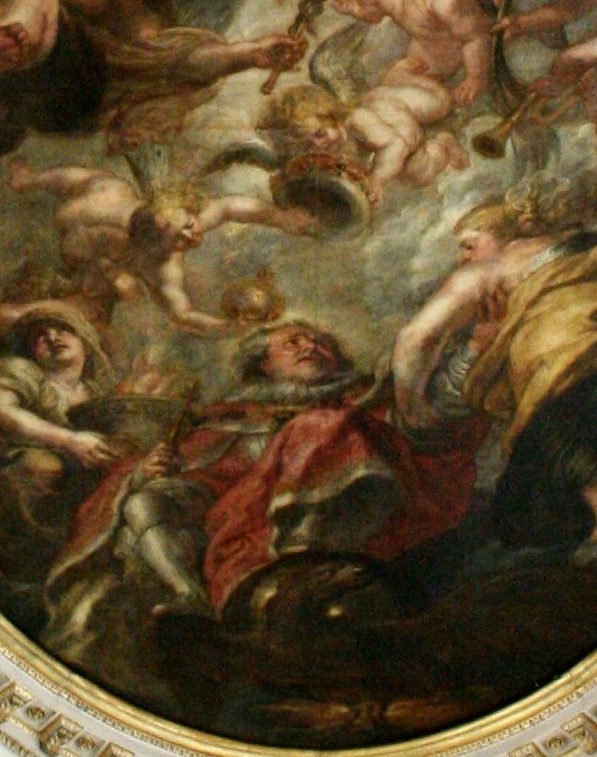
Image Credit: King James I being carried to heaven by angels, on the ceiling of the Banqueting House, painted by Peter Paul Rubens.

Friday, April 15, 2016

Restoring a Reputation: NOT Mary I's

Major League Baseball is far from the topic of this blog, but the theme of historians revising received history and setting the record straight is. In justice to the dead, I want to see our views corrected if they are wrong and personal reputations restored if they are unjust: Ty Cobb's no less than Mary I's.

The latest biographer of Ty Cobb found out that there was a reputation to restore. We don't really know the truth about Ty Cobb at all. Charles Leerhsen writes for Imprimis at Hillsdale College, noting how everyone accepted the "truth" that Cobb was a dirty player and terrible racist:

Ty Cobb was one of the greatest baseball players of all time and king of the so-called Deadball Era*. He played in the major leagues—mostly for the Detroit Tigers but a bit for the Philadelphia Athletics—from 1905 to 1928, and was the first player ever voted into the Hall of Fame. His lifetime batting average of .366 is amazing, and has never been equaled. But for all that, most Americans think of him first as an awful person—a racist and a low-down cheat who thought nothing of injuring his fellow players just to gain another base or score a run. Indeed, many think of him as a murderer. Ron Shelton, the director of the 1995 movie Cobb, starring Tommy Lee Jones in the title role, told me it was “well known” that Cobb had killed “as many as” three people.

It is easy to understand why this is the prevailing view. People have been told that Cobb was a bad man over and over, all of their lives. The repetition felt like evidence. It started soon after Cobb’s death in 1961, with the publication of an article by a man named Al Stump, one of several articles and books he would write about Cobb. Among other things, Stump claimed that when children wrote to Cobb asking for an autographed picture, he steamed the stamps off the return envelopes and never wrote back. In another book—this one about Cobb’s contemporary Tris Speaker—baseball historian Timothy Gay wrote (implausibly, if you think about it) that Cobb would pistol-whip any black person he saw on the sidewalk. And then there were the stories about how Cobb sharpened his spikes: before every game, numerous sources claim, he would hone his cleats with a file. In the 1989 film
Field of Dreams, Shoeless Joe Jackson says that Cobb wasn’t invited to the ghostly cornfield reunion of old-time ballplayers because “No one liked that son of a bitch.” The line always gets a knowing laugh.

When I pitched my idea for a book on Cobb to Simon and Schuster, I was squarely in line with this way of thinking. I figured my task would be relatively easy. I would go back to the original source material—the newspaper accounts, documents, and letters that previous biographers had never really looked at. I would find fresh examples of Cobb being monstrous, blend them with the stories that Al Stump and others wrote, and come up with the first major Cobb book in more than 20 years. But when I started in on the nuts-and-bolts research with original sources—the kind of shoe-leather reporting I had learned working at Newsweek in its heyday—it didn’t even take me ten minutes to find something that brought me up short.

Leerhsen then describes how much that we thought was true, and much that has been repeated and repeated--including by Ken Burns in his PBS series on Baseball--is wrong. Cobb was certainly not a racist and those who played with him did not consider him a dirty player. *Leerhsen refers to "the so-called Deadball Era" before Babe Ruth and other sluggers came along, hitting home runs and driving up the score. Major League Baseball B.R. (before Ruth) was probably much more exciting to watch because it was all about base running, stealing bases--Cobb, Leerhsen reminds us "still holds the record for stealing home, doing so 54 times. He once stole second, third, and home on three consecutive pitches, and another time turned a tap back to the pitcher into an inside-the-park home run." Now, that's thrilling. But MLB changed some rules and the equipment (the ball, especially), and baseball play changed.

Cobb was no angel (who but an angel is?) but it's not right that his reputation should be as abused as it is. If documentary maker Ken Burns reads this book, he should revise his presentation of Cobb in his Baseball series, since it's not true. Leerhsen notes that Burns casts Cobb as the "anti-Jackie Robinson" when in fact Cobb was all in favor of integration in Major League Baseball. Even though he has a nice narrative going, he should eschew the legend and broadcast the fact. As Leerhsen points out, when people start saying things like "it's well-known fact" and then can't cite any source to prove that "well-known fact", they should admit that they might not know what they are talking about!