Showing posts with label portraits. Show all posts

Tuesday, February 15, 2022

Holbein in New York

At the Morgan Library in New York City, a Holbein exhibition just opened (on February 11) and the assemblage of works will be on display through May 15. It had previously visited the J. Paul Getty Museum at the Getty Center from October 19, 2021, to January 9, 2022:

Holbein: Capturing Character is the first major exhibition dedicated to the artist in the United States. Spanning Holbein’s entire career, it starts with his early years in Basel, where Holbein was active in the book trade and created iconic portraits of the great humanist scholar Erasmus of Rotterdam (1466–1536). Holbein stayed in England in 1526–1528 and moved there permanently in 1532, quickly becoming the most sought-after artist among the nobles, courtiers, and foreign merchants of the Hanseatic League. In addition to showcasing Holbein’s renowned drawn and painted likenesses of these sitters, the exhibition highlights the artist’s activities as a designer of prints, printed books, personal devices (emblems accompanied by mottos), and jewels. This varied presentation reveals the artist’s wide-ranging contributions to the practice of personal definition in the Renaissance. Works by Holbein’s famed contemporaries, such as Jan Gossaert (ca. 1478–1532) and Quentin Metsys (1466–1530), and a display of intricate period jewelry and book bindings offer further insights into new cultural interests in the representation of individual identity, and highlight the visual splendor of the art and culture of the time.

You may explore the exhibition online here.

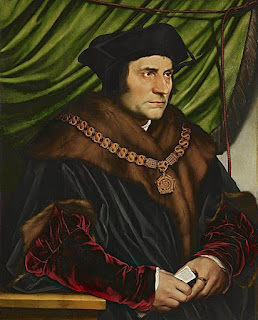
Of course, one of the featured portraits is on loan from the Frick Collection: Holbein's painting of Saint Thomas More:

This is the canonical portrait of one of the key figures in sixteenth-century England. More is depicted in a three-quarter view, similar to Holbein’s favored pose for Erasmus. The man’s imposing form fills nearly the entire panel. The fairly dark palette of More’s fur-lined velvet robe and the green drapery behind him heighten the focus on the sitter’s face and intent gaze. The astonishing realism of Holbein’s portrayal extends to More’s salt-and-pepper whiskers.

Image credit (Public Domain)

Saturday, September 28, 2019

Dangerous to Be an Heir: Margaret Stanley, RIP

Margaret Stanley, Countess of Derby, who died on September 28, 1596, is another example of an heir to Elizabeth I who found out how dangerous that position was. Like the Grey sisters, Catherine and Mary (and Jane before them), she was an heir because her grandmother (on her mother's side) was Mary Tudor, former Queen of France, wife of Charles Brandon, 1st Duke of Suffolk, and Henry VIII's younger sister. Her father was Henry Clifford, 2nd Earl of Cumberland and her mother Lady Eleanor Brandon, the Brandon's second daughter.

Because she was a possible successor, whom she would marry was an important decision. John Dudley, the 1st Duke of Northumberland suggested in 1552 that she should marry his son Guildford, but Edward VI was opposed to that alliance (thus Dudley had that son available to marry Lady Jane Grey); then Dudley's brother Andrew was mentioned. Finally, when Mary I came to the throne, Margaret Clifford married Henry Stanley, 4th Earl of Derby. As this blog explains her situation:

She was the great granddaughter of Henry VII and according to Henry VIII’s will if anything happened to Elizabeth she would become queen of England. She therefore became Elizabeth’s heir presumptive. It was not a good place to be.

Before then she’d managed to avoid becoming a pawn in the game of crowns through her father’s forethought and then through her own lack of popularity. In 1553 the Duke of Northumberland had proposed to marry her to either his son, Guildford, or his brother, Sir Andrew Dudley, but Cumberland refused the match on his daughter’s behalf and took no part in the attempt to make Lady Jane Grey queen (sensible man).

Instead, Margaret was married with Queen Mary’s blessing in Westminster Abbey in February 1555 to Henry Stanley, Lord Strange. He was descended from the Woodvilles, Howards, Nevilles and a certain Thomas Stanley who happened to be married to Margaret Beaufort and who sat around on hillsides during key battles of the Wars of the Roses waiting to see how it would all pan out – landing the title Earl of Derby for his pains.

By 1557 Margaret was recorded as saying that Lady Jane Grey’s treason had excluded her sisters, Catherine and Mary Grey, from the succession, thus making Margaret, Queen Mary’s heiress presumptive…yes I know there was Elizabeth to take into consideration but Mary’s relationship with her sister was fraught by 1557. Mary was fond of stating that Elizabeth had the look of lute player Mark Smeaton. There was also the fact that Elizabeth was notably not Catholic whereas Margaret was. . . .

But Mary I was more obedient to the wishes of her father and the decisions of Parliament to interfere with the line of succession. Her great hope was to have a son to displace Elizabeth, not contravene the settled succession. Nevertheless, Margaret's troubles continued apace as she speculated on her opportunity to succeed Elizabeth I during her reign:

Lady Strange developed a dangerous interest in alchemy, to which she had been introduced by her father. An interest in the occult, although widespread among Elizabethans, could be a dangerous hobby; an interest in fortune-telling especially so for one in Margaret's position on the periphery of the succession dispute. From 1572, Margaret was countess of Derby. She consulted with wizards "with a vain credulity, and out of I know not what ambitious hope”, according to William Camden, and lost the Queen’s favor. In 1578 she was accused of employing a "magician", actually a well-known physician named Dr. Randall, to cast spells to discover how long Queen Elizabeth would live. According to one source, Randall was hanged and Margaret was banished from court and spent the rest of her life, eighteen years, in the custody of her kinsman, Thomas Seckford (d.1587), Master of Requests, to whom she was related through his mother, Margaret (d. 1557), the daughter of Sir John Wingfield (d. 1509) of Letheringham, and aunt of Charles Brandon, Duke of Suffolk. Later she had a series of keepers, although she was allowed to live in her own house at Isleworth.

According to a book on the Stanley family, her debts continued to mount. In 1579, the Privy Council ordered the Lord Mayor of London to pressure her creditors to stop hounding her. In May 1580, Margaret's husband petitioned to be allowed to sell lands to pay debts. In Jun 1581, the Privy Council appointed a commission to find ways to reduce the Derbys' debts. In Dec 1581, the Privy Council was after the Earl to pay Margaret her pension. In 1582, Queen Elizabeth finally approved the sale of Derby lands. Margaret proceeded to sell off land in Lincolnshire, Yorkshire, and Staffordshire valued at £88 8s.4d/year. With a twenty year purchase, that meant she probably received £1,768 6s.10d. In 1584-93, her husband and sons borrowed at least £8,732 13s.4d. against Derby holdings and sold other land for £3800. Not only had Margaret's debts mounted, but the Earl had incurred other debts in the course of undertaking diplomatic missions for the Crown. Before their separation, Margaret gave Lord Strange four sons, Edward and Francis, who died young, Ferdinando, 5th Earl of Derby, and William, 6th Earl of Derby.

In spite of chronic rheumatism and toothache, her husband's infidelities and their acrimonious financial disputes, the Countess of Derby lived on into the mid-1590s. The historian William Camden said of her that "through an idle mixture of curiosity and ambition, supported by sanguine hopes and a credulous fancy, she much used the conversations of necromancers and figure flingers". She seems to have been rather a frivolous and silly woman.

Her husband preceded her in death by three years and three days, dying on September 25, 1593.

It can't have helped her relationship with Elizabeth I that her father, Henry Clifford, 2nd Earl of Cumberland, had some involvement in the Howard-Dacre plots against Elizabeth and may have sheltered Catholic priests:

After his retirement in 1547 he is said to have visited the court only thrice: at Queen Mary's coronation, on his daughter's marriage, and again soon after Queen Elizabeth's accession (Whitaker, 338). In July 1561 he and Lord Dacre, his father-in-law [through Clifford's second marriage to Anne Dacre], were accused of protecting the popish priests in the north. A similar charge was advanced in February 1562. He was in 1569 strongly opposed to the contemplated marriage of Mary Queen of Scots and the Duke of Norfolk, and readily promised support to the great rebellion of that year. In May 1569 he was in London. As the year wore on he gave in his adherence to the scheme for proclaiming Mary queen of England; but when the critical moment arrived he did not act with vigour, but as a 'crazed man, leaving his tenants to the leadership of Leonard Dacres' (Froude, vii. 469, ix. 412, 446, 449, 511). According to Dugdale, he even assisted Lord Scrope in fortifying Carlisle against the rebels (i. 345). 

As to Margaret Clifford's dangerous interest in the occult (which I agree is dangerous), we should recall that science in that era was mixed with alchemy and astrology. Dr. Randall may have suffered for the spells or charts he cast, but Elizabeth I's favorite scientist and astronomer, Dr. John Dee, survived casting charts to predict Mary I and Philip of Spain's fates, held in house arrest by Bishop Bonner during Mary I's reign. Evidently Elizabeth I consulted Dr. Dee for both magic and scientific insights.

Image credit: Portrait by Hans Eworth thought to be either Lady Margaret or her mother, Lady Eleanor Brandon.
Thursday, February 2, 2017

February 2, 1879: A Cardinal's Hat for Newman?


At the end of January, 1879, Father John Henry Newman had a bad cold and was resting in bed when he received a summons from Bishop Ullathorne to come see him. Because he was so ill he sent another Oratorian, Father Pope, went to see the bishop and returned with the news that Pope Leo XIII wanted to make Newman a Cardinal!

Newman was delighted but concerned. It was a great honor: he felt it would eliminate the suspicion about the sincerity of his becoming Catholic and being loyal to the Church and the pope. He was also concerned that he'd be required to live in Rome; since he wasn't a bishop, that was the custom for "Cardinal Deacons". So he wrote a delicate message in reply and then Bishop Ullathorne wrote another letter--a cover letter--describing more fully what Newman was trying to say: he would be honored to become a Cardinal, but he did not want to leave the Oratory!

The Oratory, Birmingham:
Feb. 2, Feast of the Purification, 1879.
My Right Rev. Father,—I trust that his Holiness, and the most eminent Cardinal Nina will not think me a thoroughly discourteous and unfeeling man, who is not touched by the commendation of superiors, or a sense of gratitude, or the splendour of dignity, when I say to you, my Bishop, who know me so well, that I regard as altogether above me the great honour which the Holy Father proposes with wonderful kindness to confer on one so insignificant, an honour quite transcendent and unparalleled, than which his Holiness has none greater to bestow.

For I am, indeed, old and distrustful of myself; I have lived now thirty years in nidulo meo in my much loved Oratory, sheltered and happy, and would therefore entreat his Holiness not to take me from St. Philip, my Father and Patron.

By the love and reverence with which a long succession of Popes have regarded and trusted St. Philip, I pray and entreat his Holiness in compassion of my diffidence of mind, in consideration of my feeble health, my nearly eighty years, the retired course of my life from my youth, my ignorance of foreign languages, and my lack of experience in business, to let me die where I have so long lived. Since I know now and henceforth that his Holiness thinks kindly of me, what more can I desire?
'Right Rev. Father,
Your most devoted
JOHN H. NEWMAN


Bishop Ullathorne sent Newman's letter to Henry Cardinal Manning with his explanation of Newman's letter the next day:

St. Mary's College, Oscott, Birmingham: Feb. 3, 1879.
My dear Lord Cardinal,—Your kind letter, enclosing that of Cardinal Nina, gave me very great gratification. As I could not with any prudence go to Birmingham, I wrote and asked Dr. Newman if he could come to Oscott. But he was in bed suffering from a severe cold, and much pulled down. I, therefore, took advantage of a clause in Cardinal Nina's letter, and asked him to send a Father in his intimate confidence whom he might consult in a grave matter of importance, to whom I could communicate in secrecy the Holy Father's message. Father Pope was sent, and with him I went into the subject, and sent the documents with a paper in which I had written my own reflections. {441}

Dr. Newman contrived to come himself today, although quite feeble. He is profoundly and tenderly impressed with the goodness of the Holy Father towards him, and he spoke to me with great humility of what he conceived to be his disqualifications, especially at his age, for so great a position, and of his necessity to the Birmingham Oratory, which still requires his care.

I represented to him, as I had already done through Father Pope, that I felt confident that the one intention of the Holy Father was to confer upon him this signal proof of his confidence, and to give him an exalted position in the Church in token of the great services he had rendered to her cause, and that I felt confident also that his Holiness would not require his leaving the Oratory and taking a new position at his great age. But that if he would leave it to me, I would undertake to explain all to your Eminence, who would make the due explanations to Cardinal Nina.

Dr. Newman has far too humble and delicate a mind to dream of thinking or saying anything which would look like hinting at any kind of terms with the Sovereign Pontiff. He has expressed himself in a Latin letter addressed to me, which I could send to your Eminence, and which you could place in the hands of Cardinal Nina.

I think, however, that I ought to express my own sense of what Dr. Newman's dispositions are, and that it will be expected of me. As I have already said, Dr. Newman is most profoundly touched and moved by this very great mark of consideration on the part of the Sovereign Pontiff, and I am thoroughly confident that nothing stands in the way of his most grateful acceptance except what he tells me greatly distresses him, namely, the having to leave the Oratory at a critical period of its existence, and when it is just beginning to develop in new members, and the impossibility of his beginning a new life at his advanced age.'I cannot, however, but think myself that this is not the Holy Father's intention, and that His Holiness would consider his presence in England of importance, where he has been so much in communication with those who are in search of the Truth.

I have also said to Dr. Newman himself that I am confident that the noble Catholics of England would not leave him without the proper means for maintaining his dignity in a suitable manner.

Although expecting me to make the official communication, Dr. Newman will write to you himself. I remain, my dear Lord Cardinal, your faithful and affectionate servant,

WILLIAM BERNARD, Bp. of Birmingham.

But Cardinal Manning sent on just Newman's letter without his bishop's explanation. Word got out and the story was published in the London papers that Newman had turned down the Cardinal's hat! It took months to straighten it out. You may read all the letters and narrative of the confusion here and here. And then he had his portrait painted by Sir John Everett Millais, one of the great Pre-Raphaelites!

Pope Leo XIII referred to Newman as "my cardinal" and said that "It was not easy, not easy… They said he was too liberal; but I had determined to honour the Church in honouring Newman. I always had veneration for him. I am proud that I was allowed to honour such a man."

Sunday, December 25, 2016

St. Thomas More for Christmas

My husband surprised me with a wonderful Christmas gift: a portrait of St. Thomas More by Pieter Paul Rubens (after the famous portrait by Hans Holbein). When Crisis Magazine published my article on St. Thomas More in June this year, they used a detail of this portrait:


He gave me hints to find the hidden present--he had kept me away from the door when it was delivered earlier in the week--and then we hung it in our living room beside our secretary:


Pieter Paul Rubens' version of Holbein's portrait--which is itself a great work of character and introspection--depicts More as a little more vulnerable. More is not wearing his Collar of Esses with the Tudor Rose nor is he set against such a rich background as in Holbein's original. According to the Museo del Prado:

This is a free copy [meaning that Rubens copied it freely with his own interpretation] of Hans Holbein´s portrait of the Thomas More, the English humanist and statesman. He wears a cape with a fur collar and a magistrate's cap. In his hands, he holds a paper alluding to his condition as an intellectual. Holbein was a favorite of Rubens, who copied his works on numerous occasions, especially at the beginning of his career. The present portrait was made in the sixteen twenties and reflects his great interest in the northern esthetic, as well as his approach to the world of humanist philosophy. It is first listed in 1746 in Isabel Farnesio´s collection at the La Granja Palace.

Dame Alice More wrote to Henry VIII during the Christmas of 1534, begging Henry to be merciful to her husband, herself, and Thomas's son John. Since Thomas More had been attainted a traitor, all his assets were forfeit to the Crown; Alice was afraid that she and John would be left without resources. Alice also asked Henry to have mercy on her husband because he was ill ("great continual sickness of body and heaviness of heart"). She asked Henry to release her Thomas More to her care and declared herself to be Henry's beadswoman, praying for him constantly.

Tuesday, August 30, 2016

G.K. on G.F. Watts

G.K. is of course G.K. Chesterton (Gilbert Keith); G.F. Watts is George Frederick Watts, the Victorian era artist. The G.K. and Frances Chesterton facebook page (on August 29, 2016) featured a long quote from his book about G.F. Watts, published in 1904. Chesterton introduces his remarks about the painting by noting that the observer will at first think it misnamed:

His first thought, of course, would be that the picture was called Despair; his second (when he discovered his error in the catalogue), that it has been entered under the wrong number; his third, that the painter was mad. But if we imagine that he overcame these preliminary feelings and that as he stared at that queer twilight picture a dim and powerful sense of meaning began to grow upon him—what would he see? He would see something for which there is neither speech nor language, which has been too vast for any eye to see and too secret for any religion to utter, even as an esoteric doctrine. Standing before that picture, he finds himself in the presence of a great truth. He perceives that there is something in man which is always apparently on the eve of disappearing, but never disappears, an assurance which is always apparently saying farewell and yet illimitably lingers, a string which is always stretched to snapping and yet never snaps. He perceives that the queerest and most delicate thing in us, the most fragile, the most fantastic, is in truth the backbone and indestructible. He knows a great moral fact: that there never was an age of assurance, that there never was an age of faith. Faith is always at a disadvantage; it is a perpetually defeated thing which survives all its conquerors. The desperate modern talk about dark days and reeling altars, and the end of Gods and angels, is the oldest talk in the world: lamentations over the growth of agnosticism can be found in the monkish sermons of the dark ages; horror at youthful impiety can be found in the Iliad. This is the thing that never deserts men and yet always, with daring diplomacy, threatens to desert them. It has indeed dwelt among and controlled all the kings and crowds, but only with the air of a pilgrim passing by. It has indeed warmed and lit men from the beginning of Eden with an unending glow, but it was the glow of an eternal sunset.

Here, in this dim picture, its trick is almost betrayed. No one can name this picture properly, but Watts, who painted it, has named it Hope. But the point is that this title is not (as those think who call it "literary") the reality behind the symbol, but another symbol for the same thing, or, to speak yet more strictly, another symbol describing another part or aspect of the same complex reality. Two men felt a swift, violent, invisible thing in the world: one said the word "hope," the other painted a picture in blue and green paint. The picture is inadequate; the word "hope" is inadequate; but between them, like two angles in the calculation of a distance, they almost locate a mystery, a mystery that for hundreds of ages has been hunted by men and evaded them. And the title is therefore not so much the substance of one of Watts' pictures, it is rather an epigram upon it. It is merely an approximate attempt to convey, by snatching up the tool of another craftsman, the direction attempted in the painter's own craft. He calls it Hope, and that is perhaps the best title. It reminds us among other things of a fact which is too little remembered, that faith, hope, and charity, the three mystical virtues of Christianity, are also the gayest of the virtues. Paganism, as I have suggested, is not gay, but rather nobly sad; the spirit of Watts, which is as a rule nobly sad also, here comes nearer perhaps than anywhere else to mysticism in the strict sense, the mysticism which is full of secret passion and belief, like that of Fra Angelico or Blake. But though Watts calls his tremendous reality Hope, we may call it many other things. Call it faith, call it vitality, call it the will to live, call it the religion of to-morrow morning, call it the immortality of man, call it self-love and vanity; it is the thing that explains why man survives all things and why there is no such thing as a pessimist.

Chesterton analyzes both the allegorical paintings and the many portraits of famous literary men and others by Watts. Watts produced the 1882 portrait of Cardinal Henry Manning, seen here as the cover illustration for an edition of Strachey's Eminent Victorians. Chesterton finds fault with Watts' portraiture, however, commenting:

He makes all his portraits too classical. It may seem like a paradox to say that he makes them too human; but humanity is a classis and therefore classical. He recurs too much to the correct type which includes all men. He has, for instance, a worship of great men so complete that it makes him tend in the direction of painting them all alike. There may be too much of Browning in his Tennyson, too much of Tennyson in his Browning. There is certainly a touch of Manning in his John Stuart Mill, and a touch of the Minotaur in many of his portraits of Imperial politicians. While he celebrates the individual with a peculiar insight, it is nevertheless always referred to a general human type.

Chesterton thinks Watts has gone too far in depicting Manning's ascetism and its results:

The portrait of Cardinal Manning is worth a further and special notice, because it is an illustration of the fact to which I have before alluded: the fact that while Watts in one sense always gets the best out of his sitters, he does not by any means always get the handsomest out of them. Manning was a singularly fine-looking man, even in his emaciation. A friend of mine, who was particularly artistic both by instinct and habits, gazed for a long time at a photograph of the terrible old man clad in those Cardinal's robes and regalia in which he exercised more than a Cardinal's power, and said reflectively, "He would have made his fortune as a model." A great many of the photographs of Manning, indeed almost any casual glimpses of him, present him as more beautiful than he appears in Watts' portrait. To the ordinary onlooker there was behind the wreck of flesh and the splendid skeleton the remains of a very handsome English gentleman; relics of one who might have hunted foxes and married an American heiress. Watts has no eyes for anything except that sublime vow which he would himself repudiate, that awful Church which he would himself disown. He exaggerates the devotionalism of Manning. He is more ascetic than the ascetics; more Catholic than Catholicism. Just so, he would be, if he were painting the Sheik-el-Islam, more Moslem than the Mohammedans. He has no eyes but for ideas.

Project Gutenberg of Australia has made the text of Chesterton's book on Watts available online, including 32 works of Watts, both allegories and portraits.

Tuesday, July 19, 2016

Her Nine Days Were Up Today in 1553

From History.com: This Day in History: July 19, 1553:

After only nine days as the monarch of England, Lady Jane Grey is deposed in favor of her cousin Mary. The 15-year-old Lady Jane, beautiful and intelligent, had only reluctantly agreed to be put on the throne. The decision would result in her execution.

Lady Jane Grey was the great-granddaughter of King Henry VII and the cousin of King Edward VI. Lady Jane and Edward were the same age, and they had almost been married in 1549. In May 1553 she was married to Lord Guildford Dudley, the son of John Dudley, the duke of Northumberland. When King Edward fell deathly ill with tuberculosis soon after, Jane’s father-in-law, John Dudley persuaded the dying king that Jane, a Protestant, should be chosen the royal successor over Edward’s half-sister Mary, a Catholic. On July 6, 1553, Edward died, and four days later Lady Jane Grey was proclaimed queen of England.

Lady Jane’s ascendance was supported by the Royal Council, but the populace supported Mary, the rightful heir. Two days into Lady Jane’s reign, Dudley departed London with an army to suppress Mary’s forces, and in his absence the Council declared him a traitor and Mary the queen, ending Jane’s nine-day reign.

Author Samantha Wilcoxon writes about why we don't refer to Lady Jane Grey as Queen Jane:

A recent post of mine brought questions to the forefront regarding Lady Jane Grey's status as a Tudor queen. I included her in my list of monarchs but noted that she is not always included in others. This list, for example, mentions her only parenthetically. Jane is referred to as a ruler by Royal.UK, but is still listed by the name Lady Jane Grey. In fact, we most commonly refer to her as Lady Jane Grey rather than Queen Jane.

Why is that? She had not had a coronation, but there are other examples of monarchs who have been accepted as such despite the lack of this ceremony. Edward V is a notable example quite close to Jane's time. Little Edward is never left out of discussions of England's kings though he ruled even less than his distant cousin Jane did.

Jane was proclaimed and deposed with lightening speed, causing some to refer to her as an unsuccessful usurper rather than a legal queen.

Read the rest there.

Image credit: the Streatham Portrait, discovered in 2005/2006, as noted by The Guardian:

Queen of England for nine days, then dispatched by the axeman at the Tower of London at the age of just 17, Lady Jane Grey and her tragic story have exerted a deep fascination for centuries. She is the only English monarch since 1500 of whom no portrait survives. Or so it has long been assumed.

But experts are now claiming that a painting that hung for years in a house in Streatham, south-west London, is of Lady Jane. The owner inherited the work from his great-grandfather, a collector of 16th-century antiques.

A pawn in the ambitious power games of her parents and father-in-law, Lady Jane was briefly queen after the death of her cousin Edward VI - until her short rule from the Tower of London was transformed into imprisonment when Mary I successfully claimed the throne.

Were this a painting of Lady Jane, it would satisfy a centuries-old hunger to know the appearance of this unfortunate teenager, described at the time as "prettily shaped and graceful" with a "gracious and animated figure". . . .

The "new" portrait, which experts have confidently dated to the second half of the 16th century, shows a slender young woman in an opulent gown and jewels, a book held in her left hand. Above her shoulder is a faint inscription reading "Lady Jayne". The costume she wears was in fashion in the early 1550s; Jane was queen in 1553.

There was quite a debate about whether or not this was a portrait of Lady Jane Grey; David Starkey rejected it. Eric Ives, evidently, accepted its validity enough to have it used on the cover of his 2009 book:

Lady Jane Grey, (sic) is one of the most elusive and tragic characters in English history.

In July 1553 the death of the childless Edward VI threw the Tudor dynasty into crisis. On Edward's instructions his cousin Jane Grey was proclaimed queen, only to be ousted 13 days later by his illegitimate half sister Mary and later beheaded. In this radical reassessment, Eric Ives rejects traditional portraits of Jane both as hapless victim of political intrigue or Protestant martyr. Instead he presents her as an accomplished young woman with a fierce personal integrity. The result is a compelling dissection by a master historian and storyteller of one of history’s most shocking injustices.

Tuesday, May 24, 2016

Sixteenth Century Identities: Mind the Gap!

As historians study the past, finding documents, locating contemporary reports, etc., I think one of the interesting aspects of these efforts is identifying a person. Think of the identity issues for Shakespeare--the lost years, the different signatures, the different spellings of his last name, the different portraits. Another example: we don't really know what Anne Boleyn looked like; we have contemporary descriptions but no authenticated portrait. The same is true of Catherine Howard, the other wife Henry VIII had beheaded: we have never found a portrait of her. Who knows, we may some day: but until then we don't have a clear vision of what she looked like. And then there is the issue of alias: many of the missionary priests coming to England under the threat of arrest and trial for treason used alias to disguise their identity. There are definite gaps and the careful historian observes their mysteries carefully. We have to "Mind the Gap"!

On his Recusants and renegades blog, Martin Robb is trying to identify a certain person and confirm that he was Catholic priest in Tudor England, with all its religious change and confusion:

In my last post I noted that Thomas Lucke’s will of 1551, with its explicitly Catholic preamble, suggests that Thomas retained his attachment to England’s traditional faith, despite the fact that when he made his will he was serving as a priest in the reformed Church of England, two years after the Catholic mass had been banned by Edward VI. In addition to this evidence of Thomas’ religious sympathies, his will is also a useful source of information about his relatives and contemporaries, including as it does a substantial number of bequests. I’ve been following up some of these names, in an attempt to understand the milieu in which Thomas Lucke, and my other sixteenth-century ancestors, lived.

In his will, Thomas Lucke makes a number of bequests to his niece Alice, my 12 x great grandmother. One of them reads as follows:

I wyll of that monye that ys in Gregorye Martynes hands of Mayghfelde xlv to the povertie there to be dystrybuted by my executor. And the Resydue of the monye in his hands, I wyll halfe to Alice Lucke: the other halffe I wyll equally betwene Thomasyn Lucke and Elizabeth Lucke, by the hands of my executor to theme to be delyvred.
So, Robb has been in search of Gregory Martin and has been frustrated:

However, there is one other reference to a Gregory Martin in the records, and it’s an intriguing one. In 1529 Robert Sawyer of Mayfield made his will. The opening paragraph is in Latin and it culminates in a list of witnesses, which includes the name ‘Gregorio Marten’. The word that follows this name is difficult to read, but it could be ‘clico’, which might be an abbreviation for ‘clerico’. Indeed, the transcript by the Sussex Record Society translates the word as ‘clerk’: in other words, priest.

Is this the same person who would appear in the wills of John and Thomas Lucke some twenty years later, and was he really a priest? Unfortunately, I’ve found no trace of a Gregory Martin in the clergy records, but they only begin in 1540. Could he have been a member of a religious order, rather than a secular priest? Then again, if the person mentioned in those later wills was a priest, why was he not described as such, given that Thomas Lucke doesn’t hesitate to append the word ‘clerke’ to the name of Richard Cressweller, one of the witnesses to his will? Had Gregory Martin ceased to serve as a priest by 1551, or is this a different person altogether?


And then he wonders if there's a connection between his Gregory Martin and the Father Gregory Martin who worked on the Douai-Rheims translation of the Holy Bible into English! Read the rest there; it's a fascinating exploration of identity in the sixteenth century:

On the other hand, if we could prove a connection, it might be further proof of the Catholic sympathies of my Lucke ancestors, especially if Gregory Martin of Mayfield was actually a (former?) priest. However, even if he turns out to have been born elsewhere in Sussex, and even if he was from Mayfield, we have no evidence to connect him with the Gregory Martin of Mayfield mentioned in the wills of John and Thomas Lucke. The fact that they shared a name, and an unusual one at that, suggests some kind of connection – but what?

Mind the gap!

Illustration credit: CC license from Wikipedia commons.

Thursday, April 14, 2016

The Prince of Wales in Spain

This is a good summary of the events behind the subject of Laura Cumming's book The Vanishing Velazquez:

In the spring of 1623 Charles, Prince of Wales, the young heir to the English and Scottish thrones donned a false wig and beard and slipped out of England under the assumed name of John Smith in order to journey to Madrid and secure for himself the hand of the King of Spain's daughter. His father James I and VI had been toying with the idea of a Spanish match for his son since as early as 1605, despite the profoundly divisive ramifications such a policy would have in the face of the determined 'Puritan' opposition in parliament, committed to combatting the forces of international Catholicism at every opportunity. With the Spanish ambassador, the machiavellian Count of Gondomar's encouragement to 'mount' Spain, Charles impetuously took matters into his own hands and as the negotiations stalled he departed secretly in the guise of Mr Smith to win with his romantic and foolhardy daring what his father could not achieve through diplomacy. The eventual failure and public humiliation that followed his journey to Madrid has been cited as a major influence on Charles's subsequent development and policies as king.

Another result of this journey was that Diego Velazquez painted a portrait of Prince Charles, the erstwhile suitor of the Infanta, and that portrait has been lost and found, particularly by one man in the nineteenth century, John Snare. And that's the story Laura Cummings tells, according to the publisher, Simon & Schuster:

From one of the world’s most expert art critics, the incredible true story—part art history and part mystery—of a Velazquez portrait that went missing and the obsessed nineteenth-century bookseller determined to prove he had found it.

When John Snare, a nineteenth-century provincial bookseller, traveled to a liquidation auction, he stumbled on a vivid portrait of King Charles I that defied any explanation. The Charles of the painting was young—too young to be king—and yet also too young to be painted by the Flemish painter to which the work was attributed. Snare had found something incredible—but what?

His research brought him to Diego Velazquez, whose long-lost portrait of Prince Charles has eluded art experts for generations. Velazquez (1599–1660) was the official painter of the Madrid court, during the time the Spanish Empire teetered on the edge of collapse. When Prince Charles of England—a man wealthy enough to help turn Spain’s fortunes—ventured to the court to propose a marriage with a Spanish princess, he allowed just a few hours to sit for his portrait. Snare believed only Velazquez could have met this challenge. But in making his theory public, Snare was ostracized, victim to aristocrats and critics who accused him of fraud, and forced to choose, like Velazquez himself, between art and family.

A thrilling investigation into the complex meaning of authenticity and the unshakable determination that drives both artists and collectors of their work,
The Vanishing Velazquez travels from extravagant Spanish courts in the 1700s to the gritty courtrooms and auction houses of nineteenth-century London and New York. But it is above all a tale of mystery and detection, of tragic mishaps and mistaken identities, of class, politics, snobbery, crime, and almost farcical accident. It is a magnificently crafted page-turner, a testimony to how and why great works of art can affect us to the point of obsession.

I wonder if we ever see the portrait in the book? The Wall Street Journal's review of this book (written by Henrik Bering) indicates that the painting has gone underground again:

A few scattered sightings of the portrait follow in Britain. In 1898 it was up for auction by the executors of the late Edward Snare, but it did not sell. Most likely, it was returned to a safe-deposit box at the Snares’ old bank, but again, the lead grows cold. Historians consider the painting lost, but Ms. Cumming holds out a faint hope that it will resurface one day.

I have this book on my pile to read some day: The Spanish Match: A Novel of Catholic Spain by Brennan Pursell.

Wednesday, June 11, 2014

"The Real Tudors" @ The National Portrait Gallery in London


The title of this exhibition at the National Portrait Gallery in London is intriguing:  The Real Tudors: Kings and Queens Rediscovered. In case you had been looking at portraits of the Fake Tudors. It runs from 12 September 2014  to 1 March 2015 and then travels across the Channel to the Musee du Luxembourg in Paris! Note the search for an authentic portrait of Lady Jane Dudley:

This special display, focusing on the portraiture of the Tudor monarchs, will allow visitors to rediscover these well-known kings and queens through the most complete presentation of their images staged to date.

Works from the Gallery’s Collection will be presented alongside exceptional loans and a prized possession of each monarch, as well as recent research undertaken as part of the Making Art in Tudor Britain project, to help visitors understand how and why such images were made.

The display includes the Gallery’s oldest portrait, that of Henry VII, which will be displayed with a Book of Hours inscribed by the king to his daughter; six portraits of Henry VIII, including a full-length portrait from Petworth House in Sussex, together with his rosary; portraits of Edward VI and a page from his diary in which he reports his father’s death; five portraits of Mary I combined with her Prayer Book loaned from Westminster Cathedral; and several portraits of Elizabeth I displayed alongside her locket ring. The search for a ‘real’ portrait of Lady Jane Grey in the sixteenth century will also be discussed through the display of a commemorative portrait of Jane that dates from the Elizabethan period.

A beautifully illustrated catalogue with over fifty reproduced portraits, and including the findings from recent technical analysis, is available from Gallery Shops and npg.org.uk/shop 
(not yet!)

Sunday, February 23, 2014

Will Ye No Come Again? A Portrait of Bonnie Prince Charlie


A genuine and acceptably bonny portrait of Bonnie Prince Charlie has been rediscovered, by the remorseful art historian who broke hearts in the Scottish souvenir industry by debunking the best-known portrait of the national hero, immortalised on countless tins of shortbread.
 
The long-lost portrait of the pink-cheeked prince was painted in Edinburgh in 1745 by one of Scotland's most renowned artists, Allan Ramsay, in the year the Young Pretender, grandson of the deposed Stuart king James II, launched a doomed invasion of England in an attempt to restore his family to the throne. It is the only known portrait of the prince made in Britain: the butchery of the battle of Culloden ended the Jacobite rebellion, Charles spent the rest of his life in exile, died in 1788 and was buried in Rome.
 
"Such a great image," Bendor Grosvenor said fondly of his discovery, which he tracked down from an old photograph to Gosford House, the family home of the Earls of Wemyss, just outside Edinburgh. "It gets the confidence of a man who wanted to invade England at the age of 24."

You may see the portrait at The Guardian site.

When Bendor Grosvener opined that a famous portrait of Bonnie Prince Charlie (seen at right) was really of his brother Henry Benedict, later Cardinal, Stuart, he really upset the apple cart, as this BBC article demonstrates:

Now a leading expert believes the pastel might be Prince Henry Benedict instead of Charles Edward Stuart.
 
The gallery said it was not uncommon for re-attributions to be made.
 
It follows a two-year row over the identity of the man in the painting since London art dealer Bendor Grosvenor claimed it was not Bonnie Prince Charlie.
 
At first the gallery dismissed the claim citing expert on Jacobite portraiture, Dr Edward Corp of the University of Toulouse, France, in its defence.
 
However, Dr Corp has now changed his opinion in an article in the latest issue of The British Art Journal.
 
He said: "'The weight of evidence, perhaps regrettably, supports Bendor Grosvenor's argument that the pastel in the Scottish National Portrait Gallery shows Prince Henry rather than Prince Charles."

I think when you compare that portrait above to this of the Duke of York as Cardinal York, the resemblance is clear. Part of the reason experts thought it could not be Henry was that he was a Cardinal by 1747--but he had been in command of the naval expedition of the '45, and evidently both he and his elder brother had sat for portraits by Maurice Quentin de La Tour.

As Dr. Corp noted, this re-attribution was a really big deal:

"It is not merely the catalogue of the Scottish National Portrait Gallery which needs to be corrected.
 
"The impression which an entire nation has derived of this important historical figure should also be changed.
 
"The portrait is now reproduced in all biographies of the prince, and has been selected to illustrate the article about him in the Oxford Dictionary of National Biography."
 
Still the real search is for a portrait of Bonnie Prince Charlie by Maurice Quentin de La Tour painted around the same time as this painting of Henry Benedict, the Duke of York.

More on the Scottish National Portrait Gallery here.

Friday, February 14, 2014

Charles I's Painter Looks Over His Shoulder

Richard Cork discusses Anthony Van Dyck's last "Self-Portrait" in The Wall Street Journal; he finds the artist concerned about his patron and his own health:

Van Dyck appears increasingly ill-at-ease, as if his fierce concentration on the task at hand has been diverted by some unexpected intrusion. He seems startled, and I can imagine him feeling annoyed by the disturbance. His mouth might be on the point of opening. A hint of a frown can be detected curving up from the edge of his raised right eyebrow.

What is really going on here? Van Dyck's last "Self-Portrait" may well reflect his gathering alarm about the state of his adopted home. Charles I, who contributed so greatly to Van Dyck's success, had alienated a growing number of powerful forces. And Van Dyck's eminent position within the royal court must have alerted him to the danger now confronting the monarch. (Civil war would break out in 1642.) Van Dyck was sensitive enough to appreciate the problem, and his anxiety could have been exacerbated by his own illness.

Van Dyck probably sensed, when he stared at his own reflection and set it down on canvas, that his health was ominously poor. In August 1641 the Countess of Roxburghe reported in a letter that he had been ill for a long time, and soon afterward Van Dyck grew so infirm that he abandoned a major commission to paint Cardinal Richelieu's portrait in Paris. He must have felt very frustrated, and at the base of the elaborate oak frame surrounding his last "Self-Portrait" a demonic face scowls as he opens his mouth in a roar of rage. There is certainly a haunting awareness of transience in the "Self-Portrait." Even as he emphasizes the strength of his penetrating gaze, Van Dyck conveys a melancholy awareness that nothing of him will endure very long, apart from the art he creates. The white shirt that occupies such a prominent space near the center of the painting looks as turbulent as a storm-stricken sea. This boldly handled passage of paint could almost be seen as prophetic, hinting at the military tempest that was about to engulf England and destroy the king along with so many of his subjects in a catastrophic conflict.

The National Portrait Gallery in London is raising funds to purchase, preserve, and display this portrait (and keep it from being obtained by a private collector). More about that effort here.

Friday, November 29, 2013

How Hans Holbein Survived at Henry VIII's Court


Historical novelist Nancy Bilyeau describes Hans Holbein's career at Henry VIII's Court and how he survived painting the great portrait of Thomas More (perhaps residing in More's home in Chelsea) and painting the perhaps over flattering portrait of Anne of Cleves. Holbein had some trouble finding the right patrons and portrait subjects--Anne Boleyn was a patron for a time (she lost her head) and Thomas Cromwell was another protrait subject (and he lost his head). Another fascinating story about Henry VIII's Court.

I am curious about what happened to the portrait of More after the fall and execution of Thomas More: did Margaret Roper take the painting with her to the Continent? This site includes a great analysis of the painting, which is now in the Frick Collection, New York City, NY.

By the way, this site has a portrait from the studio of Hans Holbein of More's second wife Alice.

Sunday, February 3, 2013

Another Tudor Portrait Discovery

Thanks to Elena Maria Vidal at Tea at Trianon:

Henry VIII and Katherine of Aragon are once more side by side and at Lambeth Palace, of all places. Apparently many people thought for years and years that the above painting was supposed to be Katherine Parr, although the clothes are obviously from decades before Henry married her. I knew it was Katherine of Aragon. 

The Mail online summarizes the discovery:

For years it was assumed by staff at Lambeth Palace that the oil painting hanging in a private sitting room was of Catherine Parr, Henry VIII's sixth wife.

But when experts from the National Portrait Gallery went to the Palace - the official residence of the Archbishop of Canterbury - to research a portrait of an earlier archbishop, they were able to shed new light on the matter.

First, the portrait was in a frame that pre-dated the rotund monarch's sixth wife, second; her clothes were from an earlier period, and third, well, the woman also bore a startling resemblance to Henry's first wife, Catherine of Aragon.

Tests soon showed that they were right, and now the gallery has hung the portrait of the devoutly Catholic queen rather mischievously, side by side with a portrait of Henry, whose desperation to divorce her was the catalyst for England's schism with the Catholic church.

The 'exciting discovery' about the picture was made when researchers from the National Portrait Gallery went to Lambeth Palace to find out more about William Warham, the Archbishop of Canterbury who married Henry VIII and his first wife, Catherine of Aragon, in 1509.

The researchers, who were working on a project called Making Art In Tudor Britain, noticed the painting on the wall of a private sitting room, where it has hung since at least the 19th century but probably longer, under the assumption it depicted Catherine Parr.

The paper even includes this biographical sketch of Queen Katherine of Aragon:

DEVOTED TIL THE END: THE FIRST WIFE OF KING HENRY VIII

Henry VIII's first wife was the Spanish princess Catherine of Aragon, who had been previously been married to his older brother Arthur.

When Arthur died, six months after their marriage, his younger brother Henry married her in 1509 and Catherine was crowned Queen of England in a joint coronation ceremony with her husband.

Shortly after their marriage Catherine became pregnant but gave birth to a stillborn daughter in January 1510. A subsequent pregnancy resulted in the birth of Prince Henry in 1511 and there were great celebrations, but he died aged 52 days.

Catherine then had a miscarriage, followed by another short-lived son, but in February 1516, she gave birth to a healthy daughter, Mary, and the child lived.

Henry still loved his wife but became frustrated by the lack of a male heir and took several mistresses, among them Mary Boleyn, sister of Anne.

Anne refused to become Henry's mistress but he pursued her until she succumbed, as his desperation for a son grew.

His worry was all the greater because he had read in Leviticus that if a man married his brother's wife, they would remain childless. Despite having a daughter, Henry still felt himself 'childless' for not having a son.

The King petitioned the Pope for his marriage to be annulled and when Catherine - a devout Catholic - heard of this, she was so upset that she, too, directly appealed to the Pope on her side.

Catherine's argument was that as she and Arthur had never consummated their marriage, they were not truly husband and wife.

The argument and machinations continued for six years and things came to a head in 1533 when Anne Boleyn became pregnant and Henry decided that the only way to marry her would be to reject the power of the Pope in England and have Thomas Cranmer, the Archbishop of Canterbury, annul the marriage.

Catherine had to renounce her title as Queen and be known as the Princess Dowager of Wales, which she rejected for the rest of her life.

Catherine and her daughter Mary were separated and she was forced to leave the royal court, living in dank manor houses and castles with just a handful of servants. She was said to suffer ill-health but never complained, and spent much of her time praying.

Catherine and Henry's daughter became Queen Mary I of England in 1553 and was known for her brutal persecution of Protestants - earning her the nickname 'Bloody Mary'.

"Henry and Catherine Reunited"--with Anne Boleyn nearby-- is on display in Room 1 of the National Portrait Gallery.

Saturday, January 19, 2013

Tudor Portrait Recycling with a Twist

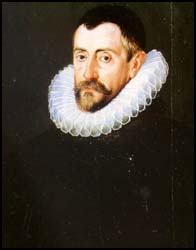
Portrait of Sir Francis Walsingham.From Elena Maria Vidal's Tea at Trianon blog comes this story from The Guardian about a special exhibition at the National Portrait Gallery in London:

He was the eyes and ears of Elizabeth I, the loyal spymaster and ruthless counterterror chief: Sir Francis Walsingham was the man who knew everything. Or not quite everything, it seems. Certainly not that his portrait was secretly painted over an overtly Roman Catholic image of the holy Virgin and Child.


“He would not have been delighted,” speculated Dr Tarnya Cooper, standing in front of the remarkable new discovery going on show at the National Portrait Gallery. “You do wonder if the artist might be enjoying a private joke."

The gallery on Thursday opened a display showing x-rays of devotional paintings it has discovered underneath its portraits of two key Tudor statesmen. As well as a Virgin and Child under Walsingham, researchers found A Flagellation of Christ under the Queen’s lord treasurer Thomas Sackville.

The Walsingham portrait dates from the 1580s when Protestant England was isolated and supporting the war in the Netherlands against the Spanish.

“The Catholics are the absolute enemy at this period so the idea that you’ve got this wonderful devotional image underneath your portrait would probably be rather horrifying to him,” Cooper, the NPG’s chief curator, said. 


It was a surprise finding. “There is not very much that Walsingham does not know about of what’s going on in courts across Europe, he has a huge network of informers, is an incredibly wily man and is someone with a public reputation. For somebody who is not wonderfully keen on Walsingham this would be a clever way of getting at him."

The NPG believes it cannot be accidental that after x-raying more than 120 Tudor portraits and mostly finding nothing, it found an image so emblematic of Roman Catholicism under Walsingham. “It is intriguing that it is under the spymaster-general,” said Cooper.

You can see the portrait in question and the x-ray results here, although I find it hard to see the image behind the portrait on-line:

Recent technical analysis undertaken as part of the Making Art in Tudor Britain project has revealed that some of the Gallery’s sixteenth-century portraits were painted over pre-existing paintings. This could have occurred for a variety of reasons and provides fascinating insight into artistic production during the period.

This display highlights two rare examples in which paintings with religious iconography have been discovered beneath portraits. Images generated by analytical techniques such as x-radiography and infrared reflectography are used to reveal the hidden paintings, and the portraits are also paired with loans from other collections to give an impression of the underlying compositions. The display also includes an interesting portrait with a fragment from a decorative scheme on the reverse, which suggests that it was originally intended to be viewed from both sides.

More on Francis Walsingham here.

Thursday, March 22, 2012

Charles I's Court Painter: Anthony Van Dyke

Anthony Van Dyke was born on March 22, 1599 in Antwerp. In 1632, he visited England for the second time and soon became Charles I's official court and portrait painter, developing a flattering style that influenced later painters like Kneller and Lely. In 2009, the Tate Britain held an exhibition titled "Van Dyck and Britain":

Sir Anthony van Dyck (1599-1641) was the greatest painter in seventeenth-century Britain. Though trained in Flanders, he had a huge impact on British cultural life as the principal painter at King Charles I’s ostensibly elegant court, where his impact was similar to that of Hans Holbein at the court of Henry VIII.

Van Dyck was born and trained in the great art centre of Antwerp. He made a brief visit to London in 1620-21 before returning in 1632 to King Charles I’s court. Intensely ambitious and hugely productive, he re-invented portrait-painting in Britain, retaining his pre-eminence until his premature death at the age of 42. Working in a period of intense political ferment during the run-up to the British Civil War, van Dyck portrayed many of the leading characters of the period. His iconic portraits of King Charles I have shaped our view of the Stuart monarchy, while the compositions he used influenced many future generations of British painters.

This visually sumptuous exhibition brings together some of the finest and most magnificent paintings that van Dyck produced during his years in Britain. It also reveals his continuing visual legacy through portraits by artists from the eighteenth to twentieth centuries, including Sir Joshua Reynolds and John Singer Sargent. Featuring loans from The Royal Collection and The National Trust, this exhibition explores the context of van Dyck’s key English works, examining his innovative approach to painting the British elite. It also looks at his use of costume and his luscious, sparkling depiction of the rich fabrics of the period, and how his art was itself influenced by more local British painting.

Of his style and method of portraying the royal family, the exhibition notes:

These royal portraits show van Dyck's ability to mix fantasy and reality in the representation of kingship. Charles I relied upon van Dyck to provide the idealising portraits that would bolster his public image. These paintings embodied the kings view of divine rule and of Neoplatonic ideas about the self-regulation of the passions. The portraits suggest a happy, settled ruling family at the head of a nation at ease with itself and with its king.

Of course, we know that wasn't so:

It was all an illusion. 'Loving rule' may have been implied by the portraits of the king and queen, the image of Cupid and Psyche, or the masques in which the royal couple participated at court. In fact, Charless relationship with Parliament had broken down, leaving him increasingly isolated. There was fear of Catholic conspiracies and discontent that the Protestant king had taken a Catholic wife.

Charles I's favor to a foreign and Catholic painter just compounded the Parliamentary view that Charles was too Catholic: the Puritans could point to his use of a Catholic artist as another cause of their discontent with the king's rule.

Van Dyke died in London before the English Civil War began.

Several of his paintings are in the National Gallery in London. Although Queen Henrietta Maria's chapel with its baroque Catholic paintings was ransacked and destroyed, the Royal collection gathered by Charles, including all the Royal Portraits seemed to have survived.