Showing posts with label Very Newman Summer. Show all posts

Friday, August 26, 2022

Preview: St. J.H. Newman on Mary as the Second Eve in his Letter to Pusey

In our concluding discussion on Saint John Henry Newman and the Blessed Virgin Mary on the Son Rise Morning Show this month, on Monday, August 29, we'll look at one of his controversial works, A Letter Addressed to the Rev. E.B. Pusey, D.D., on Occasion of His Eirenicon

I'll be on the air at my usual time, about 6:50 a.m. Central/7:50 a.m. Eastern. Please listen live here or on your local EWTN affiliate station.

In Newman's collected works, this Letter is accompanied by his 1875 Letter to the Duke of Norfolk regarding Papal Infallibility as Volume 2 of Certain Difficulties Felt by Anglicans in Catholic Teaching

In this work, Newman responds to Pusey's comments about the recently proclaimed doctrine of the Immaculate Conception of the Blessed Virgin Mary and what that proclamation might mean for the issues of Anglican and Catholic unity. Remember that Newman had been challenged by Charles Kingsley just two years before on his integrity and truthfulness about his conversion, writing his Apologia pro Vita Sua in response. He and his old Oxford Movement colleagues, John Keble and Edward Pusey had met again after almost 20 years of tension and distance.

As I've commented in a couple of previous posts (here and here), I'd never read this work through before. While it's like a mini-Apologia pro Vita Sua, Newman seems very comfortable responding to Pusey directly, although he fears that he might wound his friend as his friend has wounded him. He bases his arguments against Pusey's work on their shared study of the Fathers of the Church. Pusey knows that the Fathers of the Church described the Blessed Virgin Mary as being the Second Eve, and thus he can and should follow Newman's argument carefully.

In fact, in the fifth chapter of this public correspondence with Pusey ("Anglican Misconceptions and Catholic Excesses in Devotion to the Blessed Virgin"), Newman remonstrates with his old friend that he hasn't been as forthcoming as he could be regarding his own knowledge of and devotion to the Mother of God:

. . . that the height of our offending in our devotion to the Blessed Virgin would not look so great in your Volume as it does, had you not deliberately placed yourself on lower ground than your own feelings towards her would have spontaneously prompted you to take. I have no doubt you had some good reason for {90} adopting this course, but I do not know it; what I do know is, that, for the Fathers' sake who so exalt her, you really do love and venerate her, though you do not evidence it in your book. I am glad then in this place to insist on a fact which will lead those among us, who know you not, to love you from their love of her, in spite of what you refuse to give her; and lead Anglicans, on the other hand, who do know you, to think better of us, who refuse her nothing, when they reflect that, if you come short of us, you do not actually go against us in your devotion to her.

2. As you revere the Fathers, so you revere the Greek Church; and here again we have a witness on our behalf, of which you must be aware as fully as we are, and of which you must really mean to give us the benefit. In proportion as the Greek ritual is known to the religious public, that knowledge will take off the edge of the surprise of Anglicans at the sight of our devotions to our Lady. It must weigh with them, when they discover that we can enlist on our side in this controversy those "seventy millions" (I think they do so consider them) of Orientals, who are separated from our communion.

Pusey already knew the answer to Newman's question in chapter 3 ("The Belief of Catholics concerning the Blessed Virgin, as distinct from their Devotion to her"), "What is the great rudimental teaching of Antiquity from its earliest date concerning her?": that Mary is the Second Eve:

Now let us consider what this implies. Eve had a definite, essential position in the First Covenant. The fate of the human race lay with Adam; he it was who represented us. It was in Adam that we fell; though Eve had fallen, still, if Adam had stood, we should not have lost those supernatural privileges which were bestowed upon him as our first father. Yet though Eve was not the head of the race, still, even as regards the race, she had a place of her own; for Adam, to whom was divinely committed the naming of all things, named her "the Mother of all the living," a name surely expressive, not of a fact only, but of a dignity; but further, as she thus had her own general relation to the human race, so again had she her own special {32} place, as regards its trial and its fall in Adam. In those primeval events, Eve had an integral share. . . . As the history stands, she was a sine-qua-non, a positive, active, cause of it. And she had her share in its punishment; in the sentence pronounced on her, she was recognized as a real agent in the temptation and its issue, and she suffered accordingly. In that awful transaction there were three parties concerned,—the serpent, the woman, and the man; and at the time of their sentence, an event was announced for a distant future, in which the three same parties were to meet again, the serpent, the woman, and the man; but it was to be a second Adam and a second Eve, and the new Eve was to be the mother of the new Adam. "I will put enmity between thee and the woman, and between thy seed and her seed." The Seed of the woman is the Word Incarnate, and the Woman, whose seed or son He is, is His mother Mary. This interpretation, and the parallelism it involves, seem to me undeniable; but at all events (and this is my point) the parallelism is the doctrine of the Fathers, from the earliest times; and, this being established, we are able, by the position and office of Eve in our fall, to determine the position and office of Mary in our restoration.

Then Newman provides many excerpts from the works of the Fathers of the Church on this doctrine, commenting summarily:

Such is the rudimental view, as I have called it, which the Fathers have given us of Mary, as the Second Eve, the Mother of the living: I have cited ten authors. I could cite more, were it necessary: except the two last, they write gravely and without any rhetoric. . . .

He then outlines Mary's role in our Redemption, in a parallel contrast to Eve's role in our Fall: 

She holds, as the Fathers teach us, that office in our restoration which Eve held in our fall:—now, in the first place, what were Eve's endowments to enable her to enter upon her trial? She could not have stood against the wiles of the devil, though she was innocent and sinless, without the grant of a large grace. And this she had;—a heavenly gift, which was over and above and additional to that nature of hers, which she received from Adam, a gift {45} which had been given to Adam also before her, at the very time (as it is commonly held) of his original formation. This is Anglican doctrine, as well as Catholic . . .

Now, taking this for granted, because I know that you and those who agree with you maintain it as well as we do, I ask you, have you any intention to deny that Mary was as fully endowed as Eve? is it any violent inference, that she, who was to co-operate in the redemption of the world, at least was not less endowed with power from on high, than she who, given as a help-mate to her husband, did in the event but cooperate with him for its ruin? If Eve was raised above human nature by that indwelling moral gift which we call grace, is it rash to say that Mary had even a greater grace? And this consideration gives significance to the Angel's salutation of her as "full of grace,"—an interpretation of the original word which is undoubtedly the {46} right one, as soon as we resist the common Protestant assumption that grace is a mere external approbation or acceptance, answering to the word "favour," whereas it is, as the Fathers teach, a real inward condition or superadded quality of soul. And if Eve had this supernatural inward gift given her from the first moment of her personal existence, is it possible to deny that Mary too had this gift from the very first moment of her personal existence? I do not know how to resist this inference:—well, this is simply and literally the doctrine of the Immaculate Conception. I say the doctrine of the Immaculate Conception is in its substance this, and nothing more or less than this (putting aside the question of degrees of grace); and it really does seem to me bound up in the doctrine of the Fathers, that Mary is the second Eve. . . .

Mary may be called, as it were, a daughter of Eve unfallen. You believe with us that St. John Baptist had grace given to him three months before his birth, at the time that the Blessed Virgin visited his mother. He accordingly was not immaculately conceived, because he was alive before grace came to him; but our Lady's case only differs from his in this respect, that to her the grace of God came, not three months merely before her birth, but from the first moment of her being, as it had been given to Eve.

Newman deals with some other objections, most notably what the Catholic Church means by Original Sin as contrasted with Anglican/Protestant views (that "it is a term denoting Adam's sin as transferred to us, or the state to which Adam's sin reduces his children; but by Protestants it seems to be understood as sin, in much the same sense as actual sin. We, with the Fathers, think of it as something negative, Protestants as something positive."). Thus he concludes:

All this we teach, but we deny that she had original sin; for by original sin we mean, as I have already said, something negative, viz., this only, the deprivation of that supernatural unmerited grace which Adam and Eve had on their first formation,—deprivation and the consequences of deprivation. Mary could not merit, any more than they, the restoration of that grace; but it was restored to her by God's free bounty, from the {49} very first moment of her existence, and thereby, in fact, she never came under the original curse, which consisted in the loss of it. And she had this special privilege, in order to fit her to become the Mother of her and our Redeemer, to fit her mentally, spiritually for it; so that, by the aid of the first grace, she might so grow in grace, that, when the Angel came and her Lord was at hand, she might be "full of grace," prepared as far as a creature could be prepared, to receive Him into her bosom.

I have drawn the doctrine of the Immaculate Conception, as an immediate inference, from the primitive doctrine that Mary is the second Eve. The argument seems to me conclusive: and, if it has not been universally taken as such, this has come to pass, because there has not been a clear understanding among Catholics, what exactly was meant by the "Immaculate Conception." To many it seemed to imply that the Blessed Virgin did not die in Adam, that she did not come under the penalty of the fall, that she was not redeemed, that she was conceived in some way inconsistent with the verse in the Miserere Psalm. If controversy had in earlier days so cleared the subject as to make it plain to all, that the doctrine meant nothing else than that in fact in her case the general sentence on mankind was not carried out, and that, by means of the indwelling in her of divine grace from the first moment of her being (and this is all the decree of 1854 has declared), I cannot believe that the doctrine would have ever been opposed . . .

As we conclude this Son Rise Morning Show series on Saint John Henry Newman's assent and defense of Catholic doctrines regarding the Mother of God, it's wonderful to realize that Newman, in this work, as he would later in the Letter to the Duke of Norfolk regarding Papal Infallibility, provided an argument that has been accepted in so many ways to justify Catholic Church teaching. 

As least part of the reason he could argue so convincingly was that he knew that Pusey (and Keble) shared the same foundation for these insights: their study of the Fathers of the Church, the early interpreters of the Holy Bible and the Tradition of the Church. As he reminds his old friends: "The Fathers made me a Catholic, and I am not going to kick down the ladder by which I ascended into the Church. . . . with the Fathers I am content . . . Here, let me say, as on other points, the Fathers are {25} enough for me." One could say that this was Saint John Henry Newman's "Old Time Religion": "If it was good enough for Justin Martyr. it's good enough for me;" "If it was good enough for Irenaeus of Lyon, it's good enough for me" . . . but maybe one shouldn't.

Holy Mary, Mother of God, pray for us!
Queen conceived without original sin, pray for us!
Saint John Henry Newman, pray for us!

Image Credit (public domain): Vanity Fair caricature, 1875 of E.B. Pusey.
Image Credit (public domain): Tiepolo's Inmaculada Concepción, 281 × 155 cm. Madrid, Museo del Prado.

Friday, August 19, 2022

Preview: St. J.H. Newman's Marian "Development of Doctrine"

In our penultimate survey of Saint John Henry Newman's various opinions on Catholic Marian Doctrine and Devotion, Matt Swaim or Anna Mitchell and I will look briefly at what Newman wrote about what the Church believes about the Mother of God in An Essay on the Development of Christian Doctrine this coming Monday, August 22, on the Son Rise Morning Show.

I'll be on at my usual time, about 6:50 a.m. Central/7:50 a.m. Eastern. Please listen live here on EWTN Radio or on your local EWTN Affiliate.

Sr. Lutgart Govaert FSO, writing for the blog of the International Centre for Newman Friends, sums up Newman's efforts from late 1842 to 1844 when

 . . . Newman applied his mind to the principle of doctrinal development in the Christian Church. He was interested in whether a true development, a true growth, is possible and how to discern it from an innovation and corruption. This question was of crucial importance, since Newman still suspected the Church of Rome of having added new doctrines and practices to the original Creed.

In the Apologia pro Vita Sua, Newman suggested that there is a link between his new insight in Marian doctrine and devotion in the Roman Church and his study of doctrinal development. He wrote:

“The idea of the Blessed Virgin was as it were magnified in the Church of Rome, as time went on, – but so were all the Christian ideas; as that of the Blessed Eucharist. The whole scene of pale, faint, distant Apostolic Christianity is seen in Rome, as through a telescope or magnifier. The harmony of the whole, however, is of course what it was”[22]. . . 

In these same years, Newman translated some writings by St. Athanasius. He did not find there anything explicitly on Our Lady, but he discovered the theological principle of devotion to the Saints, as he explained in his An Essay on the Development of Christian Doctrine, a work he wrote in 1845, while finding the answers to his last doubts concerning the Church of Rome, and which he left unfinished on being received into the Roman Catholic Church. . . 

In Chapter 4 of the Essay on the Development of Christian Doctrine, "Instances in Illustration": Newman highlights developments in Marian doctrine after the Nestorian controversy, in a section titled "Our Lord's Incarnation and the Dignity of His Blessed Mother and of All Saints":

10. I have said that there was in the first ages no public and ecclesiastical recognition of the place which St. Mary holds in the Economy of grace; this was reserved for the fifth century, as the definition of our Lord's proper Divinity had been the work of the fourth. There was a controversy contemporary with those already mentioned, I mean the Nestorian, which brought out the complement of the development, to which they had been subservient; and which, if I may so speak, supplied the subject of that august proposition of which Arianism had provided the predicate. In order to do honour to Christ, in order to defend the true doctrine of the Incarnation, in order to secure a right faith in the manhood of the Eternal Son, the Council of Ephesus determined the Blessed Virgin to be the Mother of God. Thus all heresies of that day, though opposite to each other, tended in a most wonderful way to her exaltation; and the School of Antioch, the fountain of primitive rationalism, led the Church to determine first the conceivable greatness of a creature, and then the incommunicable dignity of the Blessed Virgin.

Then he offers a survey of several of the great Fathers of the Church:

11. But the spontaneous or traditional feeling of Christians had in great measure anticipated the formal ecclesiastical decision. Thus the title Theotokos, or Mother of God, was familiar to Christians from primitive times, and had been used, among other writers, by Origen, Eusebius, St. Alexander, St. Athanasius, St. Ambrose, St. Gregory Nazianzen, St. Gregory Nyssen, and St. Nilus. She had been called {146} Ever-Virgin by others, as by St. Epiphanius, St. Jerome, and Didymus. By others, "the Mother of all living," as being the antitype of Eve; for, as St. Epiphanius observes, "in truth," not in shadow, "from Mary was Life itself brought into the world, that Mary might bear things living, and might become Mother of living things." [Note 24] St. Augustine says that all have sinned "except the Holy Virgin Mary, concerning whom, for the honour of the Lord, I wish no question to be raised at all, when we are treating of sins." "She was alone and wrought the world's salvation," says St. Ambrose, alluding to her conception of the Redeemer. She is signified by the Pillar of the cloud which guided the Israelites, according to the same Father; and she had "so great grace, as not only to have virginity herself, but to impart it to those to whom she came;"—"the Rod out of the stem of Jesse," says St. Jerome, and "the Eastern gate through which the High Priest alone goes in and out, yet is ever shut;"—the wise woman, says St. Nilus, who "hath clad all believers, from the fleece of the Lamb born of her, with the clothing of incorruption, and delivered them from their spiritual nakedness;"—"the Mother of Life, of beauty, of majesty, the Morning Star," according to Antiochus;—"the mystical new heavens," "the heavens carrying the Divinity," "the fruitful vine by whom we are translated from death unto life," according to St. Ephraim;—"the manna which is delicate, bright, sweet, and virgin, which, as though coming from heaven, has poured down on all the people of the Churches a food pleasanter than honey," according to St. Maximus.

In the second part of the Essay, Newman applied a series of tests to determine whether or not a doctrine was a corruption or a valid development:

1. Preservation of Type
2. Continuity of Principles
3. Power of Assimilation
4. Logical Sequence
5. Anticipation of Its Future
6. Conservative Action upon Its Past
7. Chronic Vigour

Newman tests the development of Marian doctrine in Chapter 10. "Application of the Fifth Note of a True Development—Anticipation of Its Future" in a section titled "Office of the Blessed Virgin":

The special prerogatives of St. Mary, the Virgo Virginum, are intimately involved in the doctrine of the Incarnation itself, with which these remarks began, and have already been dwelt upon above. As is well known, they were not fully recognised in the Catholic ritual till a late date, but they were not a new thing in the Church, or strange to her earlier teachers. St. Justin, St. Irenæus, and others, had distinctly laid it down, that she not only had an office, but bore a part, and was a voluntary agent, in the actual process of redemption, as Eve had been instrumental and responsible in Adam's fall. They taught that, as the first woman might have foiled the Tempter and did not, so, if Mary had been disobedient or unbelieving on Gabriel's message, the Divine Economy would have been frustrated. And certainly the parallel between "the Mother of all living" and the Mother of the Redeemer may be gathered from a comparison of the first chapters {416} of Scripture with the last. . . 

Here, however, we are not so much concerned to interpret Scripture as to examine the Fathers. Thus St. Justin says, "Eve, being a virgin and incorrupt, having conceived the word from the Serpent, bore disobedience and death; but Mary the Virgin, receiving faith and joy, when Gabriel the Angel evangelized her, answered, 'Be it unto me according to thy word.'" [Note 19] And Tertullian says that, whereas Eve believed the Serpent, and Mary believed Gabriel, "the fault of Eve in believing, Mary by believing hath blotted out." [Note 20] St. Irenæus speaks more {417} explicitly: "As Eve," he says ... "becoming disobedient, became the cause of death to herself and to all mankind, so Mary too, having the predestined Man, and yet a Virgin, being obedient, became cause of salvation both to herself and to all mankind." [Note 21] This becomes the received doctrine in the Post-nicene Church.

We'll see how Newman reminds his old friend Pusey of this Patristic view of Mary as the Second Eve in our last segment on Newman and Marian doctrine Monday, August 29.

Chapter 11, "Application of the Sixth Note of a True Development—Conservative Action on Its Past" examines the development of devotion to the Mother of God and here demonstrates what we've read before: he asserts that devotion to her depends on worship of her Son, Jesus Christ:

It has been anxiously asked, whether the honours paid to St. Mary, which have grown out of devotion to her Almighty Lord and Son, do not, in fact, tend to weaken that devotion; and whether, from the nature of the case, it is possible so to exalt a creature without withdrawing the heart from the Creator.

In addition to what has been said on this subject in foregoing Chapters, I would here observe that the question is one of fact, not of presumption or conjecture. The abstract lawfulness of the honours paid to St. Mary, and their distinction in theory from the incommunicable worship paid {426} to God, are points which have already been dwelt upon; but here the question turns upon their practicability or expedience, which must be determined by the fact whether they are practicable, and whether they have been found to be expedient.

Newman looks again at the history of the early Ecumenical Councils:

1. Here I observe, first, that, to those who admit the authority of the Fathers of Ephesus, the question is in no slight degree answered by their sanction of the [Theotokos] or "Mother of God," as a title of St. Mary, and as given in order to protect the doctrine of the Incarnation, and to preserve the faith of Catholics from a specious Humanitarianism. And if we take a survey at least of Europe, we shall find that it is not those religious communions which are characterized by devotion towards the Blessed Virgin that have ceased to adore her Eternal Son, but those very bodies, (when allowed by the law,) which have renounced devotion to her. The regard for His glory, which was professed in that keen jealousy of her exaltation, has not been supported by the event. They who were accused of worshipping a creature in His stead, still worship Him; their accusers, who hoped to worship Him so purely, they, wherever obstacles to the development of their principles have been removed, have ceased to worship Him altogether.

2. Next, it must be observed, that the tone of the devotion paid to the Blessed Mary is altogether distinct from that which is paid to her Eternal Son, and to the Holy Trinity, as we must certainly allow on inspection of the Catholic services. The supreme and true worship paid to the Almighty is severe, profound, awful, as well as tender, confiding, and dutiful. Christ is addressed as true God, {427} while He is true Man; as our Creator and Judge, while He is most loving, gentle, and gracious. On the other hand, towards St. Mary the language employed is affectionate and ardent, as towards a mere child of Adam; though subdued, as coming from her sinful kindred.

And after a survey of common Catholic devotionals to the Blessed Virgin Mary, Newman concludes  there's no idolatry in them at all, and: "Again, a special office is assigned to the Blessed Virgin, that is, special as compared with all other Saints; but it is marked off with the utmost precision from that assigned to our Lord. . . . Again, a distinct cultus is assigned to Mary, but the {436} reason of it is said to be the transcendent dignity of her Son."

Newman is consistent in asserting--from that 1832 sermon on "The Reverence Due to the Virgin Mary," to the 1849 sermons "The Glories of Mary for the Sake of her Son" and "On the Fitness of the Glories of Mary", through to the reasons for her Assumption in the "Meditations" on the Litany of Loreto he wrote for the boys of the Oratory School--the Catholic Church's Marian doctrines and devotions are based on the Catholic Church's Christological doctrine and worship. 

Newman may have not said it so succinctly, but his arguments demonstrate that "Catholics do not worship Mary!"

Sacred Heart of Jesus, have mercy on us!
Immaculate Heart of Mary, pray for us!
Saint John Henry Newman, pray for us!

Image credit (public domain) Virgin Salus Populi RomaniRome (5th or 6th century)

Friday, August 12, 2022

Preview: Saint J.H. Newman on Mary's Bodily Assumption


We're going to continue on a Marian Newman theme throughout the month of August in our Monday morning Son Rise Morning Show exchanges, so on Monday, August 15, on the Feast of the Assumption, Anna Mitchell or Matt Swaim and I will take a look at a few of Saint John Henry Newman's Meditations on the Assumption of the Blessed Virgin Mary.

I'll be on at my usual time, about 6:50 a.m. Central/7:50 a.m. Eastern. Please listen live here on EWTN or on your local EWTN affiliate.

Of course, we must remember that when Saint John Henry Newman wrote these Meditations for the boys of the Oratory School in Birmingham, England, the Catholic Church did not teach infallibly that the Mother of God had been assumed, body and soul, upon her dormition or death. That dogma would not be proclaimed until 60 years after Newman's death. The photograph above (public domain) is of Venerable Pope Pius XII proclaiming the dogma publicly in 1950. His Apostolic Constitution of November 1, 1950, Munificentissimus Deus, stated in its 44th paragraph, after a review of the Tradition of the Church and her Saints, East and West, regarding her Assumption:

after we have poured forth prayers of supplication again and again to God, and have invoked the light of the Spirit of Truth, for the glory of Almighty God who has lavished his special affection upon the Virgin Mary, for the honor of her Son, the immortal King of the Ages and the Victor over sin and death, for the increase of the glory of that same august Mother, and for the joy and exultation of the entire Church; by the authority of our Lord Jesus Christ, of the Blessed Apostles Peter and Paul, and by our own authority, we pronounce, declare, and define it to be a divinely revealed dogma: that the Immaculate Mother of God, the ever Virgin Mary, having completed the course of her earthly life, was assumed body and soul into heavenly glory.

Newman mentions Mary's Assumption in the second of the two Discourses to Mixed Congregations I highlighted last week, "On the Fitness of the Glories of Mary":

I will be brief, but bear with me if I view her bright Assumption, as I have viewed her immaculate purity, rather as a point of doctrine than as a theme for devotion.

It was surely fitting then, it was becoming, that she {371} should be taken up into heaven and not lie in the grave till Christ's second coming, who had passed a life of sanctity and of miracle such as hers. . . . Why should {372} she share the curse of Adam, who had no share in his fall? "Dust thou art, and into dust thou shalt return," was the sentence upon sin; she then, who was not a sinner, fitly never saw corruption. She died, then, as we hold, because even our Lord and Saviour died . . . She died that she might live, she died as a matter of form or (as I may call it) an observance, in order to fulfil, what is called, the debt of nature,—not primarily for herself or because of sin, but to submit herself to her condition, to glorify God, to do what her Son did; not however as her Son and Saviour, with any suffering for any special end; not with a martyr's death, for {373} her martyrdom had been in living; not as an atonement, for man could not make it, and One had made it, and made it for all; but in order to finish her course, and to receive her crown.

Newman even mentions the tradition, shared by the Saint John Damascene, that the Apostles, having buried her, opened her tomb (because St. Thomas hadn't made to the funeral--late again!) and found it empty. That's why many paintings of the Assumption show her tomb and the Apostles at the bottom and her Assumption into Heaven on the top, like this painting by Andrea del Sarto (public domain).

In Newman's meditations on the Litany of Loreto, he offers another apologetic for believing that the Mother of God was Assumed into Heaven in considering her titles:

Holy Mother of God
Sinless Mother
Mystical Rose
Tower of David
Powerful Virgin
Help of Christians
Most Faithful Virgin
Morning Star

I've selected just a few of his arguments:

From his meditation on Mary as the Holy Mother of God:

We are told by St. Matthew, that after our Lord's death upon the Cross "the graves were opened, and many bodies of the saints that had slept"—that is, slept the sleep of death, "arose, and coming out of the tombs after His Resurrection, came into the Holy City, and appeared to many." St. Matthew says, "many bodies of the Saints"—that is, the holy Prophets, Priests, and Kings of former times—rose again in anticipation of the last day.

Can we suppose that Abraham, or David, or Isaias, or Ezechias, should have been thus favoured, and not God's own Mother? Had she not a claim on the love of her Son to have what any others had? Was she not nearer to Him than the greatest of the Saints before her? And is it conceivable that the law of the grave should admit of relaxation in their case, and not in hers? Therefore we confidently say that our Lord, having preserved her from sin and the consequences of sin by His Passion, lost no time in pouring out the full merits of that Passion upon her body as well as her soul.

From his meditation on the Sinless Mother title:

One reason for believing in our Lady's Assumption {65} is that her Divine Son loved her too much to let her body remain in the grave. A second reason—that now before us—is this, that she was not only dear to the Lord as a mother is dear to a son, but also that she was so transcendently holy, so full, so overflowing with grace. Adam and Eve were created upright and sinless, and had a large measure of God's grace bestowed upon them; and, in consequence, their bodies would never have crumbled into dust, had they not sinned; upon which it was said to them, "Dust thou art, and unto dust thou shalt return." If Eve, the beautiful daughter of God, never would have become dust and ashes unless she had sinned, shall we not say that Mary, having never sinned, retained the gift which Eve by sinning lost? What had Mary done to forfeit the privilege given to our first parents in the beginning? Was her comeliness to be turned into corruption, and her fine gold to become dim, without reason assigned? Impossible. Therefore we believe that, though she died for a short hour, as did our Lord Himself, yet, like Him, and by His Almighty power, she was raised again from the grave.

From the Mystical Rose meditation:

. . . if her body was not taken into heaven, where is it? how comes it that it is hidden from us? why do we not hear of her tomb as being here or {67} there? why are not pilgrimages made to it? why are not relics producible of her, as of the saints in general? Is it not even a natural instinct which makes us reverent towards the places where our dead are buried? . . . Christians from the earliest times went from other countries to Jerusalem to see the holy places. And, when the time of persecution was over, they paid still more attention to the bodies of the Saints, as of St. Stephen, St. Mark, St. Barnabas, St. Peter, St. Paul, and other Apostles and Martyrs. These were transported to great cities, and portions of them sent to this place or that. Thus, from the first to this day it has been a great feature and characteristic of the Church to be most tender and reverent towards the bodies of the Saints. Now, if there was anyone who more than all would be preciously taken care of, it would be our Lady. Why then do we hear nothing of the Blessed Virgin's body and its separate relics? Why is she thus the hidden Rose? Is it conceivable that they who had been so reverent and careful of the bodies of the Saints and Martyrs should neglect her—her who was the Queen of Martyrs and the Queen of Saints, who was the very Mother of our Lord? It is impossible. Why then is she thus the hidden Rose? Plainly because that sacred body is in heaven, not on earth.

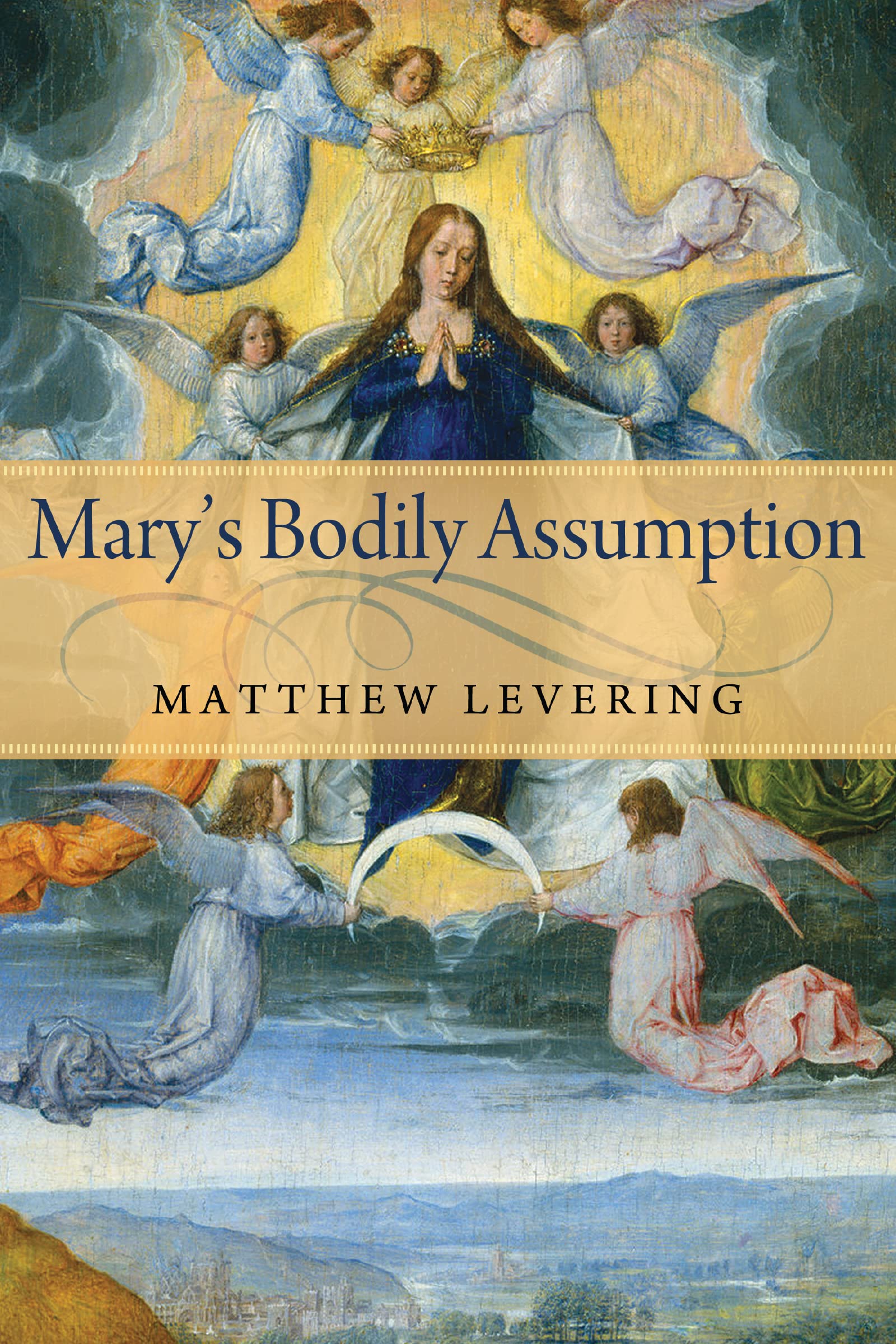
If you are interested in more background on the declaration of the Dogma of Our Lady's Assumption, I highly recommend Mary’s Bodily Assumption by Matthew Levering from Notre Dame University Press which I reviewed a few years ago. From the publisher:

In Mary’s Bodily Assumption, Matthew Levering presents a contemporary explanation and defense of the Catholic doctrine of Mary’s bodily Assumption. He asks: How does the Church justify a doctrine that does not have explicit biblical or first-century historical evidence to support it? With the goal of exploring this question more deeply, he divides his discussion into two sections, one historical and the other systematic.

Levering’s historical section aims to retrieve the rich Mariological doctrine of the mid-twentieth century. He introduces the development of Mariology in Catholic Magisterial documents, focusing on Pope Pius XII’s encyclical
Munificentissimus Deus of 1950, in which the bodily Assumption of Mary was dogmatically defined, and two later Magisterial documents, Vatican II’s Lumen Gentium and Pope John Paul II’s Redemptoris Mater. Levering addresses the work of the neo-scholastic theologians Joseph Duhr, Aloïs Janssens, and Réginald Garrigou-Lagrange before turning to the great theologians of the nouvelle théologie—Karl Rahner, Hans Urs von Balthasar, Louis Bouyer, Joseph Ratzinger—and their emphasis on biblical typology. Using John Henry Newman as a guide, Levering organizes his systematic section by the three pillars of the doctrine on which Mary’s Assumption rests: biblical typology, the Church as authoritative interpreter of divine revelation under the guidance of the Holy Spirit, and the fittingness of Mary’s Assumption in relation to the other mysteries of faith.

Levering’s ecumenical contribution is a significant engagement with Protestant biblical scholars and theologians; it is also a reclamation of Mariology as a central topic in Catholic theology.

Holy Mother of God, Assumed into Heaven, pray for us!
Saint John Henry Newman, pray for us!

Friday, August 5, 2022

Preview: St. J.H. Newman's Anglican Reverence Toward the Blessed Virgin Mary


We're going to continue on a Marian Newman theme throughout the month of August in our Monday morning Son Rise Morning Show exchanges, so on Monday, August 8, Anna Mitchell or Matt Swaim and I will take a look at the Parochial and Plain Sermon Newman delivered on the Feast of the Annunciation in 1832, as the Vicar of St. Mary's the Virgin in Oxford.

I'll be on at my usual time, about 6:50 a.m. Central/7:50 a.m. Eastern.

Please listen live here on EWTN or on your local EWTN affiliate.

Last week I mentioned this passage from chapter four of the Apologia pro Vita Sua. Writing in 1864, Newman looks back and remembers the tug at his heart he was feeling as the Vicar of St. Mary's the Virgin and Fellow at Oriel College, founded in 1326 as "the College of the Blessed Virgin Mary":

In spite of my ingrained fears of Rome, and the decision of my reason and conscience against her usages, in spite of my affection for Oxford and Oriel, yet I had a secret longing love of Rome the Mother of English Christianity, and I had a true devotion to the Blessed Virgin, in whose College I lived, whose Altar I served, and whose Immaculate Purity I had in one of my earliest printed Sermons made much of. (p. 165)

The sermon he refers to is "The Reverence Due to the Virgin Mary", sermon 12 in Parochial and Plain Sermons, Volume 2, published in 1835.

Just a little biographical context: Newman had begun reading the Fathers of the Church systematically in 1826; he'd been Vicar of St. Mary's since 1828, and he published his first book, The Arians of the Fourth Century the same year he wrote and delivered this sermon. And, as he notes in the first chapter of the Apologia pro Vita Sua, he was influenced by his friend Richard Hurrell Froude:

It is difficult to enumerate the precise additions to my theological creed which I derived from a friend to whom I owe so much. He made me [Note 47] look with admiration towards the Church of Rome, and in the same degree to dislike the {127} Reformation. He fixed deep in me the idea of devotion to the Blessed Virgin, and he led me gradually to believe in the Real Presence.

If you've had time to the read the two sermons I highlighted last week here and in my discussion with Matt Swaim on Monday, August 1, you'll see great connections between those Catholic sermons and this Anglican sermon.

Newman begins, inspired by Luke 1:43 ("From henceforth all generations shall call me blessed."):

TODAY we celebrate the Annunciation of the Virgin Mary; when the Angel Gabriel was sent to tell her that she was to be the Mother of our Lord, and when the Holy Ghost came upon her, and overshadowed her with the power of the Highest. . . .

Her cousin Elizabeth was the next to greet her with her appropriate title. Though she was filled with the Holy Ghost at the time {128} she spake, yet, far from thinking herself by such a gift equalled to Mary, she was thereby moved to use the lowlier and more reverent language. "She spake out with a loud voice, and said, Blessed art thou among women, and blessed is the fruit of thy womb. And whence is this to me, that the mother of my Lord should come to me?" ... Then she repeated, "Blessed is she that believed; for there shall be a performance of those things which were told her from the Lord." Then it was that Mary gave utterance to her feelings in the Hymn which we read in the Evening Service. (The Magnificat)

Newman introduces the image of Mary as the Second Eve and enters into the psychology of her Magnificat:

How many and complicated must they have been! In her was now to be fulfilled that promise which the world had been looking out for during thousands of years. The Seed of the woman, announced to guilty Eve, after long delay, was at length appearing upon earth, and was to be born of her. In her the destinies of the world were to be reversed, and the serpent's head bruised. On her was bestowed the greatest honour ever put upon any individual of our fallen race. God was taking upon Him her flesh, and humbling Himself to be called her offspring;—such is the deep mystery! She of course would feel her own inexpressible unworthiness; and again, her humble lot, her ignorance, her weakness in the eyes of the world. And she had moreover, we may well suppose, that purity and innocence of heart, that bright vision of faith, that confiding trust in her God, which raised all these feelings to an intensity which we, ordinary mortals, cannot understand. 

With that kind of insight into human weakness Newman often demonstrates, he notes that we take the words of the Magnificat too much for granted even as we pray or chant every evening:

We cannot understand them; we repeat her hymn day after day,—yet consider for an instant in how different a mode we say it {129} from that in which she at first uttered it. We even hurry it over, and do not think of the meaning of those words which came from the most highly favoured, awfully gifted of the children of men. "My soul doth magnify the Lord, and my spirit hath rejoiced in God my Saviour. For He hath regarded the low estate of His hand-maiden: for, behold, from henceforth all generations shall call me blessed. For He that is mighty hath done to me great things; and holy is His name. And His mercy is on them that fear Him from generation to generation."

Newman continues the theme of God's purpose in the Incarnation and His choice of a Second Eve to heal the wounds of the Fall of Adam and Eve, citing the Protoevangelium (Genesis 3:15):

I observe, that in her the curse pronounced on Eve was changed to a blessing. Eve was doomed to bear children in sorrow; but now this very dispensation, in which the token of Divine anger was conveyed, was made the means by which salvation came into the world. Christ might have descended from heaven, as He went back, and as He will come again. He might have taken on Himself a body from the ground, as Adam was given; or been formed, like Eve, in some other divinely-devised way. 

But, far from this, God sent forth His Son (as St. Paul says), "made of a woman." For it has been His gracious purpose to turn all that is ours from evil to good. Had He so pleased, He might have found, when we sinned, other beings to do Him service, casting us into hell; but He purposed to save and to change us. And in like manner all that belongs to us, our reason, our affections, our pursuits, our relations in life, He {130} needs nothing put aside in His disciples, but all sanctified. Therefore, instead of sending His Son from heaven, He sent Him forth as the Son of Mary, to show that all our sorrow and all our corruption can be blessed and changed by Him. The very punishment of the fall, the very taint of birth-sin, admits of a cure by the coming of Christ.

Newman even notes that the blessedness of Mary undoes the subjugation of women after the Fall:

But there is another portion of the original punishment of woman, which may be considered as repealed when Christ came. It was said to the woman, "Thy husband shall rule over thee;" a sentence which has been strikingly fulfilled. Man has strength to conquer the thorns and thistles which the earth is cursed with, but the same strength has ever proved the fulfilment of the punishment awarded to the woman. Look abroad through the Heathen world, and see how the weaker half of mankind has everywhere been tyrannized over and debased by the strong arm of force. . . .

But when Christ came as the seed of the woman, He {131} vindicated the rights and honour of His mother. . . . "notwithstanding, she shall be saved through the Child-bearing;" [1 Tim. ii. 15.] that is, through the birth of Christ from Mary, which was a blessing, as upon all mankind, so peculiarly upon the woman. Accordingly, from that time, Marriage has not only been restored to its original dignity, but even gifted with a spiritual privilege, as the outward symbol of the heavenly union subsisting betwixt Christ and His Church.

Thus has the Blessed Virgin, in bearing our Lord, taken off or lightened the peculiar disgrace which the woman inherited for seducing Adam, sanctifying the one part of it, repealing the other.

He considers how the Scripture speak less of Mary once Jesus begins His public ministry, but he notes that the Holy Bible was inspired and written, "not to exalt this or that particular Saint, but to give glory to Almighty God. There have been thousands of holy souls in the times of which the Bible history treats, {133} whom we know nothing of, because their lives did not fall upon the line of God's public dealings with man. In Scripture we read not of all the good men who ever were, only of a few, viz. those in whom God's name was especially honoured."

Thus, as an Anglican Vicar, Newman highlights how carefully the Church of England offers reverence to the Mother of God:

Hence, following the example of Scripture, we had better only think of her with and for her Son, never separating her from Him, but using her name as a memorial of His great condescension in stooping from heaven, and not "abhorring the Virgin's womb." [Quoting the Te Deum as he does in the 1849 sermons cited last week]

And this is the rule of our own Church, which has set apart only such Festivals in honour of the Blessed Mary, as may also be Festivals in honour of our Lord; the Purification commemorating His presentation in the {136} Temple, and the Annunciation commemorating His Incarnation. And, with this caution, the thought of her may be made most profitable to our faith; for nothing is so calculated to impress on our minds that Christ is really partaker of our nature, and in all respects man, save sin only, as to associate Him with the thought of her, by whose ministration He became our brother.

In concluding his sermon, Newman applies what he's said about the Blessed Virgin Mary to himself and his congregation:

Observe the lesson which we gain for ourselves from the history of the Blessed Virgin; that the highest graces of the soul may be matured in private, and without those fierce trials to which the many are exposed in order to their sanctification. So hard are our hearts, that affliction, pain, and anxiety are sent to humble us, and dispose us towards a true faith in the heavenly word, when preached to us. Yet it is only our extreme obstinacy of unbelief which renders this chastisement necessary. The aids which God gives under the Gospel Covenant, have power to renew and purify our hearts, without uncommon providences to discipline us into receiving them. God gives His Holy Spirit to us silently; and the silent duties of every day (it may be humbly hoped) are blest to the sufficient sanctification of thousands, whom the world knows not of. The Blessed Virgin is a memorial of this; and it is consoling as well as instructive to know it.

With a delicate reference to the Transfiguration (which we will celebrate tomorrow, August 6 on the First Saturday of the Month!), at end of this sermon Newman alludes to Christ's Second Coming, the End of the World, and Mary's presence on that day:

The day will come at length, when our Lord and Saviour will unveil that Sacred Countenance to the whole world, which no sinner ever yet could see and live. . . . And then will be fulfilled the promise pledged to the Church on the Mount of Transfiguration. It will be "good" to be with those whose tabernacles might have been a snare to us on earth, had we been allowed to build them. We shall see our Lord, and His Blessed Mother, the Apostles and Prophets, and all those righteous men whom we now read of in history, and long to know. Then we shall be taught in those Mysteries which are now above us. In the words of the Apostle, "Beloved, now are we the sons of God, and it doth not yet appear what we shall be; but we know that, when He shall appear, we shall be like Him, for we shall see Him as He is: and every man that hath this hope in Him, purifieth himself, even as He is pure." [1 John iii. 2, 3.]

We certainly won't have time Monday morning to delve into the distinctions to be made between what Newman wrote in 1832 as an Anglican and what he wrote in 1849 as a Catholic. This one passage, which I did not quote in the sequence above (p. 136), might serve as a starting point for such a comparison:

But, further, the more we consider who St. Mary was, the more dangerous will such knowledge of her appear to be. Other saints are but influenced or inspired by Christ, and made partakers of Him mystically. But, as to St. Mary, Christ derived His manhood from her, and so had an especial unity of nature with her; and this wondrous relationship between God and man it is perhaps impossible for us to dwell much upon without some perversion of feeling. For, truly, she is raised above the condition of sinful beings, though by nature a sinner; she is brought near to God, yet is but a creature, and seems to lack her fitting place in our limited understandings, neither too high nor too low. We cannot combine, in our thought of her, all we should ascribe with all we should withhold.

Otherwise, he says very little here that any Catholic would not say about the Blessed Virgin Mary as a saint and model--but I'd say that in 1832, Newman was still leery of  promoting to his Anglican congregation, not reverence toward the Mother of God, but devotion to her.

Holy Mary, Mother of God, pray for us!
Saint John Henry Newman, pray for us!

Image source: (Public Domain, provided by the Cornell University Library: This image is from the Cornell University Library's The Commons Flickr stream.The Library has determined that there are no known copyright restrictions.) Oxford. University Church of Saint Mary the Virgin. Architect: Nicholas Stone. Sculpture Date: 1637. Building Date: 1280-ca. 1637. Photograph date: ca. 1865-ca. 1885.

Image source (Public Domain): The Transfiguration by Pietro Perugino, c. 1500.

Friday, July 29, 2022

Preview: St. J.H. Newman and the Immaculate Heart of Mary

Since August is the month traditionally dedicated to devotion to the Immaculate Heart of Mary, we thought it appropriate to continue our Monday morning Summer Newman series on the Son Rise Morning Show on August 1st with some comments about Saint John Henry Newman's devotion to Mary, the Mother of God. Either Anna Mitchell or Matt Swaim and I will discuss this topic at my usual time, about 6:50 a.m. Central/7:50 a.m. Eastern.

Please listen live here on EWTN or on your local EWTN affiliate.

In chapter four of the Apologia pro Vita Sua, Newman remembers the tug at his heart he was feeling as the Vicar of St. Mary's the Virgin and Fellow at Oriel College, founded in 1326 as "the College of the Blessed Virgin Mary":

In spite of my ingrained fears of Rome, and the decision of my reason and conscience against her usages, in spite of my affection for Oxford and Oriel, yet I had a secret longing love of Rome the Mother of English Christianity, and I had a true devotion to the Blessed Virgin, in whose College I lived, whose Altar I served, and whose Immaculate Purity I had in one of my earliest printed Sermons made much of. (p. 165)

Newman was on his "death-bed" as an Anglican when he felt that secret longing and true devotion, and I think we can safely say that when he became a Catholic he was able to demonstrate that love and devotion. In 1849, he published his Discourses to Mixed Congregations and included two sermons on the Blessed Virgin Mary, "The Glories of Mary for the Sake of her Son" and "On the Fitness of the Glories of Mary" in that volume.

In the first sermon, we can see that Newman recognizes (having experienced them) the difficulties those outside the Church have with what Catholics believe about the Mother of God and how we practice devotion to the Blessed Virgin Mary. After speaking about how "great truths of Revelation are all connected together and form a whole", he states:

I am going to apply this remark to the subject of the prerogatives with which the Church invests the Blessed Mother of God. They are startling and difficult to those whose imagination is not accustomed to them, and whose reason has not reflected on them; but the more carefully and religiously they are dwelt on, the more, I am sure, will they be found essential to the Catholic faith, and integral to the worship of Christ. This simply is the point which I shall insist on—disputable indeed by aliens from the Church, but most clear to her children—that the glories of Mary are for the sake of Jesus; and that we praise and bless her as the first of creatures, that we may confess Him as our sole Creator.

So his first thoughts are on the Incarnation of the Second Person of the Holy Trinity:

When the Eternal Word decreed to come on earth, He did not purpose, He did not work, by halves; but He came to be a man like any of us, to take a human soul and body, and to make them His own. He did not come in a mere apparent or accidental form, as Angels appear to men; nor did He merely over-shadow {345} an existing man, as He overshadows His saints, and call Him by the name of God; but He "was made flesh". He attached to Himself a manhood, and became as really and truly man as He was God, so that henceforth He was both God and man, or, in other words, He was One Person in two natures, divine and human. This is a mystery so marvellous, so difficult, that faith alone firmly receives it; the natural man may receive it for a while, may think he receives it, but never really receives it; begins, as soon as he has professed it, secretly to rebel against it, evades it, or revolts from it. This he has done from the first; even in the lifetime of the beloved disciple [St. John] men arose who said that our Lord had no body at all, or a body framed in the heavens, or that He did not suffer, but another suffered in His stead, or that He was but for a time possessed of the human form which was born and which suffered, coming into it at its baptism, and leaving it before its crucifixion, or, again, that He was a mere man. That "in the beginning was the Word, and the Word was with God, and the Word was God, and the Word was made flesh and dwelt among us," was too hard a thing for the unregenerate reason.

Then, after reviewing some of the history of how the Catholic Church developed our understanding of this truth through the early Church Councils, wrestling with how to define the truth of the Incarnation against the various heresies (Arianism, Apollinarism, Nestorianism, etc) that conflicted with what the Church believed, Newman concludes:

You see, then, my brethren, in this particular, the harmonious consistency of the revealed system, and the bearing of one doctrine upon another; Mary is exalted for the sake of Jesus. It was fitting that she, as being a creature, though the first of creatures, should have an office of ministration. She, as others, {349} came into the world to do a work, she had a mission to fulfil; her grace and her glory are not for her own sake, but for her Maker's; and to her is committed the custody of the Incarnation; this is her appointed office,—"A Virgin shall conceive, and bear a Son, and they shall call His Name Emmanuel". As she was once on earth, and was personally the guardian of her Divine Child, as she carried Him in her womb, folded Him in her embrace, and suckled Him at her breast, so now, and to the latest hour of the Church, do her glories and the devotion paid her proclaim and define the right faith concerning Him as God and man. Every church which is dedicated to her, every altar which is raised under her invocation, every image which represents her, every litany in her praise, every Hail Mary for her continual memory, does but remind us that there was One who, though He was all-blessed from all eternity, yet for the sake of sinners, "did not shrink from the Virgin's womb". Thus she is the Turris Davidica, as the Church calls her, "the Tower of David"; the high and strong defence of the King of the true Israel; and hence the Church also addresses her in the Antiphon, as having "alone destroyed all heresies in the whole world".

And in the second sermon in that collection, he continues with the same theme, and with even more tender images of the human relationship between the Mother and her Son:

Now, as you know, it has been held from the first, and defined from an early age, that Mary is the Mother of God. She is not merely the Mother of our Lord's manhood, or of our Lord's body, but she is to be considered {362} the Mother of the Word Himself, the Word incarnate. God, in the person of the Word, the Second Person of the All-glorious Trinity, humbled Himself to become her Son. Non horruisti Virginis uterum, as the Church sings, "Thou didst not disdain the Virgin's womb" [in the Te Deum]. He took the substance of His human flesh from her, and clothed in it He lay within her; and He bore it about with Him after birth, as a sort of badge and witness that He, though God, was hers. He was nursed and tended by her; He was suckled by her; He lay in her arms. As time went on, He ministered to her, and obeyed her. He lived with her for thirty years, in one house, with an uninterrupted intercourse, and with only the saintly Joseph to share it with Him. She was the witness of His growth, of His joys, of His sorrows, of His prayers; she was blest with His smile, with the touch of His hand, with the whisper of His affection, with the expression of His thoughts and His feelings, for that length of time. Now, my brethren, what ought she to be, what is it becoming that she should be, who was so favoured?

These two longer sermons/discourses are most appropriate spiritual reading for the month of August.

In 1864 he answered his old Oxford Movement friend, E.B. Pusey, to defend the recent proclamation of the doctrine of Mary's Immaculate Conception with a public letter, but that's beyond the limits of these brief segments to get into!

In his Meditations and Devotions, he included a series of meditations on the Litany of Loretto for the month of May. He divided these meditations into four parts after two introductions to the month of May: The Immaculate Conception, The Annunciation, Our Lady's Dolours (Sorrows), and The Assumption.

Newman also wrote a Litany to the Immaculate Heart of Mary to be used from August 1 to 15 (the Feast of the Assumption of Our Lady) for private devotion:

Heart of Mary, Pray for us.
Heart, after God’s own Heart, Pray for us.
Heart, in union with the Heart of Jesus, 
Heart, the vessel of the Holy Ghost,
Heart of Mary, shrine of the Trinity,
Heart of Mary, home of the Word,
Heart of Mary, immaculate in thy creation,
Heart of Mary, flooded with grace, {242}
Heart of Mary, blessed of all hearts,
Heart of Mary, Throne of glory,
Heart of Mary, Abyss of humbleness,
Heart of Mary, Victim of love,
Heart of Mary, nailed to the Cross,
Heart of Mary, comfort of the sad,
Heart of Mary, refuge of the sinner,
Heart of Mary, hope of the dying,
Heart of Mary, seat of mercy,


************************

O most merciful God, who for the salvation of sinners and the refuge of the wretched, hast made the Immaculate Heart of Mary most like in tenderness {243} and pity to the Heart of Jesus, grant that we, who now commemorate her most sweet and loving heart, may by her merits and intercession, ever live in the fellowship of the Hearts of both Mother and Son, through the same Christ our Lord.—Amen.

And for the rest of the month of August, he composed a Litany to the Holy Name of Mary.

Immaculate Heart of Mary, pray for us!
Saint John Henry Newman, pray for us!

Image credit (Public Domain): Maria mit flammendem Herz; Hinterglasbild, 29 x 23 cm; Augsburg oder Murnau, 2. Hälfte 18. Jahrhundert

Friday, July 22, 2022

Preview: St. J.H. Newman on St. James the Greater and Predestination

Since Monday, July 25 is the feast of Saint James the Greater, we'll continue our series on the Son Rise Morning Show with an 1835 Parochial and Plain Sermon Newman preached on Saint James' feast day, "Human Responsibility" from volume 2 of those sermons. Either Anna Mitchell or Matt Swaim and I will discuss this sermon at my usual time, about 6:50 a.m. Central/7:50 a.m. Eastern.

Please listen live here on EWTN or on your local EWTN affiliate.

Newman takes as his text a verse from the Gospel for this feast: "To sit on My right hand and on My left is not Mine to give; but it shall be given to them for whom it is prepared of My Father." (Matt. 20:23) 

As a reminder: The mother of James and John have asked Jesus to grant her sons a special place when He comes into His power: to be seated on either side of Him (she leaves it up to Him which one on which side!). Jesus warns them that there will be a cost for being His followers but then tells them He can't promise that great honor because He is obedient to the Father's Will. That's up to His heavenly Father. (The other Apostles don't like the special attention paid the Sons of Zebedee; who is the more important disciple seems to be a recurring issue for the Twelve [Luke 9:46; Mark 9:33; Matthew 18:1-4]: they even talk about it [Luke 22;24] at the Last Supper!) Jesus reminds them again that they need to have a different view of honor and precedence, which He will model at the Last Supper when He washes their feet [John 13:4-5].

Newman begins:

IN these words, to which the Festival of St. James the Greater especially directs our minds, our Lord solemnly declares that the high places of His Kingdom are not His to give,—which can mean nothing else, than that the assignment of them does not simply and absolutely depend upon Him; for that He will actually dispense them at the last day, and moreover is the meritorious cause of any being given, is plain from Scripture. I say, He avers most solemnly that something besides His own will and choice is necessary, for obtaining the posts of honour about His throne; so that we are naturally led on to ask, where it is that this awful prerogative is lodged. Is it with His Father? He proceeds to speak of His Father; but neither does He assign it to Him, "It shall be given to them for whom it is prepared of My Father." The Father's foreknowledge and design {321} are announced, not His choice. "Whom He did foreknow, them He did predestinate." He prepares the reward, and confers it, but upon whom? No answer is given us, unless it is conveyed in the words which follow,—upon the humble:—"Whosoever will be great among you, let him be your minister; and whosoever will be chief among you, let him be your servant."

Newman is exploring the mystery of Judgment and Eternal Reward, and he is entering the debate of how we humans participate in our own salvation:

Some parallel passages may throw some further light upon the question. In the description our Lord gives us of the Last Judgment, He tells us He shall say to them on His right hand, "Come, ye blessed of My Father, inherit the kingdom prepared for you from the foundation of the world." Here we have the same expression. Who then are the heirs for whom the Kingdom is prepared? He tells us expressly, those who fed the hungry and thirsty, lodged the stranger, clothed the naked, visited the sick, came to the prisoners, for His sake. Consider again an earlier passage in the same chapter. To whom is it that He will say, "Enter thou into the joy of thy Lord?"—to those whom He can praise as "good and faithful servants," who have been "faithful over a few things." (Matthew 25:21, 34-36) 

These two passages then carry our search just to the very point which is suggested by the text. They lead us from the thought of God and Christ, and throw us upon human agency and responsibility, for the solution of the question; and they finally lodge us there, unless indeed other texts of Scripture can be produced to lead us on further still. . . . Is this as far as we can go? Does it now depend ultimately on ourselves, or on any one else, that we come to be humble, charitable, diligent, and lovers of God?

Newman then offers a sketch of early Church history on the tension between God's omniscience (knowing who will be saved) and human will and perseverance to obey God's will and commandments, before turning to various Bible verses arguing both sides. For example:

Next, let us inquire whether there be any Scripture reason for breaking the chain of doctrine which the text suggests. Christ gives the Kingdom to those for whom it is prepared of the Father; the Father prepares it for those who love and serve Him. Does Scripture warrant us in reversing this order, and considering that any are chosen to love Him by His irreversible decree? The disputants in question maintain that it does.

1. Scripture is supposed expressly to promise perseverance, when men once savingly partake of grace; as where it is said, "He which hath begun a good work in you, will perform it until the day of Jesus Christ;" [Phil. i. 6.] and hence it is inferred that the salvation of the individual rests ultimately with God, and not with himself. But here I would object in the outset to applying to individuals promises and declarations made to bodies, and of a general nature. The question in debate is, not whether God carries forward bodies of men, such as the Christian Church, to salvation, but whether He has accorded any promise of indefectibility to given individuals? Those who differ from us say, that individuals are absolutely chosen to eternal life; let them then reckon up the passages in Scripture where perseverance is promised to individuals. Till they can satisfy this demand, they have done nothing by producing such a text as that just cited; which, being spoken of the body of Christians, does but impart that same kind of encouragement, as is contained in other general declarations, such as the statement about God's {326} willingness to save, His being in the midst of us, and the like. . . .

In truth, the two doctrines of the sovereign and {327} overruling power of Divine grace, and man's power of resistance, need not at all interfere with each other. They lie in different provinces, and are (as it were) incommensurables. Thus St. Paul evidently accounted them; else he could not have introduced the text in question with the exhortation, "Work out" or accomplish "your own salvation with fear and trembling, for it is God which worketh" or acts "in you." So far was he from thinking man's distinct working inconsistent with God's continual aiding, that he assigns the knowledge of the latter as an encouragement to the former. Let me challenge then a Predestinarian to paraphrase this text. We, on the contrary, find no insuperable difficulty in it, considering it to enjoin upon us a deep awe and reverence, while we engage in those acts and efforts which are to secure our salvation from the belief that God is in us and with us, inspecting and succouring our every thought and deed.

He also offers verses that favor a strict Predestinarian view: that human action and effort mean little when it comes to salvation. But Newman comes back to the view that this is a mystery: that the Church may define some aspects (a la the Council of Trent's decree on Justification?) of it but cannot comprehend it all:

Lastly, there are passages which speak of God's judicial dealings with the heart of man; in which, doubtless, He does act absolutely at His sole will,—yet not in the beginning of His Providence towards us, but at the close. Thus He is said "to Send" on men "strong delusion to believe a lie;" but only on those who "received not the love of the truth that they might be saved." [2 Thess. ii. 10, 11.] Such irresistible influences do but presuppose, instead of superseding, our own accountableness.

These three explanations then being allowed their due weight,—the compatibility of God's sovereignty over the soul, with man's individual agency; the distinction between Regeneration and faith and obedience; and the judicial purpose of certain Divine influences upon the heart,—let us ask what does there remain of Scripture evidence in behalf of the Predestinarian doctrines? Are we not obliged to leave the mystery of human agency and responsibility as we find it? as truly a mystery in itself as that which concerns the Nature and Attributes of the Divine Mind.

Surely it will be our true happiness thus to conduct ourselves; to use our reason, in getting at the true sense of Scripture, not in making a series of deductions from it; in unfolding the doctrines therein contained, not in adding new ones to them; in acquiescing in what is told, not in indulging curiosity about the "secret things" of the Lord our God.

This may be a deep subject to take up on an early Monday morning, but remember that Newman's congregation was in church in the early evening at Sunday's Evensong service, before or after their Tea, listening to him cite chapter and verse! It does seem to me that Newman is setting himself to affirm the Catholic "via media" on this issue, as summarized in the old Catholic Encyclopedia article on Predestination:

Between these two extremes the Catholic dogma of predestination keeps the golden mean, because it regards eternal happiness primarily as the work of God and His grace, but secondarily as the fruit and reward of the meritorious actions of the predestined. 

Lord have mercy! Christ have mercy! Lord have mercy!
Saint James the Greater, pray for us!
Saint John Henry Newman, pray for us!

Image credit (public domain): Guido Reni - Saint James the Greater
Image credit (public domain): Hans von Kulmbach, Mary Salome and Zebedee with their Sons James the Greater and John the Evangelist, c. 1511

Friday, July 15, 2022

Preview: Saint J.H. Newman and Papal Infallibility (July 18, 1870)

On Monday, July 18, we will celebrate the 152nd anniversary of the proclamation of the doctrine of Papal Infallibility at the First Vatican Council in 1870. Therefore, we'll discuss Saint John Henry and Pastor Aeternus during my usual Monday segment on the Son Rise Morning Show. Either Matt Swaim or Anna Mitchell will be my interlocutor. Listen live here on EWTN Radio, at about 6:50 a.m. Central/7:50 a.m. Eastern.

First, some notes on Newman and the Papacy in general:

On October 6, 1845, just days before he became a Catholic, Blessed John Henry Newman retracted his statements against the Catholic Church and the Papacy. In his Apologia pro Vita Sua, he notes that when he was 15 years old he firmly believed the Pope was the Antichrist. As his religious opinions changed, however, he explains later in the Apologia, how his feelings toward Rome and Papacy changed under the influence of his beloved friend Richard Hurrell Froude, especially regarding some of the medieval popes. Then, while at Littlemore, on his "deathbed as an Anglican" as he put it, and while writing himself into the Catholic Church in his Essay on the Development of Christian Doctrine, he noted signs among the Fathers of the Church that argued for Papal Supremacy or Primacy.

Newman met Pope Pius IX while he was studying for the priesthood in Rome in 1846: it was not a promising start to their relationship: when Newman bent down to kiss the Pope’s foot he banged his forehead against the pope's knee. Pope Pius nevertheless, approved Newman's establishment of the Oratory of St. Philip Neri in England, gave him an honorary degree of divinity on August 22, 1850, and approved of him being named the Rector of the Catholic University of Ireland in 1851. When Pope Pius IX was planning the First Vatican Council, he asked Newman to come as an advisor to the bishops. Others requested his presence too: Bishop Felix Dupanloup of Orléans, France (who was opposed to a definition of Papal Infallibility) wanted him to be his personal theologian at the Council and Bishop Joseph Brown of Newport, who had delated Newman to Rome over The Rambler incident in 1859, also asked him to be his personal theologian. He declined all three job offers and remained at the Oratory in Birmingham. He was working on the Grammar of Assent at the time.

In June of 2019 I presented a paper on Newman's reactions to the First Vatican Council and the pending document on Papal Infallibility at Newman University during the Ad Fontes Conference hosted by Eighth Day Institute:

Newman received many letters from concerned converts and other Catholics. His advice was always to remain calm and pray. As he reminded himself and his correspondents, they had become Catholic because they believed “the present Roman Catholic Church is the only Church which is like, and it is very like, the primitive Church.”He recalled the phrase from St. Augustine: securus judicat orbis terrarum! and he relied upon the power of the Holy Spirit to keep the Church from any doctrinal error at a council. As Edward Short points out in Newman and His Contemporaries, he stressed to one of “his converts” when she threatened to leave the Church if Papal Infallibility was defined at the Council, “I say with [Robert] Cardinal Bellarmine whether the Pope be infallible or not in any pronouncement, anyhow he is to be obeyed. No good can come from disobedience . . .” He would make a similar comment in his Letter to the Duke of Norfolk. Newman did not think a decree of Papal Infallibility necessary or timely: he was an Inopportunist against the Ultramontanes. . . 

When Pastor Aeternus was finally voted on, he was pleased to see that Papal Infallibility was narrowly defined; he waited to see how the dissenting bishops responded: securus judicat orbis terrarum! Newman made no public statement except to again deny rumours that he was going to leave the Catholic Church (he had to make these periodically!)

Only when William E. Gladstone, former Prime Minister, published 
The Vatican Decrees in Their Bearing on Civil Allegiance in 1874 did Newman respond in 1875 with his Letter to the Duke of Norfolk, addressing his counter-argument to the pre-eminent Catholic peer, Henry FitzAlan Howard, scion of a family with two martyrs (Philip Howard and William Howard) in its pedigree. Selecting the 15th Duke of Norfolk as his public correspondent was testing Gladstone’s main contention: that Catholics could not be loyal Englishmen if they accepted Papal Infallibility. Was the Earl Marshall of England, who happened to be a Catholic and a graduate of Newman’s Oratory School, not a loyal Englishman? Did Gladstone really mean that?

Besides, he reminded Gladstone, the Pope’s Infallibility is limited to speaking on matters of faith and morals as abstract doctrine and principles, not on individual decisions of what to do or not to do in a certain situation. . . .

In a later chapter, on “The Vatican Definition” Newman emphasizes that the Pope speaks infallibly only under certain conditions:
He speaks ex cathedrâ, or infallibly, when he speaks, first, as the Universal Teacher; secondly, in the name and with the authority of the Apostles; thirdly, on a point of faith or morals; fourthly, with the purpose of binding every member of the Church to accept and believe his decision.
When the Pope is speaking his mind on any subject like the interpretation of scripture, economics, history, etc., he is not infallible because “he is not in the chair of the universal doctor.” Even if the Pope makes dogmatic statements in an encyclical, as Pope John Paul II did in The Gospel of Life, reiterating Catholic teaching against abortion, for example, those are not exercises of Papal Infallibility. 

Since the definition of Papal Infallibility in 1870, only one Pope has used this power: Pope Pius XII when defining the doctrine of the Assumption of the Blessed Virgin Mary in 1950. 

In spite of his reservations about the First Vatican Council's conduct, Newman accepted the work of the Council, but he knew that the Church--the whole Church, including the laity and the theologians, needed time to understand the theology and practice of the doctrine of Papal Infallibility. The First Vatican Council was abbreviated by the Franco-Prussian War and the cause of Italian unity, as the Italian Army was soon at the gates; the Papal States were lost and the long period the Pope as "the prisoner of the Vatican" began. 

Newman was always ready to obey the Pope and pray for the Pope as this 1866 Sermon preached at the Birmingham Oratory shows. He also helped Catholics and non-Catholics understand Papal Infallibility, providing an explanation that Father John O'Malley, in his book Vatican I: The Council and the Making of the Ultramontane Church, says “soon achieved almost canonical status” by answering Gladstone's objections.

Image Credit: (Public domain): Papa Pio IX fotografato da Adolphe Braun in commemorazione dell'83° compleanno di Sua Santità (I'm not sure which knee Newman bumped!)

Image Credit: (Public domain): Henry Fitzalan-Howard, 15th Duke of Norfolk (1847-1917)