Showing posts with label St. James-Spanish Place. Show all posts

Thursday, July 25, 2019

St. James the Greater and the English Reformation

Today is the Feast of St. James, the son of Zebedee, also called the Greater, one of the Twelve Apostles, not to be confused with St. James the Lesser or St. James the Just, the bishop of Jerusalem. He is renowned today because of the popularity of the Camino de Santiago and his shrine church in Compostela, Spain. Pilgrims walk the Camino to visit his shrine and gain the Indulgences of the pilgrimage.

There was an English route to the shrine which began in either A Coruña (Corunna) or Ferrol on the coast. After crossing the seas from England, Ireland, or Northern Europe, the pilgrims walked at least 75 kilometers or 46 miles. This was also a major trade route during the late Middle Ages.

Of course, once pilgrimages and other devotions to the saints, including the saints previously honored in England like Our Lady of Walsingham and St. Thomas of Canterbury, were discouraged, this pilgrimage to Spain from England was curtailed. William Farina, in his Saint James the Greater in History, Art and Culture, further suggests that there was a great animosity in England toward this traditional devotion to St. James the Greater because it was in Spain. He notes that Henry VIII named St. James Palace in the City of Westminster for St. James the Lesser "in direct opposition to the popular Spanish cult"--even though the Palace was built on the site of a former leper hostel named for St. James the Lesser, so perhaps it wasn't such direct opposition but continuity with the past. Farina also interprets several passages from Shakespeare plays, especially naming one of his greater villains, Iago in Othello, after the (Spanish) saint, as displaying not only national English animosity, but Shakespeare's personal animosity to Saint James the Greater because of his shrine in Spain, even though there were many churches in England dedicated to this saint. Finally, Farina states that more churches were built in England after the Break from Rome dedicated to St. James the Lesser than to St. James the Greater, although he does not provide any evidence of that assertion. Usually, St. James the Lesser is combined with St. Philip as in their shared feast Saints Philip and James in May.

We do know, however, that Sir Francis Drake's excursions into Spain provoked fear that English forces would desecrate the shrine of Santiago de Compostela, as this website explains:

In May 1589, faced with the fear of an attack on Compostela by the English troops of Francis Drake, whose ships were attacking Corunna, Archbishop Juan de Sanclemente ordered the concealment of the body of the apostle in the presbytery of the Cathedral. Its exact location was unknown for several centuries until 1879, the year of the second discovery of the apostolic remains.

So the conflict between England and Spain during the reigns of Elizabeth I and Philip II indirectly impacted the shrine of Saint James the Greater at Compostela, even though the Spanish forces at Corunna was prepared to thwart his attack.

In England, however, there was a Spanish presence and embassy chapel in London throughout the reigns of Elizabeth I and James I as the parish church now called St. James-Spanish Place explains:

In the reign of Elizabeth I the Bishops of Ely let their palace and chapel in Ely Place to the Spanish Ambassador, and until the reign of Charles I it was occupied by the representative of the Court of Spain. During this period the chapel was freely used by English Catholics and became a place of sanctuary for them.

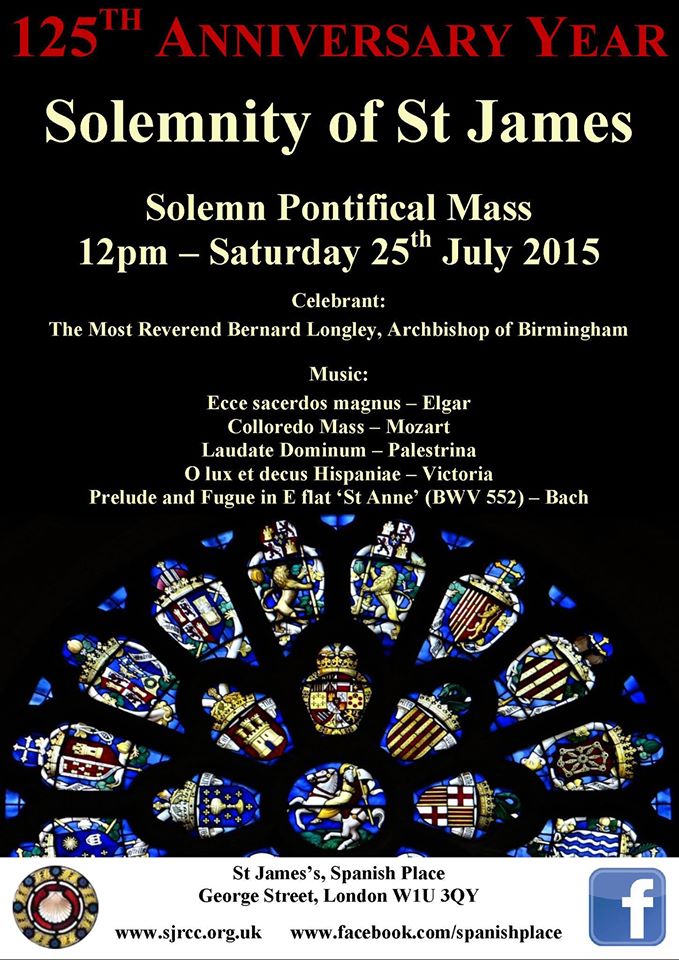
St. James-Spanish Place celebrates its patronal feast today with a Solemn Pontifical Mass and glorious music, its choir accompanied by His Majestys Sagbutts and Cornetts:

Mass Andrea Gabrieli 
Plaudite omnis terra Giovanni Gabrieli 
Iubilate Deo a 15 Giovanni Gabrieli 
O quam suavis est Giovanni Gabrieli 
O lux et decus Hispaniae Victoria (O light and grace of Spain,
most holy James, you who were the first among the apostles, were the first of them to wear a martyr’s crown. Alleluia.)
Canzon a 13 Pietro Lappi

St. James the Greater, pray for us!

Saturday, July 25, 2015

The Feast of St. James at Spanish Place

Today is the Feast of St. James the Greater. Every year on this feast day I think of the quip of my mother regarding my late father when deciding which was his patron saint, St. James the Greater or St. James the Lesser? She said immediately: "St. James THE Great". I certainly hope and pray that my father is a saint in heaven today.

In London, the parish of St. James Spanish Place is celebrating not only the patronal feast day but its 125th anniversary! From the parish's history page:

The visitor to St James's Church is often puzzled to know why a church which stands in George Street, W1, should have derived a kind of secondary title from a street called Spanish Place which can be found opposite the Presbytery door. The explanation is that St James's, Spanish Place, like so many of the older parishes in the Westminster diocese, can trace its origin to the penal times and to the benefactions of a friendly Catholic embassy. And this is perhaps the reason why, despite the magnificence of the church, there is within an atmosphere that breathes our Catholic past.

In the reign of Elizabeth I the Bishops of Ely let their palace and chapel in Ely Place to the Spanish Ambassador, and until the reign of Charles I it was occupied by the representative of the Court of Spain. During this period the chapel was freely used by English Catholics and became a place of sanctuary for them.

After the restoration of Charles II the Spanish Embassy was re-established in London, first on Ormond Street and then at Hartford house, Manchester Square, where the Wallace Collection is now housed. Here, in 1791, shortly after the first repeal of some of the laws affecting Catholic worship, a chapel was built on the corner of Spanish Place and Charles Street (now George Street), largely through the efforts of DOctor Thomas Hussey who had been a chaplain at the Embassy since his ordination in 1769. Most of the objects of piety in the present church are legacies from this older building which was famous enough in its day to be mentioned by Thackeray in
Vanity Fair as the church attended by the Marchioness of Steyne. . . .

In the year 1827 the official Spanish connection with the chapel ceased and it was handed over to the London Vicariate. However, there is much in the present church to remind us of our Spanish heritage including Alfonso XIII's personal standard which is in a frame over the sacristy door, and the parishioners of Spanish Place have never forgotten their debt to Spain for having established and maintained the mission in the dark days. An unofficial connection with the Embassy of Spain has continued and is still cherished by the Church of St James today. . . .

The site was purchased and the design for a new church was made an open competition. Edward Goldie, great grandson of the architect of the old chapel, Signor Joseph Bonomi, won the competition and the present edifice, partially completed, was opened on Michaelmas Day, 1890.

Happy Feast of St. James! St. James, pray for us!

Monday, August 18, 2014

Mosul Today and England Yesterday


Father Christopher Colven, rector of St. James, Spanish Place, offers these reflections on the current state of affairs in Mosul, Iraq and in the England during the sixteenth and seventeenth centuries:

The Christian communities of Iraq are among the oldest that have existed and it is particularly painful to see the witness of 2,000 years persecuted and dispersed. As our bishops reminded us last weekend, the Eucharist will have been celebrated in Mosul for the best part of two millennia – but now no more – no altar, no priest, no Christian people. We must continue to pray and do whatever we can for our brothers and sisters as they seek a new security, but it does us well to remember that what we take so easily for granted is a great privilege denied to many in our own times, and that there were many sad years here in England when the state forbade the celebration of the Mass. The reredos above the Martyrs altar in Saint Michael’s Chapel (this is the original which has been reproduced in many other Catholic churches) depicts a few of those who were willing to make the ultimate sacrifice of their own lives for the sake of the Mass. Several of those depicted were ordinary working people - John Roche, the Thames lighterman, together with three housewives Margaret Clitheroe, Anne Line and Margaret Ward – all of them martyred for trying to ensure that, despite every attempt to frustrate them, the Holy Sacrifice would continue to be offered on English soil.

Father Colven goes on to highlight our proper dispositions for receiving Holy Communion at Mass, citing Pope St. Pius X, whose memorial we will celebrate on Thursday this week:

The new Bishop of East Anglia has recently made the point that we are in danger of losing our grasp on the Eucharistic Mystery: because the Mass is now so easily available (a minimum of three Masses each weekday here at Spanish Place alone) and Holy Communion is received as a matter of course (often without any real time of preparation) we can become blasé in approaching the Bread of Life. It was Saint Pius X at the beginning of the last century who encouraged all Catholics to make their Holy Communion as regularly as possible – and that is clearly a very good thing to do – but Saint Paul issues a stern warning in his dealings with the Corinthian Christians about any failure to “discern the Lord’s Body” when doing so: we must never treat holy things in a casual way. “Everyone is to recollect themselves before eating this bread and drinking this cup because a person who eats and drinks without recognising the Body is eating and drinking his own condemnation” (1 Corinthians 11:28).

Then he brings us back to the memory of the English Catholic martyrs who were willing to suffer so much for the sake of the Holy Eucharist, the source and summit of our Catholic faith:

The current suffering of so many of those who are with us “in Christ", as well as the particular history of the Catholic Church in these islands, should give  pause for thought and the opportunity to think out afresh what the celebration of the Eucharist means to us.  Tyburn Tree, where so many of countrymen and women accepted terrible deaths is only a few hundred yards from Saint James’s doors – “lest we forget”. Mother Teresa of Calcutta caused a notice to be  put up in the sacristy of each of her convents worldwide: it was an admonition to the celebrant – but it applies as well to the faithful gathered around any altar: “O priest of God, offer this Mass as if it were your first … and as if it were your last”.

Image credit.

Wednesday, April 4, 2012

Historic Holy Week for the Our Lady of Walsingham Ordinariate

Last year during Holy Week, groups of former Anglicans entered the Catholic Church nearly every night. Ordinations of former Anglican clergy took place later around Pentecost. This year during Holy Week, groups of former Anglicans will enter the Catholic Church in the same way. But also this week, the Ordinariate celebrated its first Chrism Mass.

At the Chrism Mass, sometimes held on Holy Thursday morning, but also held earlier in Holy Week, the bishop and all his priests gather for Mass at the cathedral: the priests renew their vows of obedience to their bishop and the bishop blesses the oils used in the Sacraments: the oil of catechumens (Baptism), the oil of the infirm (Anointing of the Sick) and holy chrism (Baptism, Confirmation, and Holy Orders). In the Wichita diocese, for example, parish representatives attend to receive the oils from the bishop to take back to their parishes. The Personal Ordinariate of Our Lady of Walsingham has no cathedral yet, so its ordinary (who is not an ordained bishop), clergy, and laity gathered at St. James, Spanish Place on Monday, April 2.

The Apostolic Nuncio to Great Britain has celebrated the first Chrism Mass of the Personal Ordinariate of Our Lady of Walsingham.

Archbishop Antonio Mennini celebrated the Mass on Monday at the church of St James, Spanish Place, in London with 60 former Anglican clergy, including five former Anglican bishops, concelebrating. Hundreds of laity from groups across Britain were in attendance.

Archbishop Mennini celebrated the Mass at the request of the Ordinary of the Personal Ordinariate, Mgr Keith Newton.

Mgr Newton, who received the Renewal of Priestly Promises and preached at the Mass, said: “The jurisdiction given to me, unlike that of Catholic diocesan bishops, is vicarious on behalf of the Roman Pontiff.

"It is therefore particularly appropriate that our Chrism Mass should be celebrated by the Holy Father’s representative to Great Britain particularly as at this time we celebrate the 30th anniversary of full diplomatic relations between the British Government and the Holy See."


The Catholic Herald also makes a note about those professing their faith in the Catholic Church this week:

In Holy Week over 200 former members of the Church of England and the Traditional Anglican Communion are expected to be received into full communion. This evening [Tuesday, April 3] four former Anglican clergy are expected to be ordained as Catholic priests and groups of faithful in Lancashire, Kent, Essex and Surrey will be received into the Catholic Church.