Showing posts with label Magnificat. Show all posts

Friday, March 3, 2023

St. Thomas Aquinas on Doctrine and Salvation

Last month, during two of my hours of Adoration I read Sanctifying Truth: Thomas Aquinas on Christian Holiness by Father Romanus Cessario, OP, published by Magnificat. It's short book, just 95 pages. 

The pages that stood for me were from 74 to 77, in the chapter titled "To Rise into Speculation". I wrote several paragraphs in a notebook to help me remember the connection St. Thomas Aquinas made between assenting to certain doctrines and achieving holiness, and herewith provide some excerpts from those notes:

How does Aquinas come to recognize the article of faith as more than a mere formula on which adherents of the Catholic faith agree? How does he come to recognize that the articles of faith as they appear in the Christian creeds are capable of uniting the believer to the very divine reality, the very Christian mystery that the article affirms?

I remember reading years and years ago an article in the magazine U.S. Catholic in which the author said he saw no purpose in reciting the Nicene Creed at Sunday Mass every week because it did not move him or elicit any emotional, devotional feeling. (At least, that's how I recall the gist of the argument.) 

Father Cessario is explaining how St. Thomas Aquinas relates the recitation and thus the assent to the articles of faith in the Creed to our acceptance of "the broader range of matters that the Church proposes for belief", so that when we proclaim that "Christ is born of the Virgin Mary, suffers under Pontius Pilate, and will come again in glory" we are also proclaiming that we believe that "Mary is the Mother of the Church", etc. As Cessario affirms, "the Creed that we recite every Sunday represents a recognizable body of saving truths to which Catholics assent. This assent of salvific faith carries with it the graces necessary to live in accord with all that the Church holds and teaches." (pp. 73-74)

I think this answers that decades old article I remember reading: it's not our emotions that matter while we recite the Creed, proclaiming that we believe those articles of faith stated in the Creed, but our assent, intellectual and willful, through the grace of faith God gives us, to "all that the Church holds and teaches" as revealed by God.

This implicit assent to the "broader range of matters that the Church proposes for belief" also reminds us that the Niceno-Constantinopolitan Creed that we profess on Sundays is a symbol of all that we believe as Catholics: it does not mention all of the Seven Sacraments (just Baptism), our doctrine of justification, or other aspects of our faith. We do not proclaim our belief, for example, that the Holy Communion we are about to receive is the Body, Blood, Soul, and Divinity of our Savior, really and sacramentally present under the appearances of bread and wine. But we assent to those beliefs by professing the Creed.

Cessario goes on to state that

Aquinas subordinates the articles of faith to God, who as First Truth energizes them with saving power. This means that when the believer professes the articles of faith, he or she adheres to God himself, First Truth in Being and Speaking. . . . the act of faith reaches beyond the expression of doctrines and brings the believer into contact with God himself. . . . Faith stops not at words but at reality. (p. 75)

The reason these pages are so crucial to Father Cessario's and St. Thomas Aquinas's efforts is that:

The intelligible character of the articles of faith lies at the heart of Aquinas's account of sanctifying truth. The articles have the capacity to unite us to the very mystery which the statement of the article enunciates. . . . In short, the believer is invited to make of the profession of faith a prayer of union between himself and the divine mystery confessed. (p. 77)

And, of course, the believer needs the reality behind what she professes to make that "prayer of union" between her and "the divine mystery" through the gifts and graces of the Holy Spirit: Knowledge and Understanding.

I highly recommend this book which Magnificat describes thus:

Get to know the life and work of Saint Thomas Aquinas, the great Doctor of the Church who dedicated his life to the search for truth.

An inviting introduction to the saint and his insight for all who want to grow holy by immersing themselves in the Divine Truth that is the Word of God.

These insightful reflections from Father Cessario explore the riches of thought that have become known as Thomist theology in a way that makes them accessible to anyone interested in growing closer to the Divine Wisdom that permeates all creation.

Please note that I purchased my copy of the book.

Saint Thomas Aquinas, pray for us!

Image credit (public domain): Icon depicting Constantine I, accompanied by the bishops of the First Council of Nicaea (325), holding the Niceno-Constantinopolitan Creed of 381.

Saturday, April 24, 2021

Another Magdalen: Dr. Lisamaria Meirowsky

The April issue of Magnificat featured a magnificent letter by Sister M. Magdalena Dominica on Thursday the 22nd (pp. 284-285). It would be worth your while to buy a copy of the issue just to read that letter, even though the month is nearly over! Or find a friend who subscribes and borrow her or his copy when the month is over!

Here's an excerpt of the letter from this blog, dedicated to St. Teresa Benedicta of the Cross (Edith Stein):

I want to send you my last greetings and to tell you that I have complete confidence in God and have surrendered myself entirely to His will. Even more — I regard it as a grace and privilege to be driven along this road under these conditions, a witness to the words of our good Fathers and shepherds in Christ.

If our sufferings have been increased somewhat then we have received a double portion of grace and a glorious crown is being prepared for us in heaven. Rejoice with me. I am going forward unshaken, confidently and joyfully — like the Sisters who are with me — to testify to Jesus Christ and to bear witness to the Truth in company with our Bishops. We are going as children of Our Holy Mother, the Church; we will unite our sufferings with the sufferings of our King, our Saviour and our Bridegroom, sacrificing ourselves for the conversion, for the Jews, for those who persecute us, so that all may know the peace of Christ and his Kingdom. Join with me in thanking God for this great favor by singing an exultant Magnificat.

The same blog provides this brief biography:

Since 1940, she had been resident in the lodge of the Trappistine Abbey near Tilburg. She was a medical doctor of Polish-Jewish origin, acquainted with our Saint with whom she had exchanged several letters. At Tilburg, she rendered valuable services to the community as doorkeeper and community doctor. She was a member of the Dominican Third Order and was regarded by the Trappistines as one of themselves.

In a letter addressed to her confessor from Westerbork, dated "Transfiguratio, 6, VIII." she expressed the most admirable spiritual sentiments, showing to what extent our Saint
[Edith Stein] was seconded in her intentions by other Hebrew Catholics.

So you know I wanted to find out more about such a woman of faith and resolve. 

Magnificat told me that she was a medical doctor of Jewish descent and a third-order Dominican and that the letter was from a book published in 1956: Dying We Live: The Final Messages and Records of the German Resistance (also published with different subtitle: The Final Messages and Records of Some Germans Who Defied Hitler), edited by Helmut Gollwitzer, Kathe Kuhn, and Reinhold Schneider.

The blog cited above told me that her name "in the world" was Dr. Meirowsky, so finally I found Dr. Lisamaria Meirowsky and this (Google translated) German website:

Like many baptized Jews, Lisamaria Meirowsky also fled to the Netherlands in autumn 1938; at the same time she was active in the aid organization for Jewish refugees. When the war spread to the Netherlands in 1940, she hid in the Trappist convent Berkel-Enschot in Brabant, where she performed modest services as a porter. On August 2, 1942, she was abducted by the Gestapo. She wrote to her confessor: “I want to send you one last greeting and tell you that I am full of trust and completely devoted to God's holy will. Even more: I consider it a grace and a choice to have to leave under these circumstances in order to stand up for the word of our fathers and shepherds in Christ”. On the following August 9th, she and other Jewish prisoners, among them the Stein siblings . . . (sic)

The biography begins with the poignant sentence: "Up to now there is not even a photograph of her." 

But with that letter, we can see her!

I couldn't find any information about a Cause for her canonization and I wonder who her confessor was and what happened to him.

Image Credit: Used under a CC BY-SA 3.0 license (Stolperstein for Dr. Lisamaria Meirowsky, installed on the street in front of her last home before she fled the Nazis, Furst-Puckler-Strasse 42 in Cologne, Germany)

Friday, June 29, 2018

Knox and Caswall, and Faber: "Decora Lux" Translations


The June issue of Magnificat includes an art essay on a mosaic in the Church of St. Prassede in Rome and cites the ancient hymn honoring St. Peter and St. Paul, Decora Lux, words attributed to Elphis, the wife of Boethius. Ronald Knox translated the hymn (read more about its development here) thus:

What fairer light is this than time itself doth own,
The golden day with beams more radiant brightening?
The princes of God’s Church this feast day doth enthrone,
To sinners heavenward bound their burden lightening.

One taught mankind its creed, one guards the heavenly gate,
Founders of Rome, they bind the world in loyalty;
One by the sword achieved, one by the cross his fate;
With laurelled brows they hold eternal royalty.

Rejoice, O Rome, this day; thy walls they once did sign
With princely blood, who now their glory share with thee.
What city’s vesture glows with crimson deep as thine?
What beauty else has earth that may compare with thee?

To God the three in one eternal homage be,
All honor, all renown, all songs victorious,
Who rules both heaven and earth by one divine decree,
To everlasting years in empire glorious. 

The Oratorian Father Edward Caswall translated it as Bathed in Eternity's All-Beauteous Beam in his Lyra Catholica in 1849. Another Oratorian, Father Frederick Faber, translated it as It Is No Earthly Summer's Ray. More about the hymn in this book , The Hymns of the Breviary and Missal (, on page 262.

Thursday, March 29, 2018

Holy Week: The Triduum


The Triduum begins tonight with the Mass of the Lord's Supper, the Washing of the Feet, the Stripping of the Altars, the Transfer of the Eucharist to the Altar of Repose, and the Night of Watching. I'll be at the Church of the Blessed Sacrament with the Holy Week issue of Magnificat, such an indispensable companion tonight and tomorrow and through the Triduum through Easter Sunday. In addition to the Morning and Evening Prayers and the readings for the Masses and Good Friday service throughout the week, it provides a beautiful collection of devotional aids. One line in the Via Crucis prayers has resonated with me since I started using it last week:

"An instrument used to execute criminals stands at the center of all Catholic life and practice. From the moment that Jesus takes up his cross, nothing that transpires in the Church of Christ makes sense apart from his cross."

Stat crux dum volvitur orbis is the Carthusian motto: The cross stands firm while the world is turning.


In the silence of Holy Week, during the services of the Holy Triduum, it almost seems like the world stops turning as time stands still.

Pange, lingua, gloriósi
Córporis mystérium,
Sanguinísque pretiósi,
Quem in mundi prétium
Fructus ventris generósi
Rex effúdit géntium.
Nobis datus, nobis natus
Ex intácta Vírgine,
Et in mundo conversátus,
Sparso verbi sémine,
Sui moras incolátus
Miro clausit órdine.
In suprémæ nocte coenæ
Recúmbens cum frátribus
Observáta lege plene
Cibis in legálibus,
Cibum turbæ duodénæ
Se dat suis mánibus.
Verbum caro, panem verum
Verbo carnem éfficit:
Fitque sanguis Christi merum,
Et si sensus déficit,
Ad firmándum cor sincérum
Sola fides súfficit.
TANTUM ERGO SACRAMÉNTUM
Venerémur cérnui:
Et antíquum documéntum
Novo cedat rítui:
Præstet fides suppleméntum
Sénsuum deféctui.
Genitóri, Genitóque
Laus et jubilátio,
Salus, honor, virtus quoque
Sit et benedíctio:
Procedénti ab utróque
Compar sit laudátio.
Amen.

Monday, February 20, 2017

Misery and Mercy

I am not a music critic so I cannot judge the performances on this CD according to a professional jargon; my response is emotional and/or devotional. The 80-plus minutes of this music, all dealing with psalms or prayers of misery and mercy, is spread over two CDS. You can hear samples here, here, here, and here. Scattered Ashes: Josquin's Miserere and the Savonarolan Legacy compiles great Renaissance polyphonic renditions of Psalm 50 and 30 with Fra Savonarola's meditations on those prayers for mercy, written while he was in prison before his public execution for heresy.

The BBC Music Magazine liked the CD set very much in June, 2016:

Despite his condemnation of earthly pleasures, the iconoclastic Dominican friar Savonarola inspired a surprising legacy of musical outpourings. Among these 'scattered ashes' are the Latin motets recorded here, based on the psalm meditations he wrote whilst imprisoned awaiting execution. After his death, Renaissance composers across Europe, of the stature of Byrd, Gombert, Josquin, and Lassus, carved musical monuments from his words - ironically, in the polyphonic idiom against which the friar had railed because it charmed the senses and obscured the words. Savonarola's texts are deeply penitential in quality, yet the music on these two discs ranges from austere to luxuriant, urgent to serene. Magnificat's director Philip Cave shape's poised, subtly expressive and finely balanced readings from the vocal ensemble he founded a quarter of a century ago. His measured tempos reflect the predominantly contemplative tone of these works, and the sable hues and unwavering timbres of his singers are aptly evocative of Savonarolan sobriety. Fleeting visions of light illuminate the pervasive melancholy, notably in the radiant performance of Palestrina's Tribularer, si nescirem. Here, and throughout the programme, are constant allusions to Josquin's hauntingly introspective motet Miserere mei, Deus, echoes of which turn and return like obsessive memories. By offsetting single voices with the richer sound of the full ensemble, Cave throws sections of this statuesque motet into high relief- and to vivid effect.

If nothing else, this CD set introduced me to Josquin des Prez's Miserere which is so different from the Allegri Miserere with all its secret cache. With its haunting repetition of the prayer "Miserere mei, Deus" throughout the text of the psalm, it is quite effective. I enjoyed the variety of polyphonic styles on the first disc most of all, but the entire set is perfect listening for Lent. The liner notes are excellent, providing an overview of European court history and highlighting William Byrd's version of one of Savonarola's prayers, Infelix ego in the context of Recusant England. Beautiful!

Tuesday, November 22, 2016

For St. Cecilia's Day

There is a Benedictine Abbey of nuns on the Isle of Wight named for St. Cecilia; the abbey is part of the Solesme community of Dom Prosper Gueranger, who revived Benedictine monasticism in France after the French Revolution. He wrote a life of St. Cecilia which is available from Loreto Publications:

In the nineteenth century there was a concerted effort on the part of liberal revisionists to undermine the Church’s history by challenging the veracity of the Acts of the Martyrs. Some miraculous events associated with the lives of very popular saints, whose names were canonized in the Roman Missal, were treated with ridicule by scholars more concerned with documents than the living evidence of common tradition. 

It was righteous indignation that moved Abbot Dom Guéranger to defend the cause of Saint Cecilia, whose holy celebrity had spanned fifteen centuries. The abbot’s strategy was to validate the traditional accounts of all the martyrs’ lives by exonerating just one. He achieved this in the holy virgin Cecilia’s case by presenting in book form every morsel of factual evidence available, especially that which modern archeological excavations offered. As a result of his labor, there arose a refreshing new devotion to the young martyr, and – at least for a time — the cynical scoffs of the proud were silenced. This particular biography was written in response to the request of his co-reformer and friend, the Benedictine Abbess Cécile Bruyère.

Prospér Louis Pascal Guéranger was born in France, in 1805, at Sablé-sur-Sarthe. In the Napoleonic era, 1827, during the continued anti-clerical aftermath of the French Revolution, he was ordained a parish priest. As a young curé he authored several works on church-state relations. In 1836, having purchased an abandoned priory that was for sale in Solesmes, he and five other parish priests took solemn vows as Benedictines, with the intention of restoring the monastic life in France according to the ancient rule of Saint Benedict. Until his death there in 1875, Abbot Dom Guéranger devoted himself to restoring the cenobitical life as originally cultured thirteen centuries earlier by the father of western monasticism. He did much by his writings and prayers to keep the church in France loyal to the person of the Sovereign Pontiff and away from the dangers of both Gallicanism and Jansenism.

You may also find an online version here.

I see the Benedictines of St. Cecilia's Abbey listed often as translators of various Latin hymns in the monthly Magnificat liturgical prayer book/magazine. For example, for the feast of St. Elizabeth of Hungary last week (November 17) they have translated "Fortem virili pectore" by Silvio Cardinal Antoniano (1540-1603).

Monday, May 23, 2016

St. Philip Neri, Savonarola, and Renaissance Polyphony


Girolamo Savonarola was executed in the main square of Florence on May 23, 1498--it was a brutal execution that came after the Dominican friar had been tortured. He and his companions were stripped of their habits and hung by the neck above fires lit to burn their bodies. Their ashes were scattered in the Arno.

Savonarola was a hero to St. Philip Neri, as he had studied at the convent of San Marco (St. Mark's). Blessed John Henry Newman wrote about his patron's admiration of the Florentine friar in the two sermons he preached at the Oratory in Birmingham in 1848.

First, describing Savonarola:

A true son of St. Dominic, in energy, in severity of life, in contempt of merely secular learning, a forerunner of the Dominican St. Pius [V] in boldness, in resoluteness, in zeal for the honour of the House of God, and for the restoration of holy discipline, Savonarola felt "his spirit stirred up within him," like another Paul, when he came to that beautiful home of genius and philosophy; for he found Florence, like another Athens, "wholly given to idolatry." He groaned within him, and was troubled, and refused consolation, when he beheld a Christian court and people priding itself on its material greatness, its intellectual gifts, and its social refinement, while it abandoned itself to luxury, to feast and song and revel, to fine shows and splendid apparel, to an impure poetry, to a depraved and sensual character of art, to heathen speculations, and to forbidden, superstitious practices. His vehement spirit could not be restrained, and got the better of him, and—unlike the Apostle, whose prudence, gentleness, love of his kind, and human accomplishments are nowhere more happily shown than in his speech to the Athenians —he burst forth into a whirlwind of indignation and invective against all that he found in Florence, and condemned the whole established system, and all who took part of it, high and low, prince or prelate, ecclesiastic or layman, with a pitiless rigour,—which for the moment certainly did a great deal more than St. Paul was able to do at the Areopagus; for St. Paul made only one or two converts there, and departed, whereas Savonarola had great immediate success, frightened and abashed the offenders, rallied round him the better disposed, and elicited and developed whatever there was of piety, whether in the multitude or in the upper class.

It was the truth of his cause, the earnestness of his convictions, the singleness of his aims, the impartiality of his censures, the intrepidity of his menaces, which constituted the secret of his success. Yet a less worthy motive lent its aid; men crowded round a pulpit, from which others were attacked as well as themselves. The humbler offender was pleased to be told that crime was a leveller of ranks, and to find that he thus was a gainer in the common demoralization. The laity bore to be denounced, when the clergy were not spared; and the rich and noble suffered a declamation which did not stop short of the sacred Chair of St. Peter. . . .

A very wonderful man, you will allow, my Brethren, was this Savonarola. I shall say nothing more of him, except what was the issue of his reforms. For years, as I have said, he had his own way; at length, his innocence, sincerity, and zeal were the ruin of his humility. He presumed; he exalted himself against a power which none can assail without misfortune. He put himself in opposition to the Holy See, and, as some say, disobeyed its injunctions. Reform is not wrought out by disobedience; this was not the way to be the Apostle either of Florence or of Rome. Then trouble came upon him, a great reaction ensued; his enemies got the upper hand; he went into extravagances himself; the people deserted him; he was put to death, strangled, hung on a gibbet, and then burned in the very square where he had set fire to the costly furniture of vanity and sin. 

And then of St. Philip Neri's connection to Savonarola:

Philip was born in Florence within twenty years after [Savonarola]. The memory of the heroic friar was then still fresh in the minds of men, who would be talking familiarly of him to the younger generation,—of the scenes which their own eyes had witnessed, and of the deeds of penance which they had done at his bidding. Especially vivid would the recollections of him be in the convent of St. Mark; for there was his cell, there the garden where he walked up and down in meditation, and refused to notice the great prince of the day; there would be his crucifix, his habit, his discipline, his books, and whatever had once been his. Now, it so happened, St. Philip was a child of this very convent; here he received his first religious instruction, and in after times  he used to say, "Whatever there was of good in me, when I was young, I owed it to the Fathers of St. Mark's, in Florence." For Savonarola he retained a singular affection all through his life; he kept his picture in his room, and about the year 1560, when the question came before Popes Paul IV. and Pius IV., of the condemnation of Savonarola's teaching, he interceded fervently and successfully in his behalf before the Blessed Sacrament, exposed on the occasion in the Dominican church at Rome.


There's a new CD from Magnificat (directed by Philip Cave) of music inspired by Savonarola: Scattered Ashes: Josquin's Miserere and the Savonarolan LegacyYou can listen/watch a sample of this recording hereAccording to Linn Records:

Magnificat's 25th anniversary recording, Scattered Ashes, features contrasting and parallel works of great passion inspired by the meditations of the infamous Dominican friar Girolamo Savonarola.

The liner notes for the CD are here, including details about how Savonarola wrote a meditation on Psalm 50/51 and began one on Psalm 30/31 and how different composers wrote settings of those psalms or the friar's meditations. Among the works including on the recording is William Byrd's Infelix Ego and the author of the liner notes, Patrick Macey, invokes the specter of persecution of Catholics in Elizabethan England and how "Byrd's setting of Savonarola's meditation must have given voice to their sense of persecution, as well as their hope in the Lord's mercy." Note that Patrick Macey wrote an Oxford monograph of Savonarola's musical influence published in 1998 but out of print now, with the evocative title Bonfire Songs:


An underground tradition of sacred songs--Italian laude--thrived in Italy during the sixteenth century. The texts of many were written by the condemned heretic Fra Girolamo Savonarola, who was burned at the stake in Florence in 1498. This study explores the religious and social functions of these laudeduring Savonarola's time in Florence. It also reconstructs music for laude written to venerate the friar after his death. Savonarola's meditations on Psalms 30 and 50 were also set to music as motets by some of the leading composers of the 16th century, in a style of "high art" music remarkably distinct from the more popular tone of the lauda. These complex motets were often the result of networks of patronage at courts in Ferrara, France, and England. The book includes a CD with a generous selection of performances of the music discussed.

Remember that the Italian Laude were also incorporated into St. Philip Neri's Oratorian meditations, as just cited in the oratorio by Alessandro Scarlatti that I just reviewed.

Wednesday, April 16, 2014

Through Holy Week with Pope Benedict XVI--and Happy Birthday to the Author!

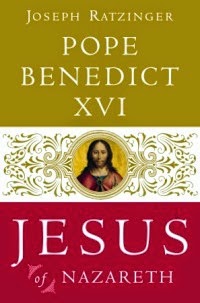
Last year I read Pope Benedict XVI's Jesus of Nazareth: Holy Week during Lent and this year I have been reading volume I of the trilogy, Jesus of Nazareth: From the Baptism in the Jordan to the Transfiguration, in which the author:

covers the bulk of Jesus' public ministry, encompassing subjects and events that include Christ's baptism at the hands of John the Baptist; the Sermon on the Mount; the meaning of the parables; the Calling of the Twelve; the Confession of Peter; and the Transfiguration.

Benedict seeks to salvage the person of Jesus from recent "popular" depictions and to restore Jesus' true identity as discovered in the Gospels. Through his brilliance as a theologian and his personal conviction as a believer, the Pope shares a rich, compelling, flesh-and-blood portrait of Jesus during the time of his ministry and invites readers to encounter, face-to-face, the central figure of the Christian faith.

In doing this, Benedict explores the meaning of key moments in the Gospels (the temptations of Jesus, the Transfiguration, and the Sermon on the Mount) and points to passages in which Jesus outlines Pauline theology. He underscores Jesus' being rooted in the Old Testament — showing, for example, that the Beatitudes participate in a long tradition of blessings, as exemplified in Psalms and Jeremiah.

Benedict XVI draws on historical-critical scholarship of the New Testament, but cautions readers that the usefulness of strictly historical readings of Scripture is limited. He asserts that one also must read Scripture theologically and view each passage of the Bible as part of a larger canonical whole.


At the same time I am reading this volume--and right now I am into the chapter on the parables, which Pope Benedict reads through the lens of the Passion and the Paschal Mystery--the Holy Week issue of Magnificat is quoting extensively from Pope Benedict XVI in its introductions to daily Mass, the meditation for priests before the Chrism Mass, etc.

Furthermore, at the same time I am reading Volume I in his Jesus of Nazareth trilogy, and reading his wisdom on Holy Week readings and celebrations, today is his birthday! Happy birthday to Emeritus Pope Benedict XVI! Ad multos annos!

(I will probably post some further comments about Volume I to go along with my reviews of Volume II and Volume III.)