Showing posts with label Blessed John Shert. Show all posts

Friday, May 19, 2023

Preview: Two Martyrs from Campion's Class of 1581-1582


On Monday, May 22, I'll be on the Son Rise Morning Show at my usual time to discuss Father Henry Bowden's "Mementoes" of two martyrs executed on May 28, 1582. Blesseds John Shert and Thomas Ford were among the 20 priests, including St. Edmund Campion, accused of conspiring against Queen Elizabeth I in the fictitious "Rome and Reims" plot.

Please listen live here at about 6:50 a.m. Central/7:50 a.m. Eastern, or check out the podcast later here.

In 1581, it was not yet Treasonous for an Englishman to return to his native land as a Catholic priest: the 1585 Act Against the Jesuits and the Seminary Priests made it easier to condemn him to death. So when 20 (twenty) priests were arrested in 1581, they had to be charged under existing treason laws. So they were accused of conspiracy, one they'd developed in meetings held in Rome and Reims. Except they hadn't formed any conspiracy, and they testified at trial that they were in England when they were supposed to be in Rome or Reims. Since the guilty verdicts were a foregone conclusion, even after Campion and others had been questioned and tortured, that didn't matter.

On page 175 of  Mementoes of the English Martyrs and ConfessorsFather Henry Sebastian Bowden recounts Blessed John Shert's last words at Tyburn on May 28, 1582, with the title "Praise and Thanksgiving" and the verse "Offer to God the Sacrifice of Praise and pay thy vows to the Most High" (Psalm 49:14). Blessed Thomas Ford, who had been captured with Campion at Lyford Grange in Berkshire, was still hanging from Tyburn Tree and Shert exclaimed:

"O happy Thomas! Happy art thou that didst run the happy race! O benedicta anima! O blessed soul, thou art in a good case! Thou blessed soul, pray for me."

When he was rebuked for "praying to the dead", he continued:

"O Blessed Lady, Mother of God, pray for me, and the saints of heaven, pray for me."

Then he made an Act of Thanksgiving:

"O Blessed Lord, to Thee be all honor and praise" and rejoiced that he would die "so happy a death for Thy Sake"!

Then he was hanged, drawn, and quartered. 
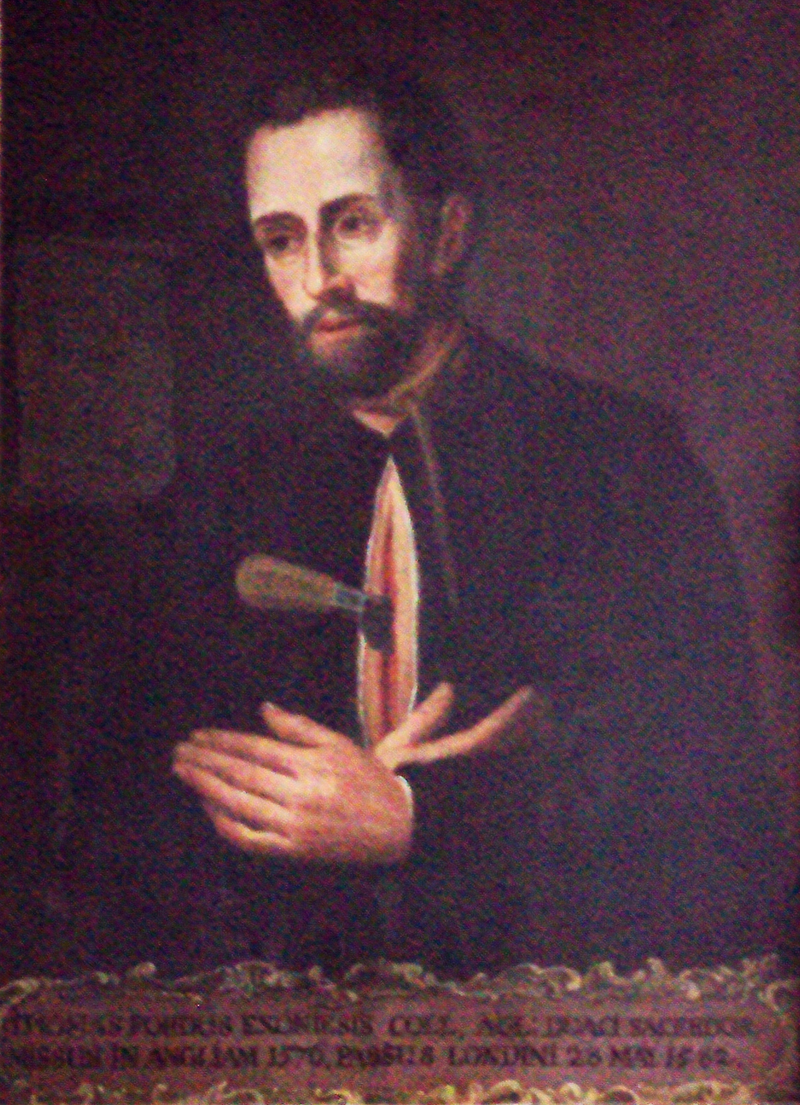
As for Blessed Thomas Ford, Bowden provides some insight into the traps the authorities tried to catch him in--to prove the conspiracy--in an entry titled "The Snares of the Pharisees" with the verse "And the Pharisees watched . . . that they might find an accusation against Him " (Luke 6:7) on page 177. 

They wanted him to say that he was in England to enforce Pope Pius V's Bull Regnans in Excelsis and further the efforts of the Northern Rebellion. He answered them:

. . .  He could not reply as to the legality of the bull of Pius V against Elizabeth, as he was not privy to its circumstances . . .

. . . As to the pope's authorization of the Northern Rebellion, being a private subject, he cannot answer . . .

As Bowden notes, this questioning "was a mere pretext, and Fr. Ford saw through the device . . ."

He, like Saint John Henry Newman centuries later, was a graduate of Trinity College at the University of Oxford. As Bowden notes, Ford began to express "Catholic sympathies," and he "abjured Protestantism and went to Douay" in 1570, and returned to England in 1576. Blessed John Shert was also an Oxford man, earning his degree from Brasenose College. The Catholic Encyclopedia offers this brief outline:

Successively schoolmaster in London, and servant to Dr. Thomas Stapleton at Douai, he entered the seminary in 1576, and was ordained subdeacon. He was ordained priest from the English College, Rome, of which he was the senior of the first six scholars. He left Reims for England 27 August, 1579, and was sent to the Tower 14 July 1581.

Along with Blessed John Shert and Thomas Ford, Blessed Robert Johnson was also executed at Tyburn on May 28. 1582. Father Bowden provides a memento of his martyrdom on page 169: Father Johnson began to pray in Latin and was admonished to "Pray as Christ taught." He replied, "Do you think Christ taught in English?"

The spirit of the martyrs! Keeping their wits about them and being witty too!

Blessed John Shert, pray for us!

Blessed Thomas Ford, pray for us!

Blessed Robert Johnson, pray for us!

Saint Edmund Campion, pray for us!

Image Credit (Public Domain): Portrait of Blessed Thomas Ford in The English Convent in Bruges (NB: the long wound on his chest and the knife protruding, signifying that he was disemboweled at his execution.)

Saturday, May 28, 2016

Three Priests at Tyburn and the "Rome and Rheims Plot"


Fathers Thomas Ford, John Shert, and Robert Johnson were hung, drawn, and quartered at Tyburn on May 28, 1582. According to the Catholic Encyclopedia, Thomas Ford was:

Born in Devonshire . . . He incepted M.A. at Trinity College, Oxford, 14 July, 1567, and was a fellow, Woods says president, of the college. He went to the English College, Douai, in 1570, and was one of the first three of its students to be ordained, receiving all orders in March, 1573, at Brussels. After becoming B.D. at Douai he left for England, 2 May, 1576, and soon became chaplain to Edward Yate and his Bridgettine guests at Lyford, Berkshire. Arrested with St. Edmund Campion 17 July, 1581, and committed to the Tower 22 July, he was thrice tortured. He was brought before the Queen's Bench 16 November, with his fellow martyr Blessed John Shert, on an absurd charge of conspiracy at Rome and Reims, where he had never been, on dates when he was in England, and both were condemned 21 November. 

So he was held (and tortured) from July 1581 until trial in November 1581, but not executed until May 1582. In addition to his connection with St. Edmund Campion, Thomas Ford had aided the protomartyr St. Cuthbert Mayne:

Late in 1570 a letter from Gregory Martin to [Saint] Cuthbert fell into the Bishop of London's hands. He at once sent a pursuivant to arrest [Saint] Cuthbert and others mentioned in the letter. [Saint] Cuthbert was in the country, and being warned by Blessed Thomas Ford, he evaded arrest by going to Cornwall, whence he arrived at Douai in 1573.

You may read details of Ford's arrest and capture with St. Edmund Campion here.

John Shert, according to the same source, was also held in prison a long time:

A native of Cheshire; took the degree of B.A. at Brasenose College, Oxford, in 1566. Successively schoolmaster in London, and servant to Dr. Thomas Stapleton at Douai, he entered the seminary in 1576, and was ordained subdeacon. He was ordained priest from the English College, Rome, of which he was the senior of the first six scholars. He left Reims for England 27 August, 1579, and was sent to the Tower 14 July 1581.

The Diocese of Shrewsbury adds these details about his trial and execution:

He was one of 20 who stood trial in Westminster Hall, London, for treason in the fictitious “Rome and Rheims Plot” against Queen Elizabeth I. Although he could amply demonstrate that he was in England when the plot was allegedly hatched he, like all the other priests, was convicted

He was the second of three priests to die at Tyburn on 28th May 1582 and was made to watch as the first, Blessed Thomas Ford, was butchered, shouting with arms outspread: “O happy Thomas! You have run that happy race. You blessed soul, pray for me.”

When it was his turn to die, Blessed John rejected an invitation from the Sheriff to request the Queen’s forgiveness on the grounds that he was guilty of no offence. He also refused an offer of clemency if he admitted treason with the words: “Should I for saving this carcass condemn my soul? God forbid!”

He did, however, acknowledge Queen Elizabeth as the legitimate English sovereign but not as the supreme governor of the Church in England. “She is not nor cannot be, nor any other, but only the supreme pastor,” he said.

To the crowd baying for his blood he left the admonition: “Extra ecclesiam nulla salus” (there is no salvation outside of the Catholic Church).

Finally, Robert Johnson:

Born in Shropshire, entered the German College, Rome, 1 October, 1571. Ordained priest at Brussels from the English College, Douai, in April, 1576, he started immediately for England. After a pilgrimage to Rome in 1579 he returned to England in 1580, and was committed to the Poultry Counter 12 July, whence he was transferred to the Tower 5 Dec. On 16 December he was terribly racked, and then thrust into an underground dungeon. He was brought before the Queen's Bench 14 November, and condemned 20 November.

Shrewsbury offers this detail about his trial and execution:

During the trial Blessed Robert gave evidence against claims by George Eliot, the renegade Catholic who betrayed Campion, that he and St John Paine had tried to persuade him to join a plot against Elizabeth. All the defendants were convicted, however, in spite of the lack of evidence against them. Campion, St Ralph Sherwin and St Alexander Briant were executed almost straight away. But Blessed Robert was held in custody until 28th May the following year when he was drawn face down on a hurdle to the Tyburn Tree along with Blessed John Shert, another Shrewsbury priest, and Blessed Thomas Ford.

Blessed Robert was the last to die, after being forced to watch the quartering of Blessed John. He went to his death vowing his loyalty to the Queen and protesting his innocence of treason, saying: “I teach (nothing) but the Catholic faith”.

When the Sheriff accused him of being a traitor he replied: “If I be a traitor for maintaining this faith then all the kings and queens of this realm heretofore, and all our ancestors, were traitors for they maintained the same.”

So why the long delay in their executions? Saints Edmund Campion, Ralph Sherwin, and Alexander Briant had all been executed on December 1, 1581, not long after the trial. Dom Bede Camm suggests in his Lives of the English Martyrs, published in 1916, that the Elizabethan government recognized that their efforts to curtail the flow of missionary priests through execution had failed and that the trumped up conspiracy charges had also been exposed as false. Camm notes that a pamphlet issued by the government to demonstrate the "traitorous affection" of Campion and the other priests didn't even mention the "Rome and Rheims Plot". Therefore, the remaining "conspirators" were asked a series of "bloody questions" about Pope Pius V's papal bull Regnans in Excelsis, Queen Elizabeth's supremacy and legitimacy as monarch, the Northern Rebellion, etc. Of course, their responses to these questions are opinions, not actions against the state or the monarch. Their responses may attest to their "traitorous affections" but are not acts of treason for which a person may be condemned and executed, even under English Common Law at that time. So both the trial and this extra-judicial questioning were unjust.

Pope Leo XIII beatified 54 martyrs of England and Wales on December 29, 1886 and these three were among that group. Blessed Thomas Ford, Blessed John Shert, and Blessed Robert Johnson, pray for us!