Showing posts with label Morgan Library. Show all posts

Tuesday, February 15, 2022

Holbein in New York

At the Morgan Library in New York City, a Holbein exhibition just opened (on February 11) and the assemblage of works will be on display through May 15. It had previously visited the J. Paul Getty Museum at the Getty Center from October 19, 2021, to January 9, 2022:

Holbein: Capturing Character is the first major exhibition dedicated to the artist in the United States. Spanning Holbein’s entire career, it starts with his early years in Basel, where Holbein was active in the book trade and created iconic portraits of the great humanist scholar Erasmus of Rotterdam (1466–1536). Holbein stayed in England in 1526–1528 and moved there permanently in 1532, quickly becoming the most sought-after artist among the nobles, courtiers, and foreign merchants of the Hanseatic League. In addition to showcasing Holbein’s renowned drawn and painted likenesses of these sitters, the exhibition highlights the artist’s activities as a designer of prints, printed books, personal devices (emblems accompanied by mottos), and jewels. This varied presentation reveals the artist’s wide-ranging contributions to the practice of personal definition in the Renaissance. Works by Holbein’s famed contemporaries, such as Jan Gossaert (ca. 1478–1532) and Quentin Metsys (1466–1530), and a display of intricate period jewelry and book bindings offer further insights into new cultural interests in the representation of individual identity, and highlight the visual splendor of the art and culture of the time.

You may explore the exhibition online here.

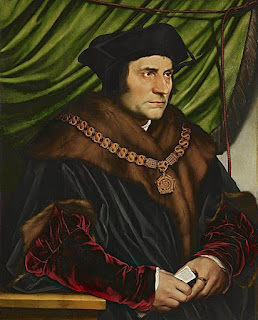
Of course, one of the featured portraits is on loan from the Frick Collection: Holbein's painting of Saint Thomas More:

This is the canonical portrait of one of the key figures in sixteenth-century England. More is depicted in a three-quarter view, similar to Holbein’s favored pose for Erasmus. The man’s imposing form fills nearly the entire panel. The fairly dark palette of More’s fur-lined velvet robe and the green drapery behind him heighten the focus on the sitter’s face and intent gaze. The astonishing realism of Holbein’s portrayal extends to More’s salt-and-pepper whiskers.

Image credit (Public Domain)

Wednesday, December 31, 2014

The Winchester Bible at the MMA


The Winchester Bible--parts of it at least--is on exhibition at the Metropolitan Museum of Art in New York:

This exhibition features masterfully illuminated pages from two volumes of the magnificent, lavishly ornamented Winchester Bible. Probably commissioned around 1150 by the wealthy and powerful Henry of Blois (1129–1171), who was the bishop of Winchester (and grandson of William the Conqueror and King Stephen's brother), the manuscript is the Winchester Cathedral's single greatest surviving treasure. Renovations at the Cathedral provide the opportunity for these pages, which feature the Old Testament, to travel to New York. This presentation marks the first time the work will be shown in the United States. At the Metropolitan Museum, the pages of one bound volume will be turned once each month; three unbound bi-folios with lavish initials from the other volume—which is currently undergoing conservation—will be on view simultaneously for the duration of the exhibition.

A highlight of the presentation is the display of an elaborately illustrated double-sided frontispiece—long separated from the Bible and now in the collection of the Morgan Library & Museum in New York—that features scenes from the life of David and Samuel. Works of art from the Metropolitan Museum's own collection—medieval sculpture, goldsmith work, ivories, stained glass, and other examples of manuscript illumination—provide a larger context for the two volumes.

The Winchester Bible consists of four bound volumes whose pages measure approximately 23 inches high by 15 inches wide (58 by 39 centimeters). The text of 468 folios was written over a period of thirty years by a single scribe with at least six different gifted painters applying expensive pigments, including lapis lazuli and gold, to calf-skin parchment. Their ambitious work was never completed.


The rest of the Winchester Bible is not displayed now at Winchester Cathedral, but will return after some renovations in February 2015. The Cathedral's website has gallery of pictures from the Bible here. The single scribe who wrote the text of the Bible was based at the Benedictine Priory of St. Swithun and we can read the history of the priory here, which was founded in 693 by Cenwalh, King of Wessex and dissolved by Henry VIII and Thomas Cromwell in September, 1538. According to the BHO entry:

The daily life of these Benedictine monks can be traced from point to point in the large number of Obedientary Rolls of the different officials of the house that still survive of the fourteenth, fifteenth and sixteenth centuries. (fn. 45) The obedientaries were monks told off to fulfil certain duties, and to superintend particular parts of the administration of the convent and its property. Their duty at St. Swithun's was essentially connected with the exercise of hospitality; their priory lay in a chief city on one of the most important highways in England, and it was their well sustained boast to keep open house for all comers. In this and in other respects the monks of the cathedral priory of the diocese maintained on the whole an excellent character. The ideal number of monks at which all the large Benedictine houses was supposed to aim was seventy; but this was seldom attained. In 1325, as has been stated, the roll reached to sixty-four; but the priory never recovered from the staggering blow of the Black Death. The numbers, even under the stirring episcopate of Bishop Wykeham, did not exceed forty-six, and at his death were only forty-two. Only once did they subsequently rise, and that by a single figure, the total in 1533 being forty-three. The Obedientary Rolls show that the lowest level was in 1495-6, when the numbers were only twenty-nine.

Wednesday, July 30, 2014

"For Which the Queen Prayed": Claude of France's Prayer Book

In The Wall Street Journal, Barrymore Laurence Scherer reviews an important exhibition of Queen Claude of France's prayer book and book of hours at The Morgan Library and Museum in New York City:

The illuminations in Claude's prayer book are imbued with richly layered symbolism not just relating to holy writ, but to the queen herself, especially to her persistent anxieties about bearing healthy sons. The central example of this symbolism is the book's only full-page image without text, a glowing painting of the Holy Trinity. "The Trinity," on the left-hand page of the opening, is complemented by an illumination of adoring choirs of angels on the right-hand page. Images of the Trinity usually depict the Dove of the Holy Spirit hovering over a white-bearded God the Father and Christ the Son either on or with the cross or bearing the stigmata of his Crucifixion. This one differs significantly—wearing identical purple robes, the Father and the Son resemble youthful twins. Moreover Jesus (on the left) bears no stigmata. This is the Christ who has not yet assumed flesh on Earth via the Immaculate Conception, explains Mr. Wieck, author of the splendid exhibition book (which includes a contribution by conservator Francisco H. Trujillo). The Father, steadying a golden-clasped book on his lap, gestures in benediction. Christ, with eyes lowered, places his left hand on the book, raising his right hand in affirmation. The implication here, explains Mr. Wieck, is that Christ will obey his Father's command to descend to Earth to suffer for humanity's sins. And in the blue cloud below the figures, an almost microscopic vignette of spires and towers represents the unredeemed world at that moment.

The symbolism extends further: Although the prayer book's other illuminations are all rectilinear, "Trinity" is oval. And it is framed differently than the others. Nearly every image in the book is framed by a cordelière, a rope motif adopted as an armorial device from the rope belt worn by Franciscan monks. Most pages are framed by Queen Claude's personal cordelière, running a rectangular course around each page and tightly knotted at the top, bottom and sides. But the cordelière framing "Trinity" is arranged in open loops—King Francis's armorial device. Thus the complete symbolism of this single page is that as God bestowed his Son upon mankind, so may he bestow a son and heir upon Francis and his queen. Even the painting's oval shape possibly symbolizes the fertility for which Claude prayed.


Queen Claude was Francois I's first wife. Both Mary Boleyn and Anne Boleyn had attended her as they remained in France after Louis XII, Mary Tudor's first husband, died. (This Mary Tudor was Henry VIII's favorite sister). Queen Claude and Catherine of Aragon met at The Field of the Cloth of Gold in 1520. Queen Claude died when she was 24 years old after bearing Francois seven children, including his heir, who would reign as Henri II. Francois remarried after Claude's death, becoming betrothed to Charles V's sister while he was held prisoner in Spain after the Battle of Pavia.

Note that for those of us who cannot go to New York City to see the exhibition, we can view the prayer book on line here.