Showing posts with label St. Eugene-St. Cecile. Show all posts

Friday, February 19, 2016

Music for Lent: William Byrd, et al.

R.J. Stove writes for The Catholic World Report, suggesting music for Lent:

Apologies if readers’ individual favorites have been omitted, but such omissions are inescapable. A playlist truly illustrative of Lenten music down the ages would be Wagnerian in its length, even if YouTube retains some surprising gaps (it is weak above all in 19th-century and early 20th-century Lenten repertoire). Order could be imposed upon “embarrassment of riches” chaos solely by adopting these stringent yardsticks for musical selection:

~To include only music that, whatever its composers’ own religious allegiance, could be performed in the context of a penitential Catholic liturgy. So nothing from Handel’s Messiah—even though that is much better attuned to Easter than to the Nativity—and no Passion settings by Bach or Heinrich Schütz either. Alas.
~To eschew pure plainchant (as distinct from composed music with a plainchant basis).
~To prefer—when a work has attracted several renditions displaying a broadly equal standard—YouTube recordings which show the relevant printed score, over YouTube recordings which do not.
~To choose nothing, however praiseworthy, over 15 minutes long (which, sadly, rules out Thomas Tallis’ complete Lamentations).
~To bypass the examples that have acquired lives of their own in secular fora. This necessitated omitting, for instance, such concert-hall staples as Pergolesi’s extremely famous Stabat Mater, the scarcely less celebrated Palestrina version, and Rossini’s disconcertingly operatic treatment of the same words. Gregorio Allegri’s thrice-familiar Miserere has likewise been avoided.

Once those criteria were put in place, the process of selecting works became not easy by any means, but less difficult. With what upshots, others must judge. . . .

I'm glad to see that he includes a selection prayed at Mass at St. Eugene-Ste. Cecile in Paris:

Henri Du Mont, born two generations earlier than Fux, spent his youth in the Low Countries (principally the cities of Maastricht and Liège) before moving, in 1639, to France. There he occupied various exalted posts in the House of Bourbon’s service. His Lenten meditation on mortality, Media Vita in Morte Sumus, dates from 1668 and—as this account of it from Paris’ own Schola Sainte-Cécile indicates—is marked by a self-effacing, no-nonsense chordal approach, better fitted to the words than any obviously histrionic idiom would have been.

And then William Byrd's Ne Irascaris, Domine" sung by the Durham Cathedral Choir:

From Du Mont we cross the Channel and move back more than half a century to William Byrd, the one outstanding Elizabethan composer who remained Catholic while living in England throughout Elizabeth’s reign. (John Bull, John Dowland, and Peter Philips all spent as much time abroad as possible. Tallis and Christopher Tye—unlike Byrd, both old enough to have adult memories of the Henrician terrorism—stayed discreet about their ultimate religious allegiances.) Originally appearing in the 1589 collection Cantiones Sacrae, Byrd’s Lenten motet Ne Irascaris, Domine is among his most powerful and most openly recusant works; no hearer at the time can possibly have misconstrued the stress he places on the word “desolata.” The Durham Cathedral Choir has a surprising and agreeable Continental harshness of sound, with a merciful absence of that Oxonian-Cantabridgian gentility which is so alien to English music’s greatest dissident.

Sunday, March 23, 2014

Sunday Mass with the Cardinal Archbishop of Paris


Last Sunday we were in Paris and attended Mass in the Extraordinary Form of the Latin Liturgy of the Roman Rite at St. Eugene-Sainte Cecile--and so did the Cardinal Archbishop of Paris, Andre Vingt-Trois. He was visiting the parish and had said the 9:45 a.m. Ordinary Form Mass. The 11:00 a.m. Extraordinary Form Mass was a Solemn High Mass with two deacons assisting the pastor. The Archbishop gave the homily for the Transfiguration Mass of the second Sunday of Lent.

St. Eugene-Ste. Cecile has offered Mass in both the Missal of 1962 (Extraordinary Form) and the Missal of 1969 (Ordinary Form) since 1984--it is "Une paroisse en deux liturgies". As we noted in 2012 when we attended the 11 a.m. Mass, the congregation is large and is a good mixture of young and old.

The outstanding Schola Sainte Cecile honored the presence of the Cardinal Archibishop with a rousing chorus of "Ad Multos Annos" after the pastor made his announcements before the conclusion of Mass. Throughout the liturgy, they sang some beautiful hymns and the Ordinary parts of the Mass. They provide copies of the programme for the Mass and of hymns to be used throughout "Careme". You can hear excerpts of their music and even the entire Mass here. Their diligence and devotion to the music for the 11:00 a.m. Mass for each Sunday is magnificently demonstrated on their blog. During our experience of the Mass, one of the sensory highlights was the choir chanting "O Salutoris Hostia" immediately following the Consecration. The processional hymn was Audi benigne Conditor; during the Offertory we sang Christe qui lux es et dies, and the recessional hymn was Attende Domine.

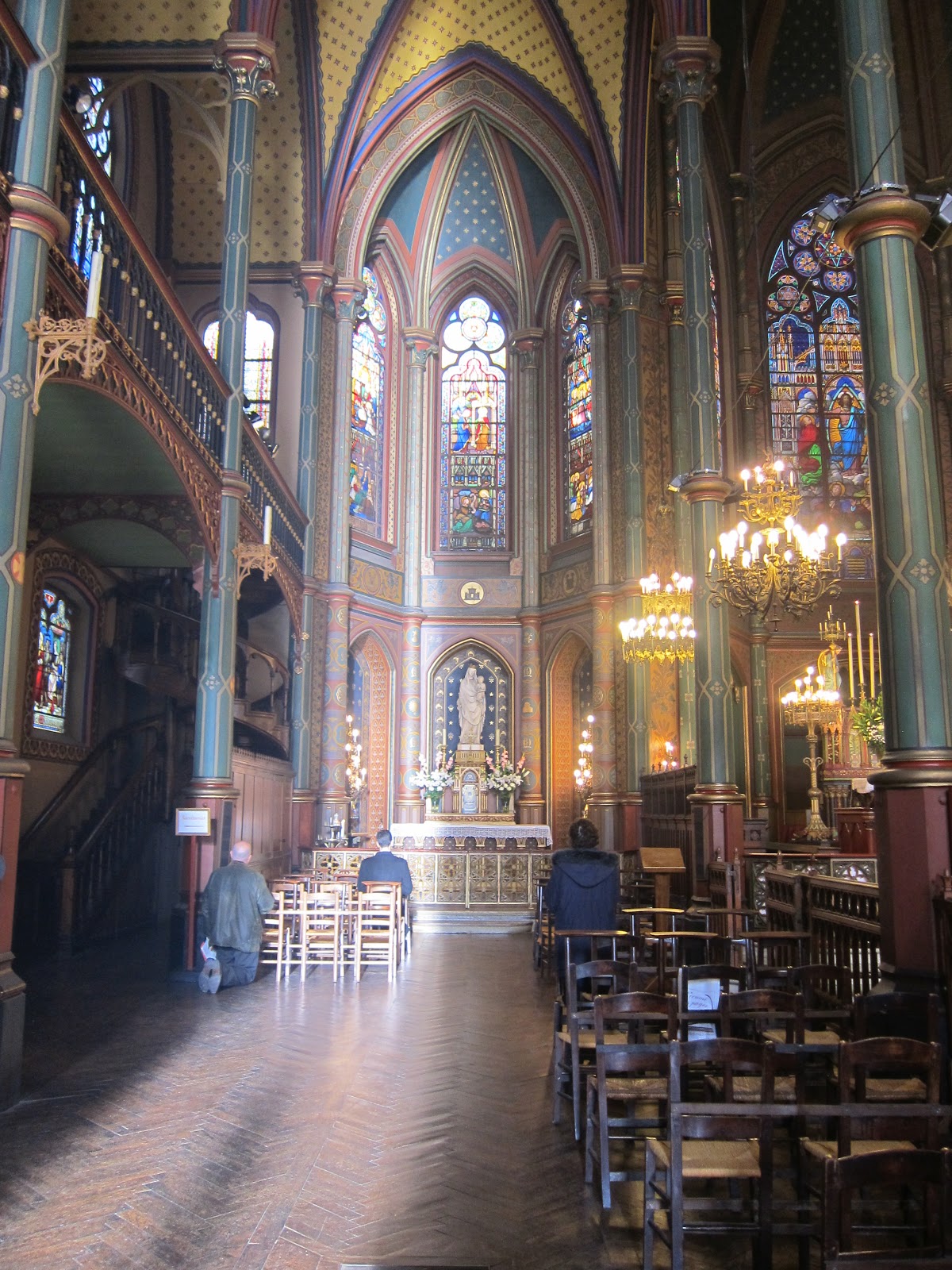
After Mass, we took a few pictures (my husband used both his Fuji X-100 Rangefinder and his Canon S-100):


When we attended Mass there in 2012, we noticed the gorgeous sunlight after Mass flooding the church. The church is built on a North/South axis, instead of the usual East/West arrangement, with the Altar at the East end.

Sunday, November 4, 2012

Sunday Mass in Paris

My husband and I attended Mass last Sunday in Paris at St. Eugene-Ste. Cecile, a double-named parish with daily Mass in the Extraordinary Form of the Latin Rite and a splendid choir in keeping with the second saint. The Saint Eugene in the church's name is an early Church martyr: and his feast day, which the church will certainly celebrate, is on November 15th. St. Eugene was a Bishop, martyr and a companion of St. Dionysius [note: St. Dionysius was converted by Saint Paul (Acts 17:34) and early writers say he became the first bishop of Athens and was martyred (c. 95).] St. Eugene was supposedly martyred near Paris, France. He was originally listed as a bishop of Toledo, Spain. His relics were reportedly translated to Toledo. Ste Cecile, or Saint Cecilia, of course, is one of the virgin martyrs of the early Church and patroness of music. The choir of the the church is named for her! Note that they will commemorate her feast with Gounod's St. Cecilia Mass!

We were there for the last Sunday in October, which is the Feast of Christ the King on the calendar of the Extraordinary Form. The homily is available on-line:

Vous connaissez peut-être la virulence avec laquelle le Pape Pie XI a institué la fête du Christ Roi en 1925 : « La peste de notre époque – écrivait-il - c'est le laïcisme, ainsi qu'on l'appelle, avec ses erreurs et ses entreprises criminelles. Ce fléau n'est pas apparu brusquement. Depuis longtemps, il couvait au sein des Etats. On commença par nier la souveraineté du Christ sur toutes les nations… peu à peu on assimila la religion du Christ aux fausses religions... On la soumit… à l'autorité civile… on la livra au bon plaisir des princes et des gouvernants… Il se trouva même des Etats qui… firent consister leur religion dans… l'oubli conscient et volontaire de Dieu. Fruits de cette apostasie, un égoïsme démesuré qui, ne poursuivant que les satisfactions et les avantages personnels, apprécie toute chose à la mesure de son propre intérêt. Fruits encore de cette apostasie, la paix domestique bouleversée par l'oubli des devoirs et l'insouciance de la conscience ; l'union et la stabilité des familles chancelantes ; toute la société, enfin, ébranlée et menacée de ruine. Une fête célébrée chaque année chez tous les peuples en l'honneur du Christ-Roi sera souverainement efficace pour incriminer et réparer en quelque manière cette apostasie publique, si désastreuse pour la société, qu'a engendrée le laïcisme. »

Read the rest here. The Abbe was referring to Pope Pius XI's Quas Primas, the encyclical establishing the feast of Christ the King, and citing this section:

We shall minister to the need of the present day, and at the same time provide an excellent remedy for the plague which now infects society. We refer to the plague of anti-clericalism, its errors and impious activities. This evil spirit, as you are well aware, Venerable Brethren, has not come into being in one day; it has long lurked beneath the surface. The empire of Christ over all nations was rejected. The right which the Church has from Christ himself, to teach mankind, to make laws, to govern peoples in all that pertains to their eternal salvation, that right was denied. Then gradually the religion of Christ came to be likened to false religions and to be placed ignominiously on the same level with them. It was then put under the power of the state and tolerated more or less at the whim of princes and rulers. Some men went even further, and wished to set up in the place of God's religion a natural religion consisting in some instinctive affection of the heart. There were even some nations who thought they could dispense with God, and that their religion should consist in impiety and the neglect of God. The rebellion of individuals and states against the authority of Christ has produced deplorable consequences.

The musical program was incredible! Some highlights:

~~Kyriale & Credo : de la Messe royale du 1er ton d’Henry du Mont, sous-maître de la chapelle du roi Louis XIV
~~After the Consecration : O salutaris hostia – François Giroust (1738 † 1799), maître de chapelle du roi Louis XVI (he was was the last person in that post!)
~~During Communion: Pendant la communion: Dixit Dominus (H. 197) de Marc-Antoine Charpentier (1643 † 1704), maître de chapelle de Mademoiselle de Guise (Marie de Lorraine), du Dauphin (Louis, Le Grand Dauphin, Louis XIV's son, who predeceased him), des Jésuites (at St. Paul-St. Louis in the Marais) et de la Sainte Chapelle (for which he wrote the Assumpta Est Maria Mass) 

Mass lasted almost two hours, but I was not aware of the time at all!
After Mass, we searched the 9th Arrondisement for a place to eat lunch and found Le Corail, 79, rue Lafayette! Bon dimanche!

Sunday, October 28, 2012

The Extraordinary Form in Paris

Today, the last Sunday of October, is the Feast of Christ the King on the calendar of the Extraordinary Form of the Latin Rite. The feast was moved from the end of the post-Pentecost season to the end of the season of Ordinary Time (the last Sunday before Advent) by Pope Paul VI.

We intend, as of this writing, to attend Mass at St. Eugene-St. Cecile (photo credit: wikipedia commons). Just hope we make it on time, because Europe ends "Summer Time" on October 28! We will "fall behind" twice this year--once in October and again in November.

After Mass and lunch, we plan a visit either to the Basilica of St. Denis or to this museum, filled with casts from great churches and cathedrals.