Wednesday, April 16, 2014

Through Holy Week with Pope Benedict XVI--and Happy Birthday to the Author!

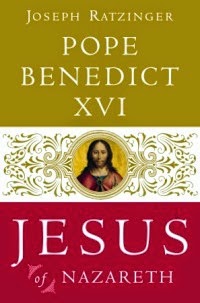
Last year I read Pope Benedict XVI's Jesus of Nazareth: Holy Week during Lent and this year I have been reading volume I of the trilogy, Jesus of Nazareth: From the Baptism in the Jordan to the Transfiguration, in which the author:

covers the bulk of Jesus' public ministry, encompassing subjects and events that include Christ's baptism at the hands of John the Baptist; the Sermon on the Mount; the meaning of the parables; the Calling of the Twelve; the Confession of Peter; and the Transfiguration.

Benedict seeks to salvage the person of Jesus from recent "popular" depictions and to restore Jesus' true identity as discovered in the Gospels. Through his brilliance as a theologian and his personal conviction as a believer, the Pope shares a rich, compelling, flesh-and-blood portrait of Jesus during the time of his ministry and invites readers to encounter, face-to-face, the central figure of the Christian faith.

In doing this, Benedict explores the meaning of key moments in the Gospels (the temptations of Jesus, the Transfiguration, and the Sermon on the Mount) and points to passages in which Jesus outlines Pauline theology. He underscores Jesus' being rooted in the Old Testament — showing, for example, that the Beatitudes participate in a long tradition of blessings, as exemplified in Psalms and Jeremiah.

Benedict XVI draws on historical-critical scholarship of the New Testament, but cautions readers that the usefulness of strictly historical readings of Scripture is limited. He asserts that one also must read Scripture theologically and view each passage of the Bible as part of a larger canonical whole.


At the same time I am reading this volume--and right now I am into the chapter on the parables, which Pope Benedict reads through the lens of the Passion and the Paschal Mystery--the Holy Week issue of Magnificat is quoting extensively from Pope Benedict XVI in its introductions to daily Mass, the meditation for priests before the Chrism Mass, etc.

Furthermore, at the same time I am reading Volume I in his Jesus of Nazareth trilogy, and reading his wisdom on Holy Week readings and celebrations, today is his birthday! Happy birthday to Emeritus Pope Benedict XVI! Ad multos annos!

(I will probably post some further comments about Volume I to go along with my reviews of Volume II and Volume III.)

Lamentations and Strepitus: Tenebrae

Today is the Wednesday of Holy Week, and is sometimes called "Spy Wednesday" in reference to Judas Iscariot plotting with the Sanhedrin to turn Jesus in for 30 pieces of silver. Liturgically, the Masses for the Monday, Tuesday, and Wednesday of Holy Week are unexceptional. The office of Tenebrae, the vigil/Matins celebration of darkness uses extinguished candles, the Lamentations of Jeremiah, and the strepitus, loud noises to represent the earthquake mentioned in the Gospels after Jesus died on the cross, to prepare for the Holy Triduum.

Thomas Tallis famously set the Lamentations in two versions, while the versions of Robert White and William Byrd are less well known.


Unfortunately (lamentably?), there does not seem to be a CD with the Tallis, Byrd, AND White versions for comparison. Magnificat recorded Byrd and White on Where late the sweet birds sang, while the Oxford Camerata recorded Talls and White on their disc of Lamentations! Dating on these compositions places them in Elizabeth's reign--yet they are written in Latin. Humanist that she was, the queen allowed Latin to be used in the liturgy at Court, at Oxford, and at Cambridge, since it would be understood in those venues.

Here is a recording from Magnificat of part one Thomas Tallis's setting of the Lamentations:


And here is a recording of the strepitus at the end of Tenebrae:


Tuesday, April 15, 2014

The Extraordinary Form on EWTN


Although not at a convenient hour for me at least, EWTN is broadcasting a series called "Extraordinary Faith", which started Monday, April 14:

Extraordinary Faith is a monthly 30 minute television program on EWTN that celebrates the beauty of classical Catholic sacred art, architecture, music, and liturgy. We’ll take you to some of the world’s most awe-inspiring churches. We’ll introduce you to dynamic young Catholics whose faith has survived the demands of a secular world and who are becoming key players in the New Evangelization by sharing their enthusiasm for the traditions of Catholicism. We’ll show you the rich vocations harvest that is synonymous with the movement to restore the Extraordinary Form of Mass to mainstream parish life. We’ll give you the resources to find churches that offer traditional worship experiences, and we’ll even assist you to organize your own Latin Masses.

EWTN airs the program at 4:30 a.m. Eastern and 2:00 a.m. Eastern (Monday and Friday) this week, but the Extraordinary Faith website will post the 30 minute programs on the website a month after. The first episode centers on the Masses in the Extraordinary Form of the Latin Liturgy of the Roman Rite in the chapel at San Juan Capistrano:

We visit one of California’s oldest Catholic Missions, located one hour south of Los Angeles. Mission San Juan Capistrano is home to one of the first Extraordinary Form Mass sites established in North America after Vatican II. Pastor Msgr. Art Holquin explains the Mission’s history and current membership. We chat with George Sarah, a Hollywood composer and organizer of Latin Masses in Los Angeles, and with Joy Lanfranchi, organizer of the annual Lenten Pilgrimage in Orange County.

The second episode, I presume to be broadcast the week of May 12, centers on Harvard and Cambridge:

We visit one of America’s most famed Catholic musical institutions, the Boys’ Choir School at St. Paul Church in Harvard Square, Cambridge, Massachusetts. Music Director John Robinson and Pastor Fr. Michael Drea explain the history of the parish and school. The ladies who help organize Harvard’s Latin Masses discuss the challenges and opportunities they face, from dating to promoting the Extraordinary Form. We meet a prodigal young organist and composer, and we attend the first Tridentine Mass sung by the choir school in over 40 years.

Since we've visited both San Juan Capistrano--and witnessed the moving live Stations of the Cross in the modern Mission parish church--and St. Paul's in Cambridge, I do look forward to these programs, even if I have to wait for the on-line showings in May and June (etc).

Image Credit: from Wikipedia Commons, by the Priestly Fraternity of Saint Peter, available from http://fssp.org.

Monday, April 14, 2014

Crowland Abbey: A Pilgrimage and a Poem


A Clerk of Oxford posts a marvelous remembrance of a pilgrimage to the ruins of Crowland Abbey in Lincolnshire. John Clare, the 19th century "labouring-class poet" wrote a sonnet about the abbey ruins:

IN sooth, it seems right awful and sublime
To gaze by moonlight on the shattered pile
Of this old Abbey, struggling still with Time,
The grey owl hooting from its rents the while;
And tottering stones, as wakened by the sound,
Crumbling from arch and battlement around,
Urging dread echoes from the gloomy aisle,
To sink more silent still. ­The very ground
In Desolation’s garment doth appear,
The lapse of age and mystery profound.
We gaze on wrecks of ornamented stones,
On tombs whose sculptures half erased appear,
On rank weeds, battening over human bones,
Till even one’s very shadow seems to fear.

Crowland Abbey was dedicated to the Blessed Virgin Mary, St. Bartholomew, and St. Guthlac, a late 7th century/early 8th century saint who came to Crowland on St. Bartholomew's Day in 699. The last abbot of Crowland and 28 monks surrendered the abbey to Cromwell's Visitors on December 4, 1539. According to this site, the last abbot had a rather contentious rule:

The last abbot, John Wells, or Bridges, ruled the house from 1512 until 1538. The visitation of Atwater, bishop of Lincoln, in 1519, shows that he was very arbitrary and unpopular. He then kept in his own hands the emoluments of the cellarer and receiver, so that they were officers only in name. In consequence the monks got neither soup nor pudding. Sick monks who were away with leave could not get the customary allowance of food and drink. One very old monk was denied the privileges which were his due. The bishop ordered the abbot to make full amends, and also to remove the janitor who spent much of his time in the town of Crowland, and sent pilgrims to Walsingham astray.

An anxious desire to appease Cromwell and Henry VIII appears in the abbot's correspondence in 1534, 1539, and 1539. Demands were made on him for leases and grants which were beyond his power to satisfy. There is no record of any discussions among the monks about the progress of affairs, and they certainly swallowed any scruples which they may have had. In June, 1534, the abbot and thirty-two monks subscribed to the royal supremacy. On 25 March, 1537, the abbot sent a present of fen fish to Cromwell, begging him 'to be good and favourable lord' unto him and his poor house. Between 1535 and 1539 he granted over thirty small annuities, some of them possibly for sums of ready money with the object of providing for the future.

John Wells received a generous pension: £133 6s. 8d, while the rest st of the monks received £5 to £10 a year. The nave and the aisles of the monastery church were saved to become the parish church in Crowland, while the monastery,  as well as the crossing, chancel, and transepts were destroyed. As usual, A Clerk of Oxford's post provides great detail and excellent pictures.

Sunday, April 13, 2014

Palm Sunday in England before the Reformation

The Catholic Church in England before the Reformation used some adaptations of the Latin or Roman Rite called the Sarum Use. These adaptations had developed at Salisbury Cathedral and took their name from the Latin for Salisbury. During Holy Week, these Sarum Use adaptations of the ritual demonstrated the great devotion of the English people to the Eucharist and the Passion of Our Lord. Eamon Duffy’s great work, The Stripping of the Altars: Traditional Religion in England, 1400-1580 offers us many details of these rituals.

At the beginning of Holy Week, Palm Sunday was celebrated with a procession from the parish church. As Duffy notes, these processions were one of the most elaborate rituals of the Sarum Use, focused on the Blessed Sacrament and the incarnational celebration of Jesus' entry into Jerusalem. Instead of a figure representing Jesus riding on a donkey, the Blessed Sacrament was carried in procession to the parish church. The Christians celebrating that day knew that Jesus was present in the Holy Eucharist, Body, Blood, Soul and Divinity--that He was really there with them as they walked in procession with palms (willow branches) and kissed the ground before Him.

The choirs sang "Gloria, Laus et Honor" (All Glory, Laud and Honor) by Theodulph of Orleans and after the procession entered the church, the dramatic reading of the St. Matthew's Passion captured the congregation's attention. Duffy notes it was sometimes read from the Rood Loft next to the Crucifixion scene in front and above the Altar, with alternating voices of the Narrator, Jesus, and the other Speakers. The holiest week of the year had begun and the parishioners were prepared to celebrate the Holy Triduum and receive Holy Communion on Easter Sunday.

During the celebration of Palm Sunday, I always think of G.K. Chesterton's poem, "The Donkey":

When fishes flew and forests walked
And figs grew upon thorn,
Some moment when the moon was blood
Then surely I was born.

With monstrous head and sickening cry
And ears like errant wings,
The devil’s walking parody
On all four-footed things.

The tattered outlaw of the earth,
Of ancient crooked will;
Starve, scourge, deride me: I am dumb,
I keep my secret still.

Fools! For I also had my hour
One far fierce hour and sweet:
There was a shout about my ears,
And palms before my feet.

Saturday, April 12, 2014

"History Today"--April Issue On-line Highlights

I'm not sure how long these stories will be available for free online, but there are several that interest me today:

A discussion of the last king of the House of Valois, Henri III, by the author of a new biography of the same:

In the 19th century, Henry appeared in the novels of Alexandre Dumas and other works of fiction. In 1941 Pierre Champion began a biography, but died before completing it. Following the Second World War, historical biography fell into disrepute among French academics, who preferred to study man as part of a group, but in the last decades the form has regained academic respectability. In 1985 Pierre Chevallier published a substantial biography of Henry III bearing the subtitle: ‘a Shakespearean king’. Since then Jacqueline Boucher, Nicolas Le Roux, Denis Crouzet, Monique Chatenet, Xavier Le Person and others have revolutionised our understanding of the reign. Unfortunately their contributions remain largely unknown to English-speaking readers. The only biography of Henry III in English, by Martha Walker Freer, dates from 1858.

Recent research has exploded the myth of Henry as an ineffectual and pleasure-seeking monarch surrounded by mignons, effeminate young men with absurd hair-dos. Henry is now seen as a highly intelligent and conscientious monarch who tried to bring peace to his troubled kingdom. Pleasure loving he may have been, but Boucher has shown that he spent long hours reading official reports and replying to them. Hundreds of his letters have been published by the Société de l’Histoire de France since 1959. Intellectually, Henry was also keen to learn: he set up a Palace Academy at the Louvre, where leading scholars discussed philosophy, astronomy or other topics. As for the mignons, far from being the parvenus of legend, they were mostly the sons of long-serving provincial nobles. They represented an attempt by Henry to use men of his own generation rather than older ministers chosen by his mother, Catherine de’ Medici.


A comparison between modern surveillance and the Tudor spy network:

Analogies between modern Britain and early modern England can also be seen in the history of social welfare. Beveridge and the creators of the welfare state hoped that by making benefits universal they would remove the stigma associated with poverty. Welfare benefits would simply be ‘social’ rights that would be as generally acceptable as property and political rights. However, opposition to taxation, benefits means testing and fears over fraud have led to the wholesale sharing of data between government bodies such as the Department of Work and Pensions and HM Revenue and Customs. ‘Troubled’ families are now targeted for various forms of social intervention to prevent them from becoming a burden on the state.

Similarly, during the English Reformation, the Dissolution of the Monasteries led to the destruction of institutions such as hospitals, which had traditionally assisted the poor. The Reformation’s emphasis on salvation by faith also undermined the belief in the spiritual efficacy of charitable works, although that does not mean that Christian charity vanished. These religious, economic and social shifts led to a perceived crisis of welfare. The response of the Tudor state was to supplement the promptings of Christian charity with the legal requirements of the Poor Laws. Each locality was to raise funds through a poor rate and disburse them to those in need via overseers. Over the following centuries this system came to be seen by the poor as a right. Yet the response of rate payers was increasingly to view the poor as a nuisance to be controlled. Consequently the Poor Laws spawned a vast system of surveillance to determine the circumstances of families and the parentage of illegitimate children.


The recounting of an exorcism conducted by a missionary Catholic priest in Elizabethan London by Jessie Childs, set in the context of the English Reformation:

Few periods of English history have endured such liberal applications of hindsight as the Golden Age of Good Queen Bess. It may indeed have been a time of glorious national achievement, but the country was not, with a nod to Sellar and Yeatman, ‘bound to be C of E’. The children of Henry VIII (whose own brand of reformation was unpredictable) had hardly imbued their subjects with a sense of religious stability. As Daniel Defoe put it, the country had swung ‘from the Romish religion to reformed, from reformed back again to Romish, and then to reformed again’. By 1586 Elizabeth I had been on the throne for just over a quarter of a century, long enough for the dizziness to have subsided, long enough for a new generation to have been raised on the Book of Common Prayer and long enough – just – for the word ‘Protestant’ to have become an acceptable term of self-reference. It was not so long, however, for Elizabethan Catholics to have stopped praying for one more swing of the pendulum. Often their prayers were linked to those for ‘God’s prisoner’, Mary, Queen of Scots, still alive in 1586 and still, for most people, England’s putative heir.

Church attendance was compulsory in Elizabethan England, the fine for absenteeism having been raised in 1581 from 12 pence to a swingeing £20 a month. Most Catholics conformed, some only occasionally or partially, and suffered the label ‘church papist’ or ‘schismatic’ for their sins. Those who persisted in their nonconformity were known as recusants (from the Latin recusare: to refuse). Many of them hoped, not only for freedom of worship, but also for the restoration of the Catholic faith in England. They were a minority – thousands in a population of around four million – but they had a loud voice, amplified by powerful friends on the Continent. ‘God has already granted’, declared Mary I’s widower, Philip II of Spain, ‘that by my intervention and my hand that kingdom has previously been restored to the Catholic Church once.’ It was an ominous statement of chutzpah and intent.


And from the magazine's blog, this examination of Jacques le Goff's legacy as an Annales historian:

By showing how it could be applied meaningfully to transform perceptions of major problems in the study of the past, Le Goff ensured that the Annales School had an enduring relevance for historical scholarship. Thanks to works such as La Naissance du Purgatoire and Pour un autre Moyen Âge, its influence both in medieval studies and more widely has become palpable. Not only are undergraduates now introduced to the Annalistes’ ideas as a matter of course, but the scholarly value of such topics as popular culture and environmental history is also appreciated by historians around the world, especially in those regions (such as Britain and the US) which were previously most hostile to the Annales approach. And it was only right that by the time of Le Goff’s death on April 1st, 2014, he had been elevated to the pantheon of modern historians.

But if Le Goff’s contribution should be celebrated for having resurrected the Annales School from its mid-century Purgatory, his death is also an occasion to reflect once again on the future of the nouvelle histoire. While it may be true that few scholars now doubt the merit of the approach he pioneered, it is striking that the grand vision which marked both his work and that of his most eminent colleagues has perhaps not survived the test of time as well as it might.


Much good reading there on four interesting topics.

St. Walburge's Catholic Church, Preston

From the UK Catholic Herald newspaper site comes good news for an endangered historical church:

Bishop Michael Campbell of Lancaster announced on Sunday that Mgr Gilles Wach, General Prior of the institute [of Christ the King Sovereign Priest], together with parish priest Fr Simon Hawksworth, have agreed to establish a foundation of the Institute at the Church of St Walburge, Preston, in the early autumn.

Bishop Campbell said that the arrival of the institute meant that the church will now be open every day with Eucharistic adoration and devotion.

Masses will be celebrated in both the Ordinary and Extraordinary Forms.

My husband and I have attended Sunday Mass at Old St. Patrick's Oratory in Kansas City, Missouri, so we have seen the results of a revival and restoration of a beautiful church, with a young and growing congregation, led by the Institute and, of course, the parishioners.

St. Walburge's, named in honor of St. Walpurga, an 8th century Saxon princess, abbess, and saint, was built in the mid-19th century during the Catholic revival in England after Emancipation. Begun in 1850--the year of the restoration of the Catholic hierarchy by Pope Pius IX--it was designed by Joseph Hansom and dedicated in 1854. Its spire is the third tallest in England and is the tallest parish church spire (as opposed to a cathedral, like Salisbury and Norwich, the first and second tallest!). 

It was designed by Joseph Hansom, Gothic revival architect and inventor of the Hansom cab. Hansom designed over 200 buildings in England and Wales, including Arundel Cathedral in West Sussex, St. John's Cathedral in Portsmouth, St. Beuno's Jesuit College in Wales, and St. Aloysius in Oxford (now the Oxford Oratory). He worked both A.W Pugin and Pugin's son Edward Welby (though he and the latter dissolved their partnership unhappily). 

It's great to see such an historic building not just preserved, but used for its glorious purpose of worship and praise--besides the celebration of Mass in the Ordinary and Extraordinary Form, St. Walburge's will be a shrine of Eucharistic Adoration!

Image credit: Wikipedia commons.

Friday, April 11, 2014

Author of the "Stabat Mater": Jacopone da Todi or Pope Innocent III?

In the liturgical calendar for the Extraordinary Form of the Latin Liturgy of the Roman Rite, today is the Friday of Passion Week, dedicated to Our Lady of Sorrows. In the calendar for the Ordinary Form of the Latin Liturgy of the Roman Rite, this memorial is celebrated in conjunction with the Exaltation of the Cross in September, which I explained last year in this article for OSV's The Catholic Answer Magazine. That memorial highlights the Seven Sorrows, while today we focus on the sorrows Mary felt at her Son's Passion and Death.

I don't think it's in any way inappropriate to reflect on the fear and sorrow she must have felt in the days leading up to the events of Holy Week. Even Palm Sunday, with its glory, laud, and honor, heightened the conflict between Jesus and the Sanhedrin. The image brought up thrice in the Propers for this Mass is the piercing of Mary's soul, foretold by Simeon in St. Luke's Gospel (in the Collect, in the Secret, and in the Post communion Prayer).

The Stabat Mater (the mother standing) sequence was once part of the celebration of this day, but the many sequences once part of the liturgy were reduced after the Second Vatican Council. Authorship of the words is contested: it is most commonly attributed either to Pope Innocent III or Jacopone da Todi.


Pope Innocent III was one of the most influential popes of the early Middle Ages. Just listing some of the historical events he was involved with demonstrates his influence: meeting St. Francis of Assisi and approving his new mendicant order; supporting the Fourth Crusade; opening the Fourth Lateran Council; forcing King John of England to accept Stephen Langton as Archbishop of Canterbury and then accepting England as a feudal fief from the same king, etc. It may seem odd that such an intellect and will would write a devotional and emotional work like the Stabat Mater, but as the Catholic Encyclopedia article notes, St. Thomas Aquinas's Corpus Christi hymns might seem out of character too.


The other candidate, Jacopone da Todi, was a 13th century Franciscan, author of many laudi, popular poetry written in an Umbrian dialect. He was one of the "Spiritual" Franciscans who desired to follow a stricter interpretation of St. Francis's rule, and did come into conflict with the pope at the time, Boniface VIII. Since the Stabat Mater is written in Latin, it might seem unusual in his oeuvre

Whomever wrote the poem, it is moving and solemn, and it has been set to music by many composers, as the Wikipedia article attests.

Stabat mater dolorosa
juxta Crucem lacrimosa,
dum pendebat Filius.

Cuius animam gementem,
contristatam et dolentem
pertransivit gladius.

O quam tristis et afflicta
fuit illa benedicta,
mater Unigeniti!

Quae mœrebat et dolebat,
pia Mater, dum videbat
nati pœnas inclyti.

Quis est homo qui non fleret,
matrem Christi si videret
in tanto supplicio?

Quis non posset contristari
Christi Matrem contemplari
dolentem cum Filio?

Pro peccatis suæ gentis
vidit Iesum in tormentis,
et flagellis subditum.

Vidit suum dulcem Natum
moriendo desolatum,
dum emisit spiritum.

Eia, Mater, fons amoris
me sentire vim doloris
fac, ut tecum lugeam.

Fac, ut ardeat cor meum
in amando Christum Deum
ut sibi complaceam.

Sancta Mater, istud agas,
crucifixi fige plagas
cordi meo valide.

Tui Nati vulnerati,
tam dignati pro me pati,
pœnas mecum divide.

Fac me tecum pie flere,
crucifixo condolere,
donec ego vixero.

Juxta Crucem tecum stare,
et me tibi sociare
in planctu desidero.

Virgo virginum præclara,
mihi iam non sis amara,
fac me tecum plangere.

Fac, ut portem Christi mortem,
passionis fac consortem,
et plagas recolere.

Fac me plagis vulnerari,
fac me Cruce inebriari,
et cruore Filii.

Flammis ne urar succensus,
per te, Virgo, sim defensus
in die iudicii.

Christe, cum sit hinc exire,
da per Matrem me venire
ad palmam victoriæ.

Quando corpus morietur,
fac, ut animæ donetur
paradisi gloria. Amen.

Thursday, April 10, 2014

Newman's "Litany of the Passion" (for Private Devotion)

From the Vultus Christi blog of Silverstream Priory in Stamullen, County Meath, Ireland, comes this Litany of the Passion composed by Blessed John Henry Newman. Father Mark, the blogger, introduces the Litany thusly:

Blessed Cardinal Newman’s Litany of the Passion reveals the tenderness and compunction of his Christocentric piety. It also demonstrates that Newman was a humble man, capable of entering into the mainstream of Catholic devotion and of learning from it, even while adapting it somewhat to his own sensibility.

To illustrate Newman’s Litany I chose a painting by a French contemporary of his, William Adolphe Bouguereau (1825–1905). The position of Jesus attached to the column already suggests the torments of the crucifixion: his arms are extended, his feet lie one upon the other as they will be on the cross. No blood is visible on His sacred body; it appears white and host–like. His face is turned upward, suggesting the mystery of His victimal priesthood. The flesh of Jesus appears luminous — almost transfigured — while, all around Him, are shadows. All the light in the painting seems to emanate from the body of Jesus. I see already the Lumen Christi
[the Easter Candle] of the Paschal Vigil. Is this Bouguereau’s way of expressing the whole mystery of Redemption?

The heart of the litany:

Jesus, the Eternal Wisdom, Have mercy on us.
The Word made flesh, Have mercy on us.
Hated by the world, Have mercy on us.
Sold for thirty pieces of silver, Have mercy on us.
Sweating blood in Thy agony, Have mercy on us.
Betrayed by Judas, Have mercy on us.
Forsaken by Thy disciples, Have mercy on us.
Struck upon the cheek, Have mercy on us.
Accused by false witnesses, Have mercy on us.
Spit upon in the face, Have mercy on us.
Denied by Peter, Have mercy on us.
Mocked by Herod, Have mercy on us.
Scourged by Pilate, Have mercy on us.
Rejected for Barabbas, Have mercy on us.
Loaded with the cross, Have mercy on us.
Crowned with thorns, Have mercy on us.
Stripped of Thy garments, Have mercy on us.
Nailed to the tree, Have mercy on us.
Reviled by the Jews, Have mercy on us.
Scoffed at by the malefactor, Have mercy on us.
Wounded in the side, Have mercy on us.
Shedding Thy last drop of blood, Have mercy on us.
Forsaken by Thy Father, Have mercy on us.
Dying for our sins, Have mercy on us.
Taken down from the cross, Have mercy on us.
Laid in the sepulchre, Have mercy on us.
Rising gloriously, Have mercy on us.
Ascending into Heaven, Have mercy on us.
Sending down the Paraclete, Have mercy on us.
Jesus our Sacrifice, Have mercy on us.
Jesus our Mediator, Have mercy on us.
Jesus our Judge, Have mercy on us.

And the closing prayer:

We adore Thee, O Christ, and we bless Thee,
Because through Thy Holy Cross Thou didst redeem the world.

Let us pray.
O God, who for the redemption of the world wast pleased to be born; to be circumcised; to be rejected; to be betrayed; to be bound with thongs; to be led to the slaughter; to be shamefully gazed at; to be falsely accused; to be scourged and torn; to be spit upon, and crowned with thorns; to be mocked and reviled; to be buffeted and struck with rods; to be stripped; to be nailed to the cross; to be hoisted up thereon; to be reckoned among thieves; to have gall and vinegar to drink; to be pierced with a lance: through Thy most holy passion, which we, Thy sinful servants, call to mind, and by Thy holy cross and gracious death, deliver us from the pains of hell, and lead us whither Thou didst lead the thief who was crucified with Thee, who with the Father and the Holy Ghost livest and reignest, God, world without end. –Amen.

This litany, along with other prayers, devotions, and meditations (including two sets of meditations on the Stations of the Cross) may be found on-line at the Newman Reader; Baronius Press has a beautiful edition of Newman's Meditations and Devotions.

If, this deep into Lent, you are looking for a deserving recipient of alms, I think Silverstream Priory qualifies. For one thing, they have a Staffordshire Terrier named Hilda as part of their community, and even make accepting her part of their notes on vocations to their priory: We have a very gentle dog; if you are not dog-friendly or are easily shocked when a dog acts in a very doggy fashion, you will not be happy among us. In another post, Father Mark comments, A dog contributes much to the quality of community life, not the least of which is the indispensable craich (an Irish word meaning fun and good times). Abba Xanthios said, “A dog is better than I am, for he has love and he does not judge.”(Just search for Hilda at the blog site!)

Information on their fundraising campaign and how to donate here.

Wednesday, April 9, 2014

Not "Papist Patriots" but "Papist Devils"! Coming Soon from CUAP

The Catholic University of America Press will release this book in June this year: Papist Devils: Catholics in British America, 1574-1783 by Robert Emmett Curran:

This is a brief [320 pages] highly readable history of the Catholic experience in British America, which shaped the development of the colonies and the nascent republic in the seventeenth and eighteenth centuries. Historian Robert Emmett Curran begins his account with the English reformation, which helps us to understand the Catholic exodus from England, Ireland, and Scotland that took place over the nearly two centuries that constitute the colonial period. The deeply rooted English understanding of Catholics as enemies of the political and religious values at the heart of British tradition, ironically acted as a catalyst for the emergence of a Catholic republican movement that was a critical factor in the decision of a strong majority of American Catholics in 1775 to support the cause for independence.

Papist Devils utilizes archival material, newspapers, and other contemporary records in addition to a broad array of general histories, monographs, and dissertations dealing with the British Atlantic world.The unprecedentedly broad scope of this study, which encompasses not only the thirteen colonies that took up arms against Britain in 1775, but also those in the maritime provinces of Canada as well as the ones in the West Indies, constitutes a unique coverage of the British Catholic colonial experience, as does the extension of the colonial period through the American Revolution, which was its logical dénouement.

With its view of "the British Catholic colonial experience" beyond Maryland, which I have usually focused on, this looks like a fascinating study to me. It would be interesting to read and compare it to Papist Patriots, which analysed how Catholics in Colonial Maryland were so ready to assist the American Revolution and the new republic, based upon their Cisalpine tendencies.